

Another Way to Say Out of This World: 15 Amazing Alternatives
If you want another way to say “out of this world,” you can use amazing, incredible, extraordinary, phenomenal, spectacular, remarkable, fantastic, exceptional, mind-blowing, or unbelievable, depending on the tone and context. The phrase usually means that something is exceptionally good, impressive, exciting, or unusual.
Key Takeaways
- “Out of this world” is usually an informal expression meaning exceptionally impressive or enjoyable.
- Amazing, incredible, and fantastic are natural everyday alternatives.
- Phenomenal, extraordinary, and exceptional work well when you want stronger or more polished language.
- Mind-blowing and unreal are more casual and expressive.
- The phrase can also have a literal meaning related to outer space, so context matters.
- Not every alternative has exactly the same emotional strength or level of formality.
What Does “Out of This World” Mean?
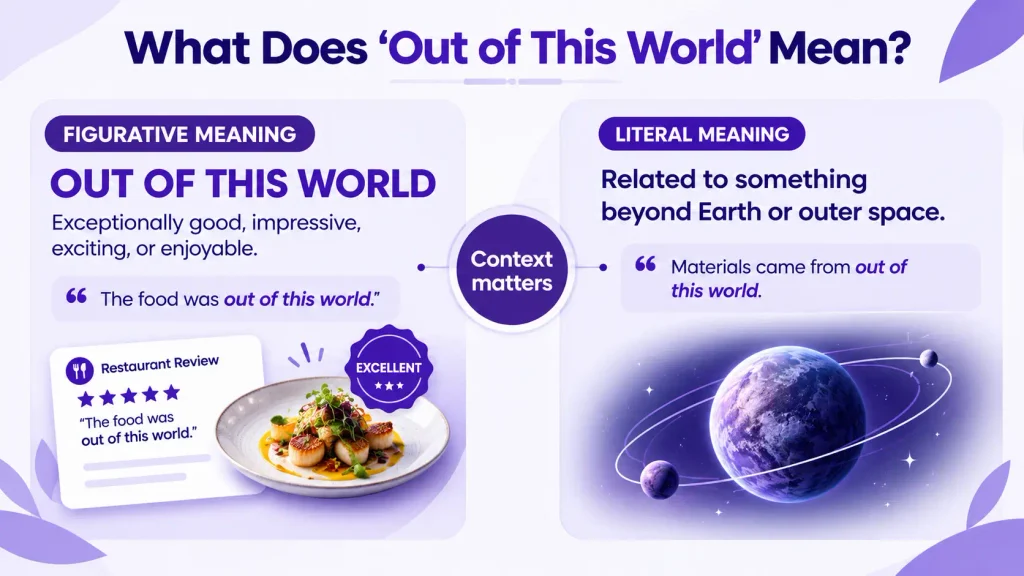
“Out of this world” is an idiomatic expression used to describe something that is extraordinarily good, impressive, beautiful, exciting, or enjoyable.
For example:
The food at that restaurant was out of this world.
Here, the speaker does not mean that the food came from outer space. They mean that the food was exceptionally delicious.
The expression is common in conversational American English and can describe experiences, food, performances, places, products, achievements, and many other things.
It can also be used literally when talking about something beyond Earth:
Scientists are studying materials that came from out of this world.
In that case, the context gives the phrase a literal space-related meaning rather than its usual figurative meaning.
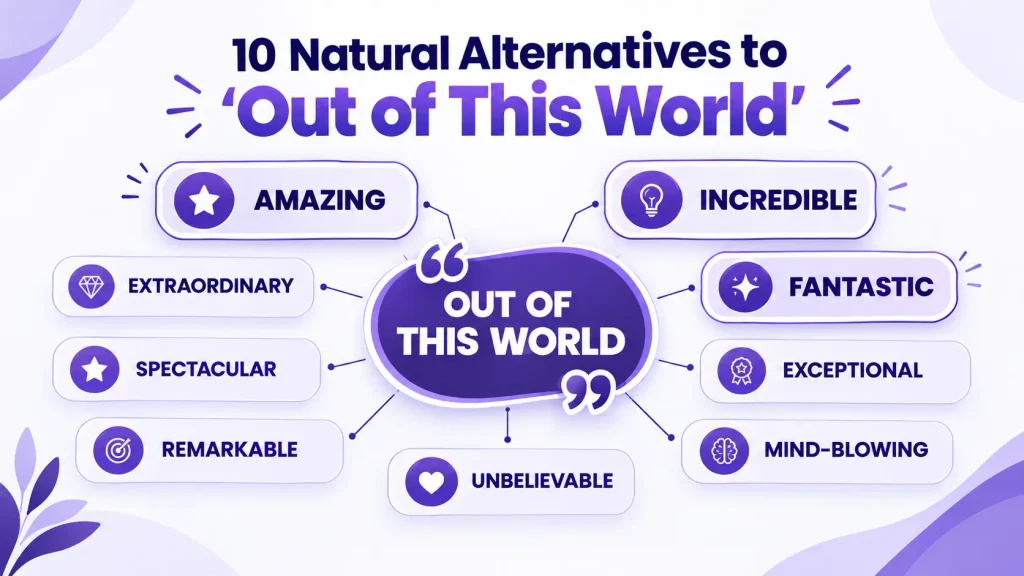
10 Natural Alternatives to “Out of This World”
1. Amazing
Amazing is one of the easiest replacements for “out of this world.” It describes something that causes strong admiration, surprise, or enjoyment.
Best for: Everyday conversation, reviews, experiences, and casual writing.
Example:
The concert was amazing from beginning to end.
Usage tip:
“Amazing” is more common and less dramatic than “out of this world,” making it a safe choice in most casual situations.
2. Incredible
Incredible suggests that something is extremely impressive or difficult to believe because of how remarkable it is.
Best for: Conversations, reviews, achievements, and enthusiastic reactions.
Example:
She gave an incredible performance at the competition.
Usage tip:
“Incredible” can describe both positive experiences and impressive achievements, so it is more versatile than some alternatives.
3. Extraordinary
Extraordinary means unusually impressive, remarkable, or far beyond what is ordinary.
Best for: Formal, professional, descriptive, and polished writing.
Example:
The museum contains an extraordinary collection of historical artifacts.
Usage tip:
This is a stronger and more formal alternative. It works particularly well when “out of this world” sounds too casual.
4. Phenomenal
Phenomenal describes something exceptionally impressive, successful, or outstanding.
Best for: Strong praise, achievements, performances, products, and experiences.
Example:
The team had a phenomenal season.
Usage tip:
“Phenomenal” carries strong praise, so it is useful when you want to emphasize that something performed far above expectations.
5. Spectacular
Spectacular means extremely impressive, beautiful, or exciting, especially when something creates a strong visual or emotional effect.
Best for: Views, events, performances, celebrations, and memorable experiences.
Example:
The sunset over the coast was spectacular.
Usage tip:
“Spectacular” is especially natural when describing something visually impressive.
6. Remarkable
Remarkable means unusual or impressive enough to deserve attention.
Best for: Professional writing, achievements, discoveries, experiences, and formal descriptions.
Example:
The company has made remarkable progress over the past year.
Usage tip:
“Remarkable” sounds more measured and polished than “out of this world,” so it is useful when you want to praise something without sounding overly enthusiastic.
7. Fantastic
Fantastic is a common informal adjective used to express strong approval or enthusiasm.
Best for: Everyday conversation, food, entertainment, services, and experiences.
Example:
We had a fantastic time at the beach.
Usage tip:
“Fantastic” is friendly and natural, but it can sound slightly less intense than “out of this world.”
8. Exceptional
Exceptional means unusually good or significantly better than what is typical.
Best for: Professional, academic, business, and formal contexts.
Example:
The hotel is known for its exceptional customer service.
Usage tip:
Choose “exceptional” when you want to sound precise and professional rather than highly emotional.
9. Mind-Blowing
Mind-blowing is an informal expression for something so impressive, surprising, or extraordinary that it strongly affects you.
Best for: Casual conversation, social media, entertainment, technology, and exciting experiences.
Example:
The special effects in the movie were mind-blowing.
Usage tip:
This is much more casual than “exceptional” or “remarkable.” It can sound too informal for academic or professional writing.
10. Unbelievable
Unbelievable can describe something so impressive or surprising that it is difficult to believe.
Best for: Casual reactions, sports, performances, surprising achievements, and exciting experiences.
Example:
That final goal was unbelievable!
Usage tip:
The word can also mean something is not credible or believable, so context and tone matter.
Quick Comparison of Alternatives
| Alternative | Meaning/Use | Tone | Best Context |
| Amazing | Very impressive or enjoyable | Casual/neutral | Everyday conversation |
| Incredible | Extremely impressive or surprising | Casual/neutral | Experiences and achievements |
| Extraordinary | Far beyond ordinary | Formal/neutral | Professional and descriptive writing |
| Phenomenal | Exceptionally impressive | Strong | Achievements and experiences |
| Spectacular | Extremely impressive or visually striking | Neutral/enthusiastic | Events, views, performances |
| Remarkable | Worthy of attention because it is unusual or impressive | Polished | Professional and general writing |
| Fantastic | Extremely good or enjoyable | Casual | Everyday conversation |
| Exceptional | Unusually good | Formal | Business and professional writing |
| Mind-blowing | Extremely impressive or surprising | Very casual | Conversation and social media |
| Unbelievable | Extremely surprising or impressive | Casual | Reactions and achievements |
Which Alternative Should You Use?
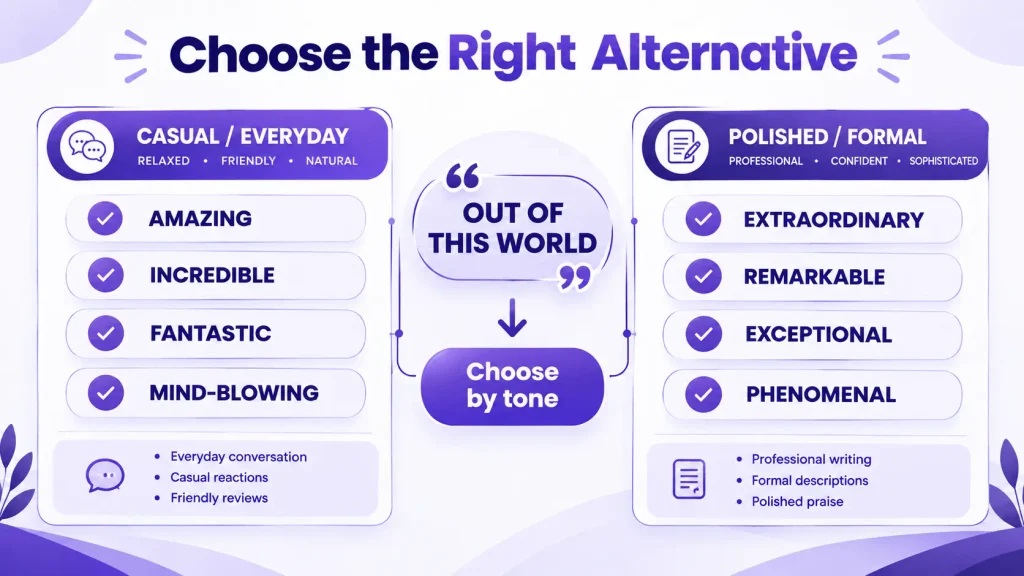
The best replacement depends on how enthusiastic you want to sound and where you’re using it.
For everyday conversation, amazing, incredible, and fantastic are easy, natural choices.
The food was out of this world.
The food was amazing.
For professional or polished writing, extraordinary, remarkable, and exceptional usually fit better.
She delivered an out-of-this-world presentation.
She delivered an exceptional presentation.
For something visually impressive, spectacular may be more precise.
We saw an out-of-this-world view from the mountain.
We saw a spectacular view from the mountain.
For a very casual and enthusiastic reaction, mind-blowing can work well.
The new game is out of this world.
The new game is mind-blowing.
“Out of This World” vs. “Amazing”
These expressions are close, but they are not identical in tone.
Amazing is a broad, everyday word that can describe almost anything impressive. Out of this world is more expressive and often communicates a stronger sense of enthusiasm.
Compare:
The hotel was amazing.
This is a straightforward positive comment.
The hotel was out of this world.
This sounds more enthusiastic and suggests that the experience was exceptional.
“Out of This World” vs. “Extraordinary”
Both can describe something far beyond the ordinary, but their registers differ.
Out of this world is an informal idiom.
Extraordinary is more polished and appropriate in formal writing.
For example:
The experience was out of this world.
works naturally in a conversation or personal review.
In a formal article, you might write:
The research team achieved extraordinary results.
“Extraordinary” also tends to sound more precise, while “out of this world” carries more emotional enthusiasm.
“Out of This World” vs. “Mind-Blowing”
These two expressions can both communicate strong excitement, but mind-blowing usually emphasizes surprise or the feeling that something is difficult to comprehend.
For example:
The concert was out of this world.
focuses on how exceptional the concert was.
The concert was mind-blowing.
emphasizes how intensely impressive or overwhelming the experience felt.
Both are informal, but “mind-blowing” can sound more dramatic.
Common Mistakes When Replacing “Out of This World”
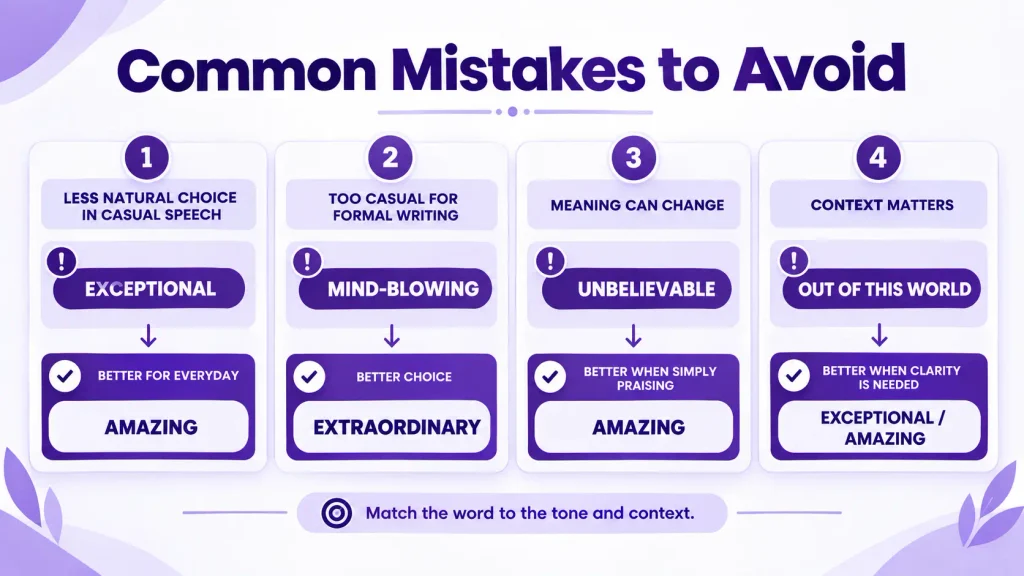
Using a formal word in a very casual sentence
Words such as exceptional and extraordinary are correct, but they may sound overly formal in some everyday conversations.
Instead of:
That burger was exceptional, bro.
A casual speaker would more naturally say:
That burger was amazing.
Assuming every synonym has the same intensity
“Amazing,” “remarkable,” “phenomenal,” and “mind-blowing” all express positive reactions, but their tone and intensity differ.
Choose based on the feeling you want to communicate rather than treating them as interchangeable in every sentence.
Using “unbelievable” when you mean only “good”
“Unbelievable” often suggests surprise as well as praise.
If you simply want to say that something was very good, amazing or fantastic may be clearer.
Using “out of this world” literally without enough context
Because the phrase contains “world,” readers may sometimes interpret it literally when discussing space or science.
For example:
The object came from out of this world.
could be interpreted literally.
If you mean that something was exceptionally good, alternatives such as amazing or extraordinary may eliminate that ambiguity.
Frequently Asked Questions
What is another way to say “out of this world”?
Natural alternatives include amazing, incredible, extraordinary, phenomenal, spectacular, remarkable, fantastic, exceptional, mind-blowing, and unbelievable. The best choice depends on the intended tone and context.
What is a professional way to say “out of this world”?
For professional writing, consider exceptional, extraordinary, remarkable, outstanding, or phenomenal. These alternatives communicate strong praise without sounding as conversational as “out of this world.”
What is a casual way to say “out of this world”?
Amazing, awesome, fantastic, incredible, unreal, and mind-blowing can work in casual conversation. The choice depends on how strong and informal you want the reaction to sound.
Is “out of this world” a compliment?
Yes. When used figuratively, “out of this world” is generally a strong compliment. It means that something is exceptionally good, impressive, enjoyable, or remarkable.
Is “out of this world” an idiom?
Yes. In its common figurative use, “out of this world” is an idiomatic expression meaning exceptionally impressive, enjoyable, or extraordinary.
Can I use “out of this world” in formal writing?
You can, but it may sound informal or conversational. In formal or professional writing, alternatives such as exceptional, extraordinary, remarkable, or outstanding may fit better.
What is a stronger word than “amazing”?
Depending on the context, phenomenal, extraordinary, spectacular, exceptional, or remarkable can communicate a stronger or more polished form of praise. “Mind-blowing” is another strong option for casual contexts.
Final Thoughts
“Out of this world” is a vivid, informal way to say that something is exceptionally good, impressive, or enjoyable. For everyday conversation, amazing, incredible, and fantastic are natural replacements. For more polished writing, extraordinary, remarkable, and exceptional are useful choices. If you want a highly enthusiastic casual reaction, phenomenal or mind-blowing may better capture the excitement.
The key is to match the alternative to the situation. A phrase that sounds natural in a conversation may not be the best choice for a professional report, so consider both meaning and tone before making the substitution.

Role: English Content Writer
Maren Whitlock writes practical English language content for RepublicsPress, with a focus on vocabulary, word alternatives, everyday expressions, and clear communication. Her articles are designed to make difficult or confusing language easier to understand, with simple explanations and useful examples readers can apply in real situations.