
Another Way to Say New Beginnings: 10 Natural Alternatives
Another way to say “new beginnings” is fresh starts, new chapters, starting over, starting anew, a clean slate, or turning the page. The best phrase depends on the situation. Some options focus on change, while others suggest leaving the past behind or getting another chance.
Key Takeaways
- Fresh start is one of the closest alternatives to “new beginnings.”
- New chapter works well for major life changes.
- Starting over suggests beginning again after an ending or setback.
- Starting anew has a more formal and literary tone.
- Clean slate means leaving past problems behind.
- Turning the page focuses on moving on from the past.
What Does “New Beginnings” Mean?
New beginnings means starting a new stage, experience, or period of life.
It can describe many types of change. For example, you may start a new job, move to a new city, or begin a new relationship. You may also use the phrase after a difficult time.
For example:
Moving to a new city gave her a chance for new beginnings.
The phrase often has a positive meaning. It can suggest hope, change, growth, renewal, or a fresh opportunity.
Still, “new beginnings” does not always mean starting again after failure. Sometimes, it simply means entering a new stage.
10 Natural Ways to Say “New Beginnings”
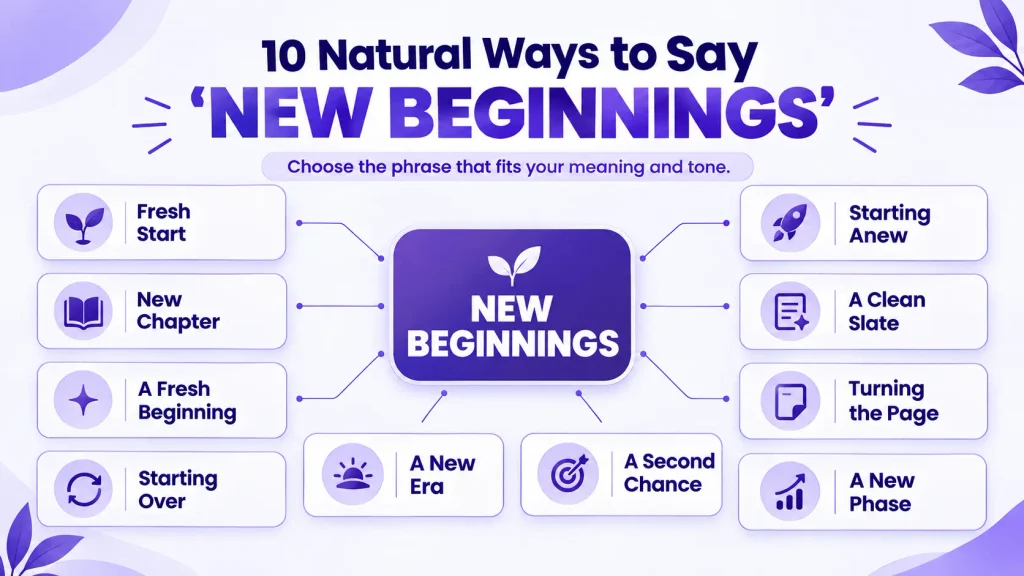
Here are ten useful alternatives. Each one has a slightly different meaning or tone.
1. Fresh Start
Fresh start is one of the closest alternatives to new beginnings.
It means starting again with a chance to make things different. It often suggests leaving an old situation behind.
Example:
The new job gave him a fresh start.
Best for: Everyday English, personal situations, work, and life changes.
Tip: Use “fresh start” when you want to show that the past is being left behind.
2. New Chapter
New chapter is a common phrase for a new stage in life.
It is often used after a major change. For example, graduation, marriage, a new job, or a move can start a new chapter.
Example:
Moving to Boston marked a new chapter in her life.
Best for: Life changes, careers, relationships, and personal growth.
Tip: “New chapter” does not mean that the past was bad. It simply shows that a new stage has begun.
3. A Fresh Beginning
A fresh beginning has almost the same meaning as “a new beginning.”
It puts more focus on renewal. It can also suggest hope after a difficult period.
Example:
The project gave the team a fresh beginning.
Best for: Personal writing, work, projects, and inspirational messages.
Tip: This phrase works well when you want to sound positive without being too informal.
4. Starting Over
Starting over means beginning again.
People often use it after a setback, ending, or major life change. It is very common in everyday American English.
Example:
After losing his job, he decided to start over.
Best for: Personal changes, setbacks, relationships, and careers.
Tip: “Starting over” often suggests that something from the past has ended.
5. Starting Anew
Starting anew also means beginning again.
However, it sounds more formal than “starting over.” You may see it in speeches, books, articles, or reflective writing.
Example:
She moved to another state and decided to start anew.
Best for: Formal writing, speeches, and reflective language.
Tip: In casual conversation, “starting over” usually sounds more natural.
6. A Clean Slate
A clean slate means starting without letting past problems affect the new situation.
It is an idiom. The phrase can suggest that past mistakes or difficulties have been set aside.
Example:
The new school gave him a clean slate.
Best for: Personal change, relationships, mistakes, and new environments.
Tip: Use “clean slate” when the past is an important part of the meaning.
For example, starting a new hobby is a new beginning. It is not always a “clean slate.”
7. Turning the Page
Turning the page is an idiom that means moving past an earlier experience and focusing on what comes next.
It is often used after a difficult event.
Example:
After a tough year, she was ready to turn the page.
Best for: Personal growth, life changes, and moving on.
Tip: This phrase focuses more on the past than “new beginnings” does.
8. A New Phase
A new phase means a new stage in a process or period of life.
It is a useful choice when you want a more neutral or formal phrase.
Example:
Having a child began a new phase of their lives.
Best for: Life, work, education, projects, and formal writing.
Tip: “New phase” highlights a change in stage. It does not always suggest starting from zero.
9. A New Era
A new era describes the start of a significant new period.
It can refer to a person’s life, a company, a team, or even a larger social change.
Example:
The new leader promised to begin a new era for the company.
Best for: Major changes, organizations, history, leadership, and formal writing.
Tip: “New era” can sound bigger and more important than “new beginning.” Use it when the change feels significant.
10. A Second Chance
A second chance means getting another opportunity after an earlier attempt, mistake, or setback.
It can be a good alternative when “new beginnings” refers to another opportunity.
Example:
The scholarship gave her a second chance to finish college.
Best for: Education, careers, relationships, mistakes, and missed opportunities.
Tip: This is not an exact synonym for “new beginnings.” Use it only when there was an earlier opportunity.
Which Alternative Should You Use?
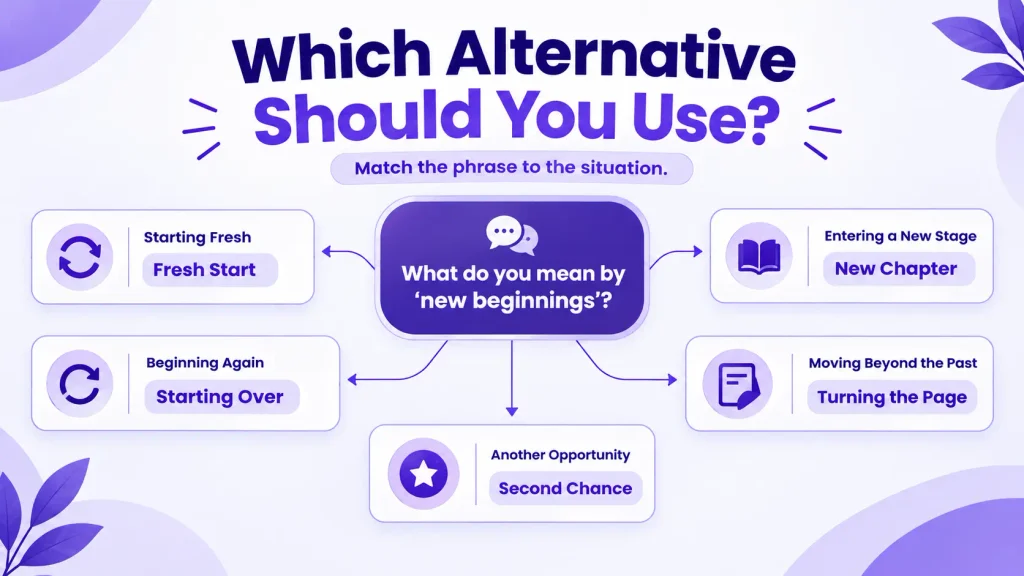
The right phrase depends on the meaning you want.
| Alternative | Main Meaning | Tone | Best Context |
| Fresh start | Begin again with a positive outlook | Neutral | Everyday use |
| New chapter | Enter a new stage | Warm | Life changes |
| A fresh beginning | Start with a sense of renewal | Neutral | Personal and professional |
| Starting over | Begin again after an ending | Casual | Everyday situations |
| Starting anew | Begin again in a fresh way | Formal | Writing and speeches |
| A clean slate | Leave past problems behind | Casual | Personal situations |
| Turning the page | Move beyond the past | Reflective | Personal growth |
| A new phase | Enter a new stage | Neutral | Life and work |
| A new era | Begin a major new period | Formal | Major changes |
| A second chance | Get another opportunity | Emotional | Setbacks and mistakes |
“New Beginnings” vs. “Fresh Start”
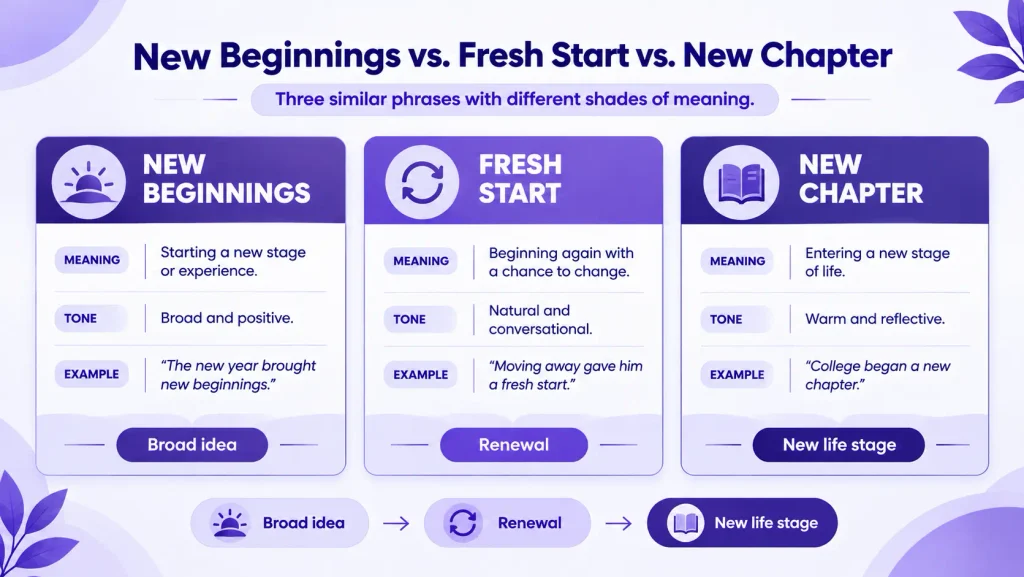
These phrases are very close.
However, they are not always the same.
New beginnings is a broad phrase. It can describe any new stage or experience.
The new year brought many new beginnings.
Fresh start often suggests leaving the past behind.
Moving away gave him a fresh start.
So, use new beginnings for a broad idea. Use fresh start when you want to stress renewal or change.
“New Beginnings” vs. “New Chapter”
Both phrases can describe a new stage in life.
Still, new chapter is more specific.
For example:
Starting college was a new chapter in her life.
This phrase shows that one stage ended and another began.
By contrast:
Starting college brought new beginnings.
This sentence has a broader meaning. It may include new friends, new goals, new habits, and new experiences.
“Starting Over” vs. “Starting Anew”
Both phrases mean beginning again.
The main difference is tone.
Starting over is common in everyday American English.
I’m ready to start over.
Starting anew sounds more formal or literary.
They returned home to start anew.
Therefore, “starting over” is usually the better choice for casual conversation.
Common Mistakes to Avoid
1. Treating Every Alternative as an Exact Synonym
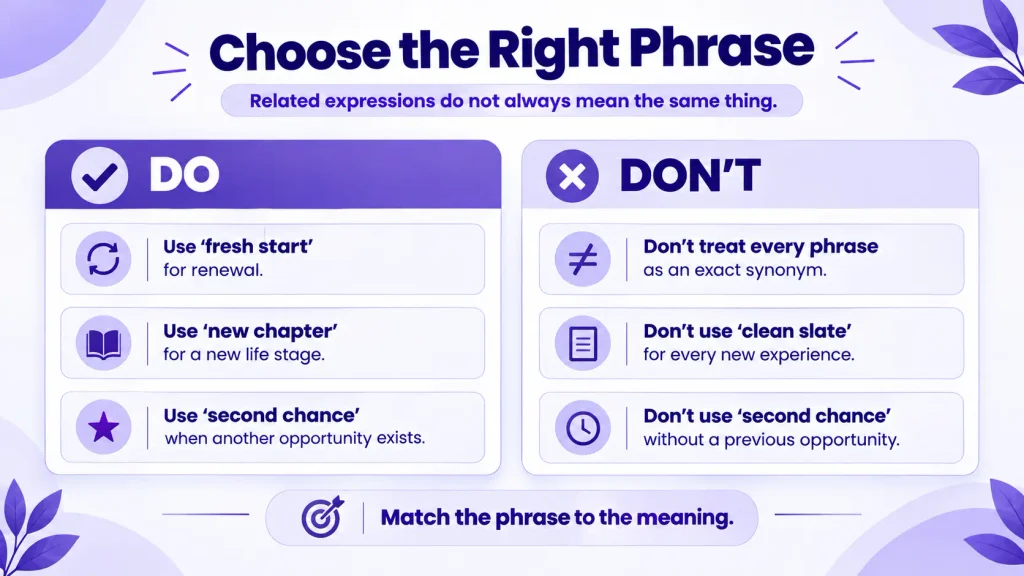
Not every phrase on this list means exactly the same thing.
For example, second chance suggests another opportunity. New era suggests a major period of change.
Choose the phrase that matches your meaning.
2. Using “Second Chance” for Any New Start
A second chance usually means that someone had an earlier chance.
For example:
The program gave him a second chance to earn his degree.
If there was no earlier opportunity, “second chance” may not fit.
Instead, try new opportunity or fresh start.
3. Using “Clean Slate” for Every New Experience
A clean slate has a strong connection to the past.
It suggests that old problems, mistakes, or judgments are being left behind.
For example:
The new school gave her a clean slate.
You would not normally use it just because you started a new hobby.
4. Using “Starting Anew” in Very Casual Situations
“Starting anew” is correct. However, it can sound formal.
In everyday conversation, “starting over” is usually more natural.
Natural:
I’m ready to start over.
More formal:
I’m ready to start anew.
5. Using “Turning the Page” Without a Past Situation
“Turning the page” usually means moving beyond something that happened before.
For example:
After the breakup, he decided to turn the page.
If you are simply beginning something new, new beginning may be clearer.
Examples in Different Situations
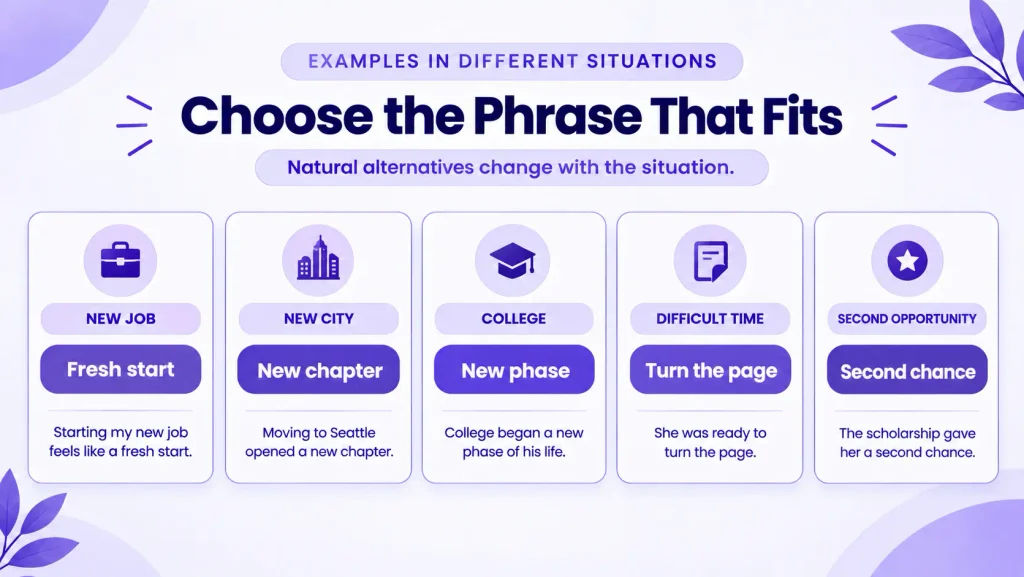
The best alternative can change with the situation.
Starting a New Job
My new job feels like a fresh start.
Moving to a New City
Moving to Seattle opened a new chapter in her life.
Starting College
College marked a new phase in his life.
Recovering From a Difficult Time
She was ready to turn the page and move forward.
After a Major Mistake
The new opportunity gave him a second chance.
Starting Again After a Setback
After the business failed, they decided to start over.
Beginning a New Project
The new team brought a fresh beginning to the project.
Making a Major Change
The change marked the start of a new era.
Frequently Asked Questions
What is another word for “new beginnings”?
Common alternatives include fresh start, new chapter, fresh beginning, starting over, starting anew, clean slate, and new phase. Each phrase has a slightly different meaning, so the best choice depends on the context.
What is a positive way to say “starting over”?
Fresh start is a natural positive alternative. You can also use new beginning, new chapter, or starting anew.
Is “new chapter” the same as “new beginning”?
Not exactly. New chapter usually describes a new stage in life. New beginning has a broader meaning and can describe many types of new starts.
What is an idiom for a new beginning?
Turning the page is one useful idiom. Turn over a new leaf is another. However, “turn over a new leaf” focuses on changing your behavior for the better.
What is another way to say “a fresh start”?
You can say a new beginning, a new chapter, starting over, starting anew, or a clean slate. The right choice depends on what you want to emphasize.
Is “starting anew” formal?
Yes. “Starting anew” is correct, but it has a more formal or literary feel. Starting over is more common in everyday American English.
What is a phrase for starting a new phase of life?
Starting a new chapter, entering a new phase, and beginning a new chapter are natural choices. “New chapter” is especially common for major life changes.
Final Thoughts
There are many natural ways to say “new beginnings.” However, each phrase gives the idea a slightly different feel.
Use fresh start when you want to stress renewal. Choose new chapter for a new stage in life. Use starting over when something has ended and you want to begin again.
For a more reflective tone, try turning the page. If you want to show that past problems are being left behind, clean slate can work well. For a major change, new era may be a better fit.
The key is simple: choose the phrase that matches the situation and the meaning you want to express.

Role: English Content Writer
Maren Whitlock writes practical English language content for RepublicsPress, with a focus on vocabulary, word alternatives, everyday expressions, and clear communication. Her articles are designed to make difficult or confusing language easier to understand, with simple explanations and useful examples readers can apply in real situations.