What’s Another Way to Say Thank You for Your Time?
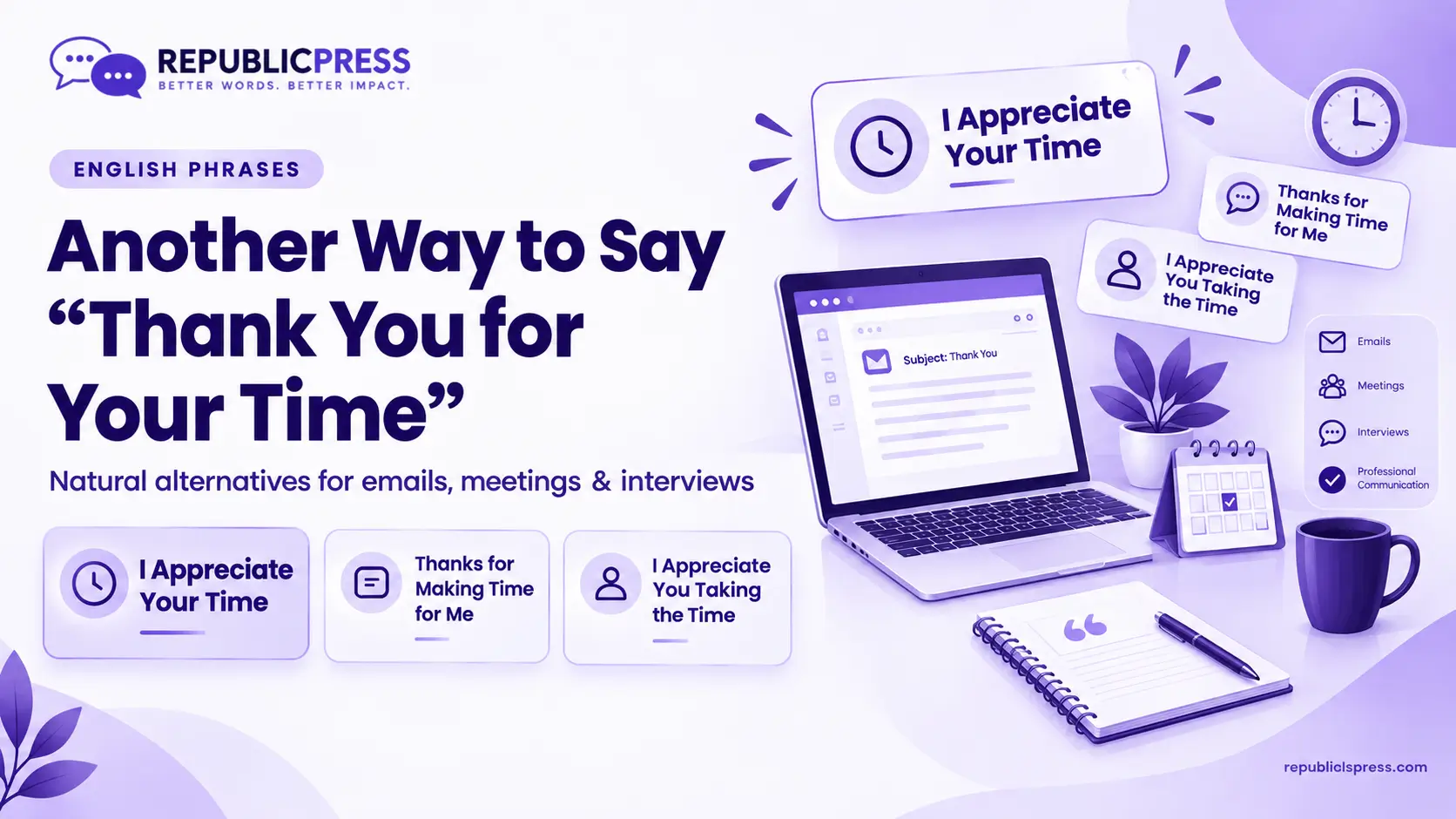
If you want another way to say “thank you for your time,” try “I appreciate your time,” “Thanks for making time for me,” or “I appreciate you taking the time to meet.” The best choice depends on whether you’re writing a professional email, following up after an interview, thanking a colleague, or speaking casually.
Key Takeaways
- “I appreciate your time” is a natural, professional alternative.
- “Thanks for making time for me” sounds warmer and more conversational.
- “I appreciate you taking the time” works well after a meeting, interview, or call.
- “Thank you for your consideration” is better when someone is reviewing a request or application.
- The most effective thank-you usually mentions what the person actually did, rather than thanking them vaguely.
- “Thank you for your time” is already correct and polite; you only need an alternative when you want a different tone or more specificity.
What Does “Thank You for Your Time” Mean?
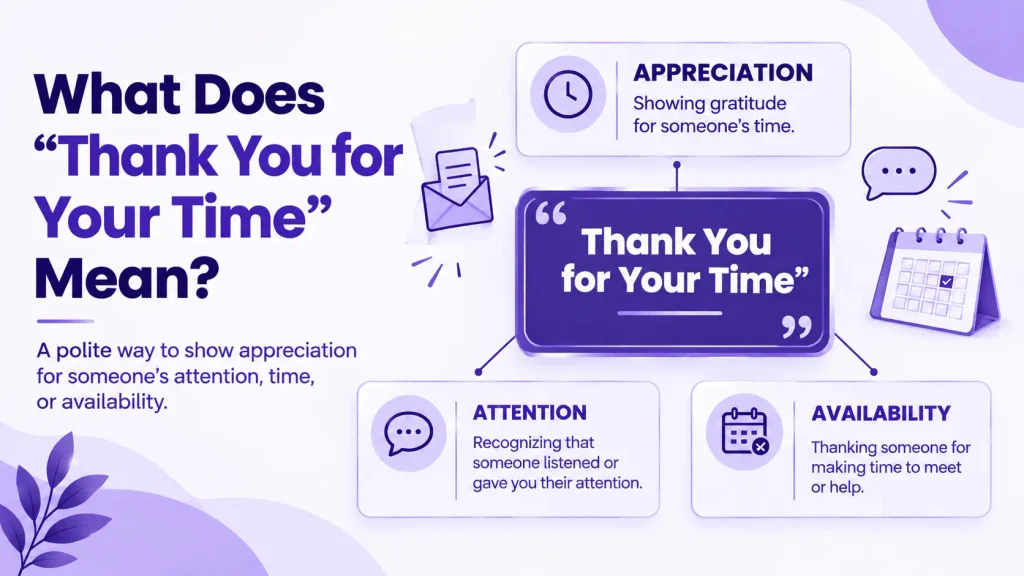
“Thank you for your time” is a polite way to acknowledge that someone gave you their attention, met with you, listened to you, answered your questions, or helped you with something.
It is especially common in professional communication, including emails, interviews, meetings, phone calls, and follow-up messages.
For example:
Thank you for your time today. It was great speaking with you about the position.
The phrase is perfectly natural, but it can sound somewhat standard when used repeatedly. A more specific alternative can make your message feel more personal and connected to the situation.
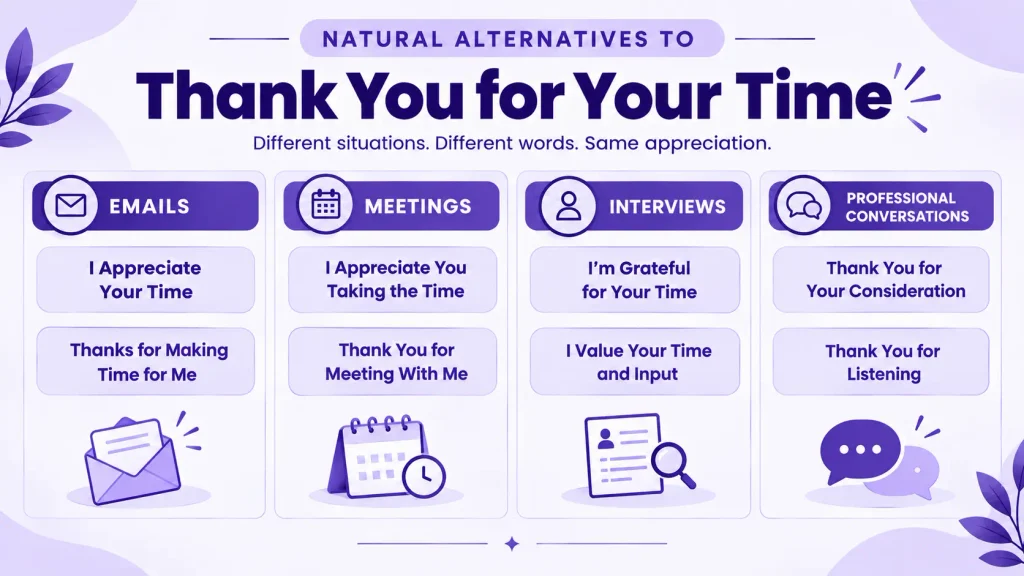
10 Natural Alternatives to “Thank You for Your Time”
1. I Appreciate Your Time
This is one of the closest and most natural alternatives. It works particularly well in professional emails and after meetings.
Example:
I appreciate your time and the thoughtful feedback you shared during our meeting.
Best for: Professional emails, meetings, interviews, and client communication.
Tone: Professional, polite, sincere
2. Thanks for Making Time for Me
This phrase emphasizes that the person adjusted their schedule to speak with you.
Example:
Thanks for making time for me today. I really enjoyed our conversation.
Best for: Coworkers, clients, managers, mentors, or professional contacts you already know.
Tone: Warm, conversational, professional
It is generally less formal than “I appreciate your time,” but it still works well in workplace communication.
3. I Appreciate You Taking the Time
This wording directly recognizes the effort involved in giving you their attention.
Example:
I appreciate you taking the time to walk me through the new process.
Best for: Meetings, explanations, interviews, calls, and requests for assistance.
Tone: Professional, appreciative
This is especially useful when someone has done more than simply meet with you.
4. Thanks for Taking the Time
This is a shorter, more relaxed version of the phrase above.
Example:
Thanks for taking the time to review my proposal.
Best for: Coworkers, clients, follow-up emails, and everyday professional communication.
Tone: Friendly, professional, natural
It works particularly well when you want your message to sound less formal without becoming casual.
5. Thank You for Meeting With Me
Use this when the person actually met with you. It is more specific than thanking them generally for their time.
Example:
Thank you for meeting with me yesterday. I enjoyed learning more about the role.
Best for: Interviews, business meetings, consultations, and appointments.
Tone: Polite, professional
Because it identifies exactly what you’re grateful for, it can sound more genuine than a generic closing.
6. I’m Grateful for Your Time
This expresses stronger appreciation than the standard phrase.
Example:
I’m grateful for your time and for the advice you shared with me.
Best for: Mentors, advisors, meaningful conversations, or situations where someone gave you substantial help.
Tone: Warm, sincere, slightly more formal
Use it when you genuinely want to emphasize gratitude rather than simply close an email politely.
7. I Value Your Time and Input
This works when someone not only gave you their time but also contributed ideas, feedback, or expertise.
Example:
I value your time and input as we work through the next steps.
Best for: Business discussions, feedback sessions, team projects, and professional collaboration.
Tone: Professional, respectful
It shifts the focus from the person’s time alone to the value of their contribution.
8. Thank You for Your Consideration
This is not a direct synonym for “thank you for your time,” so context matters.
Use it when someone is considering your application, proposal, request, or idea.
Example:
Thank you for your consideration. I look forward to hearing from you.
Best for: Job applications, proposals, formal requests, and business correspondence.
Tone: Formal, respectful
Don’t use this after an ordinary conversation unless the person actually needs to consider something you’ve submitted or requested.
9. Thank You for Listening
When the main thing someone did was listen, this can sound much more personal than a general thank-you.
Example:
Thank you for listening and giving me the chance to explain what happened.
Best for: Personal conversations, difficult discussions, advice, and situations where someone gave you their attention.
Tone: Warm, personal, sincere
It is not usually the best choice for a standard business meeting unless listening was the main purpose of the interaction.
10. I Appreciate Your Help With This
Sometimes you are not really thanking someone for their time—you are thanking them for what they accomplished during that time.
Example:
I appreciate your help with this. Your suggestions made the next steps much clearer.
Best for: Workplace assistance, problem-solving, collaboration, and requests.
Tone: Professional, natural, appreciative
This can be more meaningful than simply mentioning someone’s time because it recognizes the actual contribution they made.
Quick Comparison
| Alternative | Tone | Best Context |
| I appreciate your time | Professional | Emails, meetings, interviews |
| Thanks for making time for me | Warm | Coworkers, clients, casual professional settings |
| I appreciate you taking the time | Professional | Meetings, calls, assistance |
| Thanks for taking the time | Friendly | Everyday work communication |
| Thank you for meeting with me | Professional | Interviews and meetings |
| I’m grateful for your time | Sincere | Mentoring and meaningful conversations |
| I value your time and input | Professional | Feedback and collaboration |
| Thank you for your consideration | Formal | Applications and requests |
| Thank you for listening | Personal | Conversations and advice |
| I appreciate your help with this | Natural | Assistance and teamwork |
How to Choose the Right Phrase
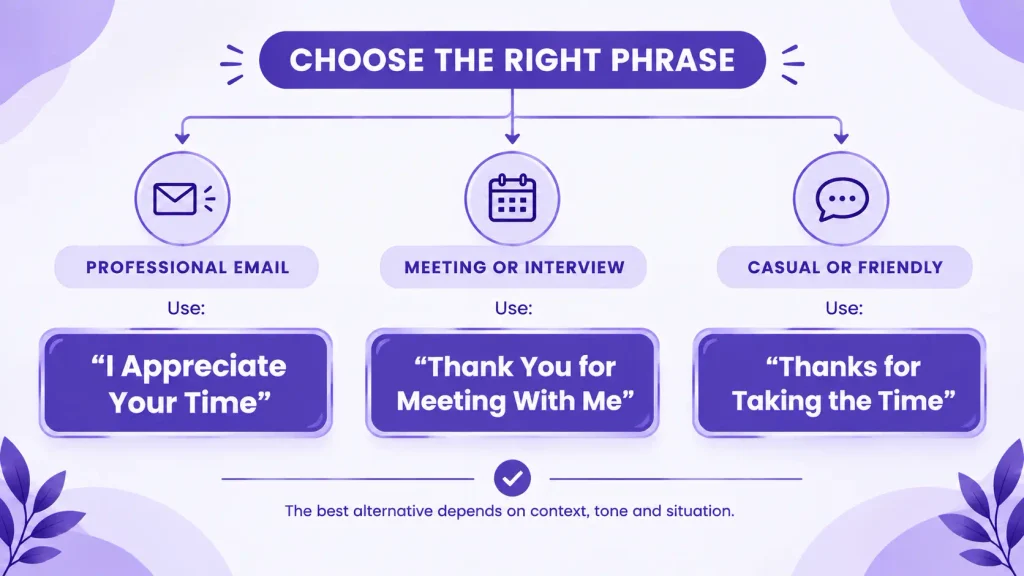
The best alternative depends on what the person actually did.
After a meeting
Use:
I appreciate your time.
Or make it more specific:
Thank you for meeting with me today. I enjoyed discussing the project with you.
After a job interview
A professional follow-up might say:
Thank you for taking the time to speak with me today. I enjoyed learning more about the position and the team.
“Thank you for your time” is also completely appropriate after an interview. Career guidance sources commonly recommend thanking interviewers for the time they spent speaking with you.
After someone gives you advice
Try:
I really appreciate your time and advice.
This is more specific because it recognizes both their time and what they contributed.
When a coworker helps you
A natural option is:
Thanks for taking the time to help me with this.
Or simply:
I appreciate your help with this.
In a formal request
Use:
Thank you for your consideration.
This is particularly appropriate when the recipient needs to review, approve, or decide something.
“Thank You for Your Time” vs. “I Appreciate Your Time”
These phrases have nearly the same basic meaning, but they can create a slightly different impression.
“Thank you for your time” is conventional, polite, and neutral.
“I appreciate your time” feels a little more personal because it directly states your appreciation.
Compare:
Thank you for your time today.
with:
I appreciate your time today and the feedback you shared.
The second version gives the reader a clearer reason for your gratitude.
Common Mistakes to Avoid
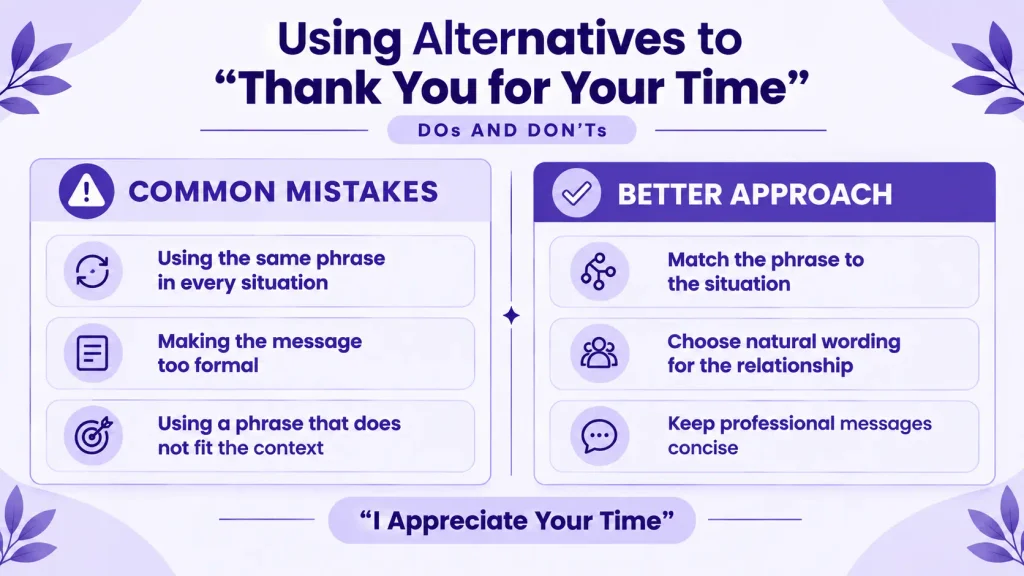
Using “Thank You for Your Consideration” for Every Situation
“Consideration” refers to reviewing or thinking about something, so it is better suited to applications, requests, proposals, and similar situations.
Being Too Formal With Someone You Know Well
You don’t need to write:
I am immensely grateful for the time you have graciously allocated to me.
For a coworker, something as simple as:
Thanks for making time for me.
will usually sound more natural.
Thanking Someone Without Saying What They Did
A specific thank-you often feels more genuine:
Thanks for taking the time to explain the new process.
This tells the reader exactly what you appreciated.
Using “Thanks for Your Time” When You Really Mean “Thanks for Your Help”
If someone spent 30 minutes fixing a problem for you, their help may be more important than their time.
Instead of:
Thanks for your time.
consider:
I really appreciate your help with this.
FAQs
What is the most professional way to say “thank you for your time”?
“I appreciate your time” is one of the most natural professional alternatives. You can also say “I appreciate you taking the time” when someone specifically made time to meet, speak with, or help you.
Is “thank you for your time” too formal?
No. “Thank you for your time” is polite and widely accepted in professional and everyday communication. It may sound somewhat standard, but it is not incorrect or excessively formal.
What can I say instead of “thank you for your time” in an email?
You can write “I appreciate your time,” “Thanks for taking the time,” or “I appreciate you taking the time to help with this.” Choose the wording based on what the recipient actually did.
What is a casual way to say “thank you for your time”?
For a casual conversation, try “Thanks for making time for me,” “Thanks for taking the time,” or “I really appreciate it.”
How do I thank someone after a meeting?
A simple option is:
Thank you for meeting with me today. I appreciate your time and enjoyed our conversation.
You can make it more specific by mentioning something you discussed.
What is a good alternative after a job interview?
Try:
Thank you for taking the time to speak with me today. I enjoyed learning more about the position and appreciate the opportunity to discuss the role.
Can I say “I appreciate your time and consideration”?
Yes. This is appropriate when someone has both given you their time and is considering an application, request, proposal, or other matter.
Final Thoughts
“Thank you for your time” is already a correct and useful phrase. The best alternative is not necessarily the most formal one—it is the phrase that accurately reflects why you are thanking the person.
For most professional situations, “I appreciate your time” is a safe choice. If someone specifically made room in their schedule, “Thanks for making time for me” sounds natural. If they helped you with something, “I appreciate your help with this” may communicate your gratitude more clearly.
Specific wording usually makes a thank-you sound more genuine than simply searching for a more complicated synonym.

Role: Language Editor
Caleb Mercer is a Language Editor at RepublicsPress, focusing on grammar, sentence structure, professional writing, and English usage. He helps ensure that language guides are clear, accurate, natural, and easy to follow.