Another Way to Say Because: 10 Better Alternatives for Any Context
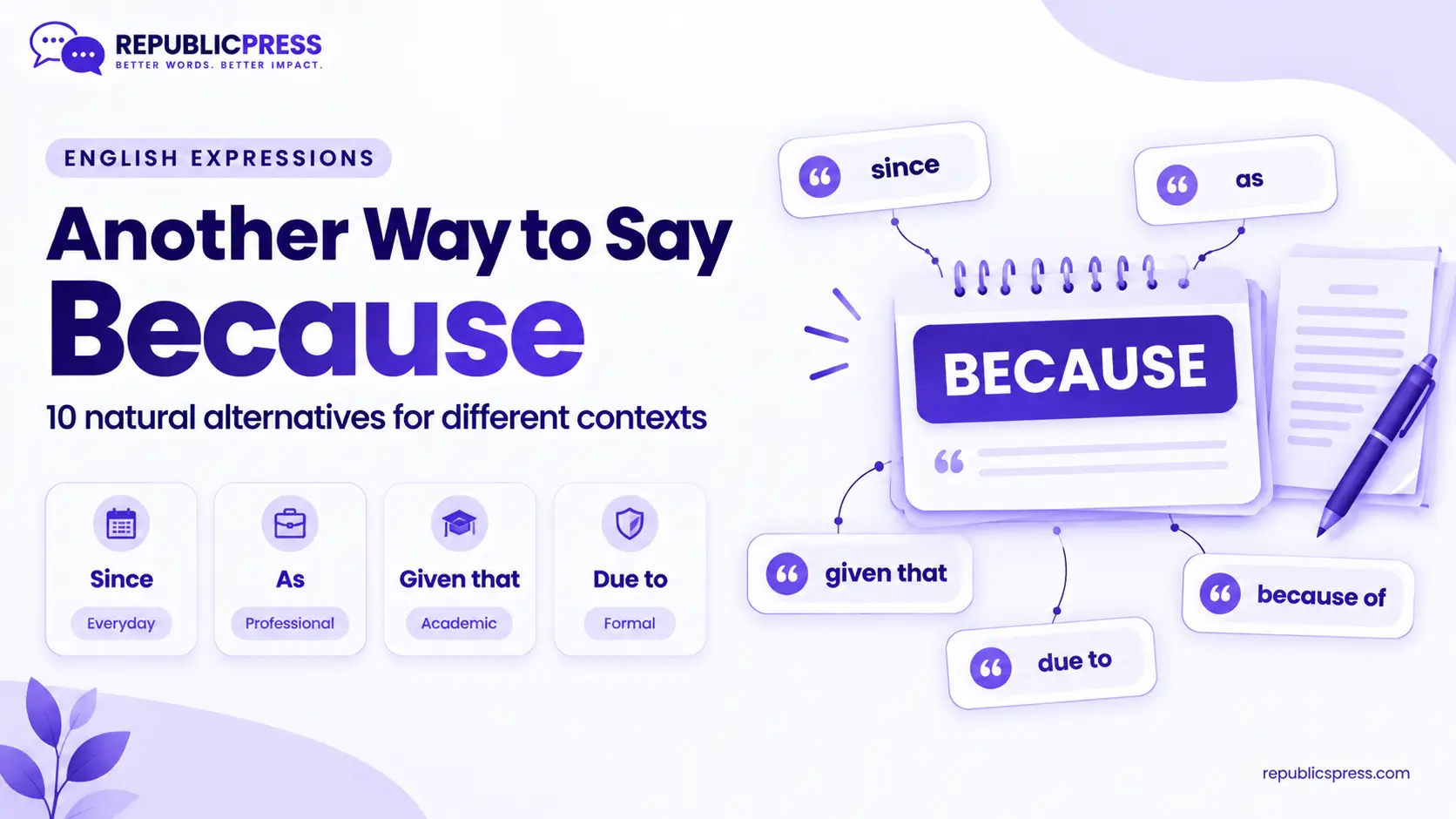
If you need another way to say “because,” you can use phrases such as “since,” “as,” “due to the fact that,” “given that,” If you need another way to say “because,” you can use phrases such as “since,” “as,” “due to the fact that,” “given that,” “considering that,” and “on account of.” The best choice depends on whether you want your sentence to sound casual, neutral, formal, or academic.
For more English vocabulary alternatives, you can also explore our guide to another way to say smart.
Key Takeaways
- “Since” and “as” are natural alternatives in everyday and professional writing.
- “Due to” works best before a noun or noun phrase, not a complete clause.
- “Given that” is useful when the reason is already known or accepted.
- “Considering that” emphasizes a fact that supports a conclusion.
- “On account of” is more formal and is usually followed by a noun.
- Some alternatives change the sentence structure, so they are not interchangeable with “because” in every situation.
What Does “Because” Mean?
“Because” introduces the reason for something. It connects an action, event, or situation with its cause.
For example:
I stayed home because I was sick.
Here, “because I was sick” explains why the person stayed home.
“Because” is one of the most common ways to introduce a reason in American English. It works well in conversations, emails, school writing, and most everyday situations.
If you want to avoid repeating “because,” or you need a more formal or specific tone, several alternatives to because can work.
10 Other Ways to Say “Because”
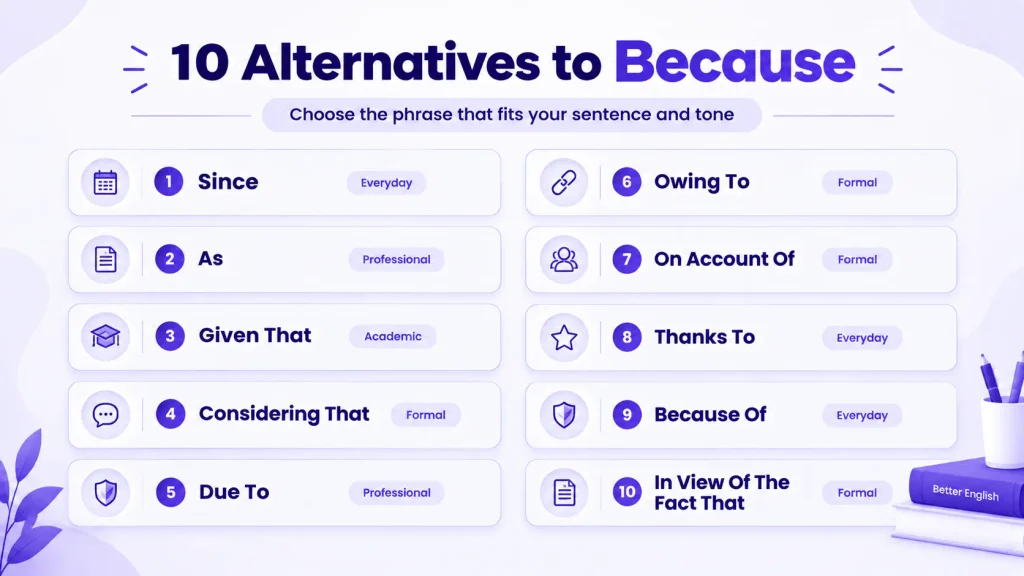
1. Since
“Since” is one of the most natural alternatives to “because.” It introduces a reason and works especially well when the reason is already known or easy to understand.
Example:
Since the weather was bad, we canceled the picnic.
Best for: Everyday, professional, and neutral writing.
Usage tip: “Since” can also refer to time, so make sure the meaning is clear from context.
2. As
“As” can introduce a reason in a concise, natural way. It is especially common in written English.
Example:
As the store was closing, we decided to leave.
Best for: Neutral and professional writing.
Usage tip: “As” has several meanings, including “while” and “in the same way,” so context matters.
3. Given That
“Given that” means “considering the fact that.” It works well when the reason is an established fact or situation.
Example:
Given that the deadline is tomorrow, we should finish the report today.
Best for: Professional, academic, and analytical writing.
Usage tip: This phrase often makes the connection between a fact and a decision or conclusion clearer than “because.”
4. Considering That
“Considering that” introduces a fact that helps explain why something happened or why a conclusion makes sense.
Example:
Considering that traffic was unusually heavy, we arrived on time.
Best for: Neutral, professional, and conversational contexts.
Usage tip: Use it when you want to draw attention to the reason rather than simply state it.
5. Due to
“Due to” expresses a cause or reason, but its grammatical structure differs from “because.”
Example:
The game was canceled due to heavy rain.
Best for: Professional, formal, and informational writing.
Usage tip: “Due to” is normally followed by a noun or noun phrase, such as “heavy rain,” rather than a full clause.
Compare:
- Because it rained heavily, the game was canceled.
- The game was canceled due to heavy rain.
6. Owing to
“Owing to” is another formal way to express a cause. It is similar to “due to.”
Example:
The flight was delayed owing to severe weather.
Best for: Formal, professional, and informational writing.
Usage tip: Like “due to,” it is generally followed by a noun or noun phrase.
7. On Account of
“On account of” means “because of” or “as a result of.” It is more formal than ordinary “because.”
Example:
The event was postponed on account of the storm.
Best for: Formal writing and situations where a more traditional expression fits.
Usage tip: It is usually followed by a noun or noun phrase.
8. Thanks to
“Thanks to” can introduce a reason, especially when the result is positive.
Example:
Thanks to your help, we finished the project early.
Best for: Casual, friendly, and positive contexts.
Usage tip: “Thanks to” often suggests that the cause produced a good result, although it can sometimes be used sarcastically for negative results.
9. Because of
“Because of” is closely related to “because,” but the grammar is different. It is followed by a noun or noun phrase.
Example:
We stayed inside because of the storm.
Best for: Everyday, professional, and neutral writing.
Usage tip: Do not confuse “because” with “because of.”
- Because the road was flooded, we turned around.
- Because of the flooding, we turned around.
10. In View of the Fact That
“In view of the fact that” introduces a reason based on a particular fact or circumstance.
Example:
In view of the fact that the roads were unsafe, the school closed early.
Best for: Formal or official writing.
Usage tip: This expression is quite long. In most situations, “because,” “given that,” or “since” will sound more natural and direct.
Quick Comparison of Alternatives to Because
| Alternative | Meaning/Use | Tone | Best Context |
|---|---|---|---|
| Since | Gives a reason | Neutral | Everyday, professional |
| As | Gives a reason | Neutral | Written, professional |
| Given that | Considers an established fact | Formal | Professional, academic |
| Considering that | Highlights a relevant fact | Neutral | Professional, analytical |
| Due to | Shows a cause | Formal | Professional, informational |
| Owing to | Shows a cause | Formal | Formal writing |
| On account of | Means because of | Formal | Formal writing |
| Thanks to | Gives a usually positive reason | Friendly | Casual, positive |
| Because of | Gives a reason before a noun | Neutral | General use |
| In view of the fact that | Refers to a specific reason or fact | Very formal | Official writing |
How to Choose the Right Alternative
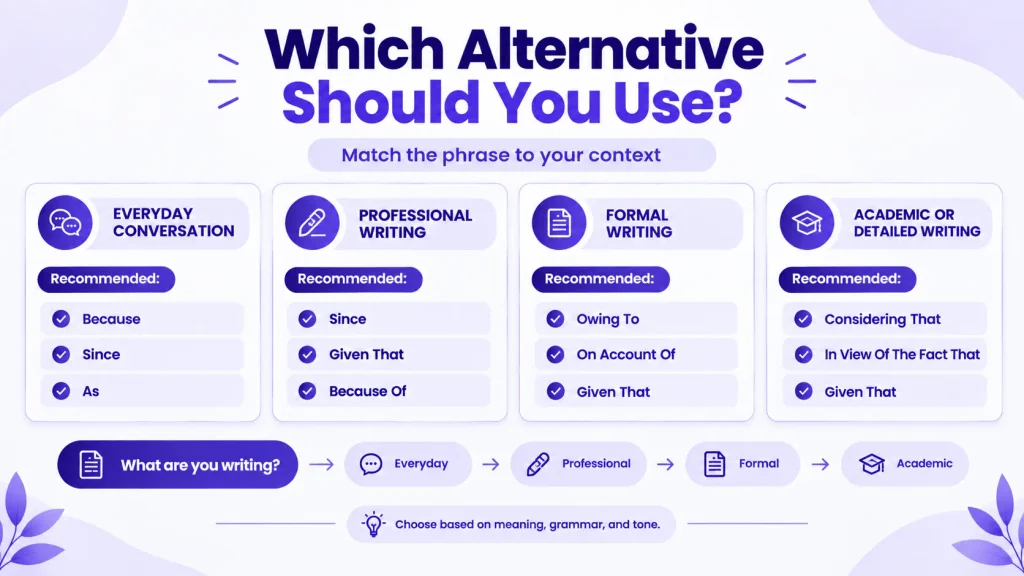
The best replacement for “because” depends on what comes after it and how you want the sentence to sound.
For Everyday Conversation
Choose “because,” “since,” or “as.”
Example:
I left early because I wasn’t feeling well.
You could also say:
I left early since I wasn’t feeling well.
For Professional Writing
“Since,” “given that,” “because of,” and “due to” can work well.
Example:
Given that the deadline has changed, we need to update the schedule.
For a noun-based construction:
The schedule changed due to the revised deadline.
For Academic Writing
Academic writing often benefits from precise cause-and-effect language. Depending on the sentence, you might use “since,” “given that,” “as,” “due to,” or “owing to.”
Example:
Given that the sample size was limited, the findings should be interpreted cautiously.
The goal is not to avoid “because” at all costs. “Because” is perfectly acceptable in academic writing when it clearly expresses the intended relationship.
For Formal or Official Writing
Use expressions such as “due to,” “owing to,” or “in view of the fact that” when they genuinely improve the tone.
Example:
The meeting was postponed due to unforeseen circumstances.
Still, shorter wording is often clearer. A formal phrase should not be used simply because it sounds more sophisticated.
“Because” vs. “Because of”
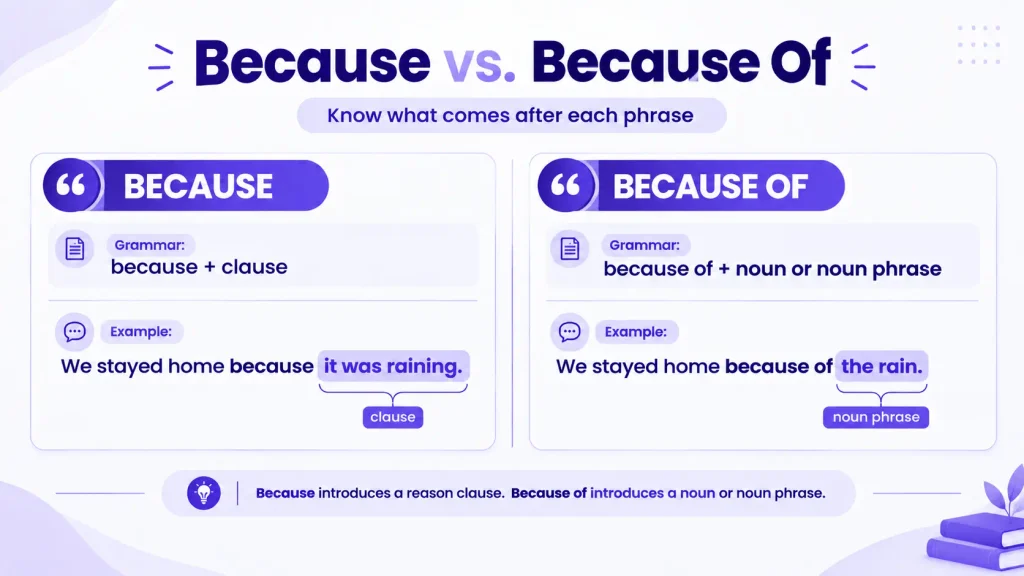
Because vs. because of grammar comparison with clause and noun phrase examples
One of the most important distinctions is the difference between “because” and “because of.”
Because is normally followed by a clause containing a subject and verb:
We stayed home because it was raining.
Because of is normally followed by a noun or noun phrase:
We stayed home because of the rain.
Both expressions give a reason, but their sentence structures are different.
“Because” vs. “Since” vs. “As”
These three words can often introduce a reason, but they are not always equally clear.
Because is usually the most direct:
I called because I needed some information.
Since can sound slightly less direct when introducing a known reason:
Since you already finished the report, could you send it to me?
As can also introduce a reason, especially in writing:
As the office was closed, we returned the next morning.
If there is any chance that “since” or “as” could be misunderstood, “because” is often the clearest option.
Common Mistakes When Replacing “Because”
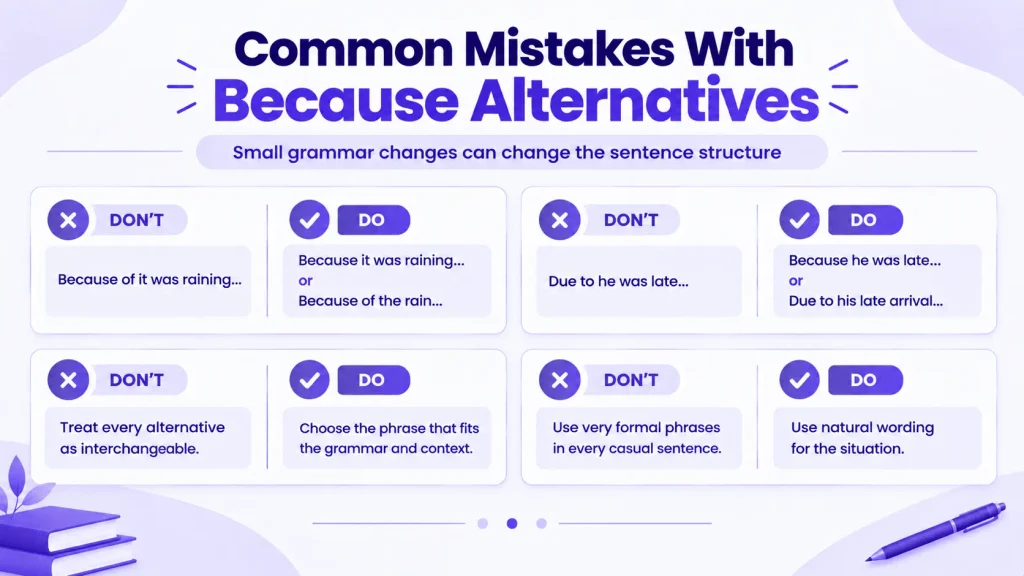
Using “Due to” Before a Complete Clause
Incorrect or awkward:
We canceled the trip due to it was raining.
Better:
We canceled the trip because it was raining.
Or:
We canceled the trip due to the rain.
Treating Every Alternative as an Exact Synonym
Words such as “thanks to” and “given that” have their own shades of meaning. They should not automatically replace “because” in every sentence.
Using Overly Formal Expressions
A phrase such as “in view of the fact that” may be grammatically appropriate, but it can make a simple sentence unnecessarily long.
Instead of:
In view of the fact that the store was closed, we left.
A more natural choice is:
Since the store was closed, we left.
Forgetting the Difference Between a Clause and a Noun Phrase
“Because” can introduce a clause:
She stayed home because she was sick.
“Because of” normally introduces a noun phrase:
She stayed home because of her illness.
Frequently Asked Questions
What Is the Most Common Alternative to “Because”?
“Since” is one of the most common alternatives to “because.” “As” can also work naturally, especially in written English. The best choice depends on the sentence and context.
What Is a Formal Way to Say “Because”?
Formal alternatives include “due to,” “owing to,” “given that,” and “in view of the fact that.” However, “because” itself is not inherently informal and can be appropriate in formal writing.
Can I Use “Since” Instead of “Because”?
Yes. “Since” can introduce a reason in many sentences. For example, “Since it was raining, we stayed home” has essentially the same meaning as “Because it was raining, we stayed home.”
What Is Another Way to Say “Because Of”?
Depending on the sentence, you can use “due to,” “owing to,” “on account of,” or “as a result of.” These expressions can differ in tone and grammatical structure.
Is “As” a Synonym for “Because”?
“As” can function as a causal conjunction meaning “because,” but it has other meanings too. If the sentence could be confusing, “because” is usually more direct.
Is “Due to” More Formal Than “Because”?
Generally, “due to” has a more formal or written feel, especially in constructions such as “due to severe weather.” That does not mean it is always a better choice. Clear, natural wording should come first.
What Is the Best Alternative to “Because” in Academic Writing?
There is no single best alternative. “Because,” “since,” “as,” “given that,” and “due to” can all be appropriate depending on the sentence structure and intended meaning.
Final Thoughts
“Because” is already a clear and natural way to explain a reason, so you do not need to replace it simply to make your writing sound more advanced. Use “since” or “as” for a natural variation, “given that” when emphasizing an established fact, and “due to” or “owing to” when a more formal noun-based construction fits.
The strongest alternative is the one that preserves the meaning while making the sentence sound natural for its context.

Role: Editorial Contributor
Graham Ellis contributes practical English and communication guides to RepublicsPress. His content focuses on vocabulary, writing techniques, word usage, and clear communication, with an emphasis on straightforward explanations and real-world examples.