
Another Way to Say “To Show”
Another way to say “to show” depends on what you mean. In academic writing, useful alternatives include demonstrate, indicate, illustrate, reveal, suggest, establish, and highlight. For everyday or professional writing, display, present, explain, point out, and make clear may sound more natural.
The best replacement depends on whether you mean proving something, making something visible, giving an example, or drawing attention to an important point.
Key Takeaways
- Demonstrate works well when evidence supports a conclusion.
- Indicate is useful when something points toward a fact or result.
- Illustrate means to explain an idea with an example or visual.
- Reveal emphasizes making previously unknown information known.
- Highlight means to draw attention to something important.
- Suggest is useful when the evidence points toward a possibility rather than proving it.
- Not every alternative to “show” has exactly the same meaning.
What Does “To Show” Mean?
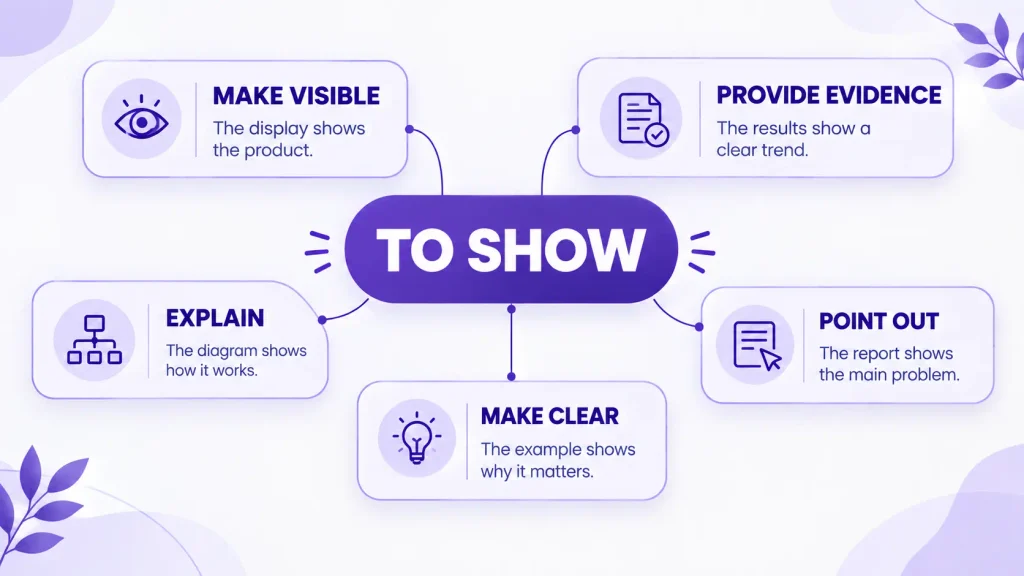
The verb “to show” has several meanings in English. It can mean to make something visible, explain an idea, provide evidence, point out information, or demonstrate how something works.
For example:
- The graph shows an increase in sales.
- The experiment shows that temperature affects the reaction.
- The teacher showed the students how to solve the problem.
- The report shows several problems with the current system.
Because “show” is so broad, replacing it with a more specific verb can make your writing clearer and more precise.
Best Alternatives to “To Show”
1. Demonstrate
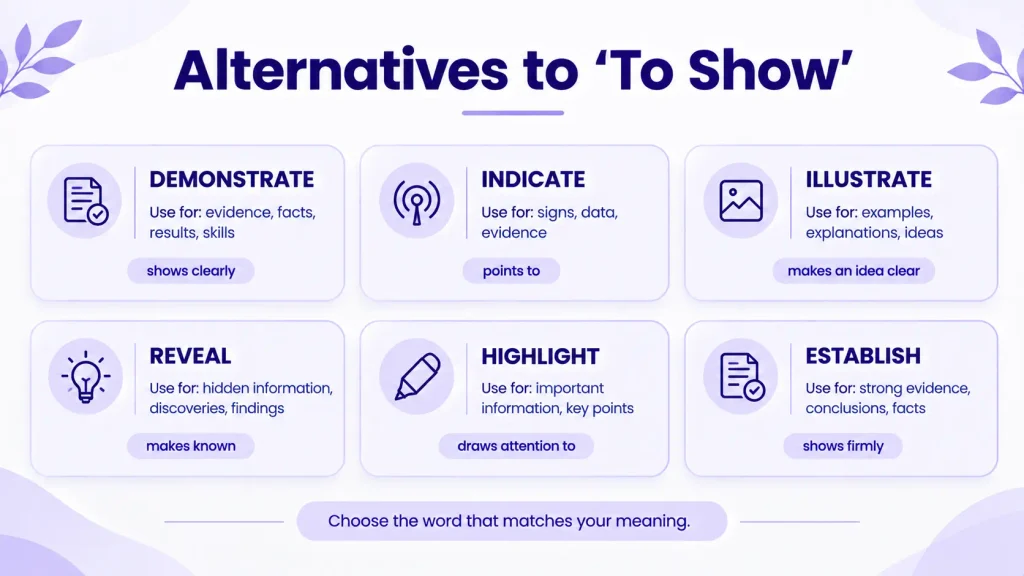
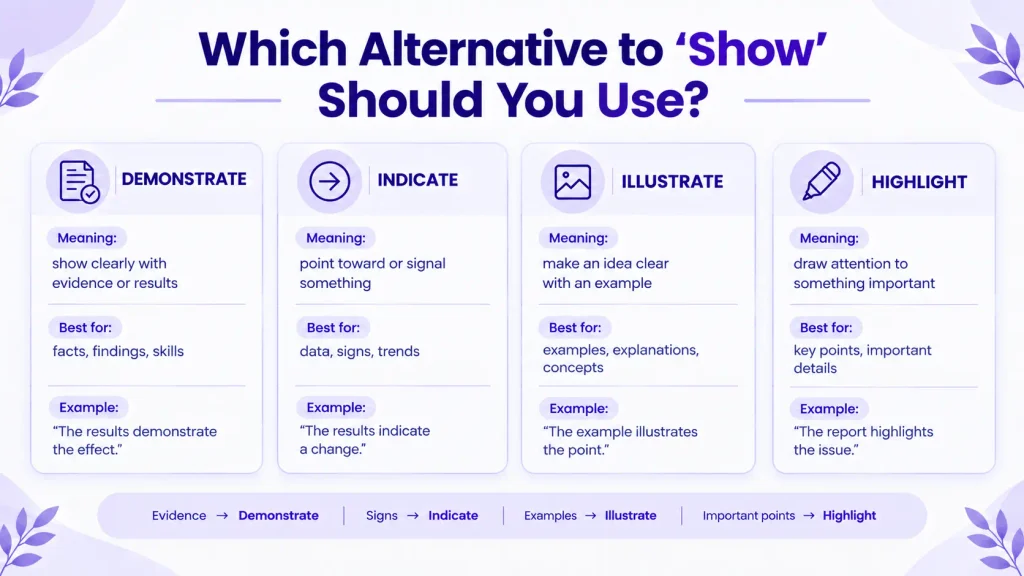
Demonstrate is one of the strongest alternatives to “show,” especially in academic, technical, and professional writing. It suggests that evidence, an example, or an action makes something clear.
Example:
The results demonstrate the importance of regular testing.
Use demonstrate when you want to emphasize evidence or a clear explanation.
2. Indicate
Indicate means that something points to, signals, or provides evidence of something else. It is particularly useful when the evidence does not necessarily prove the conclusion.
Example:
The survey results indicate that customers prefer the new design.
This is often a better choice than “show” when discussing research, statistics, charts, or trends.
3. Illustrate
Illustrate means to make an idea easier to understand by using an example, comparison, diagram, or other representation.
Example:
The example illustrates how small changes can affect the final result.
Use illustrate when the purpose is to clarify an idea rather than simply present information.
4. Reveal
Reveal means to make something previously unknown, hidden, or unclear known.
Example:
The investigation revealed several weaknesses in the system.
“Reveal” is stronger than “show” because it often suggests that information was discovered or uncovered.
5. Highlight
Highlight means to draw attention to something important.
Example:
The report highlights the need for better communication.
Use highlight when the information is already available but you want readers to notice its importance.
6. Suggest
Suggest is useful when evidence points toward an idea without proving it completely.
Example:
The findings suggest that sleep may affect academic performance.
This distinction matters in academic writing. If evidence only points toward a conclusion, suggest can be more accurate than demonstrate.
7. Establish
Establish means to show something convincingly or determine it with sufficient evidence.
Example:
The study established a clear relationship between the two variables.
Because establish can imply a relatively strong evidentiary basis, it should not be used when the evidence is weak or uncertain.
8. Present
Present means to give, provide, or put information before an audience.
Example:
The researchers presented their findings at the conference.
Use present when you are talking about delivering information rather than proving something.
9. Display
Display means to put something where it can be seen.
Example:
The screen displays the current temperature.
It is especially natural for websites, dashboards, signs, charts, photographs, and physical objects.
10. Make Clear
Make clear is a natural phrase when something explains or removes confusion about an issue.
Example:
The report makes clear why the policy needs to be revised.
This expression works well in both professional and general writing.
11. Point Out
Point out means to draw someone’s attention to a particular fact, detail, or issue.
Example:
The author points out several limitations of the study.
It is common in everyday and professional English, although highlight or note may sound more formal in academic writing.
12. Explain
Explain is appropriate when “show” means helping someone understand something.
Example:
The instructor explained how the software works.
It should not replace “show” when you literally mean making something visible.
13. Portray
Portray means to represent or depict a person, situation, idea, or characteristic.
Example:
The novel portrays the challenges faced by immigrant families.
It is particularly useful when discussing literature, film, photography, art, or other forms of representation.
14. Depict
Depict means to represent something visually or through a description.
Example:
The painting depicts a crowded city street.
Use depict for images, artwork, illustrations, photographs, maps, and similar forms of representation.
15. Exhibit
Exhibit means to display something or demonstrate a particular quality or behavior.
Example:
The patient exhibited signs of improvement.
It is more formal than ordinary “show” and is often used in academic, scientific, and professional contexts.
Another Way to Say “To Show” in Academic Writing
If you’re writing an essay, research paper, discussion post, or academic report, choose an alternative based on the exact relationship between your evidence and your claim.
For evidence
Use:
- demonstrate
- indicate
- establish
- suggest
- support
Example:
The data indicate that participation increased after the program was introduced.
For examples
Use:
- illustrate
- demonstrate
- exemplify
Example:
This case illustrates the importance of clear communication.
For important information
Use:
- highlight
- emphasize
- underscore
- point out
Example:
The findings highlight the importance of early intervention.
For visual representation
Use:
- depict
- illustrate
- display
- represent
Example:
Figure 2 illustrates the relationship between income and education.
Another Way to Say “This Shows” in an Essay
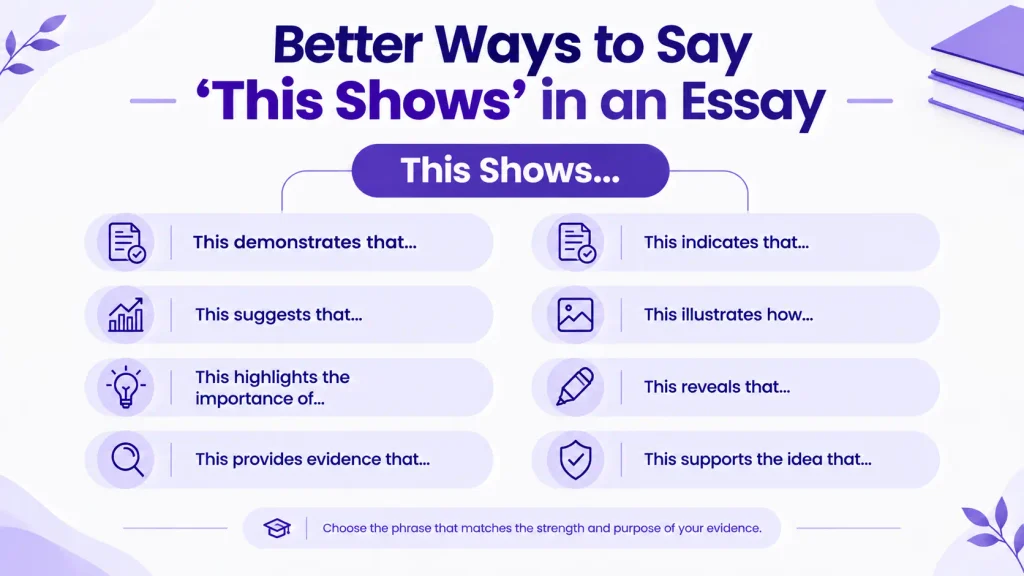
The phrase “this shows” is common in student writing, but repeatedly using it can make an essay sound repetitive. Depending on the evidence, you can replace it with:
- This demonstrates that…
- This indicates that…
- This suggests that…
- This illustrates how…
- This highlights the importance of…
- This reveals that…
- This provides evidence that…
- This supports the idea that…
- This establishes that…
- This makes clear that…
Examples
Instead of:
This shows that the character is afraid of change.
You could write:
This suggests that the character is afraid of change.
Instead of:
This shows the importance of education.
You could write:
This highlights the importance of education.
Instead of:
This shows that the policy was unsuccessful.
You could write:
This provides evidence that the policy was unsuccessful.
The best choice depends on how strongly the evidence supports your interpretation.
Comparison of Alternatives to “To Show”
| Alternative | Main Meaning | Tone | Best Context |
| Demonstrate | Prove or make something clear through evidence or action | Formal | Academic, professional |
| Indicate | Point toward or signal something | Formal | Research, reports |
| Illustrate | Explain with an example or visual | Neutral/Formal | Academic, educational |
| Reveal | Make hidden information known | Neutral | Research, analysis |
| Highlight | Draw attention to something important | Neutral/Formal | Essays, reports |
| Suggest | Point toward a possibility | Neutral/Formal | Academic, analytical |
| Establish | Show something convincingly | Formal | Research, legal, academic |
| Present | Give or provide information | Neutral/Formal | Business, academic |
| Display | Make something visible | Neutral | Websites, screens, objects |
| Explain | Make something understandable | Neutral | Education, conversation |
| Point out | Draw attention to a detail | Neutral | General, professional |
| Depict | Represent visually or descriptively | Formal | Art, literature, media |
| Portray | Represent a person, situation, or idea | Neutral/Formal | Literature, film, art |
| Exhibit | Display or demonstrate a quality | Formal | Scientific, professional |
How to Choose the Right Alternative
The easiest way to choose a replacement is to ask what “show” is doing in your sentence.
If you mean “provide evidence”
Choose demonstrate, indicate, establish, or suggest.
The results demonstrate the effectiveness of the treatment.
If you mean “give an example”
Choose illustrate or demonstrate.
The case study illustrates the problem clearly.
If you mean “draw attention to”
Choose highlight, emphasize, underscore, or point out.
The report highlights several areas for improvement.
If you mean “make visible”
Choose display.
The website displays the latest product information.
If you mean “make something known”
Choose reveal or disclose, depending on the context.
The investigation revealed previously unknown information.
If you mean “represent”
Choose depict, portray, or represent.
The photograph depicts life in a rural community.
Common Mistakes When Replacing “Show”
Using “demonstrate” for weak evidence
“Demonstrate” can suggest that something has been clearly established. If the evidence only points toward a possibility, suggest or indicate may be more accurate.
Less precise:
The results demonstrate that the treatment might work.
More precise:
The results suggest that the treatment might work.
Treating “illustrate” and “prove” as the same
An example can illustrate an idea without proving it.
The story illustrates the effects of social pressure.
That sentence does not necessarily mean the story proves anything scientifically.
Using “display” for an abstract idea
“Display” usually works best when something is visibly presented.
Natural:
The monitor displays the results.
Less natural:
The study displays that the method works.
For the second sentence, demonstrates or indicates would be more appropriate.
Choosing a phrase that changes the meaning
Not every word related to “show” is interchangeable. For example, reveal implies that something becomes known, while highlight means drawing attention to something. Suggest is also weaker than establish.
Choosing the right verb makes the relationship between your evidence and your claim clearer.
Frequently Asked Questions
What is the best formal word for “show”?
Demonstrate is often a strong formal alternative, especially when evidence or an example makes something clear. However, indicate, establish, illustrate, highlight, or reveal may be more precise depending on the sentence.
What is another way to say “this shows” in an essay?
You can use “this demonstrates,” “this indicates,” “this suggests,” “this highlights,” “this illustrates,” or “this provides evidence that.” Choose the phrase according to how strongly the evidence supports your point.
What is a synonym for “show” in academic writing?
Common academic alternatives include demonstrate, indicate, illustrate, suggest, establish, reveal, highlight, and exhibit. They have different meanings, so the best choice depends on the context.
Is “demonstrate” stronger than “show”?
Often, yes. Demonstrate can emphasize clear evidence or a convincing example, while show is a broader and more general verb.
What is another way to say “shows that”?
Depending on the evidence, you can say “indicates that,” “demonstrates that,” “suggests that,” “reveals that,” “establishes that,” or “provides evidence that.”
What is a professional way to say “show”?
In professional writing, demonstrate, indicate, highlight, present, illustrate, and make clear are useful choices. The right option depends on whether you’re presenting information, explaining something, or referring to evidence.
Can I use “prove” instead of “show”?
Only when the evidence genuinely establishes the claim. Prove is stronger than “show” and may overstate the evidence in academic or analytical writing.
Conclusion
There is no single replacement for “to show” that works in every sentence. The most accurate alternative depends on what you want the verb to communicate.
Use demonstrate for evidence, indicate for signals or findings, illustrate for examples, reveal for newly discovered information, highlight for important points, and suggest when the evidence points toward a conclusion without fully establishing it.
Choosing a more precise verb can make your writing clearer, more natural, and more effective—especially in academic and professional contexts.

Role: Language Editor
Caleb Mercer is a Language Editor at RepublicsPress, focusing on grammar, sentence structure, professional writing, and English usage. He helps ensure that language guides are clear, accurate, natural, and easy to follow.