Another Way to Say Run Fast: 15 Natural Alternatives
If you want another way to say “run fast,” the best choice depends on the situation. Sprint, dash, race, run quickly, move swiftly, hurry, bolt, rush, and speed along can all describe fast movement, but they do not mean exactly the same thing. For example, sprint usually suggests running at top speed for a short distance, while bolt suggests suddenly running away.
Key Takeaways
- Sprint is the clearest choice for a short, very fast run.
- Dash describes a quick burst of movement, often because you are in a hurry.
- Race can suggest competition between people or moving very quickly.
- Bolt emphasizes sudden movement, often away from something.
- Rush focuses more on urgency than maximum running speed.
- Some alternatives, such as scamper or hurtle, add a specific tone or style to the action.
What Does “Run Fast” Mean?
“Run fast” means to move quickly on foot, usually at a speed greater than a normal run. It is a simple, neutral phrase that works in everyday conversation.
For example:
“You need to run fast if you want to catch the bus.”
The phrase is perfectly natural, but you may want a more precise or vivid expression in writing. The right alternative can tell the reader whether the person is competing, escaping, hurrying, or simply moving at high speed.
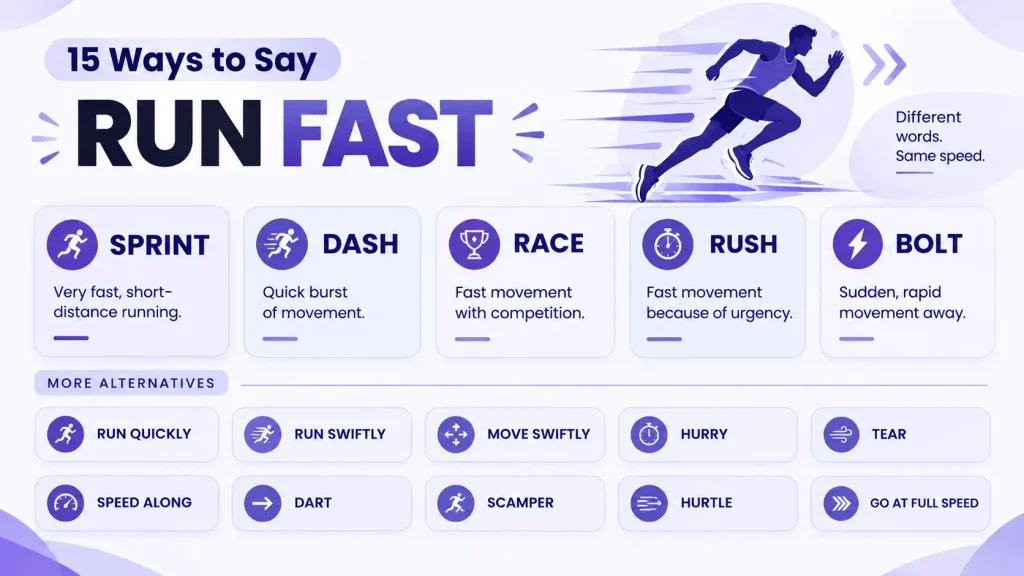
15 Ways to Say “Run Fast”
1. Sprint
Sprint is one of the most precise alternatives to “run fast.” It means to run at very high speed, usually for a short distance. Dictionaries describe a sprint as a short, fast run or race.
Example:
“Maria sprinted toward the finish line.”
Best for: Sports, races, exercise, and short bursts of maximum effort.
Usage tip: Sprint is more specific than simply run fast. It usually suggests intense speed over a relatively short distance.
2. Dash
Dash means to move or run quickly, often over a short distance. It can sound more casual and energetic than “run fast.”
Example:
“I dashed across the street before the light changed.”
Best for: Everyday conversation, storytelling, and situations involving quick movement.
Usage tip: You can dash to catch a bus, answer the phone, or get somewhere quickly. It doesn’t necessarily imply athletic maximum speed.
3. Race
Race can mean to run quickly, especially when competing with another person. It can also describe moving quickly toward a destination.
Example:
“The two boys raced to the playground.”
Best for: Competition, games, sports, and energetic situations.
Usage tip: Race often implies competition, so it isn’t always a direct replacement for “run fast.”
4. Run Quickly
Run quickly is a very close alternative to “run fast.” It changes the adverb but keeps almost exactly the same meaning.
Example:
“She ran quickly to catch the train.”
Best for: Neutral writing and everyday speech.
Usage tip: Use this when you want a straightforward alternative without adding a dramatic or emotional tone.
5. Run Swiftly
Run swiftly means to run with speed. Swiftly sounds somewhat more polished or literary than quickly.
Example:
“The athlete ran swiftly across the field.”
Best for: Descriptive writing, articles, and storytelling.
Usage tip: This expression is understandable and grammatical, but ordinary conversation will often sound more natural with run quickly or sprint.
6. Move Swiftly
Move swiftly means to move quickly, but it doesn’t necessarily mean running.
Example:
“The firefighter moved swiftly through the building.”
Best for: Formal or descriptive writing.
Usage tip: Choose this when the exact type of movement isn’t important.
7. Hurry
Hurry emphasizes urgency rather than speed itself. Someone can hurry by running, walking quickly, or simply trying to finish something sooner.
Example:
“She hurried to the station because her train was leaving.”
Best for: Everyday situations where time is limited.
Usage tip: If you specifically mean very fast running, sprint is more precise.
8. Rush
Rush describes moving quickly because something is urgent or time-sensitive.
Example:
“He rushed across the field when he heard the whistle.”
Best for: Urgent situations and fast movement caused by a need to act quickly.
Usage tip: Rush focuses on urgency, not necessarily the highest possible running speed.
9. Bolt
Bolt means to run away suddenly and quickly.
Example:
“The dog bolted through the open gate.”
Best for: Sudden escapes, surprise, fear, or unexpected movement.
Usage tip: Bolt has a stronger sense of suddenness than “run fast,” so it isn’t appropriate for every situation.
10. Tear
In informal English, tear can mean to move very quickly.
Example:
“He tore down the street after realizing he was late.”
Best for: Informal storytelling and vivid descriptions.
Usage tip: This expression is more colorful than “run fast” and can suggest a very high speed.
11. Speed Along
Speed along means to move quickly in a particular direction.
Example:
“She sped along the trail to get back before dark.”
Best for: Describing quick movement toward a destination.
Usage tip: It can describe different kinds of movement, so it doesn’t always mean running.
12. Dart
Dart means to move suddenly and quickly, often for a short distance.
Example:
“The rabbit darted across the path.”
Best for: Animals, people making sudden movements, and vivid descriptive writing.
Usage tip: Dart emphasizes a quick, sudden movement rather than sustained fast running.
13. Scamper
Scamper means to move quickly with short, light steps. It is especially common when describing children or small animals.
Example:
“The children scampered across the playground.”
Best for: Playful, light, or informal descriptions.
Usage tip: It does not simply mean “run fast.” It adds a sense of small, quick, energetic movements.
14. Hurtle
Hurtle means to move very quickly, often with considerable force or momentum.
Example:
“The runner hurtled toward the finish line.”
Best for: Dramatic or vivid writing.
Usage tip: Hurtle is stronger and more dramatic than the neutral phrase “run fast.”
15. Go at Full Speed
Go at full speed means to move as quickly as possible.
Example:
“The runner went at full speed for the final stretch.”
Best for: Sports, instructions, and situations where maximum speed matters.
Usage tip: This is a descriptive phrase rather than a single-word synonym, but it clearly communicates the idea of moving as fast as possible.
“Run Fast” Alternatives Compared
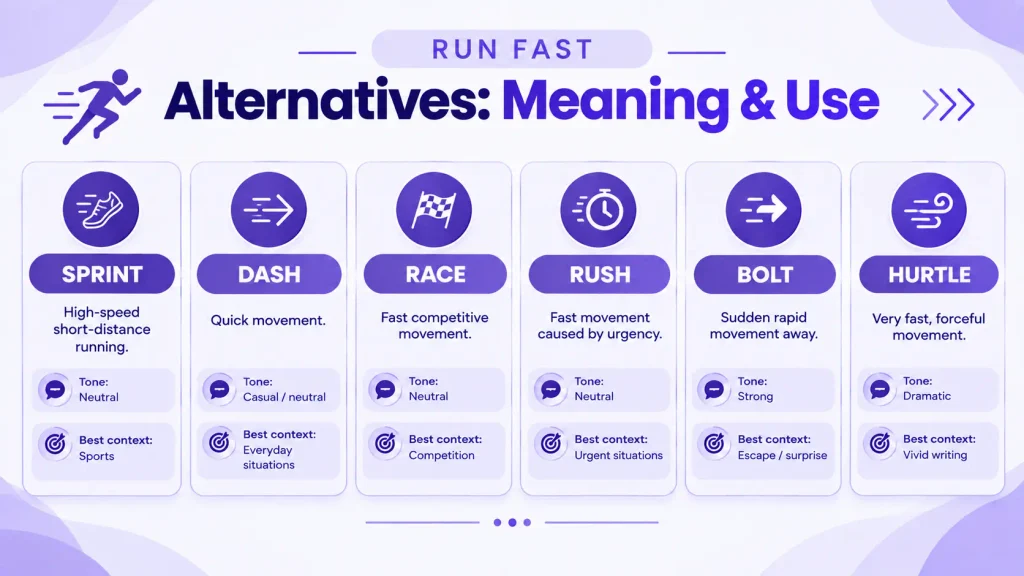
| Alternative | Main Meaning | Tone | Best Context |
| Sprint | Run at very high speed | Neutral | Sports, exercise |
| Dash | Run or move quickly | Casual | Everyday situations |
| Race | Move quickly, often competitively | Neutral | Sports, competition |
| Run quickly | Run at a high speed | Neutral | General use |
| Run swiftly | Run with speed | Slightly literary | Descriptive writing |
| Move swiftly | Move quickly | Formal/neutral | Professional or descriptive writing |
| Hurry | Move quickly because of limited time | Neutral | Everyday situations |
| Rush | Move quickly because of urgency | Neutral | Urgent situations |
| Bolt | Run away suddenly | Strong | Escape or surprise |
| Tear | Move extremely quickly | Informal | Vivid descriptions |
| Speed along | Move quickly in one direction | Neutral | Travel or movement |
| Dart | Move suddenly and quickly | Vivid | People or animals |
| Scamper | Move quickly with short steps | Playful | Children or animals |
| Hurtle | Move extremely quickly | Dramatic | Descriptive writing |
| Go at full speed | Move as fast as possible | Neutral | Sports and instructions |
Which Alternative Should You Use?
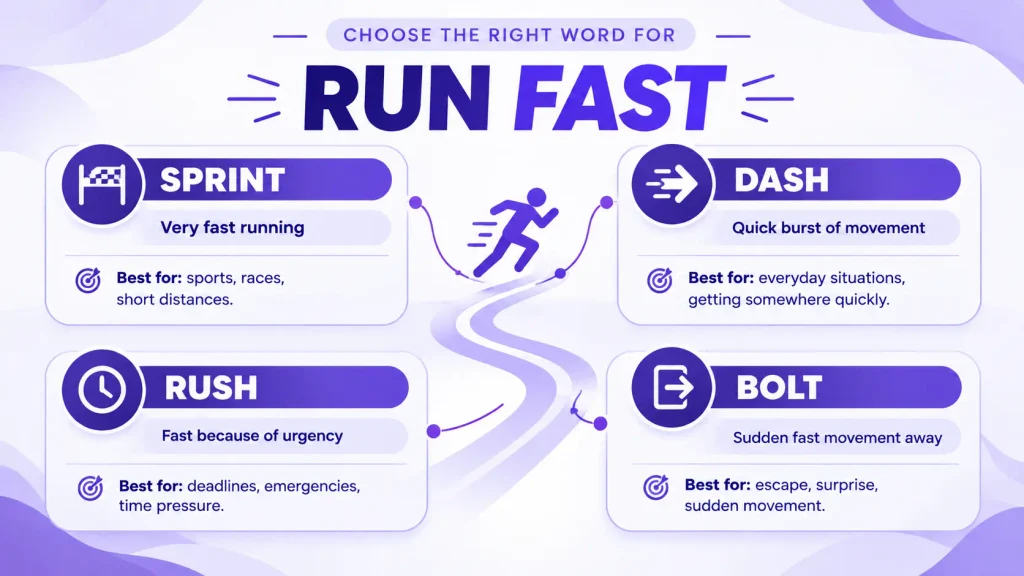
The best replacement depends on what you want to communicate.
For sports
Use sprint when someone is running at maximum speed over a short distance.
“The athlete sprinted toward the finish line.”
For everyday situations
Use dash when someone makes a quick run because they need to get somewhere.
“I dashed to the store before it closed.”
For competition
Use race when two or more people are competing to reach a destination first.
“We raced to the other side of the field.”
For urgency
Use rush or hurry when the important idea is that someone needs to act quickly.
“She rushed to the hospital.”
For sudden escape
Use bolt when someone or something suddenly runs away.
“The horse bolted when it heard the noise.”
For vivid storytelling
Use dart, tear, or hurtle when you want the movement to feel more energetic or dramatic.
“The deer darted into the woods.”
Common Mistakes When Replacing “Run Fast”
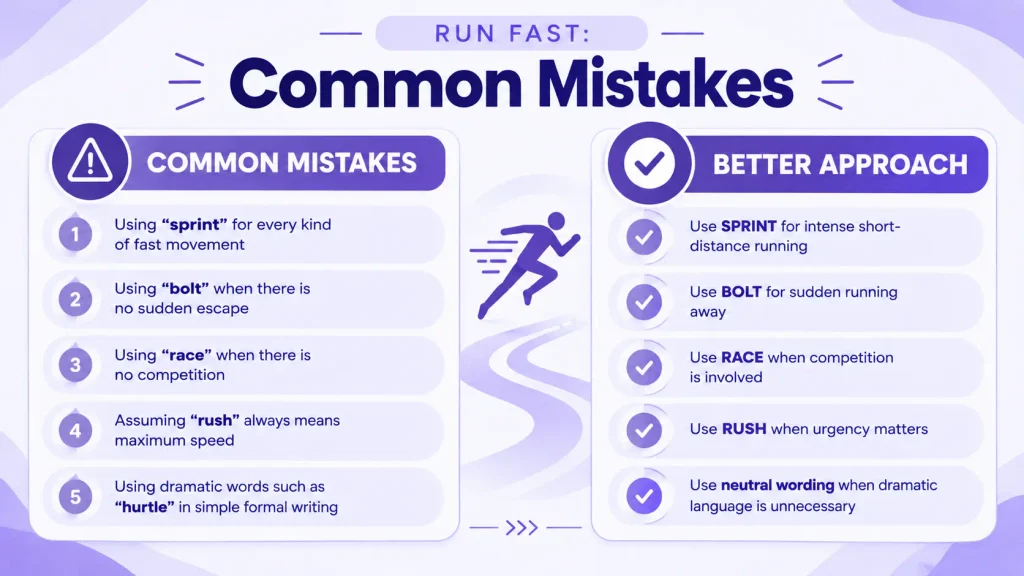
Not every word associated with speed is a true synonym for “run fast.”
Using “sprint” for every kind of fast movement
A sprint usually refers to a short period of very fast running. If someone is simply walking quickly to a meeting, sprint would sound wrong.
Better:
“She hurried to the meeting.”
Using “bolt” when there is no sudden movement
Bolt suggests suddenly running away. It can sound strange when describing an ordinary athletic run.
Better:
“The athlete sprinted around the track.”
Using “race” without a competitive meaning
Race can describe rapid movement, but it often suggests competition.
Better:
“The children raced each other to the gate.”
Assuming “rush” means maximum speed
Rush mainly communicates urgency. Someone can rush without running at full speed.
Better:
Use sprint when maximum running speed is the important detail.
Using dramatic words in formal writing
Words such as tear and hurtle can add energy to creative writing, but they may be too dramatic for a simple academic or professional sentence.
Is “Sprint” the Same as “Run Fast”?
Not exactly. Sprint is a more specific term. It generally means running at very high speed for a short distance, while run fast is a broader phrase that simply describes running at a high speed.
For example:
- “I can run fast.” — General ability.
- “I sprinted to the finish line.” — A short, intense burst of speed.
What Is a More Formal Way to Say “Run Fast”?
There isn’t always a single formal synonym for “run fast.” Depending on the sentence, run swiftly, move swiftly, or move at high speed may work.
For example:
“The emergency team moved swiftly to the affected area.”
The best choice depends on whether you specifically need to describe running or simply rapid movement.
What Is a Casual Way to Say “Run Fast”?
Dash, tear, and rush can sound natural in casual conversation, depending on the context.
For example:
“I had to dash home because I forgot my keys.”
Here, dash sounds more conversational than a formal expression such as “move rapidly.”
What Is a Stronger Word for “Run Fast”?
If you want to emphasize speed or intensity, sprint, hurtle, or tear can be stronger choices, depending on the context.
- Sprint → intense athletic speed
- Hurtle → very fast, forceful movement
- Tear → very fast, informal movement
The strongest choice isn’t always the best choice. The word should match the situation.
Frequently Asked Questions
What is another word for “run fast”?
Common alternatives include sprint, dash, race, run quickly, rush, bolt, dart, and hurry. The best option depends on whether you mean athletic speed, urgency, competition, or sudden movement.
What is the closest synonym for “run fast”?
Sprint is often the closest single-word choice when you mean running very fast over a short distance. However, it is more specific than the general phrase “run fast.”
Is “run quickly” correct English?
Yes. Run quickly is a natural and grammatically correct alternative to “run fast.” Both expressions describe running at a high speed.
What is the difference between “sprint” and “dash”?
Both describe fast movement, but sprint usually emphasizes very fast running, particularly over a short distance, while dash often describes a quick burst of movement caused by urgency or a need to get somewhere quickly.
What is the difference between “rush” and “sprint”?
Rush emphasizes urgency, while sprint emphasizes very fast running. Someone can rush by walking quickly, driving, or running, but a sprint specifically involves rapid movement, usually on foot.
Can I use “race” instead of “run fast”?
Sometimes. Race works well when there is competition or when someone is moving very quickly toward a destination. It does not always mean simply running quickly.
What is a good word for running away quickly?
Bolt is a strong choice when someone suddenly runs away. Dash can also work when you simply want to describe quick movement without the same sense of sudden escape.
Which alternative is best for academic writing?
For straightforward academic writing, run quickly is usually clearer than a dramatic word such as tear or hurtle. If the context is technical or scientific, describe the movement precisely rather than choosing a synonym simply to sound sophisticated.
Final Thoughts
“Run fast” is already a natural and useful expression, but different alternatives can make your meaning more precise. Use sprint for intense short-distance running, dash for a quick burst of movement, race for competition, rush for urgency, and bolt for sudden escape. For vivid writing, dart, tear, and hurtle can add more energy.
The key is not to replace “run fast” with the fanciest word available. Choose the expression that accurately describes why, how, and where the person is moving.

Role: Language & Content Specialist
Tessa Holloway creates language-focused content covering phrases, idioms, expressions, vocabulary, and natural American English. Her work helps readers choose words and expressions that fit different everyday, academic, and professional situations.