Another Way to Say Smart: 10 Better Ways to Describe Intelligence
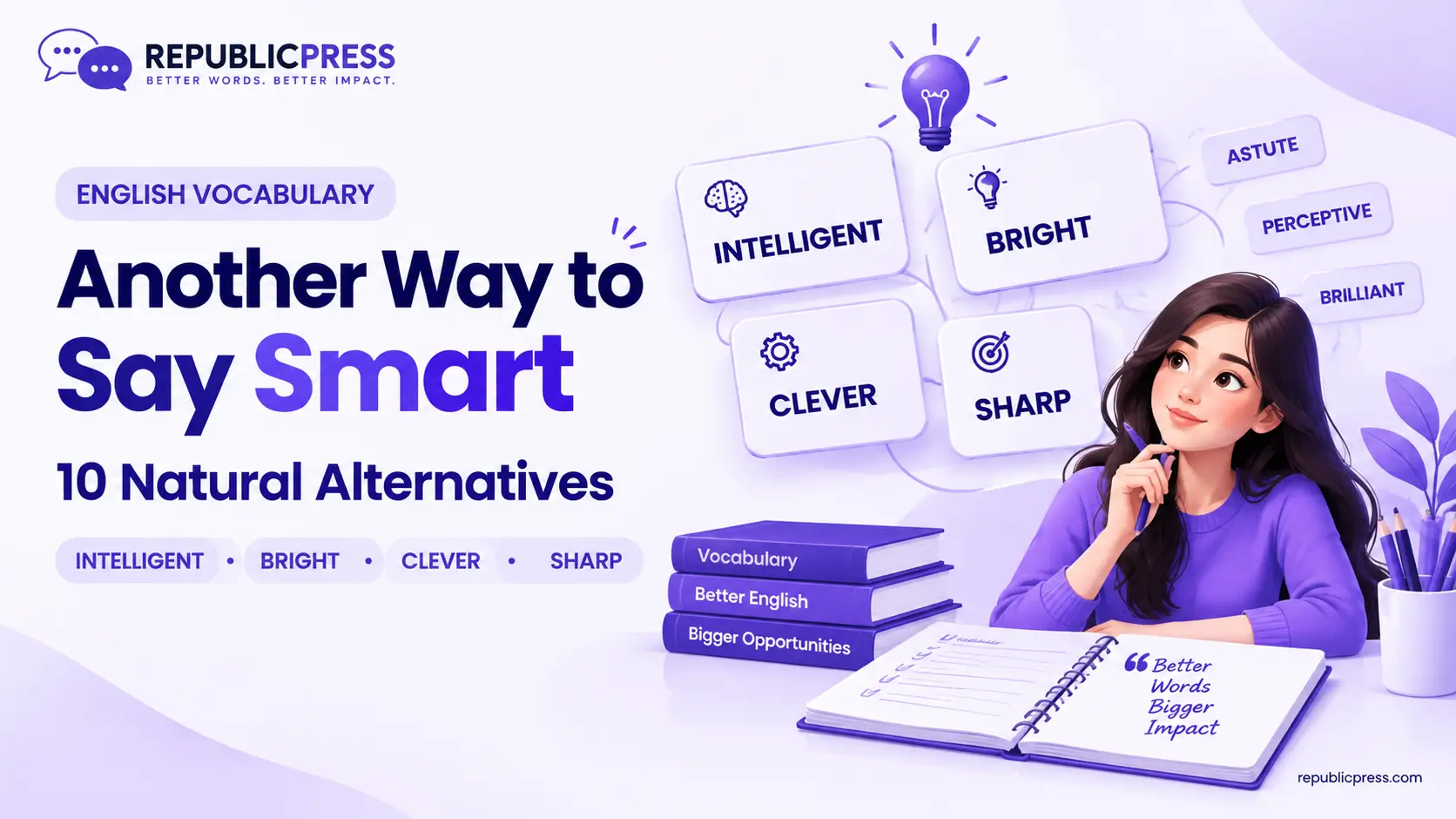
Direct answer: If you want another way to say smart, good alternatives include intelligent, bright, clever, sharp, quick-witted, brainy, knowledgeable, perceptive, astute, and brilliant. The best choice depends on what kind of intelligence you mean and whether you’re writing in a casual, professional, or academic setting.
Key Takeaways
- Intelligent is the closest general-purpose alternative to smart.
- Bright and clever work well in everyday American English.
- Sharp and quick-witted emphasize mental speed or quick thinking.
- Knowledgeable focuses on what someone knows rather than general intelligence.
- Astute and perceptive are useful when someone notices details or makes good judgments.
- Brilliant is stronger than smart and suggests exceptional ability.
What Does “Smart” Mean?
The word smart can describe several kinds of ability. Most often, it means someone is intelligent, learns quickly, understands things well, or makes good decisions.
For example:
She’s a smart student who understands difficult concepts quickly.
But smart is flexible. Depending on the sentence, it can describe academic ability, practical judgment, quick thinking, knowledge, or even good decision-making.
That’s why choosing a replacement based only on a thesaurus can sometimes produce an unnatural sentence. Intelligent may fit one situation perfectly, while sharp, knowledgeable, or astute may be better in another.
10 Natural Alternatives to “Smart”
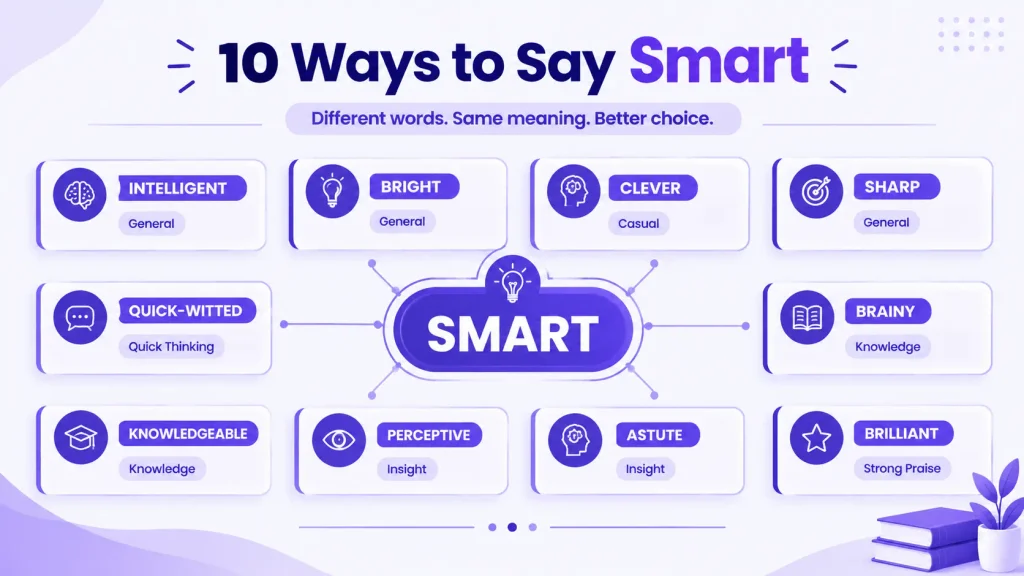
1. Intelligent
Intelligent is the closest broad synonym for smart. It describes someone who has strong mental ability, understands ideas quickly, and can reason effectively.
Best for: Professional, academic, and general writing
Example:
Maya is an intelligent student who asks thoughtful questions.
Usage tip: If you need a safe, neutral replacement for smart, intelligent is usually the best choice.
2. Bright
Bright is a friendly, common way to describe someone who is intelligent, especially in everyday conversation.
Best for: Casual and neutral contexts
Example:
He’s a bright kid who picks up new skills quickly.
Usage tip: Bright often sounds warmer and less formal than intelligent.
3. Clever
Clever describes someone who can think effectively, solve problems, or find creative ways around challenges.
Best for: Casual, conversational, and descriptive writing
Example:
That was a clever solution to a difficult problem.
Usage tip: Clever can describe an idea or solution as well as a person. In some contexts, it can also suggest someone is being crafty or slightly deceptive, so context matters.
4. Sharp
Calling someone sharp means they think quickly and understand what is happening.
Best for: Conversational and professional contexts
Example:
She’s sharp and always notices details that others miss.
Usage tip: Sharp often emphasizes alertness, quick thinking, and mental agility rather than academic intelligence.
5. Quick-Witted
Quick-witted describes someone who responds and thinks quickly, especially during conversations or unexpected situations.
Best for: Conversational, social, and descriptive contexts
Example:
His quick-witted response made everyone laugh.
Usage tip: Use this when you want to emphasize speed of thought, not simply intelligence.
6. Brainy
Brainy is an informal way to describe someone who is very intelligent, especially academically.
Best for: Casual conversation
Example:
Her brother is incredibly brainy and loves solving math problems.
Usage tip: Brainy is friendly and informal, so it usually doesn’t belong in formal business or academic writing.
7. Knowledgeable
Knowledgeable means having a lot of knowledge about a particular subject or area.
Best for: Professional, academic, and informational contexts
Example:
Jordan is knowledgeable about digital marketing and consumer behavior.
Usage tip: This isn’t an exact synonym for smart. Someone can be knowledgeable because they have learned a lot, while smart more broadly refers to mental ability.
8. Perceptive
Perceptive describes someone who notices things quickly and understands situations or people accurately.
Best for: Professional, descriptive, and formal writing
Example:
She is perceptive enough to recognize problems before they become serious.
Usage tip: Choose perceptive when the person’s strength is observation and understanding, rather than general intelligence.
9. Astute
Astute means having good judgment and the ability to understand situations quickly and accurately.
Best for: Professional and formal contexts
Example:
The astute manager recognized the change in customer behavior early.
Usage tip: Astute works especially well when talking about decisions, business judgment, strategy, or practical intelligence.
10. Brilliant
Brilliant is a stronger alternative that suggests exceptional intelligence, talent, or ability.
Best for: Strong praise, professional, academic, and conversational contexts
Example:
Her brilliant analysis helped the team solve the problem.
Usage tip: Because brilliant is stronger than smart, don’t use it when you simply mean that someone is reasonably intelligent.
Which Alternative Should You Use?
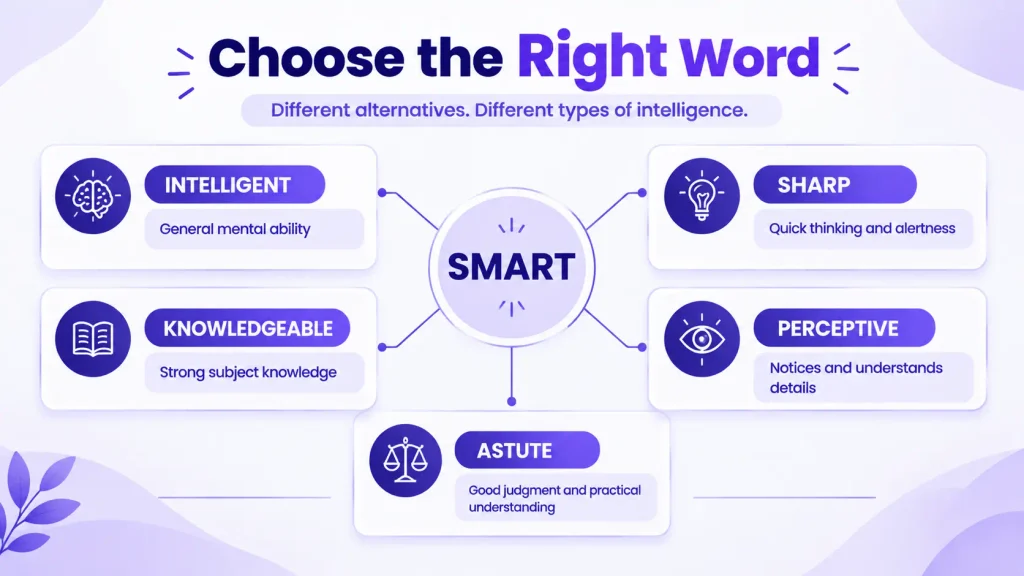
The right replacement depends on what you want to emphasize.
| Alternative | Main Meaning | Tone | Best Context |
| Intelligent | General mental ability | Neutral/Formal | Almost any context |
| Bright | Naturally intelligent | Friendly | Everyday conversation |
| Clever | Good at solving problems | Casual/Neutral | Ideas and people |
| Sharp | Quick and mentally alert | Casual/Neutral | Work and conversation |
| Quick-witted | Thinks and responds quickly | Casual | Conversation and humor |
| Brainy | Highly intelligent | Informal | Casual conversation |
| Knowledgeable | Knows a lot | Neutral/Formal | Work and academic settings |
| Perceptive | Notices and understands details | Formal/Neutral | People and situations |
| Astute | Shows excellent judgment | Formal | Business and professional writing |
| Brilliant | Exceptionally intelligent | Strong | Praise and achievement |
Smart vs. Intelligent: What’s the Difference?
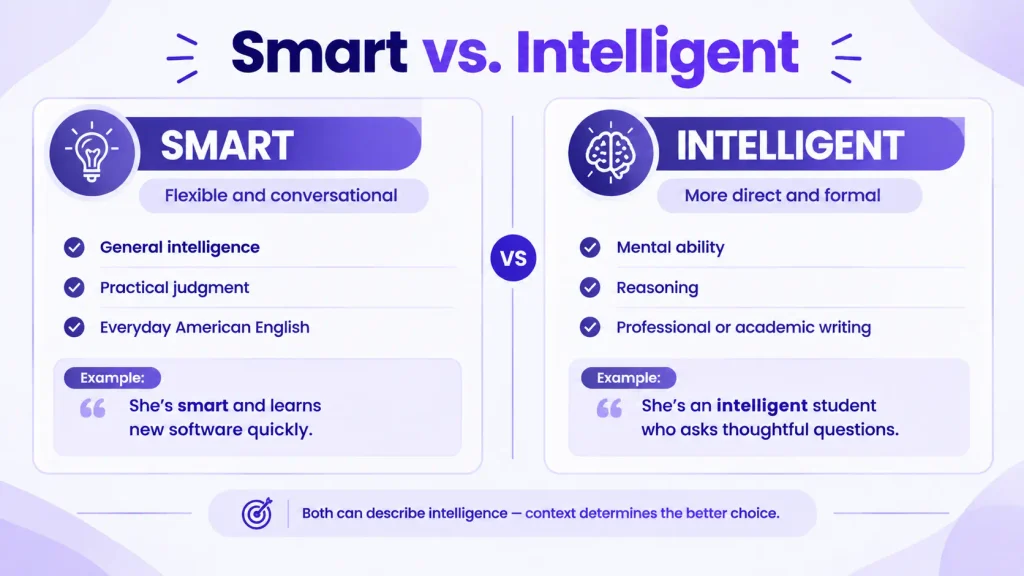
Smart and intelligent are often interchangeable, but smart is more flexible and conversational.
Compare:
She’s smart.
This could mean she is intelligent, practical, or good at making decisions.
She’s intelligent.
This more directly describes her mental ability.
For a professional document, intelligent may sound more precise. In everyday American English, smart is usually more natural.
Smart vs. Clever: What’s the Difference?
Clever often suggests skill in finding an effective or creative solution.
He came up with a clever way to fix the problem.
Smart, by contrast, has a broader meaning.
He’s smart and learns new software quickly.
So, use clever when the focus is on ingenuity or problem-solving.
Smart vs. Knowledgeable: What’s the Difference?
These words describe different qualities.
Someone who is knowledgeable has extensive information or expertise about a subject.
Someone who is smart has strong mental ability more generally.
For example:
The consultant is very knowledgeable about taxes.
This tells us about the person’s expertise. It doesn’t necessarily tell us how intelligent they are overall.
How to Say “Smart” in a Professional Setting
If you’re describing a coworker, employee, manager, or candidate, some alternatives sound more precise than smart.
Consider:
- Intelligent — broad and professional
- Sharp — quick-thinking and alert
- Knowledgeable — strong subject expertise
- Perceptive — good at understanding people or situations
- Astute — strong judgment
- Analytical — good at examining information and solving problems
For example, instead of:
She’s really smart at work.
You could write:
She’s highly analytical and consistently makes sound decisions.
That’s more specific and gives the reader useful information about how she is smart.
Common Mistakes When Replacing “Smart”
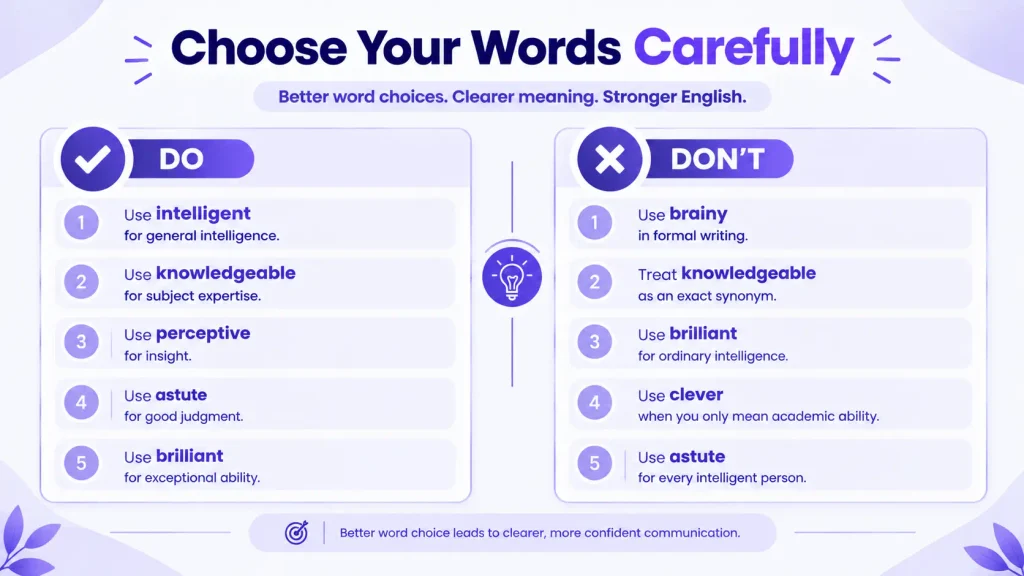
Using “Brilliant” for ordinary intelligence
Brilliant usually carries stronger praise than smart. If someone is simply capable or intelligent, intelligent or bright may be more accurate.
Using “Knowledgeable” as a direct synonym
Someone can be knowledgeable without necessarily being exceptionally intelligent. Use this word when expertise or subject knowledge is the point.
Using “Brainy” in formal writing
Brainy is natural in casual conversation but can sound too informal for a resume, business report, or academic paper.
Using “Clever” when you mean academic intelligence
Clever often suggests ingenuity or problem-solving ability. If you simply mean someone has strong intellectual ability, intelligent is clearer.
Choosing “Astute” for every intelligent person
Astute specifically suggests good judgment and practical understanding. It isn’t simply a formal version of smart.
Frequently Asked Questions
What is the best synonym for smart?
Intelligent is generally the closest synonym for smart. It’s neutral, natural, and appropriate in casual, professional, and academic contexts.
What is a fancy word for smart?
Depending on the meaning, astute, perceptive, brilliant, or intelligent can sound more sophisticated than smart. The best choice depends on the quality you want to emphasize.
What is a professional way to say someone is smart?
Use words such as intelligent, analytical, knowledgeable, perceptive, or astute. For professional writing, it’s often even better to describe the specific ability, such as strong problem-solving or sound judgment.
What is a casual way to say smart?
Bright, sharp, clever, and brainy are natural casual alternatives. Sharp is especially useful when you mean someone thinks quickly.
Is “bright” another way to say smart?
Yes. Bright commonly means intelligent, particularly in American and British English. It often sounds warmer and more conversational than intelligent.
Is “clever” the same as “smart”?
Not always. The words overlap, but clever often emphasizes ingenuity, creativity, or skill at solving a problem, while smart has a broader meaning.
What is a stronger word than smart?
Brilliant is a common stronger alternative. It suggests an unusually high level of intelligence, ability, or achievement.
Conclusion
There are plenty of natural ways to say smart, but the best choice depends on the meaning you want to convey. Intelligent is the safest all-purpose alternative, while bright and sharp work well in everyday conversation. For more specific situations, choose knowledgeable for expertise, perceptive for insight, astute for judgment, and brilliant for exceptional ability.

Role: English Content Writer
Maren Whitlock writes practical English language content for RepublicsPress, with a focus on vocabulary, word alternatives, everyday expressions, and clear communication. Her articles are designed to make difficult or confusing language easier to understand, with simple explanations and useful examples readers can apply in real situations.