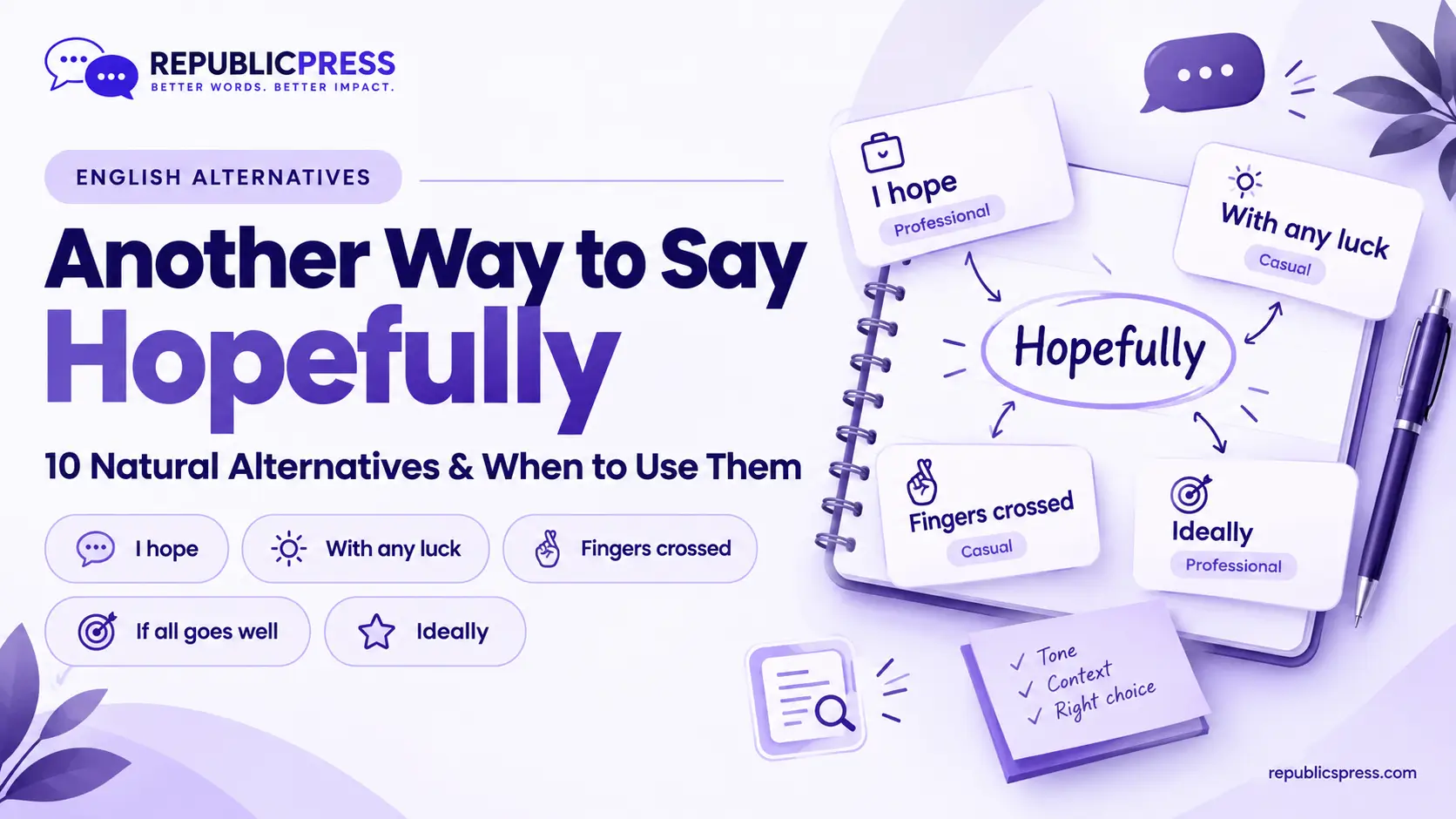
Another Way to Say Hopefully: 10 Natural Alternatives
Direct answer:
If you want another way to say “hopefully,” you can use phrases such as “I hope,” “with any luck,” “fingers crossed,” “if all goes well,” or “ideally.” The best choice depends on whether you want to sound neutral, formal, optimistic, or conversational.
Key Takeaways
- “I hope” is the most natural general alternative.
- “With any luck” expresses optimism about an uncertain outcome.
- “Fingers crossed” is casual and conversational.
- “If all goes well” works well when discussing a desired future result.
- “Ideally” is useful when describing the preferred outcome rather than simply expressing hope.
- Some alternatives change the meaning slightly, so they are not interchangeable in every sentence.
What Does “Hopefully” Mean?
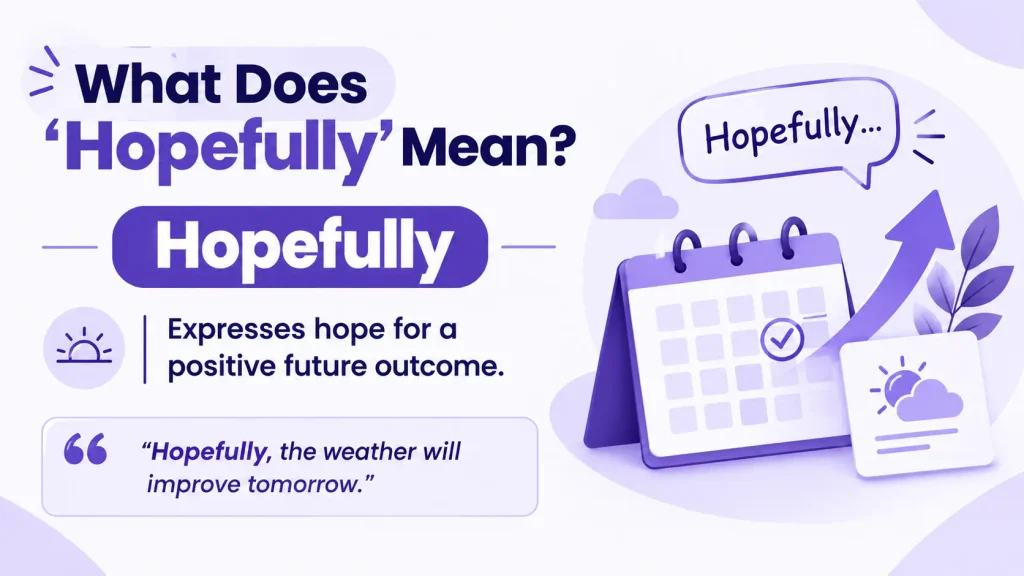
“Hopefully” usually means in a hopeful or optimistic way or it is hoped that something will happen.
For example:
Hopefully, the weather will improve tomorrow.
Here, the speaker is expressing a positive wish about something that has not happened yet.
Depending on the situation, you may want a phrase that sounds more personal, formal, confident, or conversational.
10 Natural Alternatives to “Hopefully”
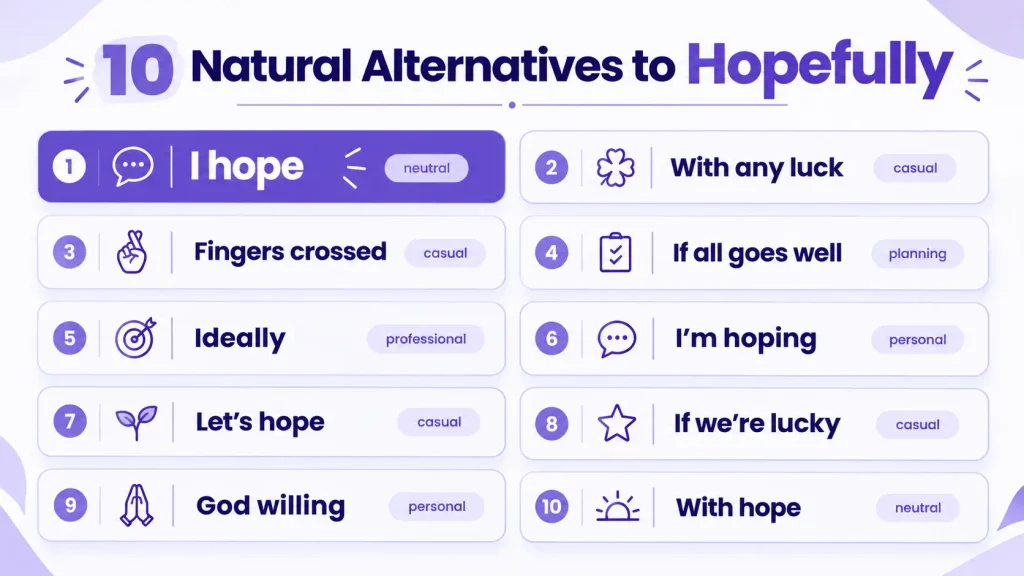
1. I Hope
“I hope” is one of the closest and most natural alternatives to “hopefully.” It clearly shows that the speaker wants a particular outcome.
Example:
I hope we can finish the project by Friday.
Best for: Everyday conversation, emails, messages, and professional communication.
Tip: “I hope” can sound more personal than “hopefully” because it directly identifies the speaker’s wish.
2. With Any Luck
“With any luck” means that you hope something happens, especially when the outcome depends partly on circumstances.
Example:
With any luck, we’ll arrive before the traffic gets heavy.
Best for: Casual and neutral conversation.
Tip: This phrase often carries a sense of uncertainty while still sounding optimistic.
3. Fingers Crossed
“Fingers crossed” is a casual way to express hope that something goes well.
Example:
Fingers crossed, I get the job.
Best for: Friendly conversations, texts, and informal messages.
Tip: Avoid it in highly formal or academic writing.
4. If All Goes Well
“If all goes well” expresses the idea that something is expected or hoped for, provided that nothing goes wrong.
Example:
If all goes well, we’ll launch the website next month.
Best for: Professional conversations, planning, and everyday speech.
Tip: This phrase is especially useful when discussing plans or future events.
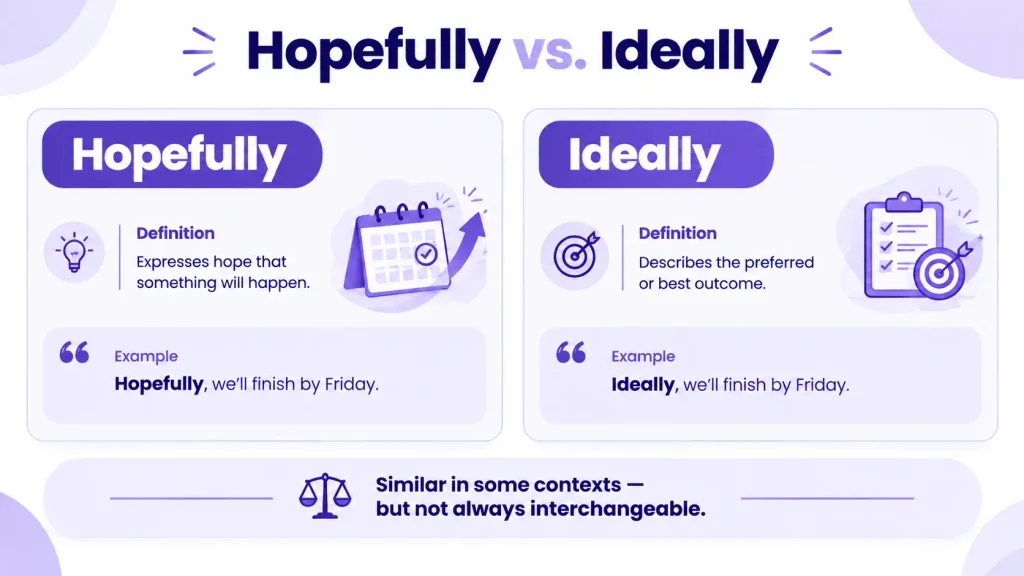
5. Ideally
“Ideally” refers to the outcome you would most like to see.
Example:
Ideally, we’d like to complete the work before the end of the week.
Best for: Professional, planning, and formal contexts.
Tip: “Ideally” is not always a direct synonym for “hopefully.” It emphasizes the preferred situation, rather than simply expressing hope.
6. I’m Hoping
“I’m hoping” makes the expression more personal and conversational.
Example:
I’m hoping we can meet sometime next week.
Best for: Friendly, conversational, and professional communication.
Tip: It works particularly well when you’re talking about your own expectations or wishes.
7. Let’s Hope
“Let’s hope” expresses a shared wish for a positive outcome.
Example:
Let’s hope the meeting goes smoothly.
Best for: Conversations and informal workplace communication.
Tip: Use it when you want to include the listener in the sentiment.
8. If We’re Lucky
“If we’re lucky” suggests that a desired outcome depends on favorable circumstances.
Example:
If we’re lucky, the package will arrive tomorrow.
Best for: Casual and conversational English.
Tip: Compared with “hopefully,” this phrase puts more emphasis on uncertainty or chance.
9. God Willing
“God willing” expresses hope that something will happen, often with the idea that circumstances beyond one’s control may affect the outcome.
Example:
God willing, we’ll be able to visit them next summer.
Best for: Personal or culturally appropriate contexts.
Tip: Because it has a religious reference, it may not be suitable for every audience or professional setting.
10. With Hope
“With hope” can express an optimistic expectation, although it is less common in everyday American English than alternatives such as “I hope” or “hopefully.”
Example:
We move forward with hope for a better outcome.
Best for: Reflective, literary, or inspirational writing.
Tip: This is not a direct replacement for “hopefully” in most everyday sentences. It works better when the sentence is deliberately expressive.
Quick Comparison
| Alternative | Meaning / Use | Tone | Best Context |
| I hope | Expresses a personal wish | Neutral | Everyday & professional |
| With any luck | Hopes for a favorable result | Casual | Conversation |
| Fingers crossed | Expresses strong casual hope | Very casual | Texts & friendly speech |
| If all goes well | Hopes plans proceed successfully | Neutral | Planning & work |
| Ideally | Describes the preferred outcome | Neutral/Formal | Work & planning |
| I’m hoping | Expresses a personal expectation | Conversational | Everyday & professional |
| Let’s hope | Expresses a shared hope | Conversational | Conversation |
| If we’re lucky | Hopes circumstances work out | Casual | Conversation |
| God willing | Expresses hope with a religious reference | Personal | Appropriate personal contexts |
| With hope | Expresses optimism | Reflective | Literary/inspirational writing |
Which Alternative Should You Use?
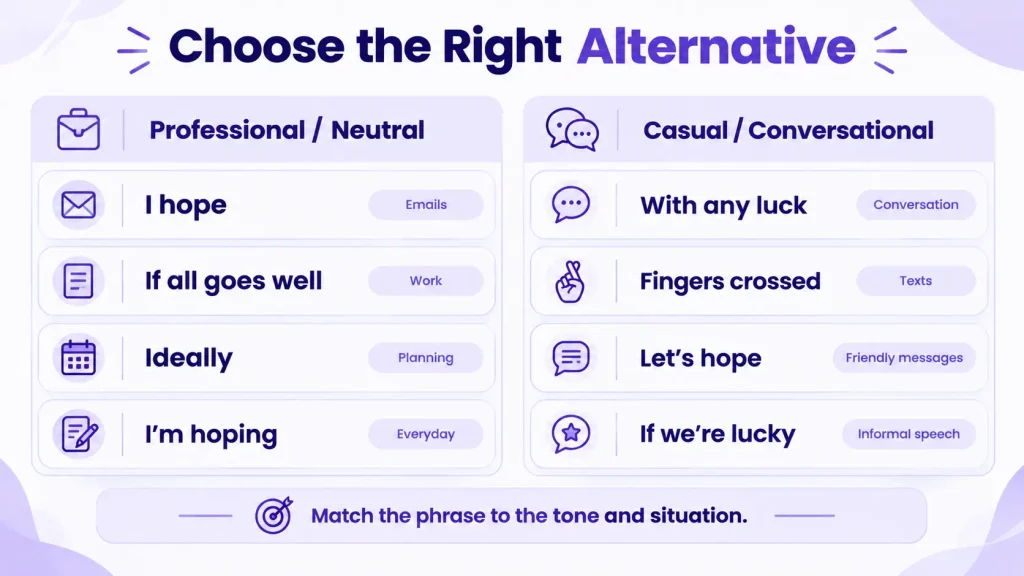
The right replacement depends on the sentence.
For everyday conversation
Use “I hope,” “with any luck,” or “I’m hoping.”
I hope everything works out.
For professional communication
Use “I hope,” “if all goes well,” or “ideally.”
If all goes well, we should have the report ready by Friday.
For casual messages
Use “fingers crossed” or “if we’re lucky.”
Fingers crossed, we get good weather this weekend.
For a preferred outcome
Use “ideally.”
Ideally, we’d like to complete the project ahead of schedule.
Common Mistakes When Replacing “Hopefully”
Treating every alternative as an exact synonym
Not every phrase above has exactly the same meaning. “Ideally” describes a preferred outcome, while “fingers crossed” expresses casual hope.
Using casual expressions in formal writing
Phrases such as “fingers crossed” may sound too informal for an academic paper, formal report, or business document.
Overusing “God willing”
Because it has a religious association, “God willing” may not fit every audience or situation.
Using “with hope” in ordinary conversation
Although understandable, “with hope” is less natural as a direct replacement for “hopefully.” In everyday American English, “I hope” is usually more natural.
Frequently Asked Questions
What is the most natural way to say “hopefully”?
“I hope” is one of the most natural alternatives. It works in both casual and professional situations.
What is a professional way to say “hopefully”?
Depending on the sentence, use “I hope,” “if all goes well,” or “ideally.” For example: “If all goes well, we should complete the project on Friday.”
What is a casual way to say “hopefully”?
“Fingers crossed” is a common casual alternative. “With any luck” is another natural option.
Is “I hope” the same as “hopefully”?
They can communicate a similar idea, but they are grammatically different. “I hope” directly expresses the speaker’s wish, while “hopefully” can modify the whole statement.
Can I use “hopefully” in professional writing?
Yes. “Hopefully” is standard English and can be appropriate in professional writing. However, “I hope” or “if all goes well” may be clearer when you want to express a specific expectation.
Is “ideally” a synonym for “hopefully”?
Not exactly. “Ideally” means in the best or preferred situation, while “hopefully” expresses hope that something will happen. The two can overlap in some contexts but should not always be substituted for each other.
What is another way to say “hopefully” in an email?
For most professional emails, “I hope” is a natural choice. For example: “I hope we can resolve this issue soon.”
Final Thoughts
“Hopefully” is already a natural and widely used English word, so you don’t always need to replace it. When you do want a different expression, choose based on the tone and meaning you need. “I hope” is the safest general option, while “fingers crossed,” “with any luck,” “if all goes well,” and “ideally” each add a slightly different nuance.

Role: Language Editor
Caleb Mercer is a Language Editor at RepublicsPress, focusing on grammar, sentence structure, professional writing, and English usage. He helps ensure that language guides are clear, accurate, natural, and easy to follow.