Another Way to Say Mean: 10 Natural Alternatives
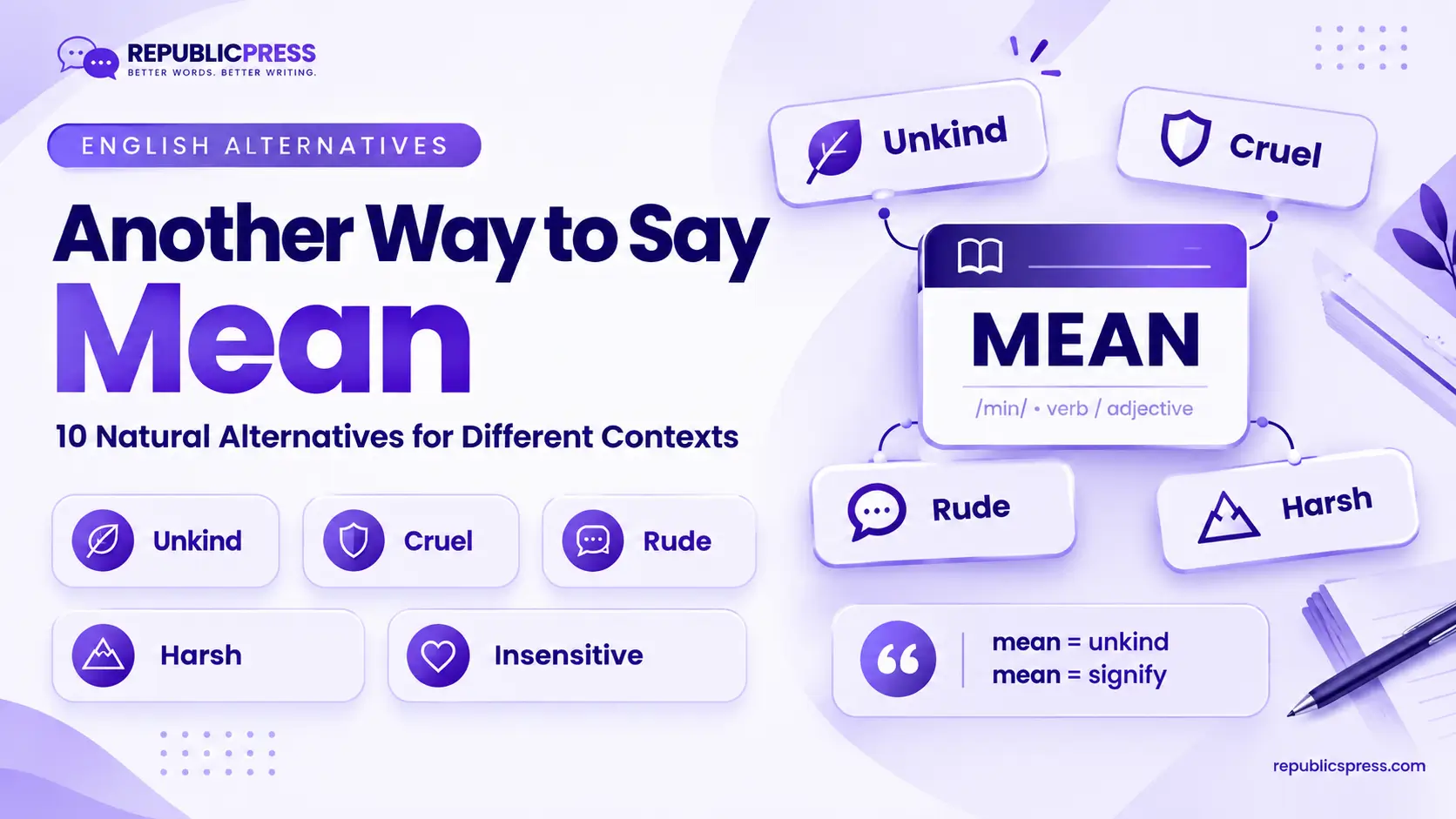
If you’re looking for another way to say “mean,” the best choice depends on what you mean by the word. For describing an unkind person, you can use unkind, cruel, harsh, rude, or nasty. For describing something that “mean” signifies, use signify, indicate, refer to, or represent.
Key Takeaways
- “Mean” has several different meanings in American English.
- Unkind and unkindness are useful when describing hurtful behavior.
- Cruel is stronger than “mean” and suggests intentional harm.
- Harsh often describes words, criticism, or treatment rather than a person’s general character.
- When “mean” means “signify,” alternatives include indicate, represent, refer to, and signify.
- Choose the alternative based on the sentence, not just the dictionary definition.
What Does “Mean” Mean?
The word mean has more than one common meaning, so there isn’t one perfect replacement for every situation.
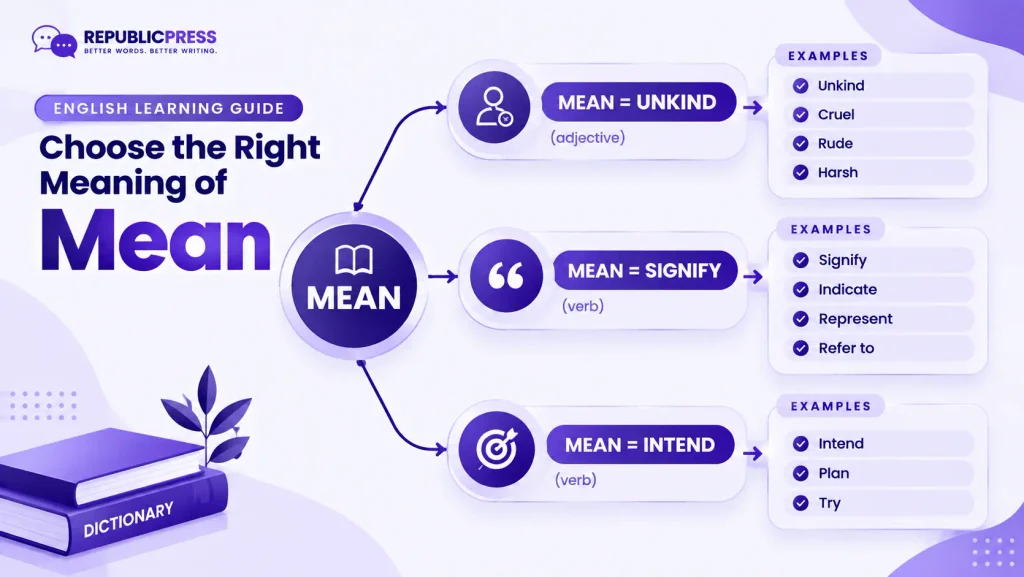
When describing someone’s behavior, “mean” usually means unkind, hurtful, unpleasant, or deliberately insensitive.
She was mean to her younger brother.
But “mean” can also mean to signify or have a particular meaning:
What does this word mean?
And it can mean to intend:
I didn’t mean to hurt your feelings.
Because these meanings are different, the right alternative depends on how “mean” is being used.
10 Another Ways to Say “Mean”
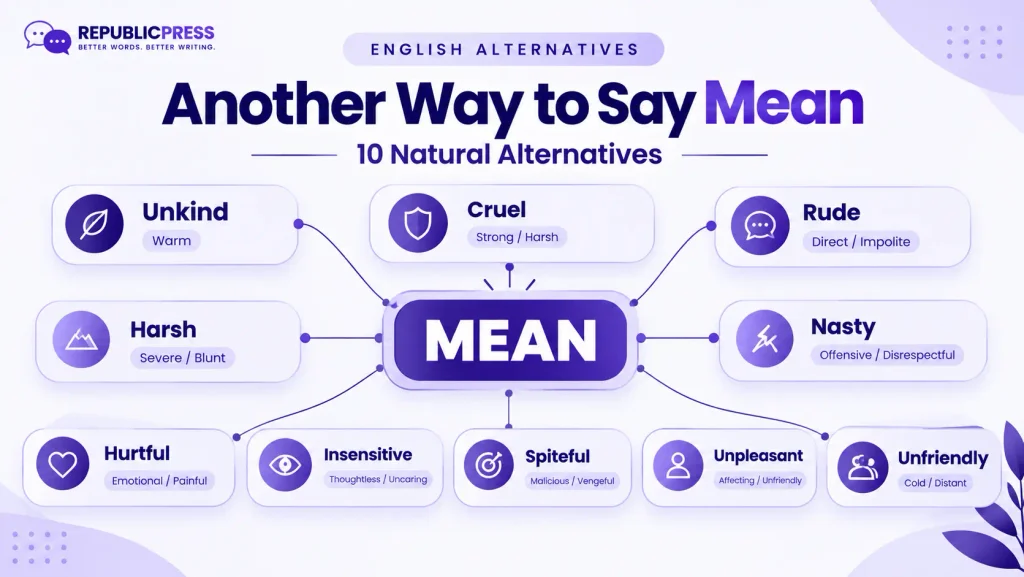
1. Unkind
Unkind is one of the closest and most natural alternatives when “mean” describes behavior that hurts or upsets someone.
Example:
It was unkind of him to make fun of her mistake.
Best for: Everyday conversation, polite descriptions, and situations where you don’t want to sound overly harsh.
2. Cruel
Cruel is stronger than “mean.” It suggests that someone causes pain, suffering, or distress, sometimes intentionally.
Example:
That was a cruel thing to say to someone who was already struggling.
Best for: Serious or deliberately hurtful behavior.
3. Rude
Use rude when “mean” refers specifically to poor manners, disrespect, or inappropriate behavior.
Example:
The customer was rude to the cashier.
Best for: Comments, behavior, manners, and social interactions.
Tip: Someone can be rude without necessarily being cruel.
4. Harsh
Harsh works well when describing words, criticism, treatment, or behavior that feels excessively severe.
Example:
Her manager was harsh when criticizing her work.
Best for: Criticism, comments, treatment, rules, or reactions.
5. Nasty
Nasty is a more informal way to describe someone or something unpleasant, spiteful, or deliberately hurtful.
Example:
He made a nasty comment about her appearance.
Best for: Casual conversations and emotionally negative situations.
6. Hurtful
Hurtful focuses on the effect someone’s words or actions have on another person.
Example:
Some of the things he said were really hurtful.
Best for: Personal conversations, relationships, apologies, and emotional situations.
7. Insensitive
Insensitive describes behavior or comments that fail to consider another person’s feelings or circumstances.
Example:
It was insensitive to joke about her situation.
Best for: Social, workplace, and interpersonal situations where the problem is a lack of consideration.
8. Spiteful
Spiteful suggests that someone deliberately wants to upset, annoy, or hurt another person.
Example:
She made a spiteful remark after the argument.
Best for: Situations involving resentment or intentional hostility.
9. Unpleasant
Unpleasant is a softer and more general alternative. It can describe a person’s behavior, interaction, experience, or attitude without directly calling someone “mean.”
Example:
The conversation became unpleasant after they started arguing.
Best for: Polite descriptions when you want to soften your wording.
10. Unfriendly
Unfriendly works when “mean” describes someone who is cold, distant, or unwilling to be welcoming.
Example:
The receptionist seemed unfriendly when we arrived.
Best for: Social interactions, customer service, first impressions, and general behavior.
Another Way to Say “Mean” When It Means “Signify”
“Mean” has a completely different meaning in questions such as:
What does this expression mean?
Here, you aren’t describing someone as unkind. You’re asking what something signifies or represents.
Useful alternatives include:
- Signify — to have a particular meaning
- Indicate — to show or point to something
- Represent — to stand for something
- Refer to — to describe or identify something
- Convey — to communicate an idea or message
Example:
What does this symbol mean?
can become:
What does this symbol represent?
or:
What does this symbol signify?
These alternatives aren’t interchangeable in every sentence, so the exact context matters.
Another Way to Say “I Didn’t Mean To”
When “mean” means intend, you need a different set of alternatives.
For example:
I didn’t mean to upset you.
You could say:
I didn’t intend to upset you.
Or:
I wasn’t trying to upset you.
Here, intend is the closest direct alternative because both words describe someone’s purpose or intention.
Choosing the Right Alternative
| Alternative | Main Meaning | Tone | Best Context |
| Unkind | Not kind or considerate | Neutral | Everyday situations |
| Cruel | Deliberately causing pain | Strong | Serious behavior |
| Rude | Lacking manners or respect | Neutral | Social interactions |
| Harsh | Excessively severe | Neutral | Criticism or treatment |
| Nasty | Spiteful or unpleasant | Informal | Casual conversation |
| Hurtful | Causing emotional pain | Neutral | Personal situations |
| Insensitive | Lacking consideration | Neutral/Formal | Social or professional settings |
| Spiteful | Intentionally hurtful | Strong | Conflict or resentment |
| Unpleasant | Not pleasant | Soft | Polite descriptions |
| Unfriendly | Cold or unwelcoming | Neutral | Social interactions |
Common Mistakes When Replacing “Mean”
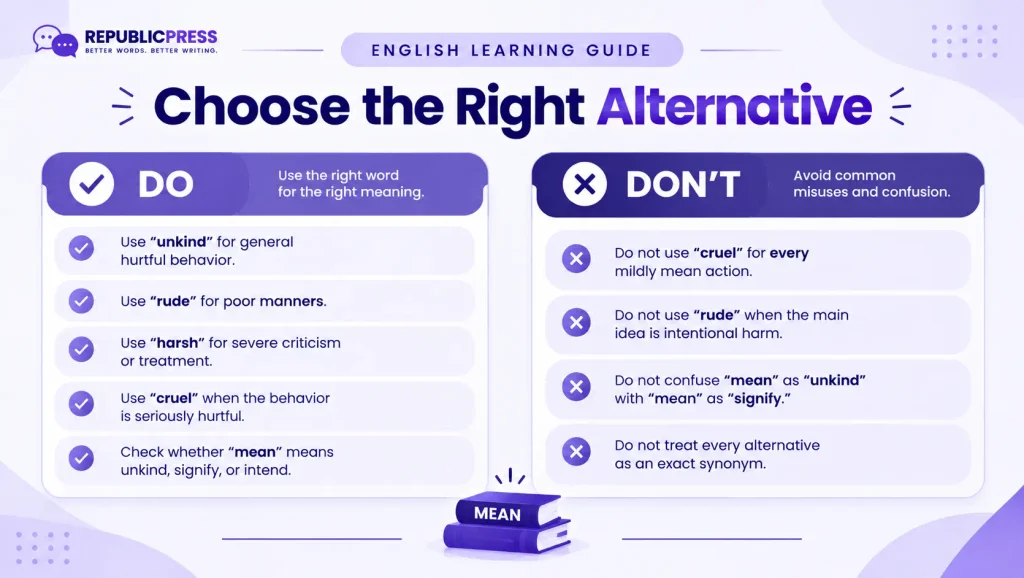
Using “cruel” for every situation
“Cruel” is much stronger than “mean.” If someone makes a mildly insensitive comment, calling them “cruel” may exaggerate the situation.
Using “rude” when the issue is intentional harm
“Rude” usually focuses on manners or respect. If someone intentionally tries to hurt another person, spiteful or cruel may communicate the idea more accurately.
Confusing the different meanings of “mean”
Always check the sentence first.
- She is mean. → unkind, rude, cruel
- What does this mean? → signify, represent, indicate
- I didn’t mean to do that. → intend, plan, try
These are different uses of the same word.
FAQs About Another Ways to Say “Mean”
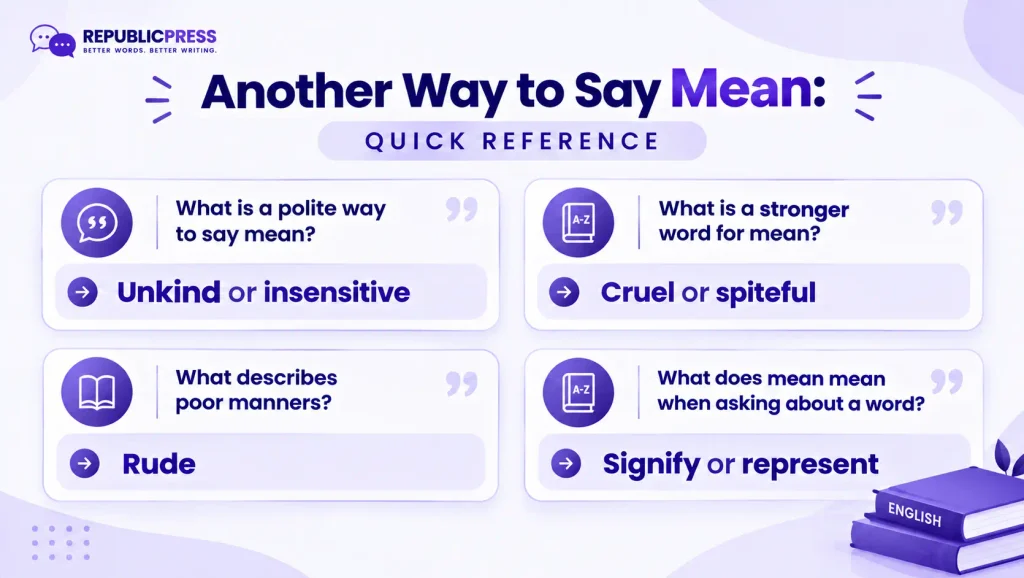
What is a polite way to say “mean”?
Unkind, insensitive, or unpleasant can be more tactful than “mean,” depending on the situation.
What is a stronger word for “mean”?
Cruel is generally stronger than “mean,” while spiteful emphasizes deliberate intent to hurt or upset someone.
What is another word for “mean” when describing a person?
Depending on the behavior, you can use unkind, rude, harsh, nasty, cruel, insensitive, spiteful, or unfriendly.
What is another word for “mean” in an academic context?
If “mean” refers to significance, signify, indicate, represent, or refer to may work. If you mean the mathematical term, “mean” can refer to an average.
Is “unkind” the same as “mean”?
They are close, but not identical in every situation. Unkind usually sounds more neutral and polite, while “mean” can sound more conversational and emotional.
What is another way to say “I didn’t mean it”?
You can say “I didn’t intend it,” “I didn’t intend to say that,” or “That wasn’t my intention,” depending on the context.
Conclusion
The best alternative for “mean” depends on what you are trying to express. For unkind behavior, unkind is a natural choice, while cruel, spiteful, and hurtful communicate stronger or more specific meanings. For poor manners, rude works well, and harsh fits criticism or severe treatment.
If “mean” means signify, choose words such as represent, indicate, or signify instead. If it means intend, intend is usually the closest replacement.

Role: English Content Writer
Maren Whitlock writes practical English language content for RepublicsPress, with a focus on vocabulary, word alternatives, everyday expressions, and clear communication. Her articles are designed to make difficult or confusing language easier to understand, with simple explanations and useful examples readers can apply in real situations.