
Another Way to Say Take Pride In: 10 Natural Alternatives
Another way to say “take pride in” is “be proud of,” “take satisfaction in,” “value,” “cherish,” or “hold in high regard.” The best alternative depends on what you want to express. Some phrases emphasize personal achievement, while others focus on appreciation, enjoyment, respect, or emotional attachment.
Key Takeaways
- “Be proud of” is the closest and most natural everyday alternative.
- “Take satisfaction in” emphasizes fulfillment from an achievement or activity.
- “Value” focuses on importance or appreciation rather than pride.
- “Cherish” expresses deep emotional affection or appreciation.
- “Take pleasure in” emphasizes enjoyment or satisfaction.
- “Hold in high regard” focuses on respect and admiration.
- The best phrase depends on the context, tone, and meaning you want to convey.
What Does “Take Pride In” Mean?
The expression “take pride in” means to feel pleased, satisfied, or proud because of something you have achieved, created, maintained, or are connected with.
For example:
She takes pride in her work.
This means she feels a strong sense of satisfaction about the quality of her work.
The expression can be used when talking about achievements, responsibilities, personal qualities, possessions, relationships, traditions, or work.
For example:
- He takes pride in his academic achievements.
- They take pride in providing excellent customer service.
- She takes pride in maintaining her garden.
- We take pride in our community.
The phrase is generally positive, although its meaning can change slightly depending on the context.
10 Natural Ways to Say “Take Pride In”
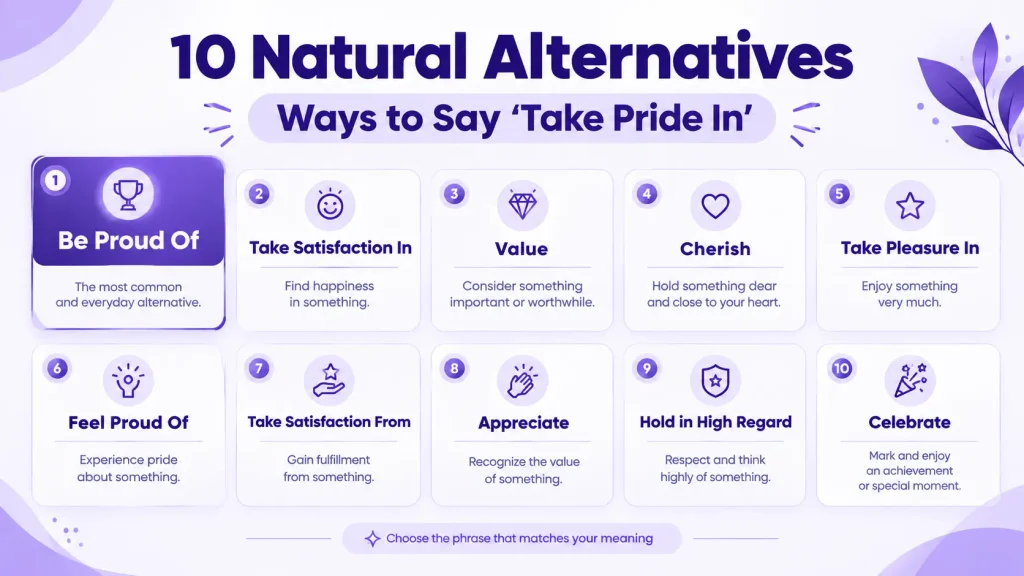
1. Be Proud Of
“Be proud of” is usually the closest and most natural alternative. It directly communicates a feeling of pride about an achievement, quality, person, or result.
Example:
You should be proud of the progress you’ve made.
Best for: Everyday conversations, professional writing, school, encouragement, and personal situations.
Why use it: It is simple, natural, and widely understood.
2. Take Satisfaction In
“Take satisfaction in” emphasizes the fulfillment someone receives from doing something well or achieving a desirable result.
Example:
She takes satisfaction in delivering high-quality work.
Best for: Professional writing, formal communication, and discussions about achievements.
Tone: Polished and slightly formal.
This phrase is especially useful when you want to emphasize the sense of accomplishment rather than simply stating that someone feels proud.
3. Value
“Value” means to consider something important, useful, or worthwhile. It can sometimes replace the original expression, but the meanings are not identical.
Example:
Our company values the quality of its customer service.
Best for: Business writing, professional communication, and general contexts.
Important: Use “value” when the focus is on importance or appreciation, not necessarily personal pride.
For example:
- I value my education. → Education is important to me.
- I am proud of my education. → I feel a sense of achievement about it.
4. Cherish
“Cherish” means to care about someone or something deeply and emotionally. It is warmer and more personal than the original expression.
Example:
She cherishes the traditions her family has passed down.
Best for: Family relationships, memories, traditions, meaningful experiences, and personal connections.
Tone: Warm and emotional.
It is usually not the best choice for ordinary professional achievements.
For example:
❌ I cherish my excellent spreadsheet.
✅ I take pride in my work.
5. Take Pleasure In
“Take pleasure in” means to enjoy or gain satisfaction from something.
Example:
He takes pleasure in helping new employees succeed.
Best for: Personal, professional, formal, and neutral contexts.
This expression focuses more on enjoyment than pride, so it works best when someone genuinely enjoys an activity or experience.
6. Feel Proud Of
“Feel proud of” is another straightforward way to communicate the same basic idea.
Example:
We feel proud of the work our team accomplished.
Best for: Personal, workplace, school, and celebratory situations.
The difference between “feel proud of” and “be proud of” is very small. In many sentences, they can be used interchangeably.
7. Take Satisfaction From
“Take satisfaction from” means to gain a feeling of fulfillment or accomplishment from something.
Example:
She takes satisfaction from knowing that her work helps others.
Best for: Reflective writing, professional communication, and formal contexts.
This expression is particularly useful when the source of satisfaction is an experience, result, or contribution.
8. Appreciate
“Appreciate” means to recognize and understand the value, quality, or importance of something.
Example:
We appreciate the effort our volunteers put into the project.
Best for: Professional communication, workplace situations, social interactions, and everyday English.
Although “appreciate” can sometimes replace the original expression, it does not necessarily communicate pride. It is more about recognizing value or effort.
For example:
- I appreciate your help. → I recognize and value your help.
- I am proud of your work. → I feel pride because of your work.
9. Hold in High Regard
“Hold in high regard” means to respect or admire someone or something greatly.
Example:
The community holds its longtime teachers in high regard.
Best for: Formal writing, professional communication, institutions, respected individuals, and public figures.
Important: This is not a direct replacement when you mean personal pride in your own achievement.
Compare:
- She takes pride in her accomplishments.
- Her colleagues hold her in high regard.
The first describes her own feeling. The second describes how other people view her.
10. Celebrate
“Celebrate” can work when the context involves openly recognizing an achievement, milestone, tradition, value, or success.
Example:
The organization celebrates its commitment to serving the community.
Best for: Achievements, milestones, traditions, organizational values, and public recognition.
However, “celebrate” usually suggests actively recognizing or highlighting something rather than simply experiencing an internal feeling of pride.
Quick Comparison of These Alternatives
| Alternative | Main Meaning | Tone | Best Context |
|---|---|---|---|
| Be proud of | Feel pride | Neutral | Everyday and professional |
| Take satisfaction in | Feel fulfilled | Formal | Work and achievements |
| Value | Consider important | Neutral | Business and general use |
| Cherish | Care deeply about | Warm | Family and memories |
| Take pleasure in | Enjoy | Neutral/Formal | Personal or professional |
| Feel proud of | Experience pride | Neutral | General use |
| Take satisfaction from | Gain fulfillment | Formal | Reflective writing |
| Appreciate | Recognize value | Neutral | General and professional |
| Hold in high regard | Respect highly | Formal | People and institutions |
| Celebrate | Recognize positively | Neutral | Achievements and milestones |
“Take Pride In” vs. “Be Proud Of”
These expressions are often interchangeable, but there is a slight difference in structure and emphasis.
Take pride in often emphasizes the satisfaction someone derives from something:
She takes pride in creating high-quality products.
Be proud of directly describes the feeling of pride:
She is proud of the high-quality products she creates.
For everyday American English, “be proud of” is usually the simplest and most natural replacement.
Image placement: A simple comparison infographic showing “take pride in” vs. “be proud of”, with two example sentences.
How to Choose the Right Alternative
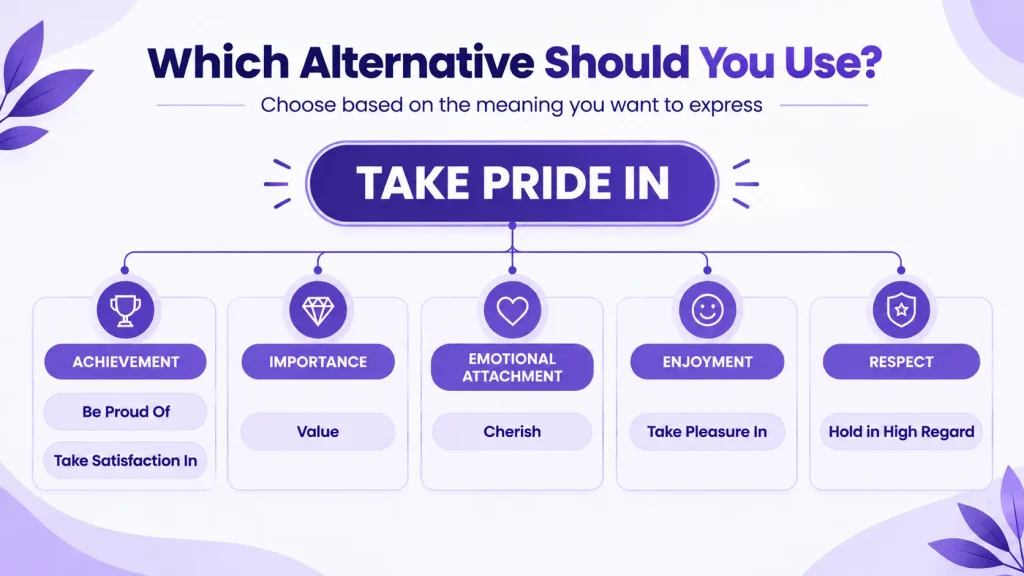
Choosing the right expression depends on the specific meaning you want.
For personal achievement
Use:
- be proud of
- feel proud of
- take satisfaction in
Example:
I am proud of everything I accomplished this year.
For professional quality
Use:
- take satisfaction in
- value
- take pride in
Example:
Our team takes satisfaction in delivering reliable results.
For emotional attachment
Use:
- cherish
- value
Example:
She cherishes the memories of her childhood.
For respect or admiration
Use:
- hold in high regard
Example:
The organization holds experienced mentors in high regard.
For enjoyment
Use:
- take pleasure in
Example:
He takes pleasure in teaching others.
For public recognition
Use:
- celebrate
Example:
The school celebrates its students’ achievements.
Image placement: Add a visual “Which phrase should you use?” decision guide here, with branches for achievement, emotion, respect, enjoyment, and recognition.
Common Mistakes to Avoid
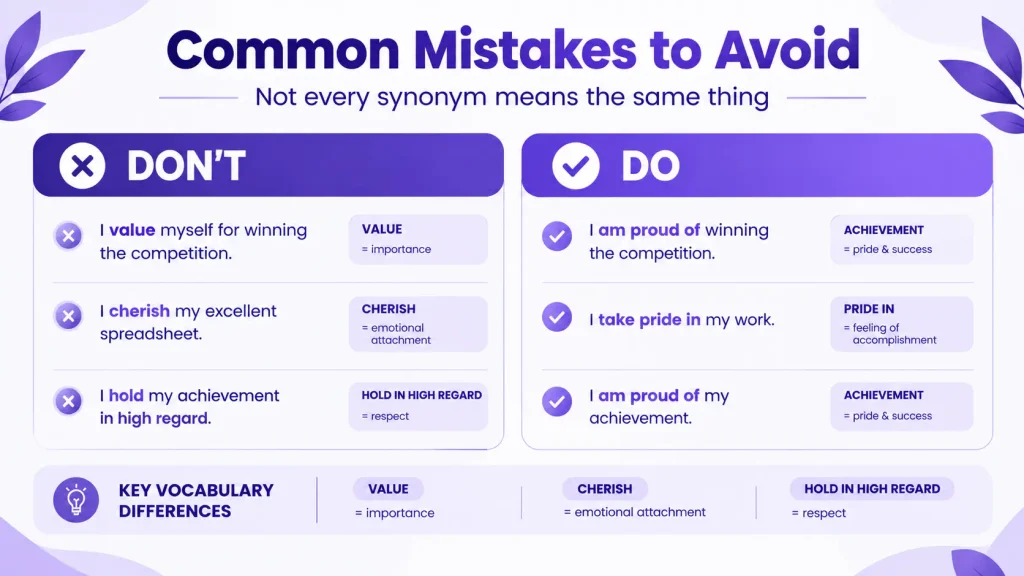
Using “value” when you mean personal pride
Unnatural:
I value myself for winning the competition.
If you mean that you feel proud of your achievement, a more natural sentence would be:
I am proud of winning the competition.
“Value” is better when you mean that something is important or worthwhile.
Using “cherish” for ordinary achievements
“Cherish” generally carries a strong emotional meaning. It works naturally with memories, relationships, traditions, and meaningful experiences.
Less natural:
I cherish my excellent spreadsheet.
More natural:
I take pride in my work.
Using “hold in high regard” for your own achievement
“Hold in high regard” normally describes respect or admiration for a person or thing.
Less appropriate:
I hold my own achievement in high regard.
Depending on the intended meaning, these may sound more natural:
I am proud of my achievement.
or
I take satisfaction in my accomplishment.
Assuming every synonym has exactly the same meaning
Many alternatives are near-synonyms rather than exact synonyms.
For example:
- Be proud of → feeling pride
- Value → recognizing importance
- Cherish → deep emotional attachment
- Appreciate → recognizing value or effort
- Hold in high regard → respecting or admiring
- Celebrate → publicly recognizing or honoring
Choosing the right expression makes your writing more precise and natural.
Examples in Different Situations
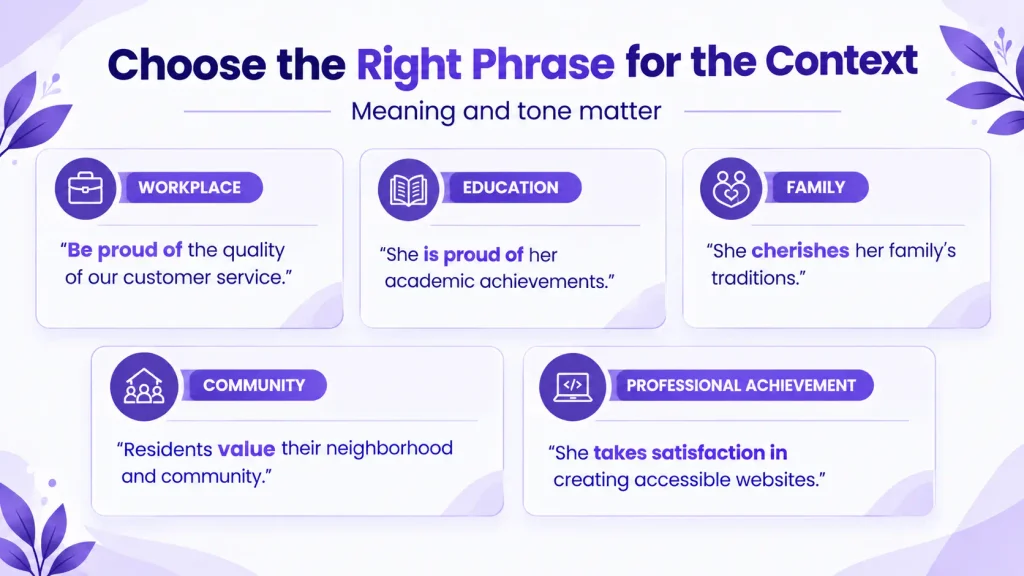
Here are some examples showing how the alternatives can work in different contexts.
Workplace
Original:
We take pride in providing excellent customer service.
Alternative:
We are proud of the quality of our customer service.
Education
Original:
She takes pride in her academic achievements.
Alternative:
She is proud of her academic achievements.
Family
Original:
He takes pride in his family’s traditions.
Alternative:
He cherishes his family’s traditions.
Community
Original:
Residents take pride in their neighborhood.
Alternative:
Residents value their neighborhood and community.
Professional achievement
Original:
The designer takes pride in creating accessible websites.
Alternative:
The designer takes satisfaction in creating accessible websites.
Image placement: Add a contextual examples infographic showing the phrase alternatives in workplace, education, family, community, and achievement settings.
Frequently Asked Questions
What is the closest synonym for “take pride in”?
“Be proud of” is generally the closest and most natural everyday alternative.
What is a formal way to say “take pride in”?
“Take satisfaction in” is a useful formal alternative, particularly when discussing work, accomplishments, or results.
What is another way to say “take pride in your work”?
You can say “be proud of your work,” “take satisfaction in your work,” or “value the quality of your work,” depending on the meaning you want.
Is “take pride in” positive or negative?
It is generally positive and describes feeling pleased or satisfied with something. However, the surrounding context can sometimes give the expression a negative or critical implication if someone is described as excessively proud.
Can I use “cherish” instead of “take pride in”?
Sometimes, but the two expressions are not exact synonyms. “Cherish” emphasizes deep emotional affection or attachment, while the other expression focuses more on satisfaction and pride.
Is “hold in high regard” the same as “take pride in”?
No. “Hold in high regard” means to respect or admire someone or something. “Take pride in” generally describes a person’s own feeling of pride or satisfaction.
What is the simplest alternative in everyday English?
“Be proud of” is usually the simplest choice.
Conclusion
If you need the most natural alternative to “take pride in,” use “be proud of.” It works in most everyday and professional situations.
For more specific meanings, choose “take satisfaction in” when you want to emphasize fulfillment, “value” when something is important, “cherish” when there is deep emotional attachment, “appreciate” when recognizing value or effort, and “hold in high regard” when expressing respect or admiration.
The key is to choose the phrase that matches the exact meaning and tone of your sentence rather than treating every synonym as completely interchangeable.

Role: English Content Writer
Maren Whitlock writes practical English language content for RepublicsPress, with a focus on vocabulary, word alternatives, everyday expressions, and clear communication. Her articles are designed to make difficult or confusing language easier to understand, with simple explanations and useful examples readers can apply in real situations.