Another Way to Say “Will Do” in Email
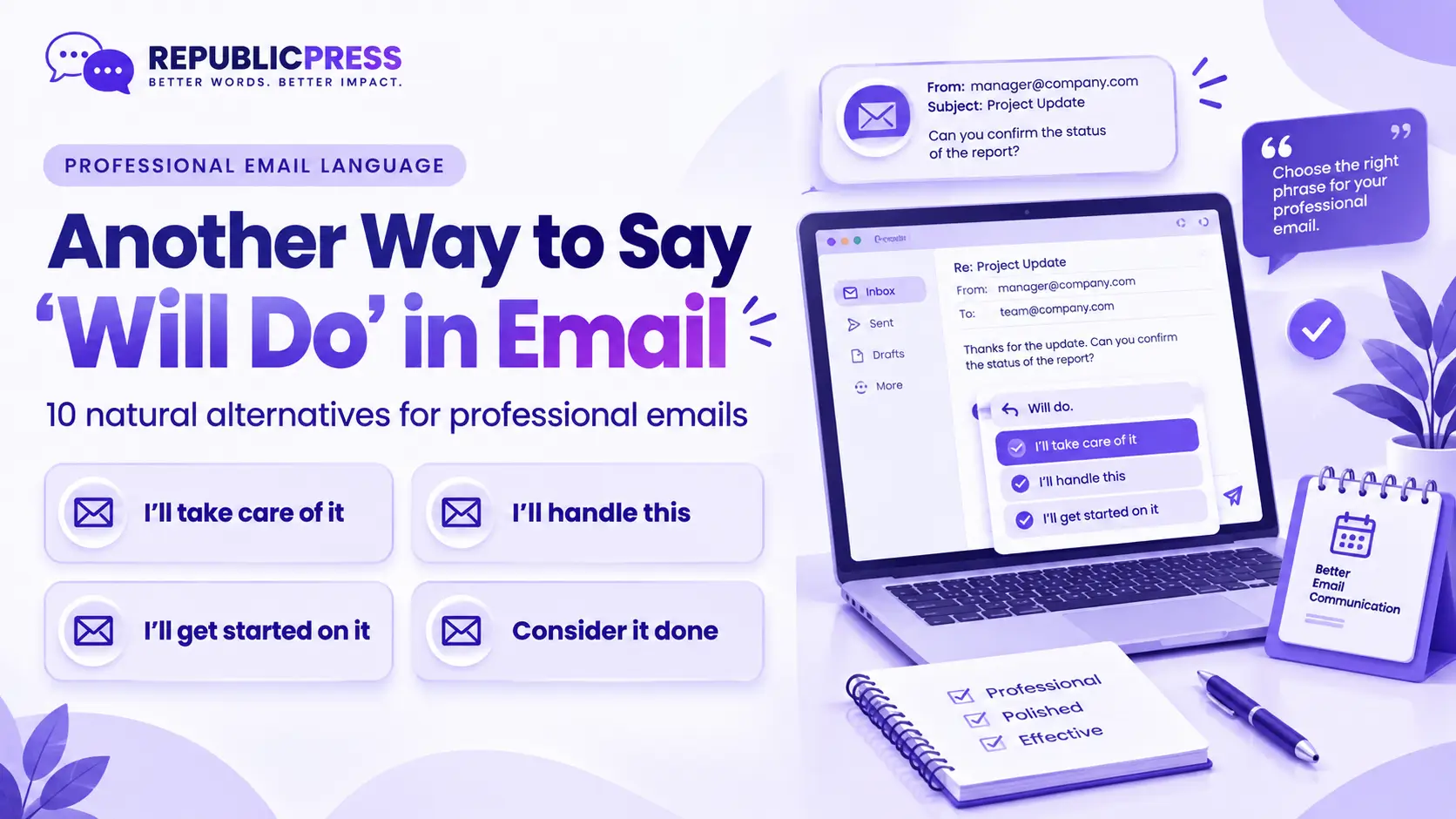
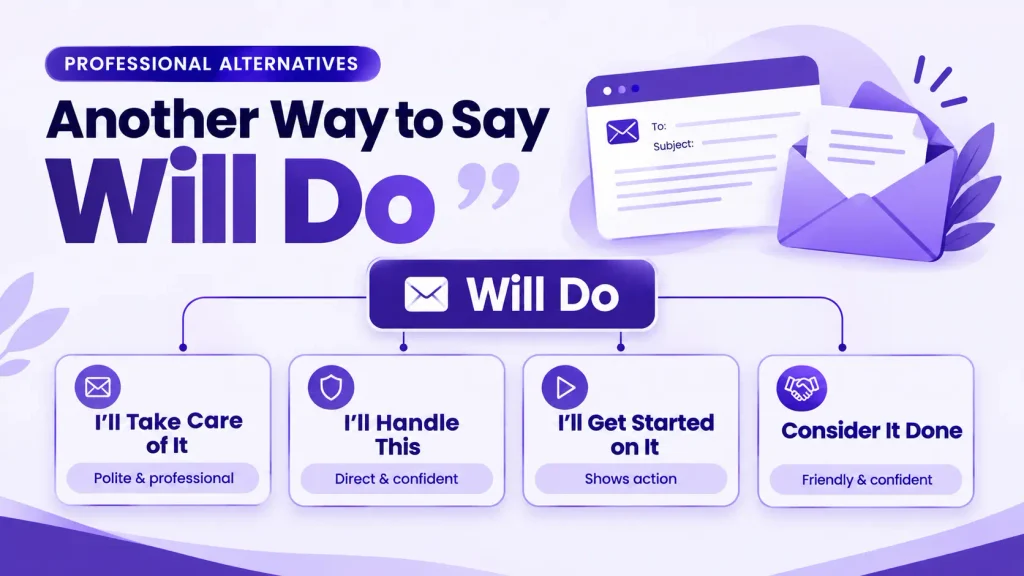
If you want another way to say “will do” in an email, you can use phrases such as “I’ll take care of it,” “I’ll handle this,” “I’ll get it done,” “I’ll take care of that,” or “Consider it done.” The best choice depends on how formal, professional, or friendly you want to sound.
Key Takeaways
- “Will do” is short, natural, and usually means “I’ll take care of it.”
- In professional emails, “I’ll take care of it” is a clear and polite alternative.
- “I’ll handle this” sounds confident and direct.
- “I’ll get started on this” works well when the task has not begun yet.
- “Consider it done” is confident but can sound more casual.
- For formal business communication, a complete sentence is often better than simply writing “Will do.”
What Does “Will Do” Mean in an Email?
In an email, “will do” is a brief way to confirm that you understand a request and intend to complete it.
For example:
Please update the product descriptions before Friday.
Will do.
Here, “will do” means “I’ll take care of that” or “I’ll complete the task.”
The phrase is common in workplace communication because it is quick and positive. However, depending on the situation, you may want a slightly more specific or polished response.
10 Professional Alternatives to “Will Do” in an Email
1. I’ll Take Care of It
Best for: Professional, polite, and neutral emails
“I’ll take care of it” is one of the most natural alternatives to “will do.” It clearly shows that you have accepted responsibility for the task.
Example:
Thanks for sending this over. I’ll take care of it and send you an update tomorrow.
This works well with clients, coworkers, managers, and other professional contacts.
2. I’ll Handle This
Best for: Direct and confident communication
“I’ll handle this” tells the recipient that you will take responsibility for the matter.
Example:
Thanks for flagging the issue. I’ll handle this and let you know once it’s resolved.
It sounds confident without being overly formal.
3. I’ll Get It Done
Best for: Confident, friendly workplace communication
“I’ll get it done” emphasizes completion. It is useful when someone has assigned you a task and you want to reassure them that you will finish it.
Example:
I’ll get it done by the end of the day and send you the final version.
This is more conversational than “I’ll take care of it,” so it may not be the best choice for very formal correspondence.
4. I’ll Take Care of That
Best for: Polite and natural responses
This is nearly identical to “I’ll take care of it,” but “that” can sound especially natural when referring to a specific request mentioned in the previous email.
Example:
Could you update the invoice and resend it?
Absolutely. I’ll take care of that.
It is professional without sounding stiff.
5. I’ll Get Started on It
Best for: Tasks you are about to begin
Use this when you want to communicate that you have received the request and are ready to start working on it.
Example:
Thanks for the details. I’ll get started on it this afternoon.
Unlike “I’ll get it done,” this phrase does not promise immediate completion.
6. I’ll Take a Look
Best for: Reviewing documents, issues, or requests
“I’ll take a look” is useful when someone asks you to review something rather than complete a specific task.
Example:
Thanks for sending the updated design. I’ll take a look and share my feedback shortly.
Keep in mind that this phrase means you will review something; it does not necessarily promise that you will make changes.
7. I’ll Handle It Accordingly
Best for: More formal professional communication
“I’ll handle it accordingly” can work in formal workplace situations when the recipient has provided instructions.
Example:
Thank you for the clarification. I’ll handle the request accordingly.
This is more formal than everyday alternatives, so it can sound unnecessarily stiff in a casual team conversation.
8. I’ll Make Sure It’s Done
Best for: Reassuring someone about completion
This phrase emphasizes that you will ensure the requested task is completed.
Example:
I’ll make sure it’s done before the client meeting.
It is useful when timing or completion is especially important.
9. Consider It Done
Best for: Friendly, confident communication
“Consider it done” is a confident way to say that you will take care of something.
Example:
Could you send the revised proposal before noon?
Consider it done.
It is natural in workplace communication, but it is somewhat more casual and expressive than “I’ll take care of it.”
10. I’ll See to It
Best for: Formal or polished communication
“I’ll see to it” means that you will take responsibility for making sure something is handled.
Example:
Thank you for bringing this to my attention. I’ll see to it that the issue is addressed.
This phrase is grammatically correct and professional, although it can sound more formal or old-fashioned than “I’ll take care of it.”
Quick Comparison: Which Alternative Should You Use?
| Alternative | Tone | Best Context |
| I’ll take care of it | Professional, polite | Most workplace emails |
| I’ll handle this | Direct, confident | Tasks and problems |
| I’ll get it done | Friendly, confident | Informal workplace emails |
| I’ll take care of that | Polite, natural | Responding to a specific request |
| I’ll get started on it | Professional, proactive | Starting a new task |
| I’ll take a look | Neutral | Reviews and feedback |
| I’ll handle it accordingly | Formal | More formal business communication |
| I’ll make sure it’s done | Reassuring | Deadlines and completion |
| Consider it done | Friendly, confident | Casual professional communication |
| I’ll see to it | Formal | Polished or formal correspondence |
Which Is the Most Professional Alternative to “Will Do”?
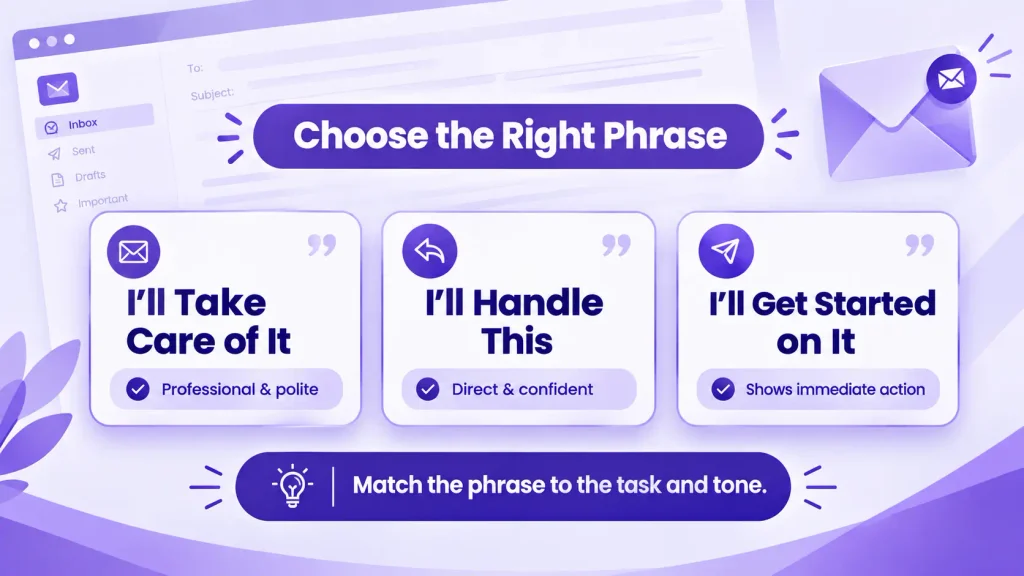
For most professional emails, “I’ll take care of it” is a strong choice because it is clear, polite, and natural.
For example:
Thanks for letting me know. I’ll take care of it and follow up once it’s complete.
If you want to sound more direct:
I’ll handle this and keep you updated.
If you want to emphasize that you are starting the task:
I’ll get started on this today.
The right choice depends on what you actually want to communicate rather than simply replacing “will do” word-for-word.
“Will Do” vs. “I’ll Take Care of It”
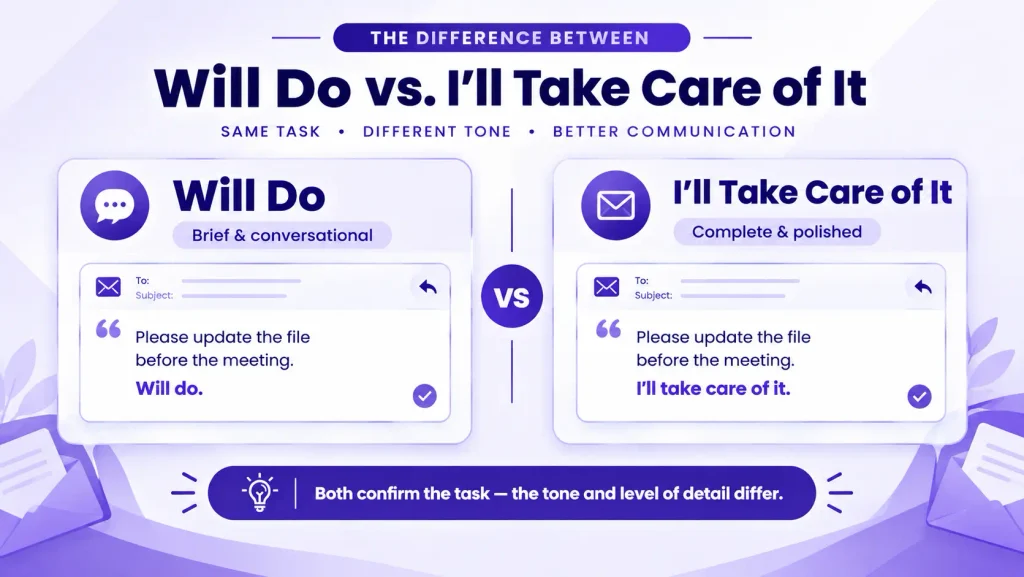
Both expressions confirm that you accept a request, but their tone is slightly different.
“Will do” is brief and conversational:
Please update the file before the meeting.
Will do.
“I’ll take care of it” is more complete and polished:
Please update the file before the meeting.
I’ll take care of it.
For quick internal messages, “will do” is perfectly natural. For client-facing emails or formal workplace communication, a complete response can sound more professional.
How to Say “Will Do” to a Client
When responding to a client, it is often helpful to confirm both the task and, when relevant, the expected timing.
Instead of:
Will do.
You could write:
I’ll take care of it and send you an update once it’s complete.
Or:
Absolutely. I’ll make the requested changes and send over the revised version today.
This gives the client more information and makes your response feel less abrupt.
How to Say “Will Do” to Your Boss or Manager
When responding to a manager, your wording can be concise while still showing that you understand the request.
For example:
I’ll take care of it.
Or:
Understood. I’ll get started on this today.
If there is a deadline:
Understood. I’ll have it ready by Thursday.
A specific response is especially useful when the task has a clear deadline or deliverable.
How to Say “Will Do” When You Need More Information
Sometimes “will do” is not appropriate because you cannot begin the task until you have additional information.
Instead, acknowledge the request and explain what you need:
I can take care of that. Could you please send me the latest version of the file?
Or:
Understood. I’ll get started once I have the updated specifications.
This avoids giving the impression that you can complete something immediately when you are still waiting for information.
Common Mistakes When Using “Will Do”
Using It for Every Professional Email
“Will do” is useful, but repeating it in every email can make your replies feel overly brief.
Instead, vary your response based on the situation:
- I’ll take care of it.
- I’ll get started on this.
- I’ll review it and follow up.
- I’ll handle this today.
Using “Consider It Done” in a Very Formal Situation
“Consider it done” is friendly and confident, but it can sound casual. For a formal client or executive email, “I’ll take care of it” may fit better.
Promising Something You Cannot Guarantee
Avoid phrases such as “I’ll have it done today” unless you are confident you can meet that deadline.
A safer response may be:
I’ll get started on it today and keep you updated.
Saying “I’ll Take a Look” When You Mean You Will Fix Something
“I’ll take a look” generally means “I’ll review or examine it.” It does not necessarily mean you will make the requested changes.
If you intend to fix the issue, say:
I’ll review the issue and make the necessary changes.
Frequently Asked Questions
Is “Will do” professional in an email?
Yes. “Will do” is grammatically acceptable and commonly used in professional communication, especially in short internal emails or messages. It has a conversational tone, so a more complete phrase may be preferable in formal or client-facing correspondence.
What is the most polite way to say “will do”?
“I’ll take care of it” is a polite and natural option. You can make it warmer by saying, “Absolutely, I’ll take care of it.”
Is “I’ll take care of it” better than “will do”?
Neither is universally better. “Will do” is shorter and more casual, while “I’ll take care of it” is more explicit and polished. Choose based on the recipient, relationship, and formality of the email.
Can I say “consider it done” in a work email?
Yes, especially in friendly workplace communication. It communicates confidence, but it is more casual than “I’ll take care of it,” so it may not suit every formal business situation.
How do I say “will do” professionally to a client?
You can say:
I’ll take care of it and follow up once it’s complete.
For a more specific response:
Absolutely. I’ll make the requested updates and send you the revised version by tomorrow.
What can I say instead of “will do” when I need to review something?
Use “I’ll take a look,” “I’ll review it,” or “I’ll look into this.” These phrases are appropriate when you need to examine something before deciding what action to take.
Is “I’ll handle this” too informal for an email?
No. “I’ll handle this” is a natural professional expression. It is direct and confident, making it suitable for many workplace emails.
Final Thoughts
“Will do” is a perfectly natural way to confirm that you will complete a request, but you have several alternatives when you want to sound more specific or polished. “I’ll take care of it” is a reliable choice for most professional emails, while “I’ll handle this,” “I’ll get started on it,” and “I’ll make sure it’s done” can communicate slightly different intentions.
Choose the phrase based on what you actually mean: accepting responsibility, starting a task, reviewing something, or promising completion

Role: Language Editor
Caleb Mercer is a Language Editor at RepublicsPress, focusing on grammar, sentence structure, professional writing, and English usage. He helps ensure that language guides are clear, accurate, natural, and easy to follow.