
Another Way to Say Checking In With You: 10 Natural Alternatives
If you need another way to say “checking in with you,” you have several natural options. You can say “touching base with you,” “following up with you,” “reaching out to you,” or “seeing how you’re doing.”
The best choice depends on your purpose. Some phrases work better at work, while others sound more natural in friendly or personal conversations.
What Does “Checking In With You” Mean?
“Checking in with you” usually means contacting someone to see how they are doing or to ask for an update.
The phrase can have a personal or professional meaning.
For example:
“I wanted to check in with you and see how you’re doing.”
Here, the speaker is asking about the person’s well-being.
In a work setting, you might say:
“I wanted to check in with you about the project.”
Here, the speaker wants an update.
So, the best alternative depends on what you want to say.
10 Alternatives to “Checking In With You”
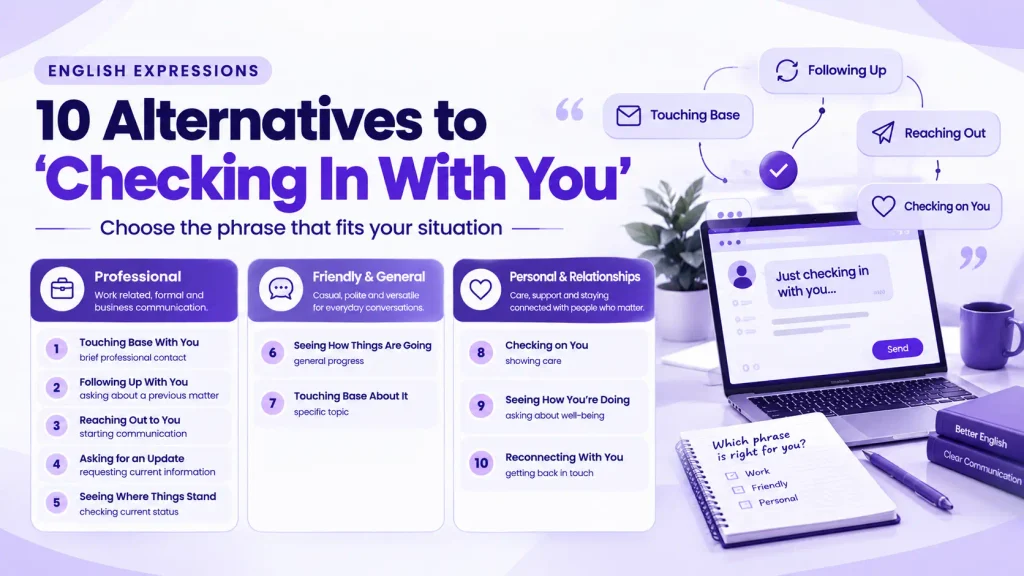
1. Touching Base With You
“Touching base with you” is a common professional alternative. It means contacting someone to discuss something or get a quick update.
It works well in emails and workplace conversations.
Example:
“I wanted to touch base with you about the project.”
Use this phrase when you want to keep communication open without sounding too formal.
2. Following Up With You
“Following up with you” is useful when you are waiting for an answer or update.
It usually refers to something you discussed or requested earlier.
Example:
“I’m following up with you about the proposal we discussed.”
This phrase is especially useful in professional emails.
It sounds clear and direct without being rude.
3. Reaching Out to You
“Reaching out to you” simply means contacting someone.
It is useful when you are starting a conversation or getting back in touch.
Example:
“I’m reaching out to you to discuss the next steps.”
This phrase works well in professional communication.
It can also be used in friendly conversations.
4. Checking on You
“Checking on you” has a more personal tone.
It often means making sure someone is okay.
Example:
“I just wanted to check on you and make sure everything is okay.”
This phrase works well with friends, family members, and people you know well.
It can also show concern when someone has been going through a difficult situation.
5. Seeing How Things Are Going
“Seeing how things are going” is a friendly and natural alternative.
It works when you want a general update.
Example:
“I wanted to reach out and see how things are going.”
You can use it at work or in casual conversations.
It does not sound too formal or too personal.
6. Seeing How You’re Doing
Use “seeing how you’re doing” when you want to ask about a person’s well-being.
It sounds warm and friendly.
Example:
“I just wanted to see how you’re doing.”
This is a good choice when talking to a friend or someone who may need support.
It focuses more on the person than on a task or project.
7. Asking for an Update
“Asking for an update” is a direct alternative when you want new information.
It works best when you are talking about a project, task, application, or request.
Example:
“I’m reaching out to ask for an update on the project.”
This phrase is more specific than “checking in.”
It tells the reader exactly why you are contacting them.
8. Touching Base About It
“Touching base about it” works when you want to discuss a specific topic.
It is common in workplace communication.
Example:
“I wanted to touch base about the changes we discussed.”
This phrase keeps the focus on the topic.
It is a good option when you do not need a long conversation.
9. Reconnecting With You
“Reconnecting with you” means getting back in touch after some time.
It is useful when you have not spoken to someone recently.
Example:
“It was great reconnecting with you after so long.”
This phrase works well with old friends, former coworkers, and professional contacts.
It is not an exact replacement for “checking in,” but it works when the main goal is to restart communication.
10. Seeing Where Things Stand
“Seeing where things stand” means checking the current status of something.
It works well in professional situations.
Example:
“I wanted to see where things stand with the contract.”
This phrase is useful when you need to know what has happened and what comes next.
It sounds more specific than a general “checking in.”
Professional Alternatives to “Checking In With You”
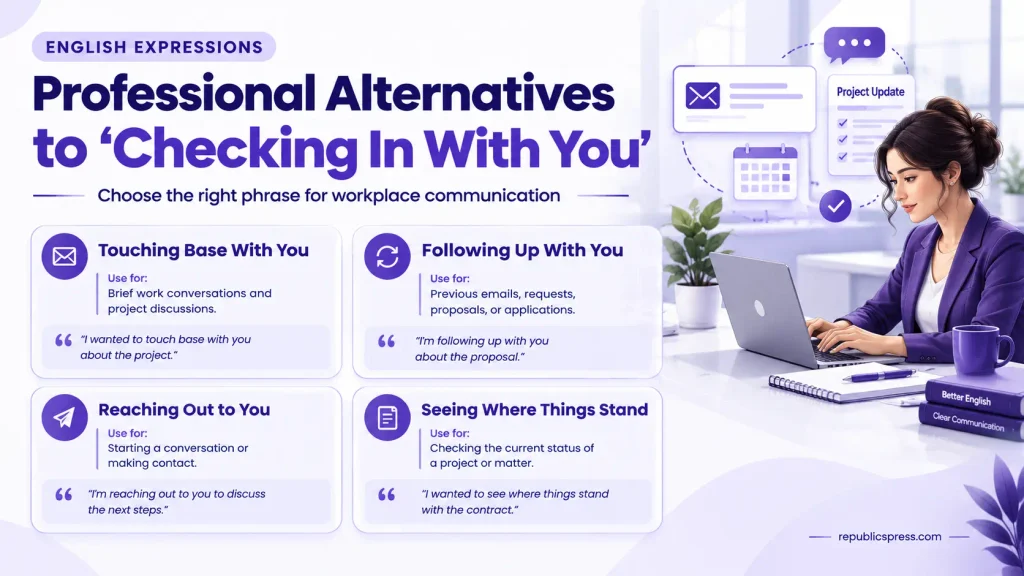
Some alternatives work especially well in professional communication.
For example, you can say:
“I wanted to touch base with you about the project.”
You can also write:
“I’m following up with you regarding the proposal.”
If you want to ask about progress, try:
“I wanted to see where things stand with the project.”
For a general work conversation, you could say:
“I’m reaching out to see how things are going.”
These phrases sound professional without being overly formal.
Friendly Alternatives to “Checking In With You”
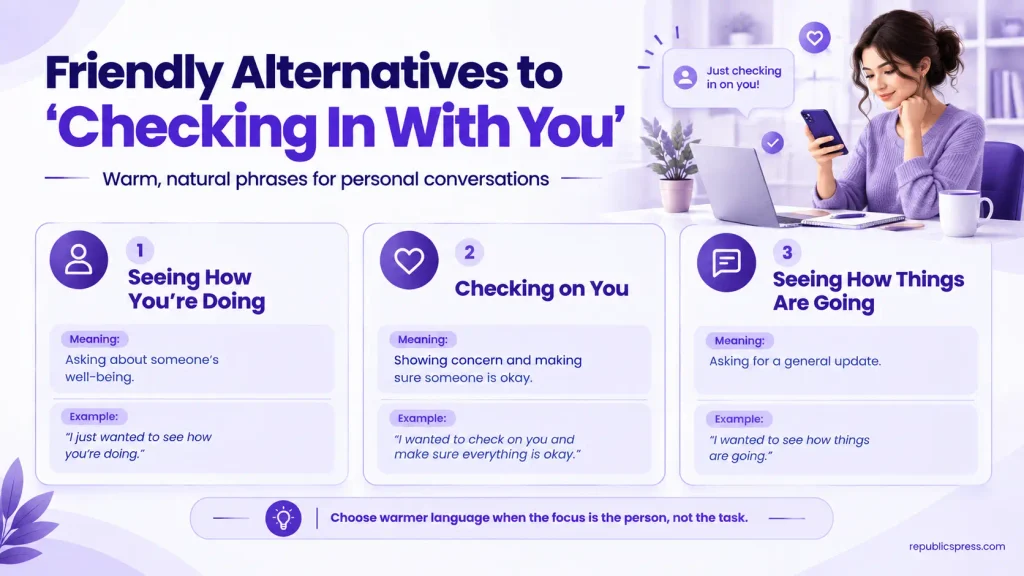
A personal conversation usually needs warmer language.
You could say:
“I just wanted to see how you’re doing.”
Another option is:
“I wanted to check on you.”
You can also say:
“I wanted to see how things are going.”
These phrases sound more natural with friends and family.
For example:
“Hey, I just wanted to check on you and see how you’re doing.”
This sounds caring and genuine.
Best Alternative Based on Context
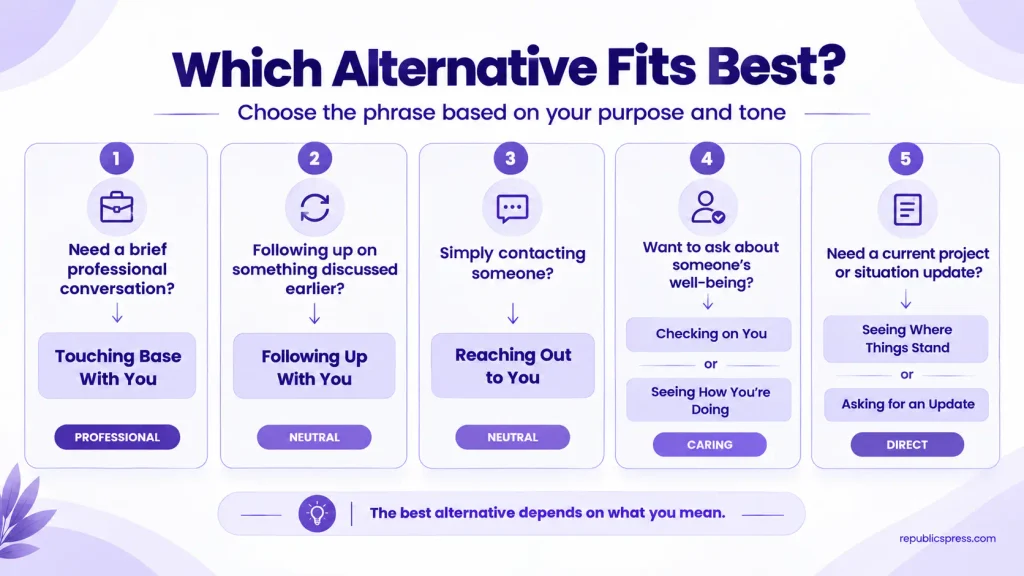
The right phrase depends on your reason for contacting someone.
| Alternative | Main Meaning | Tone | Best Context |
| Touching base with you | Starting a brief conversation | Professional | Workplace |
| Following up with you | Asking about a previous matter | Professional | Emails and requests |
| Reaching out to you | Contacting someone | Neutral | Work or personal |
| Checking on you | Making sure someone is okay | Caring | Personal conversations |
| Seeing how things are going | Asking for a general update | Friendly | Work or casual |
| Seeing how you’re doing | Asking about someone’s well-being | Warm | Personal |
| Asking for an update | Requesting new information | Direct | Projects and tasks |
| Touching base about it | Discussing a specific topic | Professional | Workplace |
| Reconnecting with you | Getting back in touch | Friendly | Old contacts |
| Seeing where things stand | Checking the current status | Direct | Work and projects |
“Checking In” vs. “Following Up”
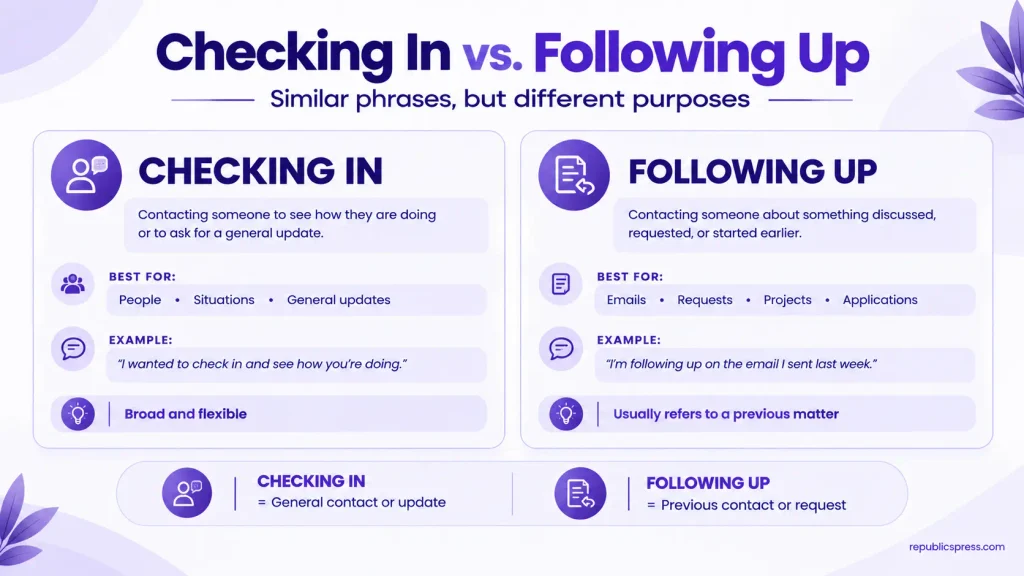
These phrases are similar, but they are not always interchangeable.
“Checking in” has a broad meaning.
You can use it to ask about a person or a situation.
“I wanted to check in and see how you’re doing.”
“Following up” usually refers to something that happened earlier.
For example:
“I’m following up on the email I sent last week.”
Use “following up” when there is a previous request, message, or conversation.
Use “checking in” when you simply want to see how someone or something is doing.
“Checking In” vs. “Touching Base”
These phrases are also very similar.
“Checking in” can sound personal or professional.
“I wanted to check in and see how the team is doing.”
“Touching base” is more common in professional settings.
“I wanted to touch base about tomorrow’s meeting.”
If you are writing a work email, “touching base” can be a natural choice.
If you are talking to a friend, “checking in” usually sounds more natural.
How to Say “Checking In” in an Email
The best wording depends on why you are sending the email.
If you need an update, you could write:
“I’m following up to see if you have any updates.”
If you want to discuss a project, try:
“I wanted to touch base about the project.”
If you want a general update, you can say:
“I wanted to reach out and see how things are going.”
If you are writing to someone you know well, you can make it warmer:
“I just wanted to see how you’re doing.”
Each option gives the email a slightly different tone.
Common Mistakes to Avoid
Using “Following Up” Without a Previous Matter
“Following up” usually refers to something that happened before.
For example:
“I’m following up on the application I submitted.”
This makes sense because there was a previous action.
If you are contacting someone for the first time, “reaching out” may be better.
Using Too Much Formal Language With Friends
Some professional phrases can sound unnatural in personal conversations.
For example:
“I’m following up with you to see how you’re feeling.”
This sounds more like a business email.
A friend would more naturally say:
“I just wanted to see how you’re doing.”
Choose language that fits the relationship.
Treating Every Alternative as an Exact Synonym
Not every alternative has exactly the same meaning.
“Checking on you” suggests concern.
“Following up with you” suggests a previous matter.
“Reconnecting with you” suggests that you have not spoken for some time.
These differences matter.
Frequently Asked Questions
What is a professional way to say “checking in with you”?
“Touching base with you” and “following up with you” are good professional options. Use “touching base” for a general conversation and “following up” when you need an update.
What is a friendly way to say “checking in with you”?
You can say “I wanted to see how you’re doing” or “I just wanted to check on you.” Both sound warm and natural.
Is “touching base” the same as “checking in”?
They have similar meanings, but “touching base” is more common in professional communication. “Checking in” works in both personal and professional situations.
Is “following up” the same as “checking in”?
Not exactly. “Following up” usually relates to an earlier message, request, or conversation. “Checking in” has a broader meaning.
Is “reaching out” a good alternative to “checking in”?
Yes. “Reaching out” means contacting someone, but it does not always mean you want an update. It is a broader expression.
What is a caring way to say “checking in”?
“I wanted to see how you’re doing” is one of the most natural choices. You can also say, “I just wanted to check on you and make sure you’re okay.”
What is the best alternative for a work email?
It depends on your purpose. “Following up” works well for a previous request. “Touching base” works well for a general work conversation.
Final Thoughts
There are many natural ways to say “checking in with you.”
For professional communication, “touching base” and “following up” are strong choices.
For personal conversations, “checking on you” and “seeing how you’re doing” sound more natural.
If you simply want to contact someone, “reaching out” is a flexible option.
The key is to choose a phrase that matches your purpose. That small change can make your message sound clearer, warmer, and more natural.

Role: Editorial Contributor
Graham Ellis contributes practical English and communication guides to RepublicsPress. His content focuses on vocabulary, writing techniques, word usage, and clear communication, with an emphasis on straightforward explanations and real-world examples.