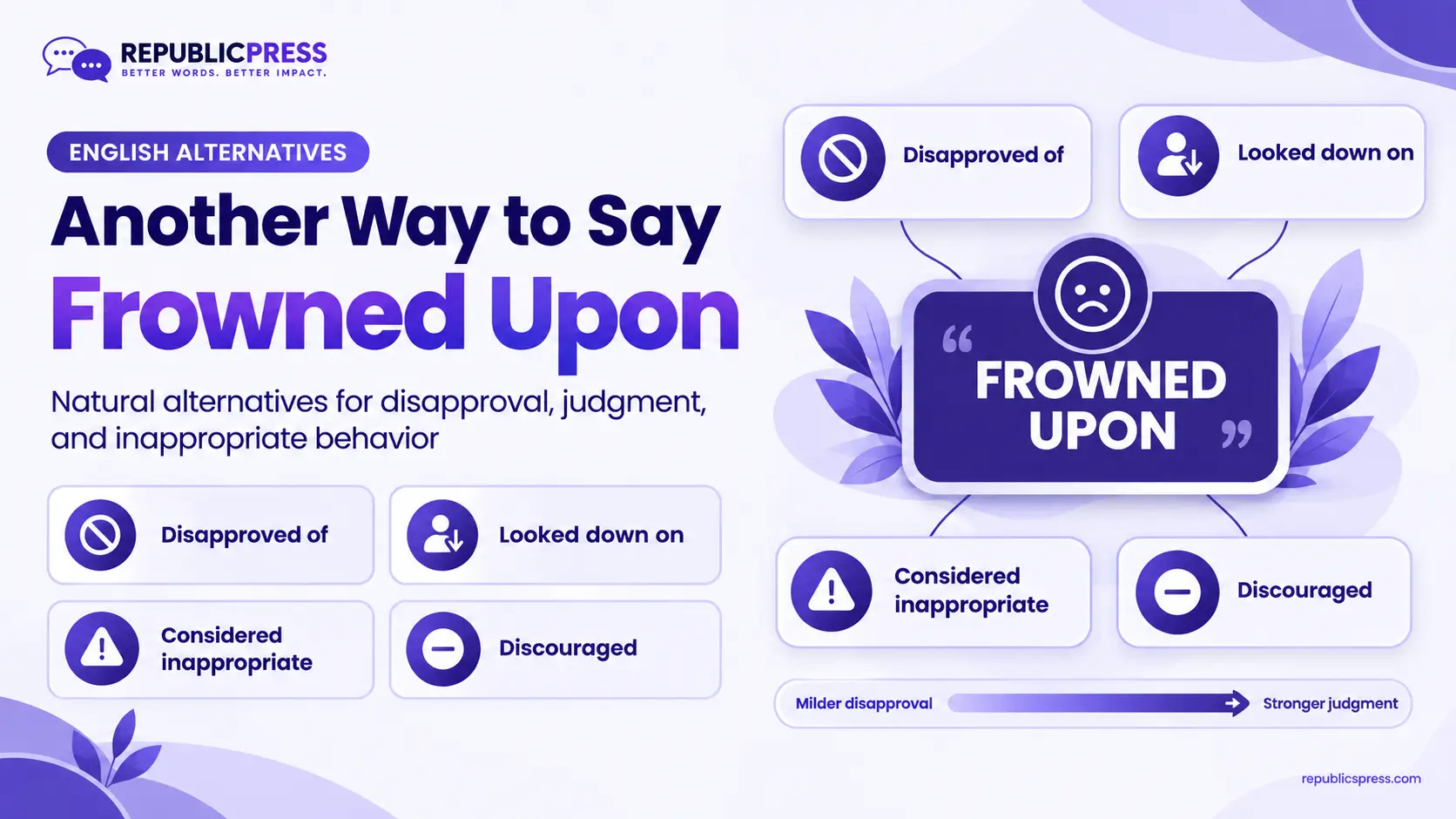
Another Way to Say Frowned Upon: 12 Polite & Professional Alternatives
Another way to say “frowned upon” is “disapproved of,” “looked down on,” “considered inappropriate,” “viewed negatively,” or “regarded as unacceptable.” The best replacement depends on context and tone. “Disapproved of” is the closest general alternative, while “looked down on” suggests social judgment and “deemed unacceptable” sounds more formal.
Key Takeaways
- “Frowned upon” means something is viewed with disapproval or considered undesirable.
- “Disapproved of” is usually the closest direct replacement.
- “Looked down on” adds a sense of negative social judgment.
- “Considered inappropriate” works well when discussing behavior, language, or conduct.
- “Discouraged” is useful when an action is not necessarily forbidden but people are advised against it.
- For formal writing, phrases such as “regarded as unacceptable” or “deemed inappropriate” can sound more precise.
What Does “Frowned Upon” Mean?
“Frowned upon” means that something is viewed negatively, discouraged, or regarded with disapproval by a person, group, workplace, community, or society.
For example:
Smoking is frowned upon in many public places.
This means that smoking is generally viewed negatively or is considered inappropriate in those settings.
The phrase is usually figurative, not literal. It does not normally mean that someone physically frowned. Instead, it describes an attitude of disapproval.
The expression can apply to many situations, including:
- Social behavior
- Workplace conduct
- School rules
- Cultural expectations
- Personal habits
- Professional etiquette
- Public behavior
Best Alternatives to “Frowned Upon”
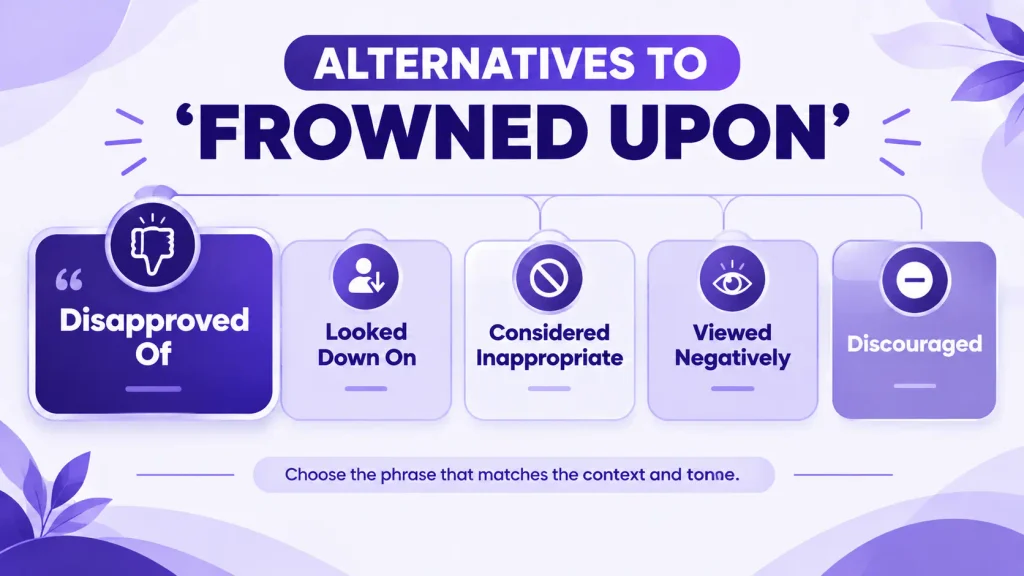
1. Disapproved Of
“Disapproved of” is the closest general alternative to “frowned upon.” It clearly communicates that someone or a group does not approve of an action, behavior, or idea.
Example:
Excessive use of personal devices during meetings is disapproved of by some employers.
Best for: General, neutral writing and everyday communication.
2. Looked Down On
“Looked down on” means regarded as inferior, undesirable, or socially unacceptable. It is often stronger and more personal than “frowned upon.”
Example:
Taking credit for someone else’s work is often looked down on by colleagues.
Best for: Social situations and discussions of judgment or status.
Usage tip: Use this phrase when the negative attitude toward someone or something involves a sense of disrespect or superiority.
3. Considered Inappropriate
This phrase works particularly well when the behavior does not fit the situation, setting, or expected standards.
Example:
Wearing casual clothes to a formal interview may be considered inappropriate.
Best for: Workplace, academic, social, and formal contexts.
4. Viewed Negatively
“Viewed negatively” is a neutral way to describe something that receives an unfavorable reaction.
Example:
Arriving late without notifying your manager may be viewed negatively.
Best for: Professional, academic, and analytical writing.
It is less judgmental than “looked down on,” making it useful when you want a neutral tone.
5. Regarded as Unacceptable
This phrase indicates that a behavior or practice is considered outside an accepted standard.
Example:
Harassment is regarded as unacceptable in the workplace.
Best for: Formal, professional, policy, and institutional writing.
Usage tip: This can sound stronger than “frowned upon,” because “unacceptable” suggests that the behavior crosses a clear standard.
6. Deemed Inappropriate
“Deemed inappropriate” is a concise and formal alternative.
Example:
The comments were deemed inappropriate for a professional setting.
Best for: Formal documents, workplace communication, policies, and official writing.
This expression is more formal than everyday alternatives such as “looked down on.”
7. Discouraged
“Discouraged” means that people are advised or expected not to do something. It can be a good replacement when “frowned upon” refers to behavior that is not necessarily prohibited.
Example:
Employees are discouraged from using personal phones during client meetings.
Best for: Workplace rules, instructions, policies, and guidance.
Important distinction: “Discouraged” focuses on advice or prevention, while “frowned upon” focuses more on social or organizational disapproval.
8. Not Approved Of
This is a straightforward and conversational alternative to “frowned upon.”
Example:
The practice is not approved of by many members of the community.
Best for: Simple explanations and general communication.
Because it is somewhat wordier than “disapproved of,” it is usually not the first choice in polished writing.
9. Regarded Unfavorably
“Regarded unfavorably” communicates that something is viewed in a negative or unfavorable way.
Example:
Frequent unexplained absences may be regarded unfavorably by an employer.
Best for: Professional and formal writing.
It has a more detached tone than “looked down on.”
10. Considered Unacceptable
This phrase clearly communicates strong disapproval.
Example:
Sharing confidential client information is considered unacceptable.
Best for: Workplace policies, professional communication, rules, and formal explanations.
Usage tip: Because “unacceptable” is strong, do not use it when the original situation only involves mild social disapproval.
11. Condemned
“Condemned” means strongly criticized or publicly expressed as wrong or unacceptable.
Example:
The organization condemned the use of discriminatory language.
Best for: Strong criticism, public statements, serious misconduct, and formal reporting.
Important distinction: “Condemned” is substantially stronger than “frowned upon,” so it should not be used as a direct replacement in every sentence.
12. Disparaged
“Disparaged” means spoken about or treated as though it were inferior or unworthy.
Example:
The profession was once disparaged by some people as impractical.
Best for: Formal writing and situations involving criticism or belittling.
This is not an exact synonym for “frowned upon,” but it can work when the intended meaning involves treating something negatively or dismissively.
Quick Comparison
| Alternative | Meaning/Use | Tone | Best Context |
| Disapproved of | Not approved or accepted | Neutral | General |
| Looked down on | Judged as inferior or undesirable | Conversational | Social |
| Considered inappropriate | Not suitable for the situation | Neutral | Professional/social |
| Viewed negatively | Seen in an unfavorable way | Neutral | General/formal |
| Regarded as unacceptable | Outside accepted standards | Strong/formal | Policies/work |
| Deemed inappropriate | Officially or formally considered unsuitable | Formal | Professional |
| Discouraged | Advised against | Neutral | Rules/guidance |
| Regarded unfavorably | Viewed in an unfavorable manner | Formal | Professional |
| Considered unacceptable | Clearly not acceptable | Strong | Workplace/policies |
| Condemned | Strongly criticized | Very strong | Serious issues |
| Disparaged | Belittled or spoken of negatively | Formal | Critical writing |
How to Choose the Right Alternative
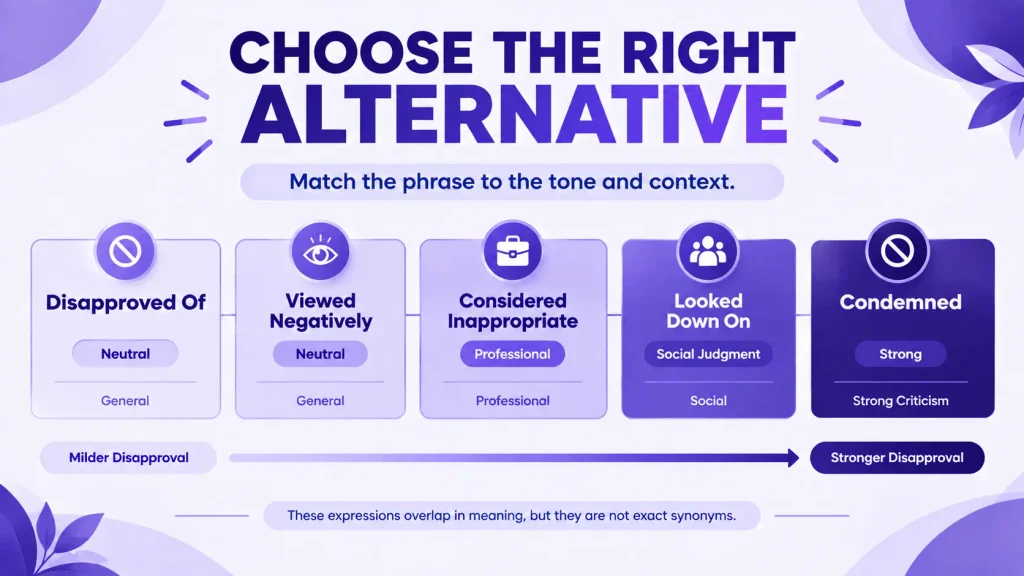
The best replacement depends on how strong the disapproval is and where you are using the phrase.
For a neutral alternative
Use “disapproved of” or “viewed negatively.”
The behavior was disapproved of by the community.
The decision was viewed negatively by some employees.
For social judgment
Use “looked down on.”
Talking loudly in a library is generally looked down on.
This emphasizes how other people judge the behavior.
For professional communication
Use “considered inappropriate,” “discouraged,” or “regarded unfavorably.”
Employees are discouraged from discussing confidential information in public.
These options sound more natural in workplace communication than some strongly judgmental expressions.
For formal writing
Use “deemed inappropriate” or “regarded as unacceptable.”
The conduct was deemed inappropriate under the organization’s guidelines.
These phrases work particularly well in formal reports and policies.
For strong criticism
Use “condemned.”
The organization condemned the discriminatory remarks.
This should be reserved for situations involving strong criticism rather than mild disapproval.
“Frowned Upon” vs. “Looked Down On”
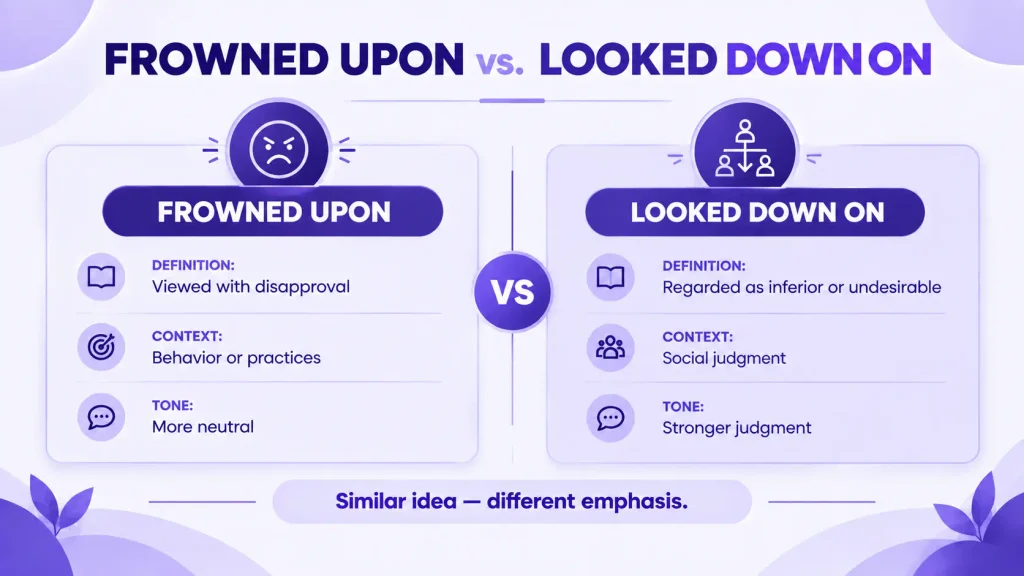
These expressions are similar, but they are not identical.
“Frowned upon” generally means that a behavior or practice is disapproved of or discouraged.
Working during a vacation may be frowned upon by some employees.
“Looked down on” often suggests that people regard the behavior or person as inferior or less respectable.
Some people look down on workers who change careers frequently.
So, “frowned upon” is usually more neutral, while “looked down on” can carry a stronger sense of social judgment.
“Frowned Upon” vs. “Discouraged”
These phrases can overlap, but the emphasis is different.
Frowned upon focuses on disapproval:
Bringing personal problems into every meeting is frowned upon.
Discouraged focuses on advising people not to do something:
Employees are discouraged from discussing confidential matters outside the office.
A company policy might explicitly discourage an action, while a social group may simply frown upon it.
“Frowned Upon” vs. “Condemned”
These two expressions differ significantly in strength.
Frowned upon usually describes mild or moderate disapproval:
Arriving late to a casual gathering may be frowned upon.
Condemned expresses much stronger criticism:
The organization condemned the violent behavior.
Using “condemned” where “frowned upon” is intended can make the statement sound unnecessarily severe.
Common Mistakes When Replacing “Frowned Upon”
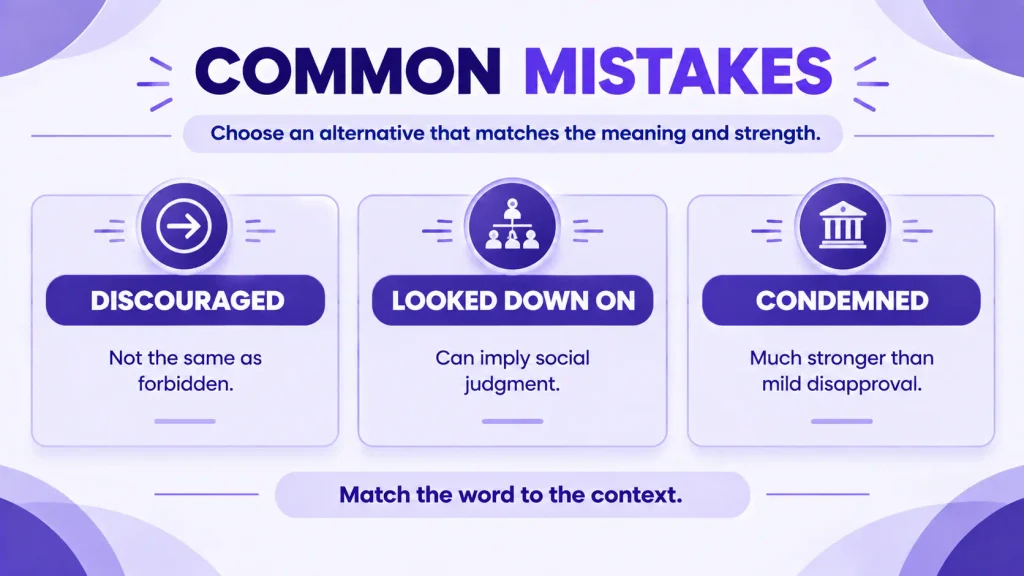
Using “forbidden” when something is only discouraged
“Forbidden” means that something is not allowed.
Parking here is forbidden.
That is much stronger than:
Parking here is frowned upon.
If something is merely viewed negatively, “disapproved of” or “discouraged” may be more accurate.
Using “looked down on” when you want a neutral tone
“Looked down on” can imply social judgment or superiority.
For neutral professional writing, “viewed negatively” or “considered inappropriate” may work better.
Using “condemned” for minor issues
“Condemned” suggests strong criticism. It is usually too intense for ordinary etiquette or mild social disapproval.
Treating every alternative as an exact synonym
The phrases above overlap with “frowned upon,” but they do not all carry exactly the same meaning.
For example:
- Disapproved of → closest general match
- Discouraged → emphasizes advice against something
- Looked down on → emphasizes social judgment
- Condemned → emphasizes strong criticism
- Forbidden → emphasizes prohibition rather than disapproval
Choosing the phrase that matches the intended meaning is more important than simply replacing one expression with another.
Frequently Asked Questions
What is the closest synonym for “frowned upon”?
“Disapproved of” is generally the closest synonym. It communicates the basic idea that a person, group, or organization does not approve of something.
Is “looked down upon” the same as “frowned upon”?
Not exactly. Both can describe negative judgment, but “looked down upon” often suggests that someone or something is regarded as inferior or less respectable.
Is “frowned upon” formal?
“Frowned upon” is a standard English expression that can be used in both everyday and formal contexts. In highly formal writing, alternatives such as “deemed inappropriate” or “regarded as unacceptable” may sound more precise.
What is a professional way to say “frowned upon”?
Depending on the context, use “discouraged,” “considered inappropriate,” “viewed negatively,” or “regarded as unacceptable.” The best choice depends on how strong the disapproval is.
What is a polite way to say something is frowned upon?
“Not generally encouraged” or “generally discouraged” can sound softer than “condemned” or “unacceptable.”
For example:
This practice is generally discouraged in professional settings.
Is “frowned upon” negative?
Yes. It communicates disapproval or an unfavorable attitude toward something, although it does not necessarily mean that the behavior is forbidden or seriously wrong.
Can “frowned upon” be used in an essay?
Yes. “Frowned upon” is acceptable in many essays, especially when discussing social attitudes, cultural expectations, or common behavior. For a highly formal academic context, “disapproved of,” “regarded negatively,” or “considered inappropriate” may be preferable.
Final Takeaway
“Frowned upon” is a useful expression for describing something that receives disapproval or is generally considered undesirable. If you need the closest replacement, choose “disapproved of.” For social judgment, use “looked down on”; for professional contexts, try “considered inappropriate” or “discouraged”; and for stronger formal criticism, “condemned” may be appropriate.
The key is to match the alternative to the intended meaning, strength, and context rather than treating every related phrase as an exact synonym.

Role: Language & Content Specialist
Tessa Holloway creates language-focused content covering phrases, idioms, expressions, vocabulary, and natural American English. Her work helps readers choose words and expressions that fit different everyday, academic, and professional situations.