Another Way to Say New and Improved: 10 Natural Alternatives
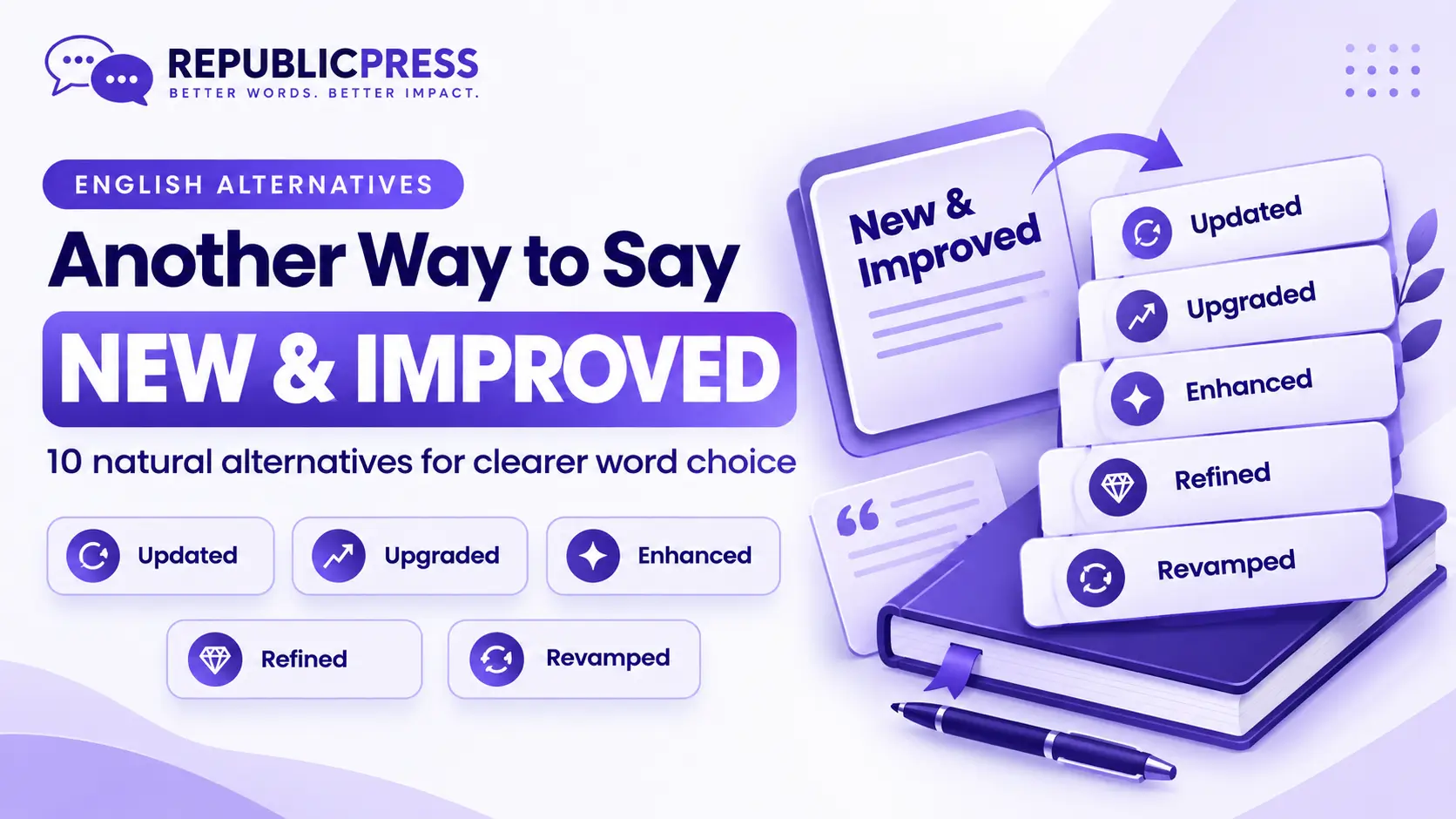
If you want another way to say “new and improved,” the best choice depends on what actually changed. Natural alternatives include “updated,” “upgraded,” “enhanced,” “refined,” “revamped,” and “redesigned.” For products or software, “latest version” and “next-generation” can also work when they accurately describe the change.
Key Takeaways
- “New and improved” usually describes a newer version that has been changed for the better.
- “Updated” works well when something has been brought up to date.
- “Upgraded” suggests a meaningful improvement, often in features, quality, or performance.
- “Enhanced” emphasizes added quality, value, or capability.
- “Revamped” and “redesigned” are useful when the appearance, structure, or overall approach has changed.
- The most precise alternative is often better than simply replacing the phrase with another marketing expression.
What Does “New and Improved” Mean?
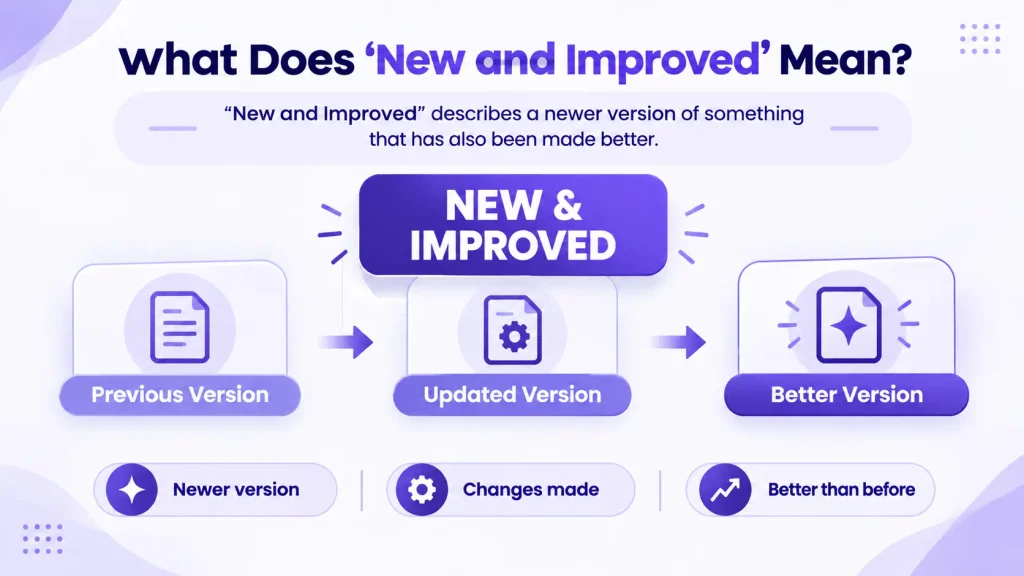
“New and improved” is commonly used for a product, service, website, recipe, system, or other existing thing that has been changed and is presented as better than its previous version. The phrase is especially associated with advertising and product packaging.
For example:
Our new and improved website is easier to navigate.
The phrase can be useful, but it is also broad. It does not tell the reader exactly what was changed. If you know the specific improvement, a more precise phrase can make your writing clearer.
For example:
- “Our updated website now includes a simpler checkout process.”
- “Our redesigned website has a cleaner layout.”
- “Our upgraded software now processes files faster.”
That is why the best alternative depends on the type of change.
10 Natural Alternatives to “New and Improved”
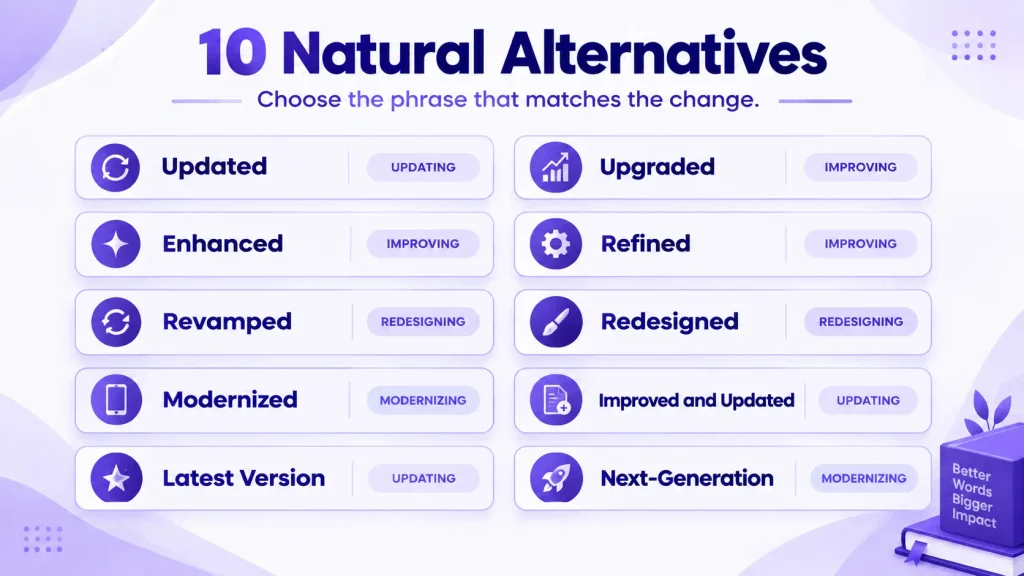
1. Updated
“Updated” is one of the most natural replacements when something has been changed to reflect current information, features, standards, or technology.
Best for: Websites, documents, software, information, policies, and products.
Example:
“Our updated website now includes a faster checkout process.”
Usage tip: “Updated” does not automatically mean something is dramatically better. It simply tells the reader that changes have been made.
2. Upgraded
“Upgraded” suggests that something has been improved by moving it to a higher level of quality, capability, or performance.
Best for: Technology, software, equipment, services, and features.
Example:
“We’ve upgraded our booking system to make reservations faster.”
Usage tip: Use “upgraded” when the change represents a meaningful step up from the previous version.
3. Enhanced
“Enhanced” means that something has been improved or made more effective, useful, attractive, or valuable.
Best for: Features, performance, security, user experience, images, services, and functionality.
Example:
“The latest release includes enhanced security features.”
Usage tip: “Enhanced” sounds somewhat polished and is common in professional and product-related writing. Oxford lists “improve” in contexts involving quality, efficiency, technology, and services.
4. Refined
“Refined” suggests that an existing version has been carefully adjusted or improved rather than completely changed.
Best for: Designs, processes, recipes, writing, products, and systems.
Example:
“We’ve refined the design to make the controls easier to use.”
Usage tip: Choose “refined” when the changes are thoughtful adjustments rather than a complete overhaul.
5. Revamped
“Revamped” means significantly changed or improved, often giving something a fresh look or approach.
Best for: Websites, brands, products, systems, programs, and marketing materials.
Example:
“Our revamped website makes it easier to find important information.”
Usage tip: “Revamped” is more energetic and informal than “updated,” so it works especially well in promotional or conversational writing.
6. Redesigned
“Redesigned” is the clearest option when the structure, appearance, layout, or visual presentation has been changed.
Best for: Websites, apps, products, logos, packaging, and interfaces.
Example:
“Explore our redesigned app with a cleaner, more intuitive interface.”
Usage tip: Don’t use “redesigned” simply to mean “better.” It specifically tells readers that the design changed.
7. Modernized
“Modernized” means something has been changed to make it more suitable for current needs, technology, or expectations.
Best for: Systems, websites, facilities, processes, technology, and infrastructure.
Example:
“The company has modernized its customer service system.”
Usage tip: This word emphasizes bringing something older or outdated up to date.
8. Improved and Updated
If you want to preserve the two main ideas in “new and improved” without using the original wording, “improved and updated” is a straightforward alternative.
Best for: Websites, services, software, documents, and existing products.
Example:
“We’ve launched an improved and updated version of the training program.”
Usage tip: This is clearer than “new and improved” when you want to explicitly state that an existing version has been changed.
9. Latest Version
“Latest version” is useful when you’re referring to the newest release of something that already exists.
Best for: Software, apps, websites, documents, products, and systems.
Example:
“Download the latest version of the app to access the new features.”
Usage tip: “Latest version” emphasizes recency, not necessarily superiority. A newer version can be different without every change being an improvement.
10. Next-Generation
“Next-generation” describes something designed as a newer stage or generation of an existing product, technology, or system.
Best for: Technology, electronics, software, vehicles, and other innovative products.
Example:
“Our next-generation platform offers faster data processing and improved security.”
Usage tip: This has a strong promotional tone, so it is best used when the product genuinely represents a significant new generation rather than a minor update.
Quick Comparison
| Alternative | Main Meaning | Tone | Best Context |
| Updated | Brought up to date | Neutral | Websites, information, software |
| Upgraded | Moved to a better level | Neutral | Technology, equipment, services |
| Enhanced | Made better or more capable | Professional | Features, performance, security |
| Refined | Carefully improved | Polished | Design, writing, products |
| Revamped | Significantly refreshed | Energetic | Websites, brands, products |
| Redesigned | Design changed | Neutral | Websites, apps, packaging |
| Modernized | Made more current | Professional | Systems, technology, processes |
| Improved and updated | Better and brought up to date | Neutral | Services, websites, programs |
| Latest version | Most recent version | Neutral | Software, apps, products |
| Next-generation | Newer generation of technology/product | Promotional | Technology, innovation |
Which Alternative Should You Use?
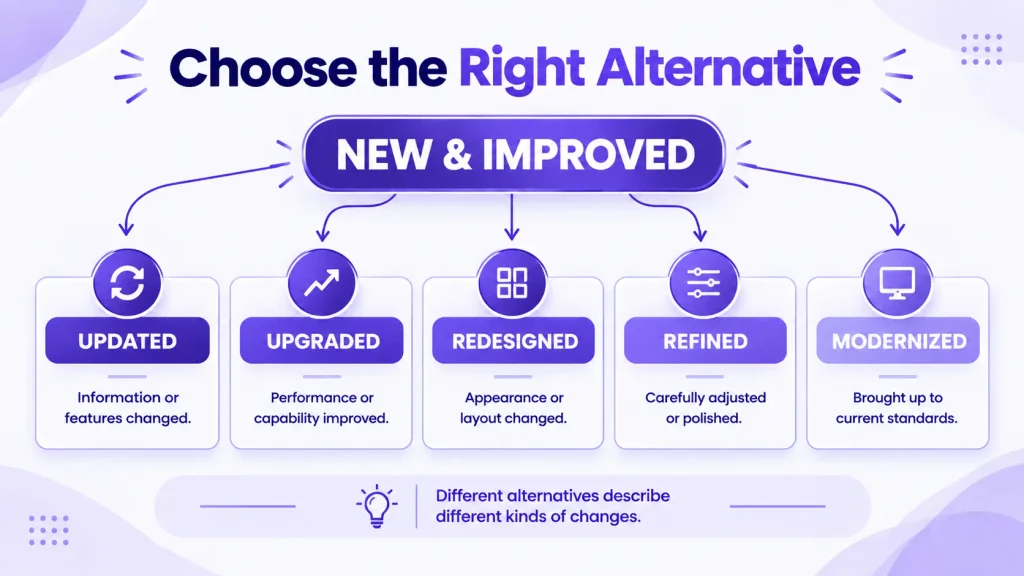
The right phrase depends on what changed.
If information changed
Use updated.
“We’ve published an updated version of the guide.”
If performance improved
Use upgraded or enhanced.
“The upgraded system processes requests faster.”
If the appearance changed
Use redesigned or revamped.
“Check out our redesigned homepage.”
If small improvements were carefully made
Use refined.
“We’ve refined the checkout process.”
If an older system was brought up to current standards
Use modernized.
“The company modernized its payment system.”
If you’re talking about the newest release
Use latest version.
“The latest version includes several new features.”
If it represents a major technological step forward
Use next-generation.
“The company introduced its next-generation battery technology.”
“New and Improved” vs. “Updated”
These phrases are related, but they are not identical.
“New and improved” emphasizes both change and claimed improvement. It is particularly common in advertising. Plain English
“Updated” is more precise when something has simply been brought up to date.
Compare:
“Our new and improved website is better than ever.”
with:
“Our updated website now includes current product information.”
The second sentence gives the reader more concrete information.
“New and Improved” vs. “Upgraded”
“Upgraded” is stronger when you want to emphasize a move to a higher level.
“We upgraded our servers to improve performance.”
This tells readers what kind of change occurred. By contrast, “new and improved” makes a broader claim without specifying the improvement.
“New and Improved” vs. “Redesigned”
Use redesigned when the actual design has changed.
“Our redesigned app has a simpler navigation menu.”
Don’t use “redesigned” merely because something works better. The word specifically points to a change in design or layout.
Common Mistakes
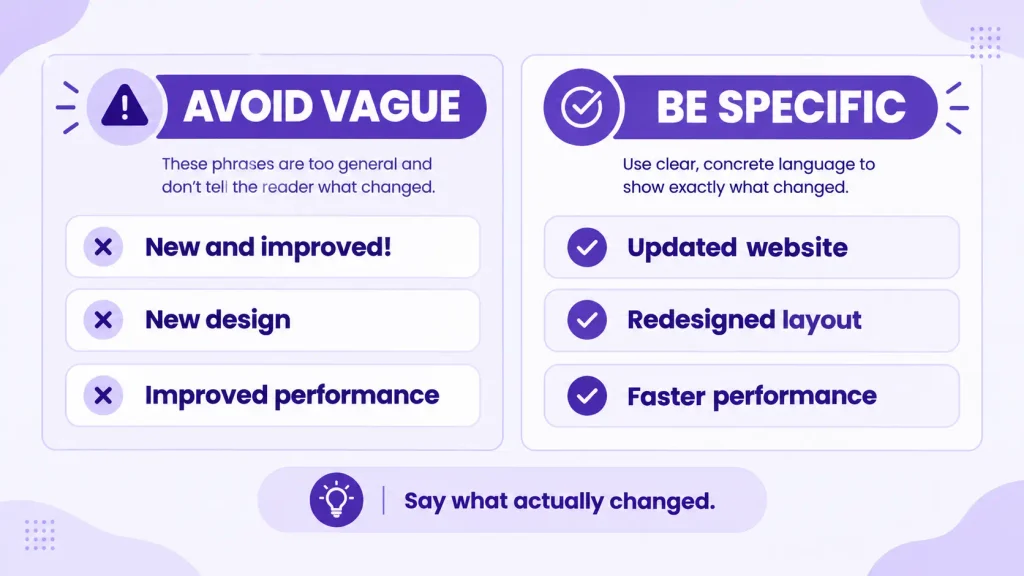
Using “new” when you mean “updated”
If an existing product has been modified, calling it simply “new” may hide an important distinction.
Instead of:
“Our new website has several changes.”
Try:
“Our updated website has several new features.”
Treating every alternative as an exact synonym
“Updated,” “upgraded,” “redesigned,” and “revamped” overlap, but they describe different types of changes.
For example, a website can be updated without being redesigned.
Using promotional language when precision matters
“Next-generation” sounds impressive, but it is not appropriate for every minor update. In technical, professional, or factual writing, a specific description of the improvement is often clearer.
Assuming “new” automatically means “better”
A new version is not necessarily an improved version. “New and improved” specifically combines the idea of a newer version with an assertion of improvement. The phrase is widely used in advertising for this reason. PhraseMix
Frequently Asked Questions
What is a professional way to say “new and improved”?
“Updated,” “enhanced,” “upgraded,” or “refined” can sound more professional, depending on the change. For example, “an updated version” is straightforward, while “an enhanced user experience” emphasizes a specific improvement.
What is another way to say “new and improved version”?
You can say “updated version,” “upgraded version,” “enhanced version,” “refined version,” or “latest version.” Choose the phrase that accurately describes what changed.
Is “updated” the same as “new and improved”?
Not exactly. “Updated” means something has been brought up to date, while “new and improved” suggests both a newer version and an improvement over the previous one.
What is a good alternative to “new and improved” for a website?
“Updated website,” “redesigned website,” or “revamped website” are all natural choices. Use “redesigned” when the layout or visual design changed, and “updated” when content or features were changed.
What is a better phrase than “new and improved” in marketing?
A specific benefit is often clearer than a general claim. Instead of “new and improved,” you could say “now with faster performance,” “now with enhanced security,” or “featuring a redesigned interface,” provided those claims are accurate.
Is “upgraded” stronger than “updated”?
Usually, yes. “Updated” mainly communicates that changes were made, while “upgraded” suggests that something was moved to a better or higher-performing version.
Can I use “revamped” in formal writing?
Yes, but it has a more energetic and less neutral tone than “updated” or “revised.” For highly formal writing, “revised,” “updated,” or a specific description of the change may be preferable.
Final Takeaway
“New and improved” is a familiar phrase, especially in advertising, but it can be vague. The clearest alternative depends on the change: use updated for current information, upgraded for better performance or capability, enhanced for added quality or features, refined for careful improvements, and redesigned when the structure or appearance has changed.
When possible, naming the actual improvement is even clearer than using a general phrase.

Role: English Content Writer
Maren Whitlock writes practical English language content for RepublicsPress, with a focus on vocabulary, word alternatives, everyday expressions, and clear communication. Her articles are designed to make difficult or confusing language easier to understand, with simple explanations and useful examples readers can apply in real situations.