Another Way to Say Jumping to Conclusions: 10 Natural Alternatives
If you need another way to say “jumping to conclusions,” natural options include making assumptions, assuming too much, making a snap judgment, jumping the gun, and reaching a conclusion too quickly. The best choice depends on whether you want to sound neutral, conversational, critical, or more formal.
Key Takeaways
- Making assumptions is the most general alternative.
- Making a snap judgment emphasizes deciding too quickly.
- Rushing to judgment is useful when someone forms an opinion without enough evidence.
- Jumping the gun is casual and can suggest acting too soon, not just assuming something.
- Reaching a conclusion too quickly is clear and neutral.
- For professional or academic writing, choose precise phrases such as drawing a conclusion without sufficient evidence.
What Does “Jumping to Conclusions” Mean?
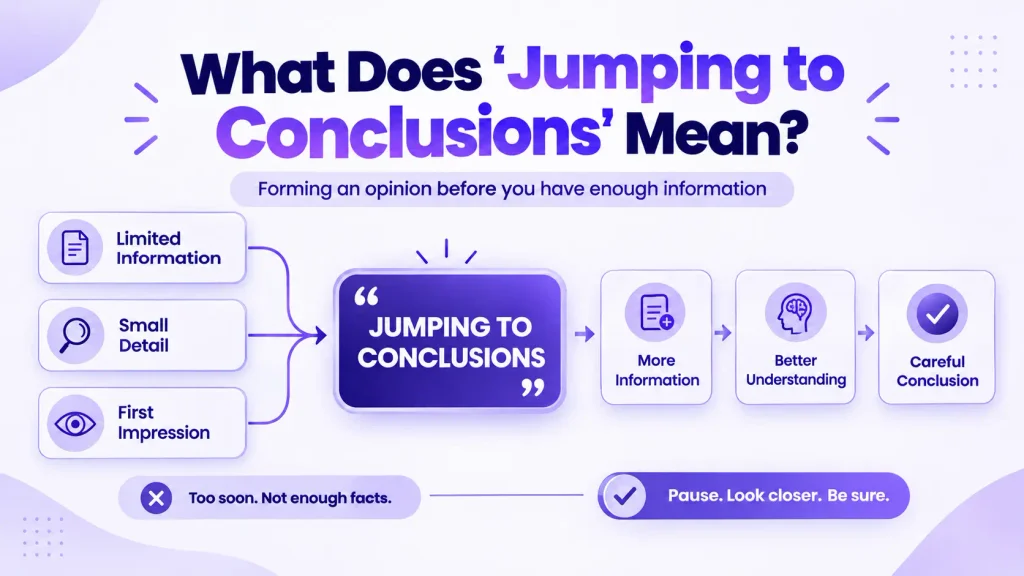
“Jumping to conclusions” means forming an opinion or making a decision before you have enough information or evidence.
For example, if someone sees a coworker leave a meeting early and immediately assumes the coworker is upset, they may be jumping to conclusions. The person might have had another reason for leaving.
The phrase is usually used critically. It suggests that someone has moved from limited information to a conclusion too quickly.
10 Natural Alternatives to “Jumping to Conclusions”
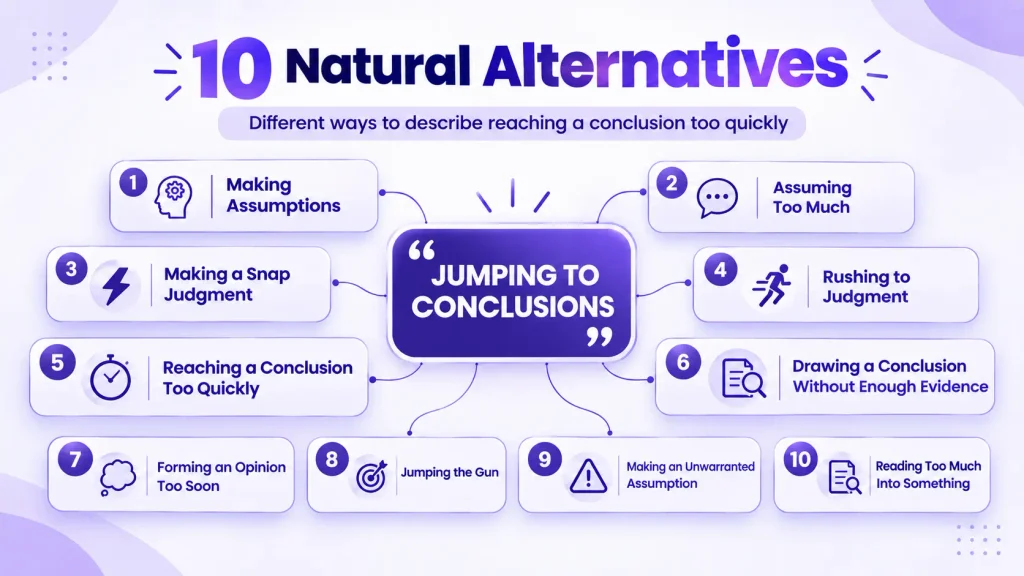
1. Making Assumptions
“Making assumptions” is the most flexible alternative. It means believing something is true without having enough information to confirm it.
Example:
“Don’t start making assumptions before you hear the whole story.”
Best for: Everyday, professional, and neutral situations.
Usage tip: This phrase is broader than “jumping to conclusions.” An assumption is not always unreasonable, while jumping to conclusions usually implies that the assumption was made too quickly.
2. Assuming Too Much
“Assuming too much” suggests that someone is treating limited information as if it proves more than it actually does.
Example:
“You’re assuming too much based on one conversation.”
Best for: Casual and conversational English.
It works especially well when you want to point out that someone’s interpretation goes beyond the available facts.
3. Making a Snap Judgment
A “snap judgment” is a quick opinion formed with little thought or information.
Example:
“She made a snap judgment about him after only a few minutes.”
Best for: Conversations, workplace discussions, and situations involving opinions about people.
This phrase focuses strongly on speed. It does not necessarily mean the judgment is wrong, but it suggests that it was made very quickly.
4. Rushing to Judgment
“Rushing to judgment” means forming an opinion before considering all the relevant information.
Example:
“We should avoid rushing to judgment until we know what happened.”
Best for: Neutral, serious, and professional contexts.
This is a particularly useful choice when discussing accusations, disagreements, or decisions involving incomplete information.
5. Reaching a Conclusion Too Quickly
This is a clear and direct way to express the idea without using an idiom.
Example:
“I think we’re reaching a conclusion too quickly. We need more information.”
Best for: Professional, academic, and everyday communication.
It is useful when clarity matters more than conversational style.
6. Drawing a Conclusion Without Enough Evidence
This phrase makes the problem very specific: the conclusion is being made without adequate evidence.
Example:
“Drawing a conclusion without enough evidence could lead us to the wrong decision.”
Best for: Academic writing, reports, analysis, and professional communication.
This is more formal than “jumping to conclusions,” so it is often a better choice when writing about reasoning or evidence.
7. Forming an Opinion Too Soon
“Forming an opinion too soon” emphasizes that someone has not taken enough time to understand the situation.
Example:
“Try not to form an opinion too soon. There may be more to the story.”
Best for: Everyday conversations and discussions about people or situations.
It is softer than directly accusing someone of making an unreasonable assumption.
8. Jumping the Gun
“Jumping the gun” is a common informal idiom meaning to act, decide, or respond before the appropriate time.
Example:
“We may be jumping the gun by announcing the project before the final approval.”
Best for: Casual and conversational English.
Important distinction: “Jumping the gun” is not an exact synonym for “jumping to conclusions.” It can refer to acting too early, while “jumping to conclusions” specifically involves reaching an unsupported conclusion.
9. Making an Unwarranted Assumption
An “unwarranted assumption” is an assumption that is not justified by the available facts.
Example:
“Assuming the customer is unhappy without asking for feedback is an unwarranted assumption.”
Best for: Professional, analytical, and formal writing.
This phrase is stronger and more precise than simply saying “making assumptions.”
10. Reading Too Much Into Something
“Reading too much into something” means finding a meaning or significance that may not actually be there.
Example:
“You might be reading too much into his short reply. He could just be busy.”
Best for: Casual conversations, relationships, social situations, and everyday interactions.
This is especially useful when someone is interpreting a small detail as evidence of a larger situation.
Which Alternative Should You Use?
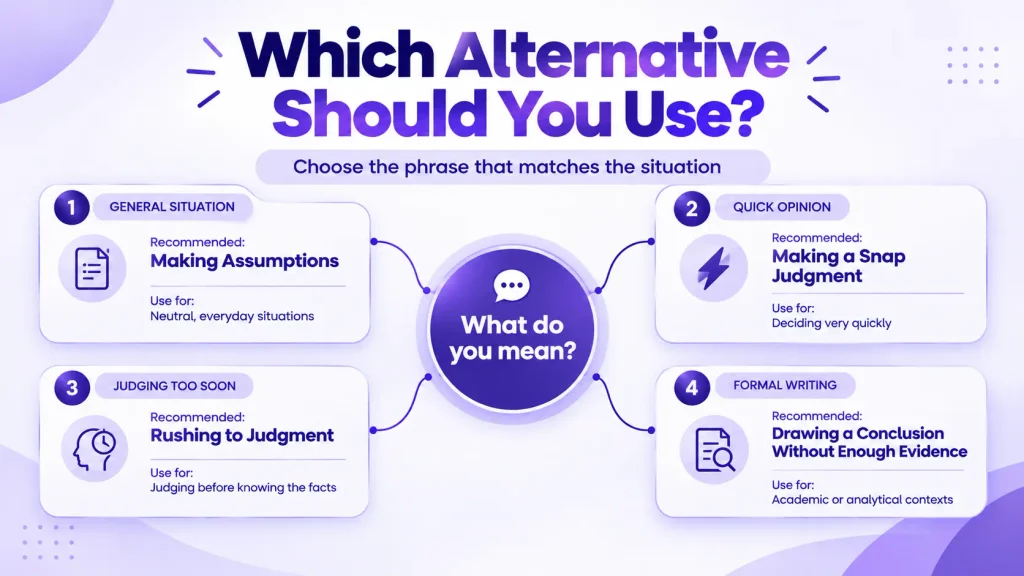
The right phrase depends on what you want to emphasize.
| Alternative | Main idea | Tone | Best Context |
| Making assumptions | Believing something without enough information | Neutral | General use |
| Assuming too much | Going beyond what the facts support | Casual | Conversations |
| Making a snap judgment | Deciding very quickly | Neutral | Opinions about people |
| Rushing to judgment | Judging before knowing the facts | Serious | Disagreements, accusations |
| Reaching a conclusion too quickly | Concluding prematurely | Neutral | General, professional |
| Drawing a conclusion without enough evidence | Lack of supporting evidence | Formal | Academic, analytical |
| Forming an opinion too soon | Deciding before learning enough | Neutral | Discussions |
| Jumping the gun | Acting too early | Casual | Actions and decisions |
| Making an unwarranted assumption | Making an unjustified assumption | Formal | Professional, analytical |
| Reading too much into something | Overinterpreting a detail | Casual | Social situations |
“Jumping to Conclusions” vs. “Making Assumptions”
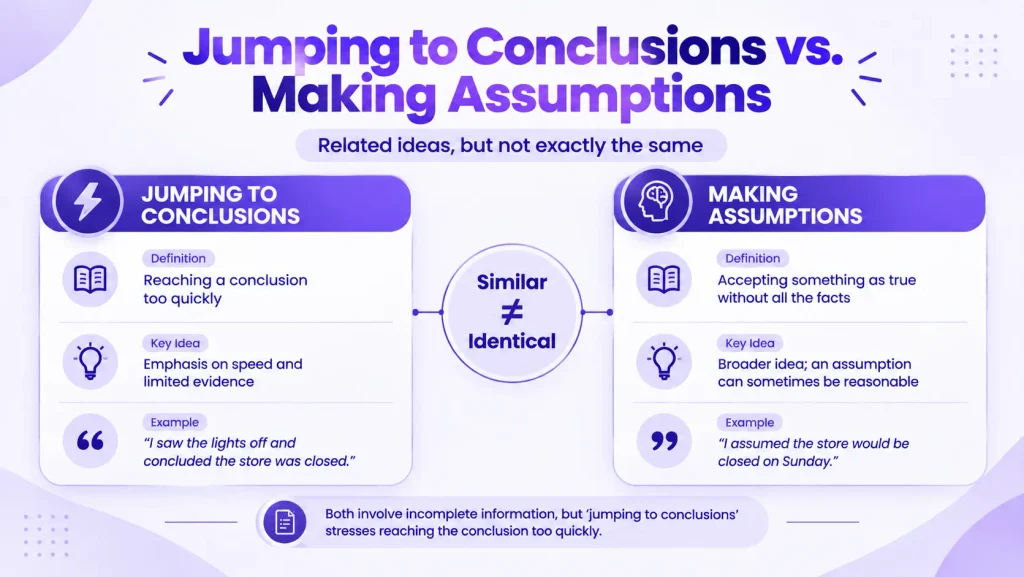
These expressions are closely related, but they are not identical.
Making assumptions means accepting something as true without having all the facts. An assumption can sometimes be reasonable.
Jumping to conclusions usually suggests that the person has reached a conclusion too quickly, often from insufficient evidence.
For example:
“I assumed the store would be closed on Sunday.”
This is an assumption.
“I saw the lights off and jumped to the conclusion that the store was closed.”
This describes a conclusion based on limited evidence.
Formal Alternatives for Professional or Academic Writing
“Jumping to conclusions” is perfectly understandable, but it is somewhat conversational. In formal writing, consider:
- Drawing a conclusion without sufficient evidence
- Making an unsupported assumption
- Reaching a premature conclusion
- Making an unwarranted inference
- Forming a conclusion based on limited evidence
For example:
Conversational:
“We shouldn’t jump to conclusions about the results.”
More formal:
“We should not draw conclusions from the results without sufficient evidence.”
The second version is more precise for a report, essay, or analytical discussion.
Common Mistakes
Treating Every Alternative as an Exact Synonym
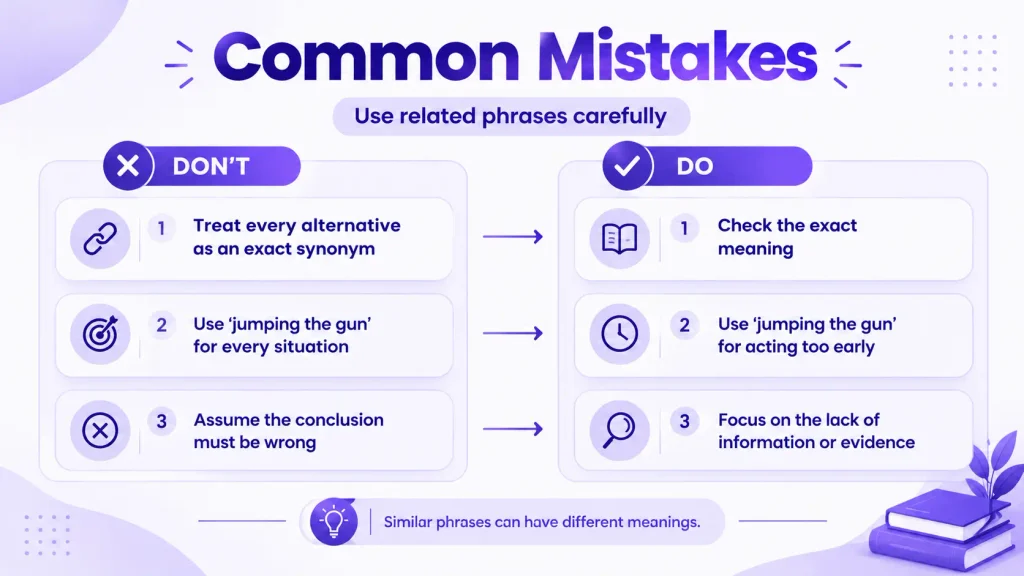
Not every phrase above means exactly the same thing. For example, “jumping the gun” usually refers to acting too soon, while “jumping to conclusions” refers specifically to reaching a conclusion too quickly.
Using Formal Language in Casual Conversation
“Drawing an inference without sufficient evidence” may be accurate, but it can sound unnecessarily formal in an everyday conversation.
In casual speech, “Don’t jump to conclusions” or “You’re making assumptions” is usually more natural.
Assuming the Conclusion Is Always Wrong
“Jumping to conclusions” does not necessarily mean the final conclusion is false. The criticism is usually about how quickly or with how little evidence the conclusion was reached.
Frequently Asked Questions
What is another word for jumping to conclusions?
Common alternatives include assuming too much, making assumptions, making a snap judgment, rushing to judgment, and reaching a conclusion too quickly.
What is a more formal way to say “jumping to conclusions”?
For formal writing, try “drawing a conclusion without sufficient evidence,” “reaching a premature conclusion,” or “making an unsupported assumption.”
Is “making assumptions” the same as “jumping to conclusions”?
They are closely related but not exactly the same. “Making assumptions” is broader, while “jumping to conclusions” emphasizes reaching an opinion or conclusion too quickly.
Is “jumping the gun” the same as “jumping to conclusions”?
No. “Jumping the gun” means acting or doing something too early. “Jumping to conclusions” means forming a conclusion before you have enough information.
What is a polite way to say someone is jumping to conclusions?
You can say, “I think we may be making assumptions,” “Maybe we should wait until we have more information,” or “Let’s not reach a conclusion yet.” These sound less confrontational.
What is another way to say “don’t jump to conclusions”?
Natural options include “Don’t make assumptions,” “Let’s wait for more information,” “Let’s not rush to judgment,” and “Let’s not decide too quickly.”
What is the opposite of jumping to conclusions?
The opposite is taking time to consider the evidence, gathering more information, evaluating the facts, or reaching a conclusion carefully.
Conclusion
“Jumping to conclusions” describes reaching an opinion or decision before you have enough information. “Making assumptions” is the most general alternative, while “making a snap judgment” emphasizes speed and “rushing to judgment” focuses on judging before knowing the facts. For formal writing, “drawing a conclusion without sufficient evidence” is often more precise.
Choose the phrase that matches both your meaning and your audience. A casual conversation may call for “you’re assuming too much,” while a professional report may be better served by “the conclusion is not supported by sufficient evidence.”

Role: English Content Writer
Maren Whitlock writes practical English language content for RepublicsPress, with a focus on vocabulary, word alternatives, everyday expressions, and clear communication. Her articles are designed to make difficult or confusing language easier to understand, with simple explanations and useful examples readers can apply in real situations.