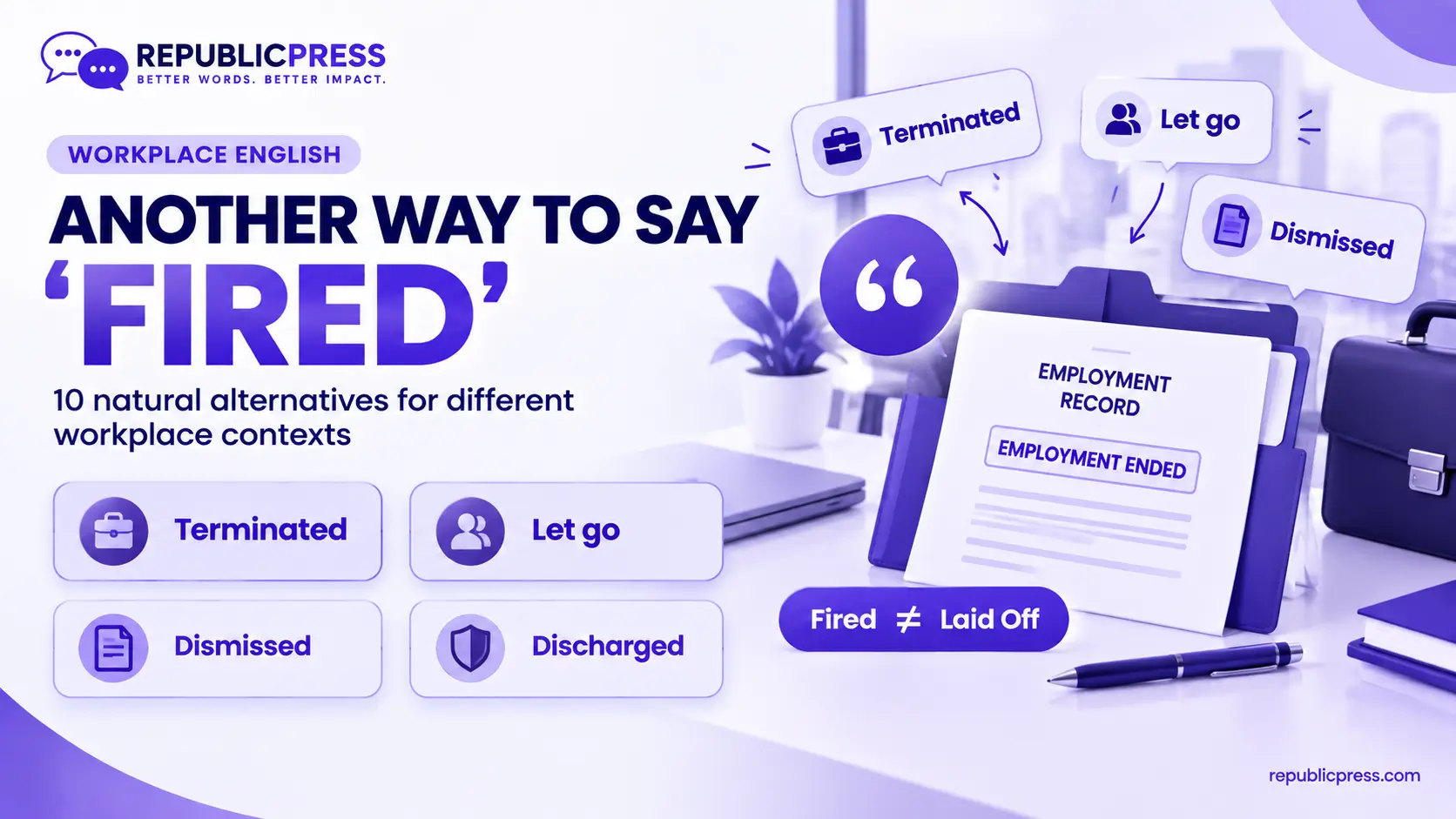
Another Way to Say Fired: 10 Natural Alternatives for Different Contexts
Direct answer: Common alternatives to “fired” include terminated, dismissed, discharged, let go, relieved of your position, removed from the role, separated from the company, shown the door, canned, and parted ways. The best choice depends on whether you want to sound professional, neutral, casual, or indirect. Note that “laid off” is not an exact synonym for “fired” because a layoff usually results from business conditions rather than an employee’s performance or conduct.
Key Takeaways
- Terminated is a professional, neutral way to describe the end of employment.
- Let go is common in everyday American English and can sound softer than “fired.”
- Dismissed and discharged are more formal and often appear in workplace or official contexts.
- Laid off should not normally replace “fired” because it usually refers to job loss caused by business circumstances.
- Canned and shown the door are informal and should be avoided in formal workplace communication.
- The right alternative depends on why the job ended, who you’re speaking to, and how direct you want to be.
What Does “Fired” Mean?
To be fired means that an employer ends an employee’s employment, typically because of performance problems, misconduct, policy violations, or another reason related to the employee or employment relationship. In everyday American English, “fired” is direct and widely understood.
For example:
“She was fired for repeatedly missing deadlines.”
The word can sound blunt or negative, especially in a professional setting. That’s why people often choose a more neutral expression when discussing a previous job.
One important distinction is “laid off.” A layoff generally occurs because of business conditions such as restructuring, downsizing, reduced work, or financial changes rather than because of an individual’s performance.
10 Natural Ways to Say “Fired”
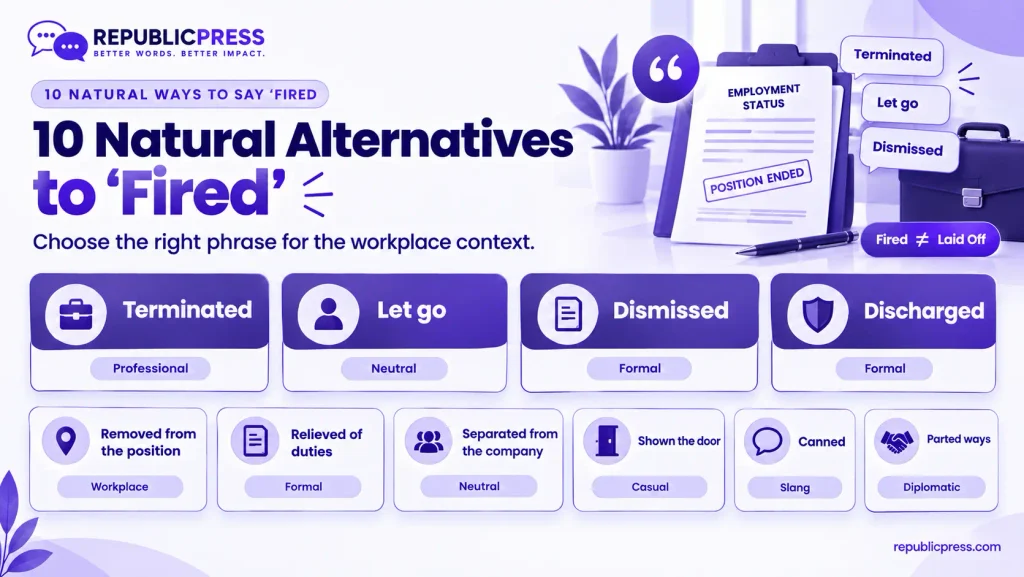
1. Terminated
Best for: Professional, formal, HR, workplace contexts
“Terminated” is one of the most common professional alternatives to “fired.” It is more neutral and can sound less personal.
Example:
“His employment was terminated after an internal investigation.”
Usage tip:
“Terminated” is broader than “fired.” Employment termination can refer to different ways an employment relationship ends, so the word alone does not necessarily explain why someone left.
2. Let Go
Best for: Everyday conversation, interviews, neutral explanations
“Let go” is a very common and relatively gentle way to say that someone lost their job.
Example:
“I was let go from my previous position last year.”
It can be useful when you want to discuss a job loss without using the more blunt word “fired.”
Important: “Let go” does not always tell the listener why the employment ended. The reason could involve performance, restructuring, or another circumstance.
3. Dismissed
Best for: Formal or professional English
“Dismissed” means that an employer ended someone’s employment. It is more formal than “fired.”
Example:
“The employee was dismissed for violating company policy.”
It works particularly well in formal writing, workplace documentation, and serious discussions.
Tone: Formal and direct.
4. Discharged
Best for: Official, formal, or workplace contexts
“Discharged” is another formal term for ending someone’s employment.
Example:
“The employee was discharged after repeated violations of workplace rules.”
In employment contexts, discharged can cover different circumstances, so the surrounding explanation matters. Indeed notes that a discharge can occur for different reasons and is not necessarily identical to a layoff.
Tone: Formal and somewhat bureaucratic.
5. Removed From the Position
Best for: Formal explanations, workplace writing
This phrase emphasizes that the person is no longer in the role rather than using the blunt word “fired.”
Example:
“She was removed from her position following an investigation.”
It is especially useful when discussing a specific role or position.
Usage tip: This phrase does not necessarily mean the person lost all employment with the organization. Context is important.
6. Relieved of Duties
Best for: Formal or institutional contexts
“Relieved of duties” means that someone is no longer performing their assigned responsibilities. Depending on the situation, it may or may not mean that employment itself has ended.
Example:
“The manager was relieved of his duties following the investigation.”
Because the phrase can describe a change in responsibilities rather than termination itself, don’t use it as an exact replacement for “fired” unless the context makes the employment status clear.
7. Separated From the Company
Best for: HR, professional, neutral language
“Separated from the company” is a relatively neutral and indirect way to describe someone’s departure.
Example:
“She recently separated from the company after five years.”
This wording can be useful when discussing employment history without emphasizing the circumstances of the departure.
Usage tip: It can be deliberately vague. If the reader needs to know whether the departure was voluntary, involuntary, a layoff, or a firing, provide that information separately.
8. Shown the Door
Best for: Casual conversation, humorous or figurative language
“Shown the door” is an idiomatic way to say someone was forced to leave a job or organization.
Example:
“After several warnings, he was eventually shown the door.”
It is colorful and easy to understand, but it is not appropriate for formal workplace communication.
Tone: Casual, figurative, and sometimes humorous.
9. Canned
Best for: Very casual American English
“Canned” is informal slang meaning fired.
Example:
“He got canned after arguing with his manager.”
The phrase is recognizable in American English but can sound blunt, casual, or slightly humorous.
Avoid it in:
- Resumes
- Cover letters
- Job interviews
- Formal emails
- HR documents
For those situations, terminated or let go is usually more appropriate.
10. Parted Ways
Best for: Diplomatic or indirect language
“Parted ways” is a softer expression suggesting that an employee and employer ended their working relationship.
Example:
“After three years with the company, we decided to part ways.”
This phrase is intentionally less specific than “fired.” It can describe an involuntary departure, a mutual decision, or simply an employment relationship that ended.
Usage tip: Don’t use it when you need to communicate a precise reason for termination.
Quick Comparison: Which Alternative Should You Use?
| Alternative | Tone | Best Context | Exact Meaning? |
| Terminated | Professional | HR, workplace, formal writing | Usually close |
| Let go | Neutral/casual | Conversation, interviews | Context-dependent |
| Dismissed | Formal | Workplace, official writing | Close |
| Discharged | Formal | Official/workplace contexts | Close, but broader |
| Removed from the position | Formal | Workplace explanations | Not always |
| Relieved of duties | Formal | Management/institutional settings | Not always |
| Separated from the company | Neutral/formal | HR, professional discussion | Indirect |
| Shown the door | Casual/idiomatic | Informal conversation | Yes, indirectly |
| Canned | Informal/slang | Casual American English | Yes |
| Parted ways | Diplomatic/indirect | Professional conversation | Not necessarily |
Fired vs. Laid Off: Don’t Confuse These Terms
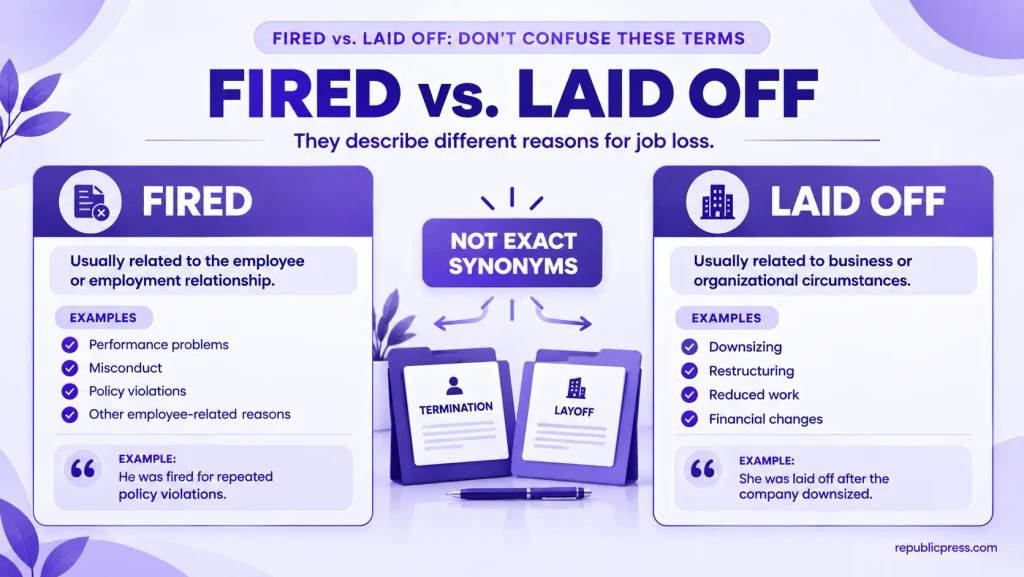
One of the most important distinctions is between fired and laid off.
They both describe involuntary job loss, but they generally communicate different circumstances.
| Term | Typical reason | Example |
| Fired | Performance, conduct, policy violation, or another employee-related reason | “He was fired for repeated policy violations.” |
| Laid off | Business or organizational circumstances | “She was laid off after the company downsized.” |
| Terminated | Broad term for ending employment | “His employment was terminated.” |
| Let go | Neutral/indirect description of job loss | “I was let go last month.” |
A layoff generally results from circumstances such as restructuring, reduced demand, mergers, or downsizing rather than the employee’s individual performance.
So, if you were fired for poor performance, saying “I was laid off” can change the meaning.
How to Say “I Got Fired” More Professionally
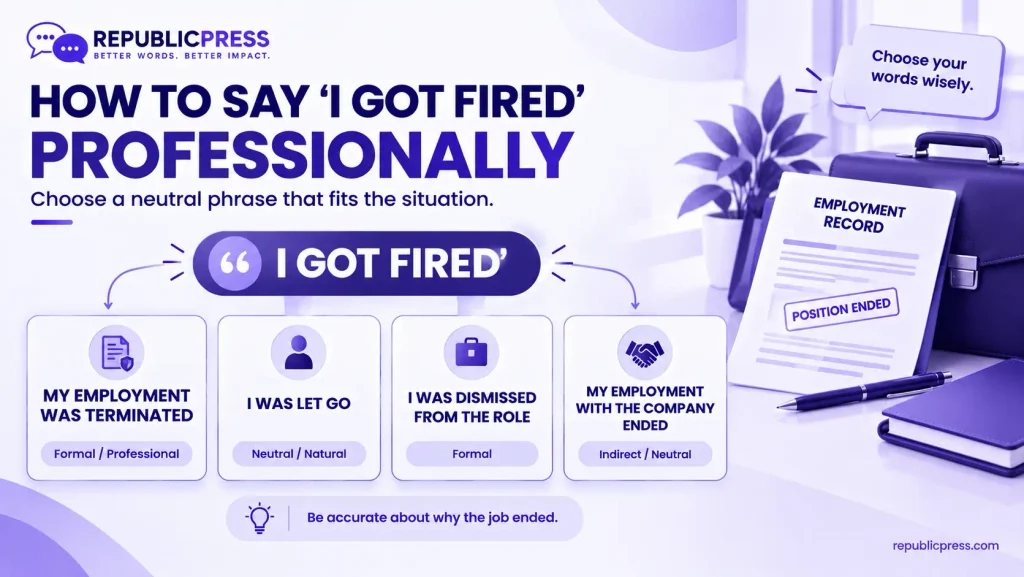
The best replacement depends on how much detail you want to give.
Direct but professional
“My employment was terminated.”
Natural and neutral
“I was let go from my previous position.”
More formal
“I was dismissed from the role.”
More indirect
“My employment with the company ended.”
Diplomatic
“The company and I decided to part ways.”
If you’re discussing the situation during a job interview, avoid using slang such as “I got canned.” A neutral expression allows you to explain the circumstances clearly and professionally.
Common Mistakes When Replacing “Fired”
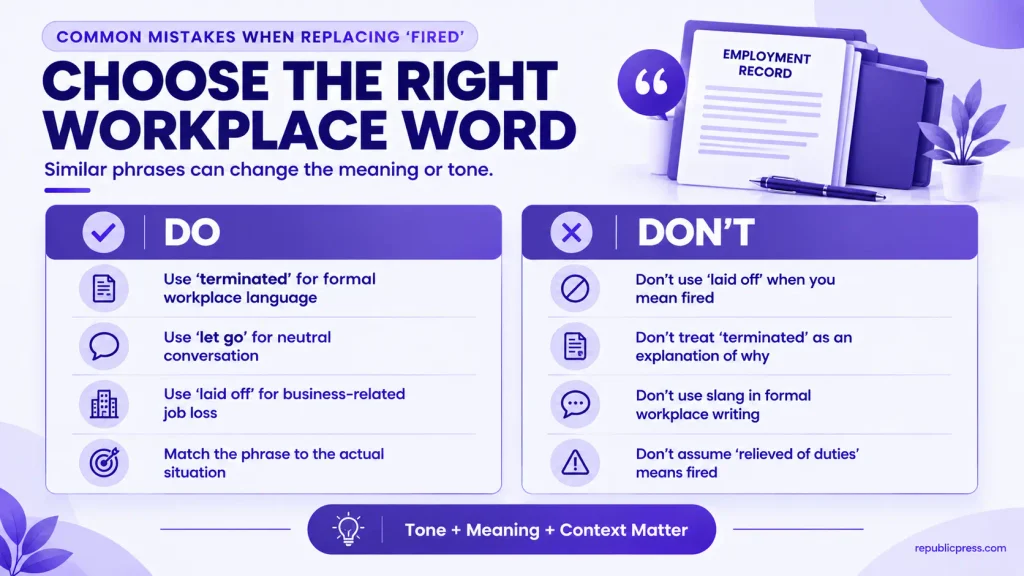
1. Using “laid off” when you were actually fired
These terms are not interchangeable. A layoff generally relates to business conditions, while a firing usually relates to the employee or employment relationship.
Less accurate:
“I was laid off because I repeatedly violated company policy.”
Better:
“My employment was terminated after I violated company policy.”
2. Assuming “terminated” always means “fired”
Terminated is broader and more neutral than fired. It describes the end of employment but does not, by itself, explain the reason or circumstances.
For example:
“Her employment was terminated.”
This sentence doesn’t tell us whether she was fired for misconduct, laid off, or left under another arrangement.
3. Using slang in professional writing
Words such as canned can work in casual conversation but sound inappropriate in a resume or formal email.
Casual:
“I got canned last month.”
Professional:
“My employment was terminated last month.”
4. Treating “relieved of duties” as an exact synonym
Someone can be relieved of certain duties while remaining employed by the organization.
For example:
“The manager was relieved of his administrative duties.”
That doesn’t necessarily mean:
“The manager was fired.”
The context changes the meaning.
5. Using “parted ways” when precision matters
Parted ways is deliberately vague.
If someone needs to know exactly what happened, say so clearly:
“My position was eliminated during a restructuring.”
or
“My employment was terminated following a performance review.”
Which Phrase Is Best for a Job Interview?
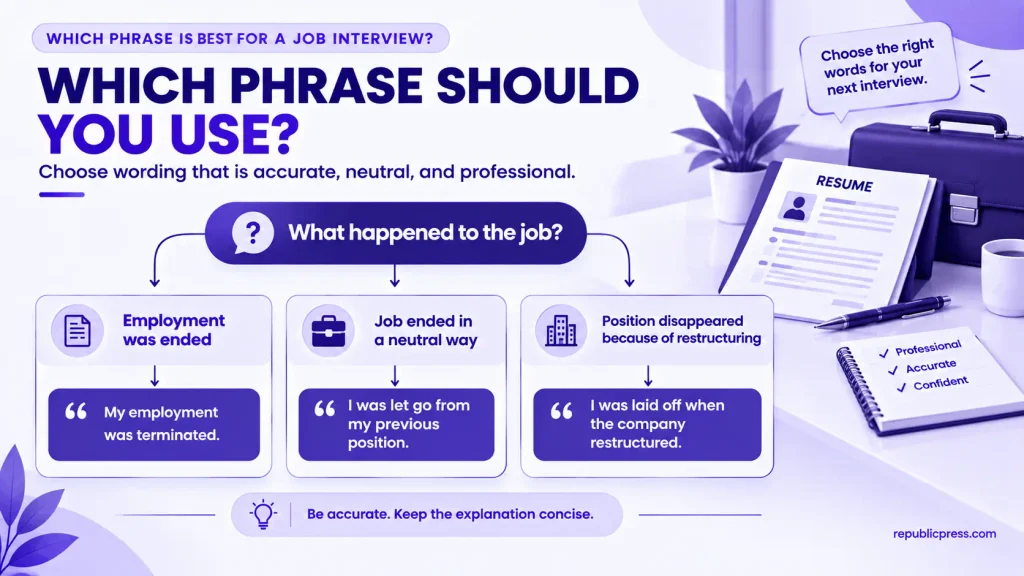
If you’re explaining a previous job separation, choose language that is accurate, concise, and professional.
For example:
If you were fired:
“My employment was terminated, and I’ve since worked on improving my skills in that area.”
If you were laid off:
“I was laid off when the company restructured the department.”
If the situation was more complicated:
“My employment with the company ended after the role changed significantly.”
The goal is not to hide what happened. It’s to describe the situation accurately without relying on unnecessarily blunt or informal language.
Is “Terminated” More Professional Than “Fired”?
Generally, yes, “terminated” sounds more formal and neutral than “fired.” But that doesn’t make it a perfect substitute in every sentence.
Compare:
“I was fired because of repeated attendance problems.”
with:
“My employment was terminated because of repeated attendance problems.”
The second sentence has a more formal workplace tone, while the first is more direct and conversational.
Can “Let Go” Mean “Fired”?
Yes. “Let go” can mean that an employer ended someone’s employment, including in situations where the person was fired.
For example:
“I was let go because I wasn’t meeting the company’s performance expectations.”
But let go is softer and less specific than fired. It can also be used for situations where the circumstances are not clearly explained.
Is “Dismissed” the Same as “Fired”?
In many employment contexts, dismissed can mean that an employer ended someone’s employment, so it can function as a formal alternative to fired.
However, it is more formal and can sound less conversational in American English.
“The employee was dismissed for violating company policy.”
is formal, while:
“The employee was fired for violating company policy.”
is more direct and everyday.
Frequently Asked Questions
What is another professional way to say “fired”?
“Terminated” is one of the most common professional alternatives. “Dismissed,” “discharged,” and “let go” can also work depending on the context and desired tone.
What is a polite way to say “I got fired”?
You could say:
“I was let go from my previous position.”
For more formal situations:
“My employment was terminated.”
What is a formal word for “fired”?
Terminated, dismissed, and discharged are formal alternatives. “Terminated” is especially common in professional and HR-related language.
Is “laid off” another way to say “fired”?
Not exactly. A layoff generally occurs because of business or organizational circumstances, while firing usually refers to an employer ending someone’s employment for a reason connected to the employee or employment relationship.
What is a casual way to say “fired”?
“Let go,” “canned,” and “shown the door” can be casual alternatives. “Canned” is slang, while “shown the door” is an idiom.
Can I say “terminated” instead of “fired” on a resume?
Usually, it’s better to describe the employment situation accurately rather than simply replacing one word with another. A resume typically focuses on your role, accomplishments, and employment dates rather than explaining a termination.
What does “parted ways” mean at work?
“Parted ways” means that two parties ended their working relationship. It is intentionally indirect and does not necessarily mean that someone was fired.
Is “sacked” an American English alternative to “fired”?
“Sacked” means fired, but it is much more strongly associated with British English than standard American English. For a U.S. audience, fired, let go, terminated, or dismissed will usually sound more natural.
Final Takeaway
There isn’t one perfect replacement for “fired.” Choose the expression according to the situation:
- Professional: terminated, dismissed, discharged
- Neutral: let go, separated from the company
- Formal: terminated, dismissed
- Casual: shown the door
- Slang: canned
- Diplomatic: parted ways
- Business-related job loss: laid off — not normally a synonym for fired
The most important distinction is between precision and tone. If you need to communicate exactly what happened, choose a phrase that preserves the circumstances. If you simply want a softer way to discuss job loss, “let go” is often a natural choice

Role: English Content Writer
Maren Whitlock writes practical English language content for RepublicsPress, with a focus on vocabulary, word alternatives, everyday expressions, and clear communication. Her articles are designed to make difficult or confusing language easier to understand, with simple explanations and useful examples readers can apply in real situations.