
Another Way to Say Most of the Time: 10 Natural Alternatives
If you need another way to say “most of the time,” the best alternatives include “usually,” “generally,” “typically,” “for the most part,” “in most cases,” and “more often than not.” The right choice depends on whether you want to sound casual, neutral, formal, or more precise.
Key Takeaways
- “Usually” is the closest and most natural everyday alternative to “most of the time.”
- “Generally” and “typically” work well when describing common patterns or habits.
- “For the most part” means mostly or largely, but it does not always describe frequency.
- “In most cases” is useful when discussing situations, conditions, or outcomes.
- “More often than not” emphasizes that something happens more frequently than it does not.
- Some alternatives sound more formal and are better suited to professional or academic writing.
What Does “Most of the Time” Mean?
“Most of the time” means on the majority of occasions or during the majority of a period. It suggests that something happens frequently, but not necessarily every time.
For example:
I work from home most of the time.
This means working from home is the usual situation, although there may be some days when the person works somewhere else.
The phrase is common in everyday American English and works well in both casual and neutral contexts.
10 Other Ways to Say “Most of the Time”

1. Usually
“Usually” is the closest direct alternative to “most of the time.” It describes something that happens regularly or under normal circumstances.
Best for: Everyday, conversational, and neutral writing
Example:
I usually take the train to work.
You can replace “most of the time” with “usually” in many sentences without changing the basic meaning.
Example:
I work from home most of the time.
→ I usually work from home.
2. Generally
“Generally” means in most situations or as a general rule. It can describe habits, patterns, opinions, or conditions.
Best for: Neutral and professional contexts
Example:
I generally avoid eating late at night.
“Generally” can sound slightly more formal than “usually,” making it useful in workplace or informational writing.
3. Typically
“Typically” refers to what normally happens or what is characteristic of a person, situation, or group.
Best for: Neutral, professional, and informational writing
Example:
The store typically closes at 9 p.m.
It is especially useful when describing a regular pattern rather than a personal habit.
4. For the Most Part
“For the most part” means mostly or largely. It indicates that something is true in general, although there may be exceptions.
Best for: Conversational and neutral writing
Example:
For the most part, I enjoy working remotely.
This phrase is similar to “most of the time,” but the meaning is not always identical. “For the most part” can describe an overall condition or opinion, not just how frequently something happens.
5. In Most Cases
“In most cases” means in the majority of situations or circumstances.
Best for: Professional, formal, and informational contexts
Example:
In most cases, the issue can be resolved without restarting the system.
This is a useful choice when you are talking about situations, outcomes, rules, or exceptions rather than personal routines.
6. More Often Than Not
“More often than not” means something happens more frequently than it does not. It suggests a tendency rather than certainty.
Best for: Conversational, neutral, and descriptive writing
Example:
More often than not, she finishes her work before the deadline.
This phrase emphasizes frequency and naturally leaves room for exceptions.
7. As a Rule
“As a rule” means generally or under normal circumstances. It often introduces a general practice or principle.
Best for: Formal, professional, and explanatory writing
Example:
As a rule, we respond to customer inquiries within one business day.
It can sound more deliberate than “usually,” so it is less common in casual conversation.
8. Ordinarily
“Ordinarily” means normally or under usual circumstances.
Best for: Formal and professional writing
Example:
The office is ordinarily open until 6 p.m.
This is a correct alternative, but it is more formal and less common in casual American conversation than “usually” or “normally.”
9. On Most Occasions
“On most occasions” means on the majority of occasions or events.
Best for: Formal, neutral, and specific contexts
Example:
On most occasions, the meeting ends within an hour.
This phrase is particularly useful when you are talking about repeated events rather than an ongoing habit.
10. Generally Speaking
“Generally speaking” means when considering something overall or as a general observation.
Best for: Explanatory, professional, and conversational contexts
Example:
Generally speaking, customers prefer a simple checkout process.
Unlike “usually,” this expression often introduces a broad observation rather than a repeated personal action.
Quick Comparison of Alternatives
| Alternative | Main Use | Tone | Best Context |
| Usually | What normally happens | Neutral | Everyday conversation |
| Generally | What is generally true | Neutral/Formal | Professional writing |
| Typically | A common pattern | Neutral | Informational writing |
| For the most part | Mostly or largely | Neutral | Conversation and general writing |
| In most cases | Majority of situations | Formal/Neutral | Professional or informational |
| More often than not | Happens more frequently than not | Neutral | General conversation |
| As a rule | General practice or principle | Formal | Workplace/formal writing |
| Ordinarily | What normally happens | Formal | Professional/formal writing |
| On most occasions | Majority of occasions | Formal/Neutral | Specific repeated events |
| Generally speaking | Broad overall observation | Neutral/Formal | Explanations and analysis |
Which Alternative Is Closest to “Most of the Time”?
“Usually” is generally the closest everyday replacement.
For example:
Original:
I drink coffee most of the time.
Natural alternative:
I usually drink coffee.
Other alternatives can work, but they may slightly change the emphasis:
- “I generally drink coffee” focuses on a general pattern.
- “I typically drink coffee” emphasizes what is normal or expected.
- “For the most part, I drink coffee” suggests that there are some exceptions.
- “More often than not, I drink coffee” emphasizes that coffee is more common than another choice.
“Most of the Time” vs. “Usually”
These expressions are very close, but they are not always interchangeable in every sentence.
“Most of the time” emphasizes that something happens during the majority of occasions or a period.
Example:
I stay home most of the time.
“Usually” describes what normally happens.
Example:
I usually stay home on Sundays.
Both communicate a similar idea, but “usually” often sounds more natural when describing a regular habit.
“Most of the Time” vs. “For the Most Part”
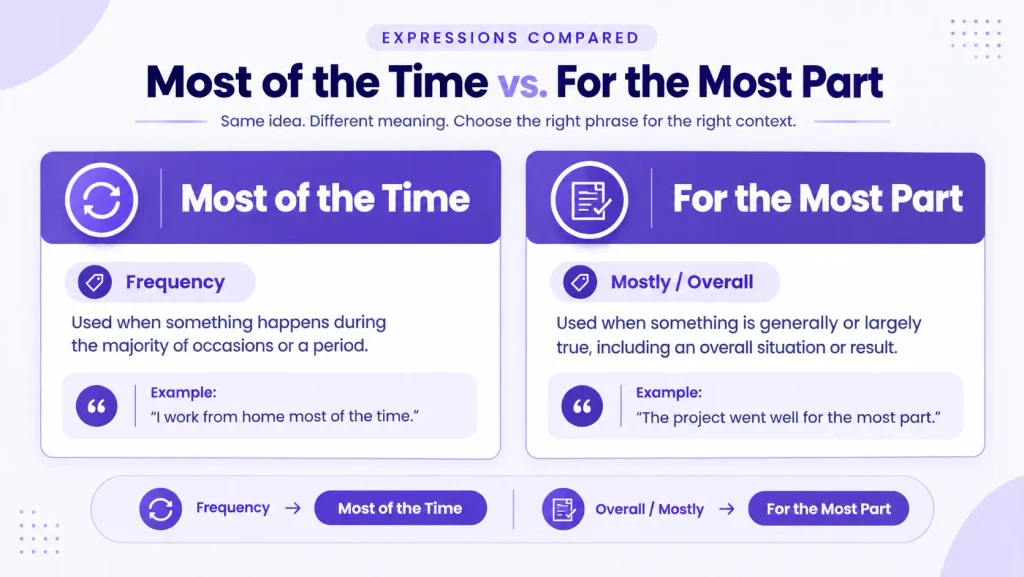
These phrases overlap, but “for the most part” has a broader meaning.
Most of the time:
I feel happy most of the time.
This focuses on frequency.
For the most part:
The project went well for the most part.
This means the project was mostly successful, although there may have been some problems.
So, use “most of the time” when frequency matters. Use “for the most part” when you mean mostly or largely.
“Most of the Time” vs. “More Often Than Not”
“More often than not” specifically suggests that something happens more frequently than the opposite.
Example:
More often than not, he arrives early.
This means he arrives early on more occasions than he arrives late.
By contrast:
He arrives early most of the time.
This has a similar meaning but sounds simpler and more direct.
How to Choose the Right Alternative
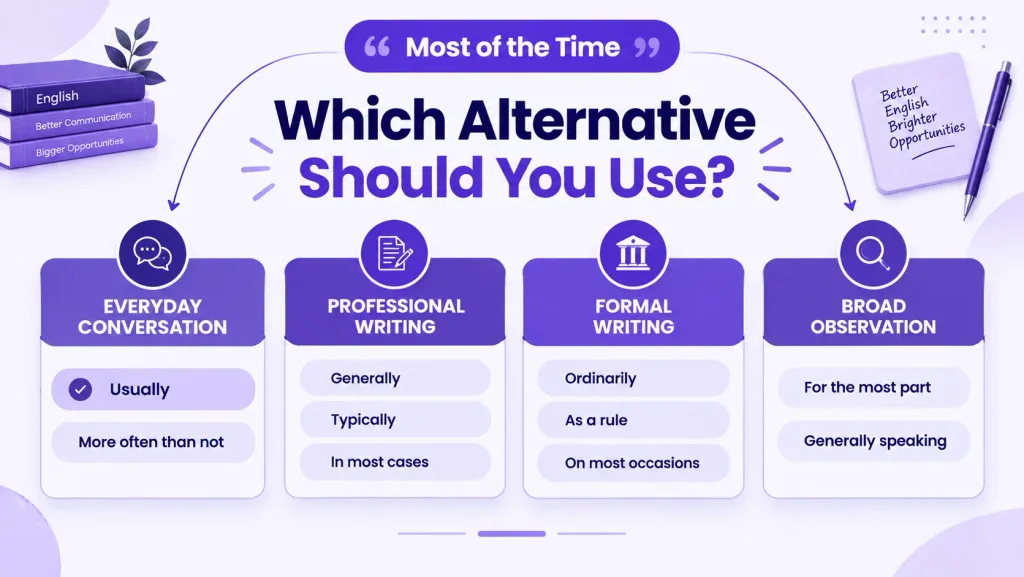
Choose the expression based on what you are actually trying to communicate.
For everyday conversation
Use:
- Usually
- Generally
- More often than not
- For the most part
Example:
I usually eat breakfast at home.
For professional writing
Use:
- Generally
- Typically
- In most cases
- As a rule
Example:
In most cases, employees can complete the process online.
For formal writing
Use:
- Generally
- Typically
- Ordinarily
- On most occasions
- As a rule
Example:
As a rule, applications are reviewed within five business days.
When describing a broad observation
Use:
- Generally speaking
- Generally
- For the most part
Example:
Generally speaking, customers prefer shorter wait times.
Common Mistakes to Avoid
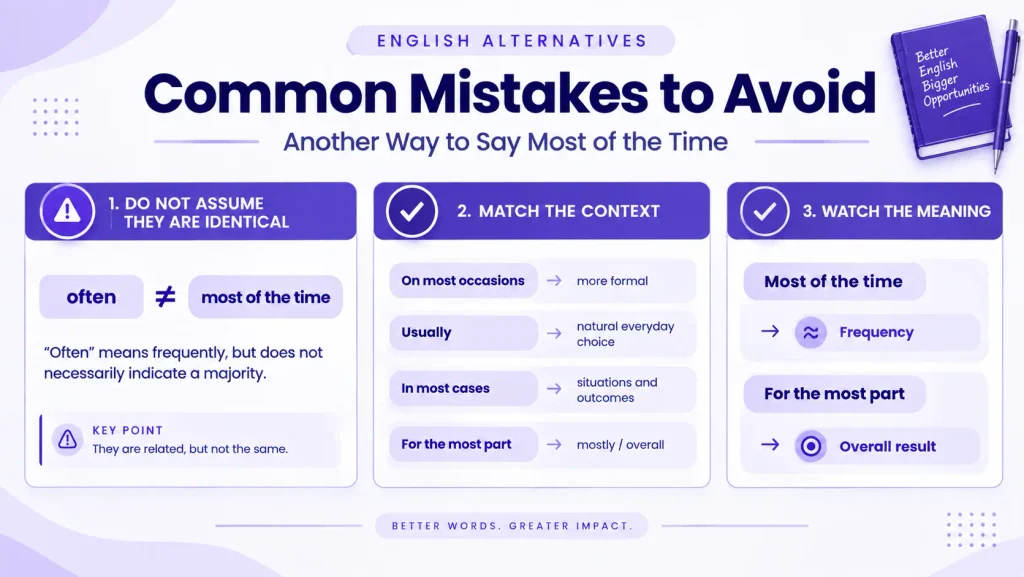
Using “often” as an exact replacement
“Often” means frequently, but it does not necessarily mean a majority of the time.
For example:
I often go to the gym.
This tells the reader that going to the gym happens frequently, but it does not clearly say that it happens more than half the time.
If you mean a majority of occasions, “usually” or “most of the time” may be more precise.
Using formal alternatives in casual conversation
Words such as “ordinarily” and phrases such as “on most occasions” are grammatically correct, but they can sound unnecessarily formal in casual conversation.
Instead of:
On most occasions, I eat at home.
A natural conversational version would be:
I usually eat at home.
Treating “for the most part” as an exact synonym
“For the most part” often means “mostly,” not strictly “during most of the time.”
For example:
The presentation was successful for the most part.
This describes the overall result rather than the frequency of an event.
Assuming every alternative has exactly the same meaning
These expressions overlap, but their emphasis differs. “Usually” focuses on what normally happens, “in most cases” focuses on situations, and “more often than not” emphasizes frequency relative to the opposite outcome.
Choosing the phrase that matches the intended meaning makes the sentence sound more natural.
Frequently Asked Questions
What is the best synonym for “most of the time”?
“Usually” is the closest and most natural synonym in many everyday sentences. Depending on context, “generally,” “typically,” “for the most part,” and “in most cases” can also work.
Is “usually” the same as “most of the time”?
They are very similar, but not perfectly identical in every context. “Usually” means normally or habitually, while “most of the time” more directly emphasizes that something occurs during the majority of occasions or a period.
What is a formal way to say “most of the time”?
Depending on the sentence, you can use “generally,” “typically,” “ordinarily,” “in most cases,” or “as a rule.” The best choice depends on whether you are describing a habit, situation, or general principle.
Can I use “for the most part” instead of “most of the time”?
Sometimes. “For the most part” means mostly or largely and can describe an overall situation. “Most of the time” more specifically refers to frequency or the majority of occasions.
Is “more often than not” the same as “most of the time”?
They are closely related but emphasize slightly different ideas. “More often than not” means something happens more frequently than it does not, while “most of the time” simply indicates that it happens during the majority of occasions or a period.
What is a casual way to say “most of the time”?
“Usually” is the most natural choice in everyday American English. “Most of the time” itself is also completely natural and does not need to be replaced unless you want a different tone or sentence structure.
What is the difference between “usually” and “typically”?
“Usually” often describes a person’s normal habit or routine, while “typically” often describes a characteristic pattern or what is expected to happen.
Usually:
I usually take the bus.
Typically:
The bus typically arrives every 15 minutes.
Conclusion
“Most of the time” is already a natural and widely used phrase in American English, so you do not always need to replace it. When you want variety, “usually” is the closest everyday alternative, while “generally” and “typically” work well for broader patterns. For more specific contexts, “in most cases,” “for the most part,” and “more often than not” can communicate slightly different shades of meaning.
The key is to choose the phrase based on what you mean—not simply to find a different way to say the same words.dy a natural and widely used phrase in American English, so you do not always need to replace it. When you want variety, “usually” is the closest everyday alternative, while “generally” and “typically” work well for broader patterns. For more specific contexts, “in most cases,” “for the most part,” and “more often than not” can communicate slightly different shades of meaning.
The key is to choose the phrase based on what you mean—not simply to find a different way to say the same words.

Role: English Content Writer
Maren Whitlock writes practical English language content for RepublicsPress, with a focus on vocabulary, word alternatives, everyday expressions, and clear communication. Her articles are designed to make difficult or confusing language easier to understand, with simple explanations and useful examples readers can apply in real situations.