Another Way to Say “On Top of Things”: 10 Natural Alternatives
If you’re looking for another way to say “on top of things,” natural alternatives include organized, in control, keeping track of things, staying on top of it, up to date, prepared, keeping up, handling things well, well-managed, and on top of it all. The best choice depends on whether you mean being organized, informed, prepared, or able to manage responsibilities effectively.
Key Takeaways
- “On top of things” means being organized, informed, prepared, or able to manage responsibilities effectively.
- “Organized” is useful when planning and structure are the main focus.
- “In control” emphasizes successfully managing a situation.
- “Up to date” works when you mean having the latest information.
- “Keeping track of things” focuses on monitoring tasks, details, or deadlines.
- The best another way to say “on top of things” depends on the situation, tone, and exact meaning.
What Does “On Top of Things” Mean?
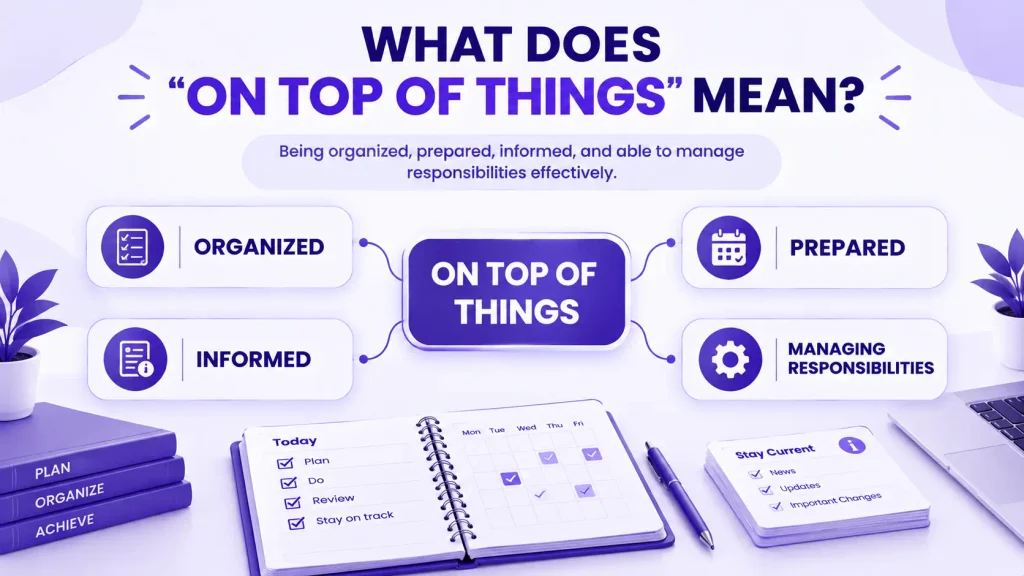
The phrase “on top of things” is an informal American English expression that means someone is managing their responsibilities well and knows what needs to be done.
It can describe someone who is organized, prepared, attentive, or aware of what is happening.
For example:
“She’s really on top of things at work.”
This means she is handling her responsibilities effectively, keeping track of important details, and responding to tasks as needed.
The expression can also mean staying informed:
“I try to stay on top of things by checking my email every morning.”
Here, the speaker means they are keeping up with information, tasks, and responsibilities.
Because “on top of things” can express several related ideas, there isn’t always one exact replacement. The right alternative depends on what you want to emphasize.
Why Look for Another Way to Say “On Top of Things”?
You may want another way to say “on top of things” because the original expression can sound conversational in some situations.
For example, in everyday English, you might say:
“She’s always on top of things.”
In professional writing, you might prefer:
“She manages her responsibilities effectively.”
You may also need a more specific phrase when you mean being organized, staying informed, or being prepared.
If you’re learning related English expressions, is another useful reference for checking definitions and usage.
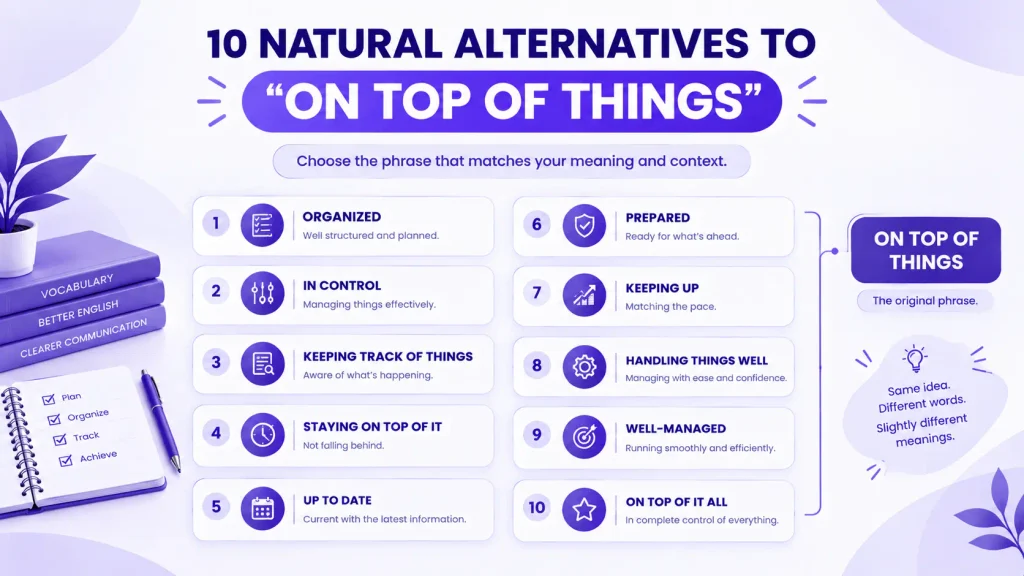
10 Natural Alternatives to “On Top of Things”
1. Organized
“Organized” is one of the simplest alternatives when you mean someone plans well, keeps things in order, and manages responsibilities efficiently.
Example:
“She’s very organized and rarely misses a deadline.”
Best for: Work, school, personal responsibilities, and everyday conversation.
Usage tip: “Organized” focuses on planning and structure, while “on top of things” can also suggest actively managing a changing situation.
2. In Control
“In control” is a useful alternative when the main idea is successfully managing a situation.
Example:
“Despite the last-minute changes, the project manager stayed in control.”
Best for: Problems, projects, difficult situations, and responsibilities.
Usage tip: “In control” can sound stronger than “on top of things” because it suggests that the person is successfully managing the situation.
3. Keeping Track of Things
If you mean monitoring tasks, deadlines, appointments, or details, “keeping track of things” is a natural choice.
Example:
“I use a calendar to keep track of things during busy weeks.”
Best for: Schedules, deadlines, information, tasks, and personal organization.
Usage tip: This expression emphasizes monitoring and remembering details. It does not necessarily mean that everything is being handled successfully.
4. Staying on Top of It
“Staying on top of it” is very close to “staying on top of things.” It works especially well when you’re talking about one particular task, problem, or responsibility.
Example:
“I’ve been staying on top of it, so we should have everything ready by Friday.”
Best for: Work, projects, responsibilities, and everyday conversation.
Usage tip: Use “it” when the specific task or responsibility is already clear from the conversation.
5. Up to Date
“Up to date” is a good alternative when “on top of things” means having the latest information.
Example:
“Make sure you’re up to date on the latest changes to the schedule.”
Best for: News, information, policies, schedules, records, and professional situations.
Usage tip: Someone can be up to date without necessarily being organized. Use this phrase when current information is the main point.
6. Prepared
“Prepared” works when the meaning is being ready for something that is coming.
Example:
“She was prepared for the meeting and had answers to all the major questions.”
Best for: Meetings, presentations, interviews, school, work, and upcoming events.
Usage tip: “Prepared” focuses on readiness rather than ongoing organization.
7. Keeping Up
“Keeping up” can work when you mean staying current with a workload, schedule, responsibilities, or changing situation.
Example:
“I’ve been keeping up with my assignments despite having a busy schedule.”
Best for: Workloads, assignments, responsibilities, and information.
Usage tip: “Keeping up” emphasizes maintaining pace. It doesn’t necessarily mean someone is especially organized.
8. Handling Things Well
“Handling things well” is a natural paraphrase when you want to emphasize someone’s ability to deal effectively with responsibilities or problems.
Example:
“She’s handling things well despite the extra workload.”
Best for: Stressful situations, responsibilities, work, and personal challenges.
Usage tip: This phrase focuses more on performance and problem-solving than organization.
9. Well-Managed
“Well-managed” is a more formal alternative that works particularly well when describing a project, process, workload, or situation.
Example:
“The team’s workload is well-managed, and everyone knows their responsibilities.”
Best for: Professional, business, academic, and formal contexts.
Usage tip: Unlike the conversational phrase “on top of things,” “well-managed” sounds more formal and is often used for systems, projects, or situations.
10. On Top of It All
“On top of it all” can describe someone who is successfully dealing with several responsibilities or complications at once.
Example:
“Even with several deadlines approaching, she’s on top of it all.”
Best for: Multiple tasks, busy schedules, complicated situations, and conversational English.
Usage tip: This expression is closely related to “on top of things,” but it often highlights the number or complexity of responsibilities being managed.
Which Alternative to “On Top of Things” Should You Use?
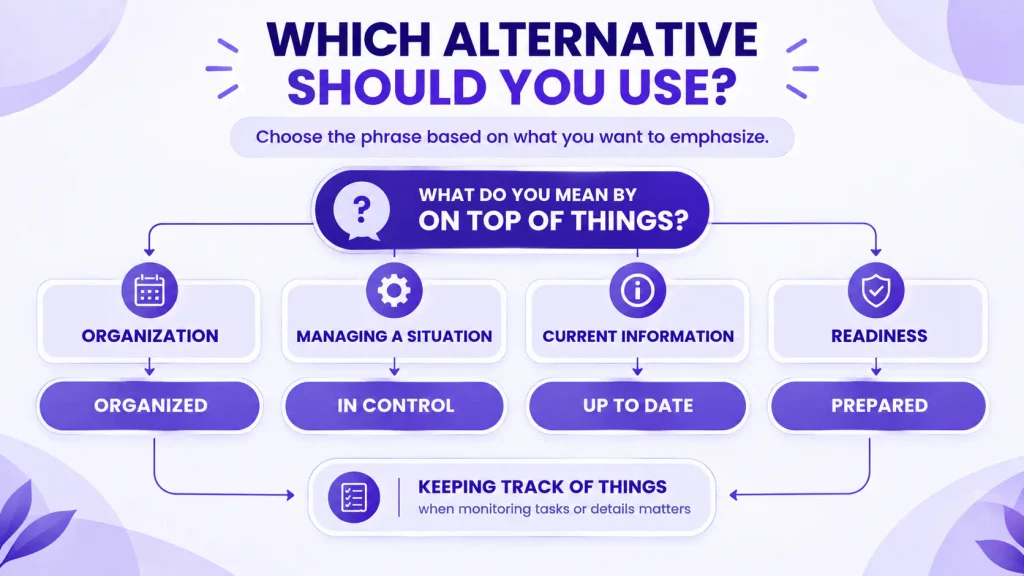
The best alternative to “on top of things” depends on the specific meaning you want.
| Alternative | Main Meaning | Tone | Best Context |
| Organized | Plans and manages things efficiently | Neutral | Work, school, everyday life |
| In control | Successfully manages a situation | Neutral | Problems, projects, difficult situations |
| Keeping track of things | Monitors tasks or details | Neutral | Schedules, deadlines, information |
| Staying on top of it | Manages a specific responsibility | Casual/Neutral | Work and conversation |
| Up to date | Has current information | Neutral/Formal | News, policies, schedules |
| Prepared | Ready for what is coming | Neutral | Meetings, events, work, school |
| Keeping up | Maintains pace with responsibilities | Casual/Neutral | Workloads and assignments |
| Handling things well | Deals effectively with responsibilities | Neutral | Problems and stressful situations |
| Well-managed | Effectively organized or controlled | Formal | Business and projects |
| On top of it all | Manages multiple responsibilities | Casual/Neutral | Busy or complicated situations |
Another Way to Say “On Top of Things” Professionally
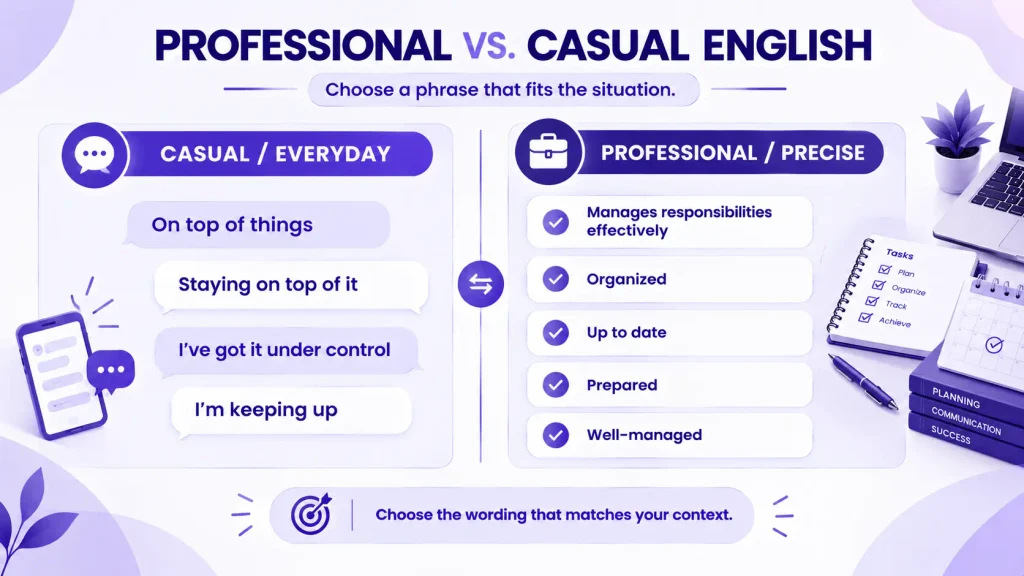
Although “on top of things” is common in American English, it has a conversational tone. In formal workplace writing, you may want to use more precise wording.
Instead of:
“She is always on top of things.”
You could write:
“She consistently manages her responsibilities effectively.”
Or:
“She keeps projects organized and meets deadlines consistently.”
If you mean that someone has current information, “up to date” may be more precise:
“The team is up to date on the latest policy changes.”
If you mean that someone is ready for an upcoming task, “prepared” is a better choice:
“The team is fully prepared for the upcoming presentation.”
Specific wording can make professional communication clearer and more precise.
Casual Alternatives to “On Top of Things”
In everyday conversation, these expressions can sound natural:
- I’ve got it under control.
- I’m keeping up.
- I’m staying on top of it.
- I’m keeping track of everything.
- I’m handling it.
- I’m organized.
For example:
“Don’t worry. I’ve got everything under control.”
This is a natural way to reassure someone that you are managing a situation.
Common Mistakes When Choosing an Alternative to “On Top of Things”
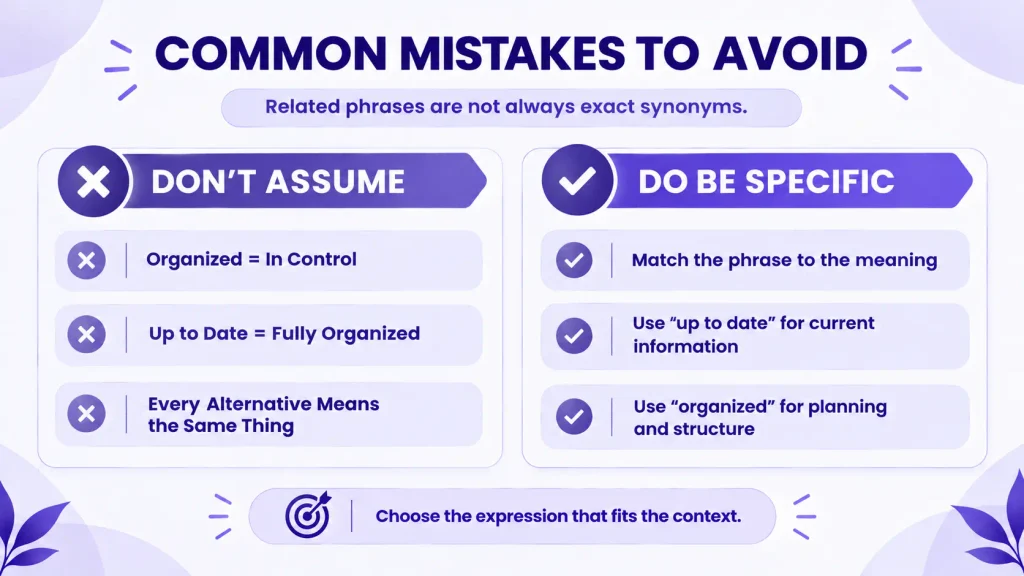
Treating Every Alternative as an Exact Synonym
The alternatives above overlap with “on top of things,” but they don’t all have exactly the same meaning.
For example, being “up to date” means having current information. Being “organized” means having things arranged effectively. Being “in control” suggests successfully managing a situation.
Choose the expression that matches your intended meaning.
Using “In Control” When You Mean “Organized”
Someone can be highly organized without necessarily being in control of a situation.
For example:
“She keeps detailed notes and maintains an organized calendar.”
In this sentence, “organized” is more precise than “in control.”
Using Casual Language in Formal Writing
“On top of things” is common in conversation, but formal writing may benefit from more specific alternatives such as well-managed, prepared, informed, or organized.
Assuming “Up to Date” Means Fully Organized
A person can be completely up to date on information but still struggle with a workload.
Use “up to date” when the main focus is current information.
Frequently Asked Questions About “On Top of Things”
What is another word for “on top of things”?
Common alternatives include organized, prepared, informed, in control, and well-managed. The best choice depends on whether you’re talking about organization, information, readiness, or managing a situation.
What does “on top of things” mean?
“On top of things” means being aware of responsibilities and managing them effectively. It can suggest that someone is organized, prepared, informed, or keeping up with what needs to be done.
Is “on top of things” formal or informal?
“On top of things” is generally informal to neutral. It is common in everyday American English and can also appear in casual workplace communication. More specific wording may be preferable in formal writing.
What is another way to say “on top of things” professionally?
Depending on the meaning, you can say organized, well-prepared, up to date, managing responsibilities effectively, keeping projects on track, or well-managed.
How do you say “stay on top of things” differently?
You can say keep up with responsibilities, stay organized, keep track of tasks, remain up to date, manage things effectively, or keep everything under control, depending on the situation.
Is “on top of it” the same as “on top of things”?
They are closely related. “On top of it” usually refers to a particular task, issue, or responsibility, while “on top of things” is broader and can refer to someone’s overall ability to manage responsibilities.
What is the opposite of being “on top of things”?
Depending on the context, possible opposites include disorganized, behind, overwhelmed, unprepared, out of the loop, or struggling to keep up. Each describes a slightly different problem.
Conclusion
“On top of things” is a flexible American English expression for being organized, informed, prepared, or capable of managing responsibilities effectively. Since the phrase can express several related ideas, the best alternative depends on the situation.
Use “organized” when planning and structure are the focus, “in control” when managing a situation is the focus, “up to date” when current information matters, and “prepared” when readiness is most important.
For professional writing, expressions such as “well-managed” or “managing responsibilities effectively” can make your meaning clearer and more precise.

Role: Editorial Contributor
Graham Ellis contributes practical English and communication guides to RepublicsPress. His content focuses on vocabulary, writing techniques, word usage, and clear communication, with an emphasis on straightforward explanations and real-world examples.