Another Way to Say Alot: 15 Natural Alternatives to “A Lot”
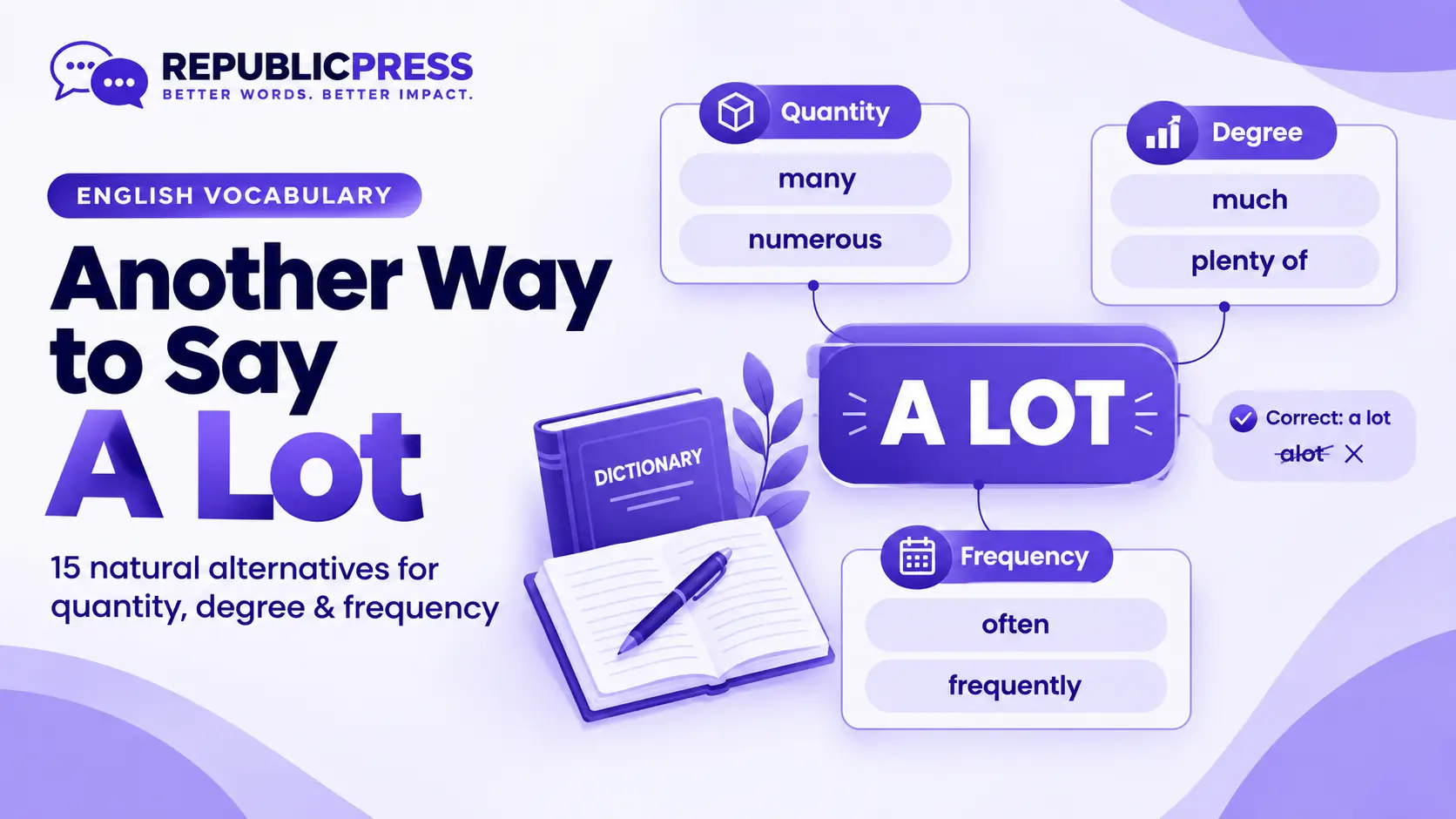
If you’re looking for another way to say “alot,” the correct spelling is actually “a lot”—two words. Depending on the sentence, natural alternatives include “many,” “much,” “plenty of,” “numerous,” “a great deal,” “frequently,” and “often.” The best choice depends on whether you mean a large quantity, a high degree, or frequent action.
Key Takeaways
- “Alot” is not the standard spelling; write “a lot” as two words.
- Use “many” with countable nouns, such as “many people” or “many books.”
- Use “much” mainly with uncountable nouns, especially in more formal or negative constructions.
- “Plenty of” suggests more than enough, while “numerous” emphasizes a large number.
- When “a lot” means “often,” alternatives such as “frequently,” “regularly,” or “often” work better.
- “Allot” is a different word meaning to assign or distribute something; it is not another spelling of “a lot.”
What Does “A Lot” Mean?
“A lot” can express a large quantity, a high degree, or frequent action.
For example:
- We have a lot of work to finish.
- She knows a lot about photography.
- He travels a lot for work.
The best replacement changes according to the meaning.
When “a lot” refers to a large number of countable things, words such as “many” and “numerous” can work. When it refers to an uncountable amount, “much” or “a great deal” may be more appropriate. When it describes how frequently something happens, “often” or “frequently” may be the better choice.
Another Way to Say “A Lot”
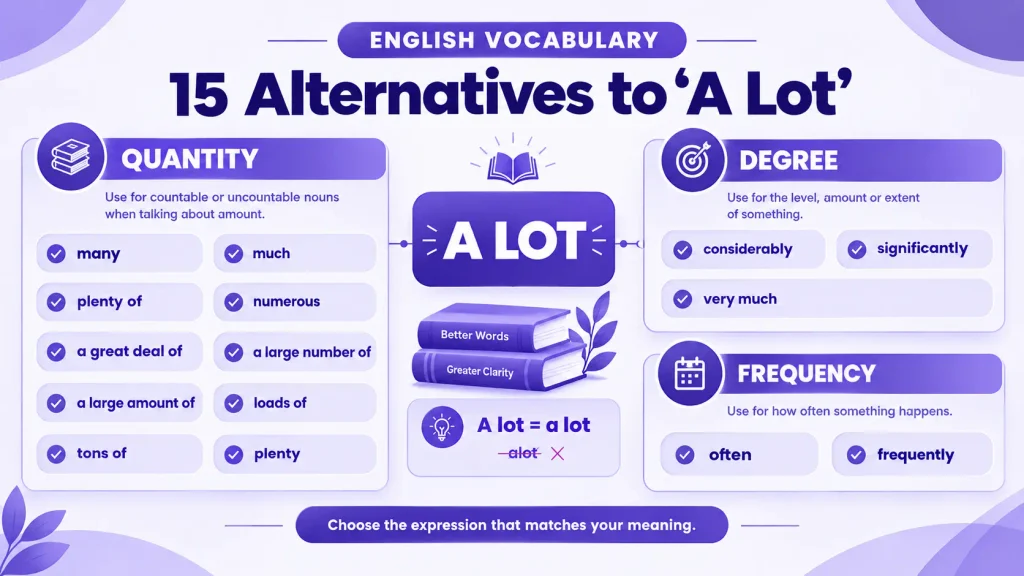
Here are natural alternatives, with the context where each one works best.
1. Many
“Many” is one of the simplest replacements for “a lot of” when you are talking about countable nouns.
Example:
- A lot of students attended the event.
- Many students attended the event.
Best for: Everyday, academic, and professional writing.
Tip: Use “many” with plural countable nouns: many people, many books, many ideas, many questions.
2. Much
“Much” refers to a large amount of something that cannot normally be counted individually.
Example:
- I don’t have a lot of time.
- I don’t have much time.
Best for: Formal writing, negative sentences, and questions.
Tip: In positive everyday sentences, “a lot of” often sounds more natural than “much.”
For example, “I have a lot of work” is more natural in ordinary conversation than “I have much work.”
3. Plenty of
“Plenty of” means a large amount or number, often with the idea that there is enough or more than enough.
Example:
- We have a lot of food for everyone.
- We have plenty of food for everyone.
Best for: Conversational, friendly, and reassuring language.
Tip: This isn’t always an exact replacement. “Plenty of” can imply sufficiency, while “a lot of” simply emphasizes quantity.
4. Numerous
“Numerous” means many and is especially useful when you want a more formal tone.
Example:
- The company received a lot of applications.
- The company received numerous applications.
Best for: Professional, academic, and formal writing.
Tip: “Numerous” normally describes countable plural nouns.
5. A Great Deal of
“A great deal of” means a large amount and is generally more formal than “a lot of.”
Example:
- The project required a lot of patience.
- The project required a great deal of patience.
Best for: Formal and professional writing.
Tip: Use it mainly with uncountable nouns such as time, effort, money, attention, or patience.
6. A Large Number of
“A large number of” is a clear formal alternative when you are talking about countable things.
Example:
- A lot of customers responded to the survey.
- A large number of customers responded to the survey.
Best for: Reports, research, business writing, and formal explanations.
Tip: Because it refers to numbers of individual items or people, it works with plural countable nouns.
7. A Large Amount of
“A large amount of” works with uncountable nouns.
Example:
- The renovation required a lot of money.
- The renovation required a large amount of money.
Best for: Formal and informational writing.
Tip: Don’t use “a large amount of” with ordinary plural countable nouns. Say “a large number of employees,” not “a large number of employees.”
8. Loads of
“Loads of” is an informal way to express a large quantity.
Example:
- We had a lot of fun at the party.
- We had loads of fun at the party.
Best for: Casual conversation, texting, and friendly writing.
Tip: It can sound too informal for academic or highly professional writing.
9. Tons of
“Tons of” is an informal expression meaning a very large amount or number.
Example:
- There are a lot of great restaurants downtown.
- There are tons of great restaurants downtown.
Best for: Casual American English.
Tip: “Tons of” is usually figurative, not a literal measurement of weight.
10. Plenty
Sometimes you can remove “of” altogether and use “plenty” naturally.
Example:
- We have a lot of time.
- We have plenty of time.
It can also stand alone:
- Don’t worry. We have plenty.
Best for: Conversational and everyday English.
Tip: “Plenty” often communicates that there is enough or more than enough, not merely that the amount is large.
11. Considerably
When “a lot” means “to a great degree,” “considerably” can be a strong alternative.
Example:
- The new system improved performance a lot.
- The new system considerably improved performance.
Best for: Formal, professional, and analytical writing.
Tip: This works with degree or extent, not with a literal quantity of objects.
12. Significantly
“Significantly” can replace “a lot” when the meaning is that something changed or increased by a noticeable degree.
Example:
- The new strategy reduced costs a lot.
- The new strategy significantly reduced costs.
Best for: Academic, professional, business, and analytical writing.
Tip: “Significantly” can suggest an important or substantial change, so it is not interchangeable with every use of “a lot.”
13. Very Much
When “a lot” means “to a great degree,” “very much” is often a natural replacement.
Example:
- I appreciate your help a lot.
- I appreciate your help very much.
Best for: Polite, emotional, and conversational situations.
Tip: This is especially useful with verbs expressing feelings, opinions, or appreciation.
14. Often
If “a lot” means that something happens frequently, “often” is usually the clearest alternative.
Example:
- I go there a lot.
- I go there often.
Best for: Everyday and neutral English.
Tip: This is a meaning-based replacement, not a quantity-based one. “Often” describes frequency.
15. Frequently
“Frequently” also means often, but it generally sounds more formal.
Example:
- She travels a lot for work.
- She frequently travels for work.
Best for: Professional, academic, and formal writing.
Tip: Use it when the important idea is how often something happens rather than how much of something exists.
Quick Comparison: Which Alternative Should You Use?
| Alternative | Meaning/Use | Tone | Best Context |
| Many | Large number | Neutral | Everyday, academic |
| Much | Large amount | Neutral/formal | Uncountable nouns |
| Plenty of | More than enough | Friendly | Everyday |
| Numerous | Large number | Formal | Professional, academic |
| A great deal of | Large amount | Formal | Professional, academic |
| A large number of | Large number | Formal | Reports, business |
| A large amount of | Large quantity | Formal | Reports, informational writing |
| Loads of | Large amount/number | Casual | Conversation |
| Tons of | Large amount/number | Casual | Conversation |
| Considerably | To a great degree | Formal | Analytical writing |
| Significantly | By a substantial degree | Formal | Business, academic |
| Very much | To a great degree | Neutral | Feelings, opinions |
| Often | Frequently | Neutral | Everyday English |
| Frequently | Often | Formal | Professional, academic |
“A Lot” for Quantity vs. “A Lot” for Frequency
One of the easiest ways to choose the right alternative is to determine what “a lot” means in your sentence.
When “a lot” means a large quantity
Use alternatives such as:
- many
- much
- plenty of
- numerous
- a great deal of
- a large number of
- a large amount of
Example:
There are a lot of people at the concert.
You could say:
There are many people at the concert.
Or:
There are numerous people at the concert.
When “a lot” means frequently
Use:
- often
- frequently
- regularly
- repeatedly
Example:
She visits her grandparents a lot.
You could say:
She often visits her grandparents.
The meaning is about frequency rather than quantity.
When “a lot” means to a great degree
Use:
- very much
- considerably
- significantly
- greatly
Example:
The experience helped me a lot.
Depending on the context, you could write:
The experience helped me greatly.
Or:
The experience helped me considerably.
The exact replacement depends on the sentence and the level of formality you want.
“A Lot” vs. “Alot” vs. “Allot”
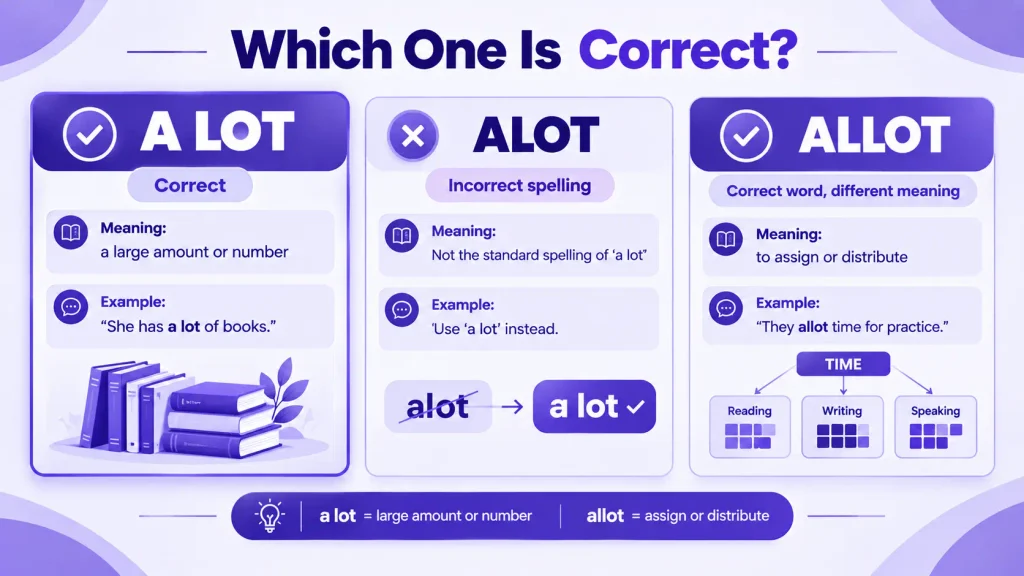
These three forms are easy to confuse, but they do not have the same status or meaning.
A lot
A lot is the standard spelling. It can refer to a large quantity or amount, or it can function adverbially to mean “very much” or “often.”
Example:
I learned a lot from that course.
Alot
Alot is a common misspelling of “a lot.” In standard English, it should be written as two words.
Incorrect:
I enjoyed the movie alot.
Correct:
I enjoyed the movie a lot.
Allot
Allot is a completely different verb. It means to assign, distribute, or set aside something for a particular purpose.
Example:
We need to allot enough time for questions.
A useful way to remember the distinction is:
- a lot = a large amount or frequently
- allot = assign or distribute
- alot = incorrect spelling in standard English
Common Mistakes When Replacing “A Lot”
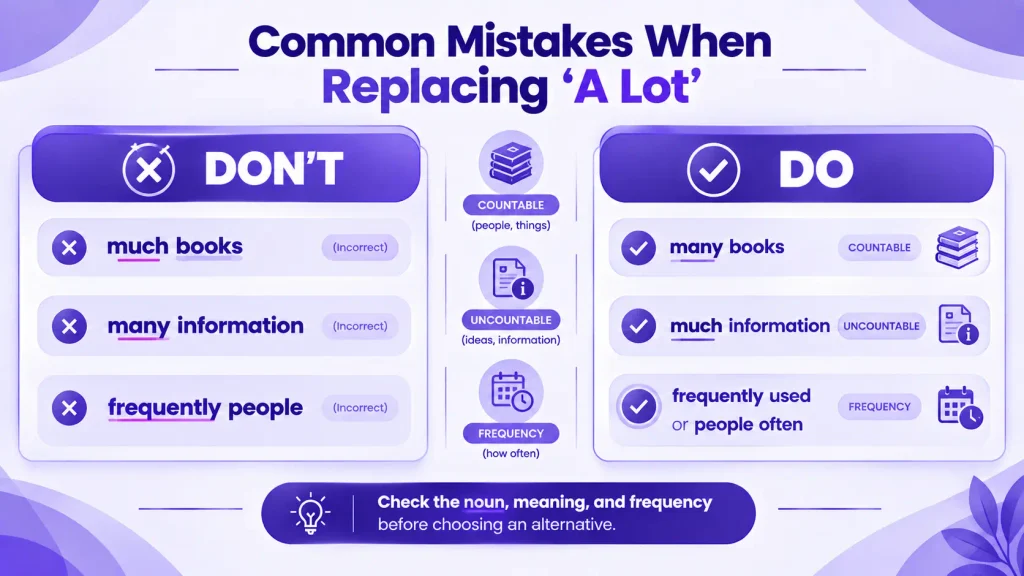
Using “many” with an uncountable noun
Incorrect:
I don’t have much time.
Correct:
I don’t have much time.
Or:
I don’t have a lot of time.
“Many” generally works with plural countable nouns, while “much” works with uncountable nouns.
Using “numerous” with an uncountable noun
Incorrect:
She showed numerous patience.
Better:
She showed a great deal of patience.
“Numerous” refers to a large number of individual countable things.
Using casual expressions in formal writing
Phrases such as “loads of” and “tons of” are natural in conversation but may sound too casual in a formal report.
Instead of:
The company received tons of complaints.
A formal report might say:
The company received numerous complaints.
Treating “a lot” and “often” as exact synonyms
They are not always interchangeable.
Compare:
I read a lot.
This can mean that I read frequently or that I read extensively.
But:
I read often.
Specifically emphasizes frequency.
Context determines which replacement is accurate.
How to Choose the Right Alternative
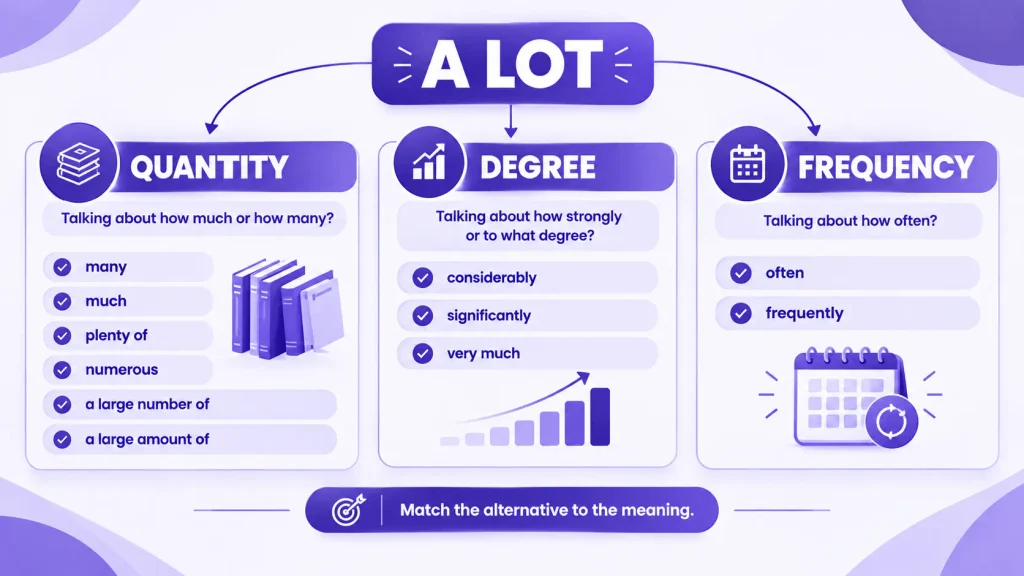
Use this simple guide:
Talking about people, books, ideas, or other countable things?
Try “many,” “numerous,” or “a large number of.”
Talking about time, money, effort, information, or another uncountable thing?
Try “much,” “a great deal of,” or “a large amount of.”
Want to say there is more than enough?
Use “plenty of.”
Writing casually?
“Loads of” or “tons of” can work.
Writing professionally or academically?
Consider “numerous,” “a great deal of,” “a large number of,” or “significantly,” depending on the meaning.
Talking about how frequently something happens?
Use “often,” “frequently,” or “regularly.”
Frequently Asked Questions
What is another word for “a lot”?
Common alternatives include “many,” “much,” “plenty of,” “numerous,” “a great deal of,” and “a large number of.” The correct choice depends on whether you are referring to a countable number, an uncountable amount, or degree.
Is “alot” one word or two?
The standard spelling is “a lot,” with two words. “Alot” is a common misspelling and should not be used in standard English.
What is a formal way to say “a lot”?
Depending on the sentence, formal alternatives include “numerous,” “a great deal of,” “a large number of,” “a large amount of,” “considerably,” and “significantly.”
What is a casual way to say “a lot”?
“Loads of” and “tons of” are common informal alternatives. “Plenty of” is also natural in everyday conversation, although it can carry the additional meaning of having enough or more than enough.
Can I use “many” instead of “a lot”?
Often, yes, when “a lot of” refers to a large number of countable things.
A lot of people came.
can become:
Many people came.
But “many” cannot replace every use of “a lot.”
Can I use “much” instead of “a lot”?
Sometimes. “Much” is used with uncountable nouns, but its naturalness depends on the sentence. In everyday positive statements, “a lot of” is often more natural.
What is the difference between “a lot” and “allot”?
“A lot” refers to a large amount, number, or degree, while “allot” is a verb meaning to assign or distribute something.
Final Thoughts
The best alternative to “a lot” depends on what you are trying to express. Use “many” for countable things, “much” for uncountable amounts, “numerous” or “a great deal of” for a more formal tone, and “often” or “frequently” when “a lot” describes how often something happens.
Most importantly, remember the spelling: “a lot” is two words. “Alot” is not the standard form.

Role: English Content Writer
Maren Whitlock writes practical English language content for RepublicsPress, with a focus on vocabulary, word alternatives, everyday expressions, and clear communication. Her articles are designed to make difficult or confusing language easier to understand, with simple explanations and useful examples readers can apply in real situations.