
Another Way to Say “Per”: Meaning, Alternatives & Examples
Another way to say “per” depends on the context. Common alternatives include each, for every, according to, by, in accordance with, for each unit, and for every unit. For rates, “each” or “for every” often works naturally. In phrases such as “per the instructions,” “according to” is usually the better choice.
Key Takeaways
- “Per” commonly means “for each,” “according to,” or “for every.”
- Use “each” for rates and quantities, such as “$10 each.”
- Use “for every” when you want to make a comparison or ratio clearer.
- Use “according to” instead of “per” when referring to a rule, instruction, or source.
- “By” can replace “per” in some measurement and rate expressions, but not all.
- The best alternative depends on the sentence, tone, and intended meaning.
What Does “Per” Mean?
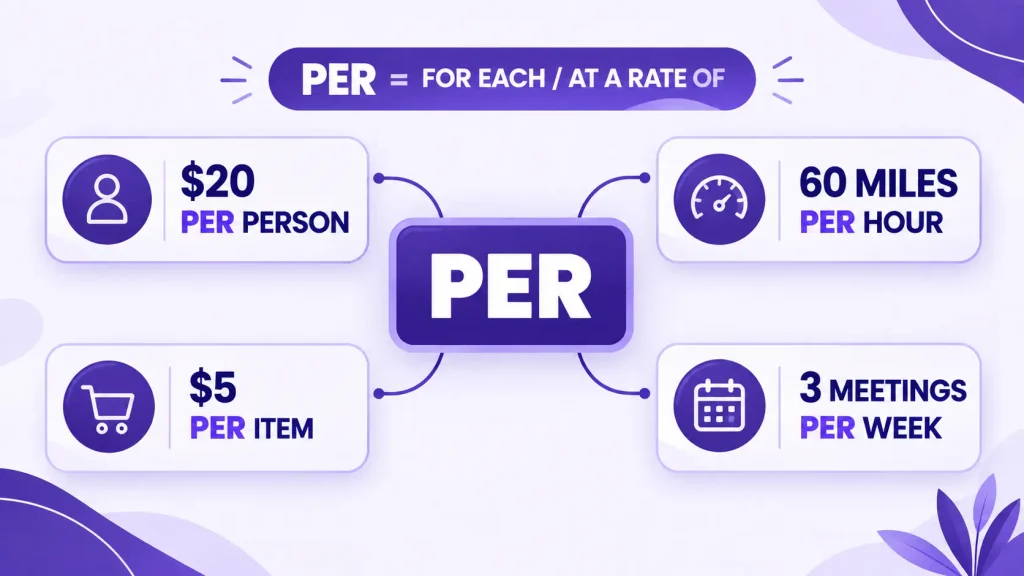
The word “per” is a preposition used to express a rate, ratio, unit, or reference to a rule or source.
For example:
- The tickets cost $20 per person.
- The car gets 30 miles per gallon.
- Employees are paid per hour.
- Per the agreement, payment is due within 30 days.
Because “per” has more than one use, there is no single replacement that works in every sentence.
“Per” Meaning “For Each”
When “per” describes a rate or quantity for individual units, it often means “for each” or simply “each.”
The apples cost $2 per pound.
You could write:
The apples cost $2 for each pound.
Or, depending on the sentence:
The apples cost $2 each.
The exact replacement depends on what is being measured.
“Per” Meaning “According to”
In expressions such as “per the instructions” or “per the policy,” the word means something closer to “according to” or “in accordance with.”
For example:
Per the company’s policy, employees must submit the form by Friday.
A natural alternative is:
According to the company’s policy, employees must submit the form by Friday.
This use is especially common in workplace and professional writing.
Best Alternatives to “Per”
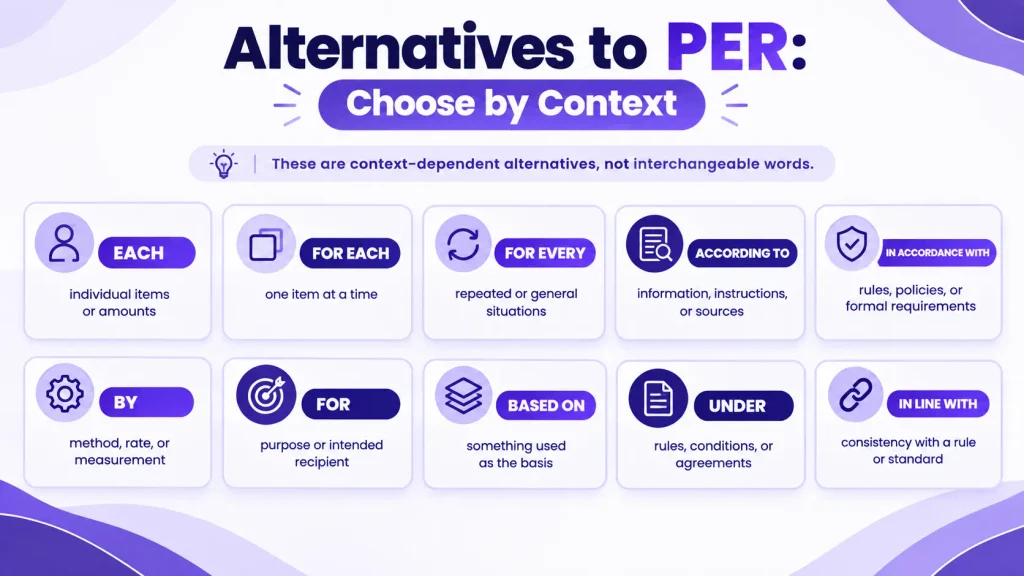
Here are useful alternatives, grouped by meaning rather than simply listed as dictionary synonyms.
1. Each
“Each” is one of the most natural alternatives when “per” means an amount for an individual item or person.
Example:
The tickets cost $25 per person.
Alternative:
The tickets cost $25 each.
Best for: Prices, quantities, and individual units.
Keep in mind that “each” cannot replace “per” in every sentence. The sentence structure may need to change.
2. For Each
“For each” is a direct and clear alternative when you want to emphasize the relationship between an amount and a unit.
Example:
Students receive one point per correct answer.
Alternative:
Students receive one point for each correct answer.
Best for: Instructions, calculations, quantities, and explanations.
“For each” is often especially useful when clarity matters more than brevity.
3. For Every
“For every” works well when describing a repeated relationship, ratio, or comparison.
Example:
The company plants one tree per order.
Alternative:
The company plants one tree for every order.
Best for: Ratios, comparisons, policies, and cause-and-effect relationships.
It can sound more conversational and explicit than “per.”
4. According to
Use “according to” when “per” refers to information, instructions, rules, policies, or another source.
Example:
Per the manufacturer’s instructions, the device should be turned off before cleaning.
Alternative:
According to the manufacturer’s instructions, the device should be turned off before cleaning.
Best for: Policies, instructions, reports, sources, and professional writing.
This is not a synonym for the rate-related meaning of “per.” It replaces a different use of the word.
5. In Accordance With
“In accordance with” is a formal alternative to “per” when referring to rules, requirements, policies, or procedures.
Example:
Per company policy, employees must wear identification badges.
Alternative:
In accordance with company policy, employees must wear identification badges.
Best for: Formal, legal, administrative, and professional writing.
It is more formal and longer than “per,” so it should not be used simply to make ordinary sentences sound sophisticated.
6. By
In certain measurement expressions, “by” can replace “per” or express a similar relationship.
Example:
The medication is measured per kilogram of body weight.
Depending on the intended meaning, this may be expressed as:
The medication is measured by kilogram of body weight.
However, this substitution is context-dependent and may not sound natural in every sentence. “By” is not a universal replacement for “per.”
Best for: Certain measurements, rates, and methods where the sentence naturally supports the construction.
7. For
In some expressions, simply using “for” produces a more natural sentence.
Example:
The hotel charges $150 per night.
A possible alternative is:
The hotel charges $150 for a night.
The second version changes the structure slightly and may sound less standard depending on the context.
Best for: Rephrasing sentences where “per” expresses a charge or amount associated with a period or unit.
8. Based on
When “per” refers to a standard, calculation, guideline, or specified basis, “based on” can sometimes provide a clearer alternative.
Example:
The payment was calculated per the terms of the contract.
Depending on the intended meaning:
The payment was calculated based on the terms of the contract.
The two sentences are related, but they are not always interchangeable. “Based on” emphasizes the foundation for a decision or calculation.
Best for: Calculations, decisions, reports, and explanations.
9. Under
“Under” can sometimes replace “per” when referring to a policy, agreement, law, rule, or set of conditions.
Example:
Per the agreement, either party can terminate the contract with 30 days’ notice.
A possible alternative is:
Under the agreement, either party can terminate the contract with 30 days’ notice.
Best for: Agreements, policies, rules, laws, and contractual conditions.
The nuance is slightly different: “under” often emphasizes the conditions established by something.
10. In Line With
“In line with” can work when “per” means that something follows a policy, expectation, recommendation, or established standard.
Example:
Per the new guidelines, the application process has changed.
Alternative:
In line with the new guidelines, the application process has changed.
Best for: Professional communication, policies, guidelines, and general explanations.
This phrase is generally more conversational than “in accordance with.”
Comparison of Alternatives to “Per”
| Alternative | Main Meaning | Tone | Best Context |
| Each | For individual units | Neutral | Prices, quantities |
| For each | For every individual unit | Neutral | Instructions, calculations |
| For every | For each occurrence or unit | Neutral | Ratios, comparisons |
| According to | As stated by a source or rule | Neutral | Policies, instructions |
| In accordance with | Following a rule or requirement | Formal | Legal, professional |
| By | Measurement or method in some contexts | Neutral | Certain rates and measurements |
| For | Associated with a unit or period | Neutral | Charges, amounts |
| Based on | Using something as a foundation | Neutral | Calculations, decisions |
| Under | Within the conditions of something | Neutral/Formal | Agreements, rules |
| In line with | Consistent with something | Neutral/Professional | Guidelines, policies |
How to Choose the Right Alternative
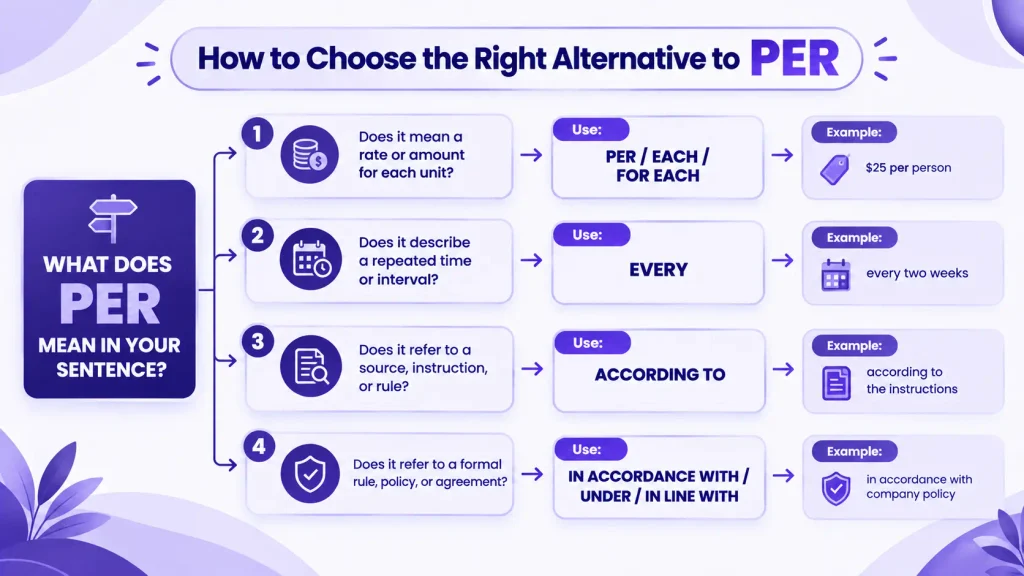
The easiest way to replace “per” is to identify what it means in your sentence.
If “per” means “each”
Use “each” or “for each.”
$5 per item → $5 for each item
If “per” means “for every”
Use “for every.”
One free drink per five purchases → One free drink for every five purchases
If “per” refers to a source or rule
Use “according to.”
Per the instructions → According to the instructions
If “per” refers to a policy or agreement
Use “in accordance with,” “under,” or “in line with,” depending on the sentence.
Per the agreement → Under the agreement
The best choice is the one that preserves both the meaning and grammatical structure of the original sentence.
“Per” in Professional Writing

“Per” is common in workplace communication, especially in phrases such as:
- Per our conversation
- Per your request
- Per company policy
- Per the agreement
- Per the instructions
- Per the schedule
Some of these expressions are perfectly understandable, but alternatives can sound more natural depending on the audience.
For example:
Per your request, I have attached the revised document.
Could become:
As requested, I have attached the revised document.
The second version is often more direct and natural in an email.
Similarly:
Per our conversation, the meeting has been moved to Friday.
Could become:
As discussed, the meeting has been moved to Friday.
These alternatives can make professional writing feel less formulaic.
Common Mistakes When Replacing “Per”
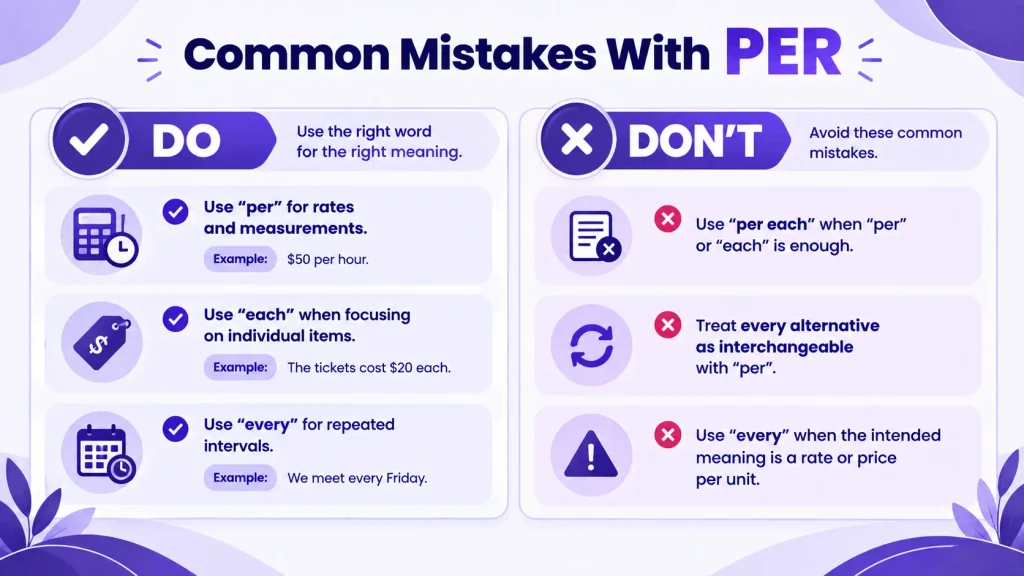
Mistake 1: Treating every alternative as an exact synonym
“Each” and “according to” do not mean the same thing.
$10 per person → $10 each
works because “per” means “for each.”
But:
Per company policy → Each company policy
does not work.
Always identify the meaning before choosing a replacement.
Mistake 2: Using “according to” for rates
“According to” normally introduces information, a source, rule, or authority. It does not naturally replace “per” in ordinary rate expressions.
$50 per hour
should not normally become:
$50 according to hour.
The correct alternative would involve a different sentence structure, such as:
$50 for each hour.
Mistake 3: Making a sentence unnecessarily formal
“In accordance with” is useful in formal contexts, but it can sound excessive in casual communication.
Instead of:
In accordance with your request, I have sent the file.
a simple professional email might say:
As requested, I have sent the file.
Mistake 4: Assuming “by” always replaces “per”
“By” can work in certain measurement or method-related expressions, but it is not a universal substitute.
Check the complete sentence rather than replacing “per” automatically.
Frequently Asked Questions
What is the simplest word for “per”?
When “per” means “for each,” “each” is often the simplest alternative.
For example:
$10 per person → $10 each
The exact wording depends on the sentence structure.
What is another way to say “per person”?
Common alternatives include “for each person,” “for every person,” or “each,” depending on the sentence.
$20 per person
can become:
$20 for each person.
What is another way to say “per day”?
Depending on the sentence, you can use “each day,” “for each day,” or “daily.”
For example:
The hotel charges $100 per day.
can become:
The hotel charges $100 each day.
What is another way to say “per hour”?
Possible alternatives include “each hour,” “for each hour,” or “hourly.”
For example:
The employee earns $20 per hour.
can become:
The employee earns $20 an hour.
What is another way to say “per the instructions”?
Natural alternatives include “according to the instructions,” “following the instructions,” or “as instructed.”
The best choice depends on the sentence.
Is “per” formal or informal?
“Per” is neither strictly formal nor informal. It is a standard English preposition used in many settings, including everyday, technical, business, and academic writing. Some constructions, such as “per our conversation,” can sound more businesslike than their simpler alternatives.
Is “per” the same as “each”?
Sometimes. When “per” means “for each,” “each” can often replace it.
$5 per item → $5 each
But “per” has other meanings, so the two words are not interchangeable in every sentence.
What is a more natural alternative to “per your request”?
“As requested” is often a concise and natural alternative.
Per your request, I attached the document.
can become:
As requested, I attached the document.
Final Takeaway
The best alternative to “per” depends on what the word means in the sentence. Use “each” or “for each” for rates and individual units, “for every” for repeated relationships, and “according to” when referring to a source, instruction, or rule. In professional writing, phrases such as “as requested,” “under,” and “in accordance with” can also provide more natural or precise wording.
Rather than replacing “per” automatically, first identify its meaning. That small distinction will help you choose an alternative that sounds natural and preserves the original message.

Role: Language & Content Specialist
Tessa Holloway creates language-focused content covering phrases, idioms, expressions, vocabulary, and natural American English. Her work helps readers choose words and expressions that fit different everyday, academic, and professional situations.