Another Way to Say Brought to You By: 10 Natural Alternatives
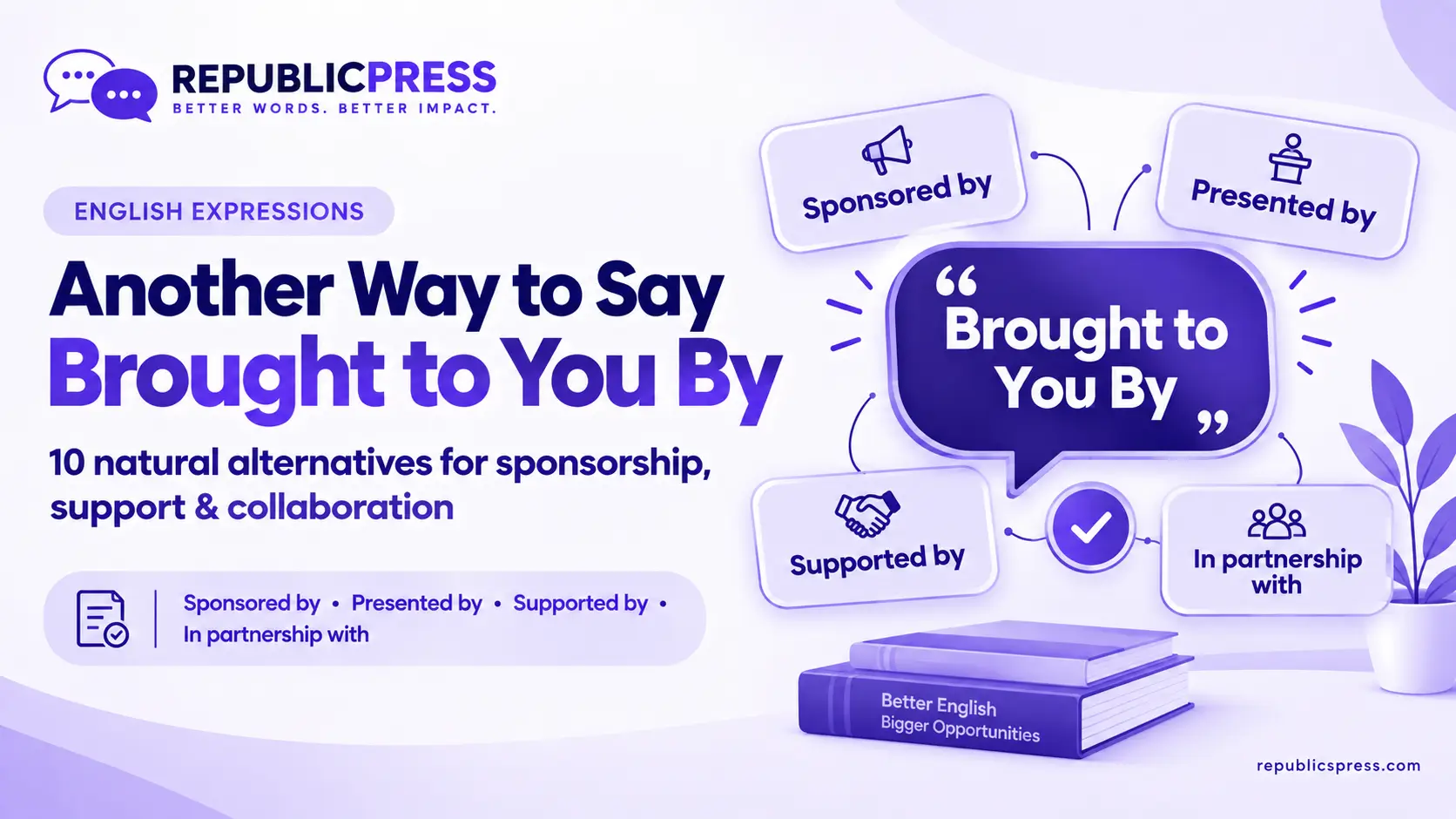
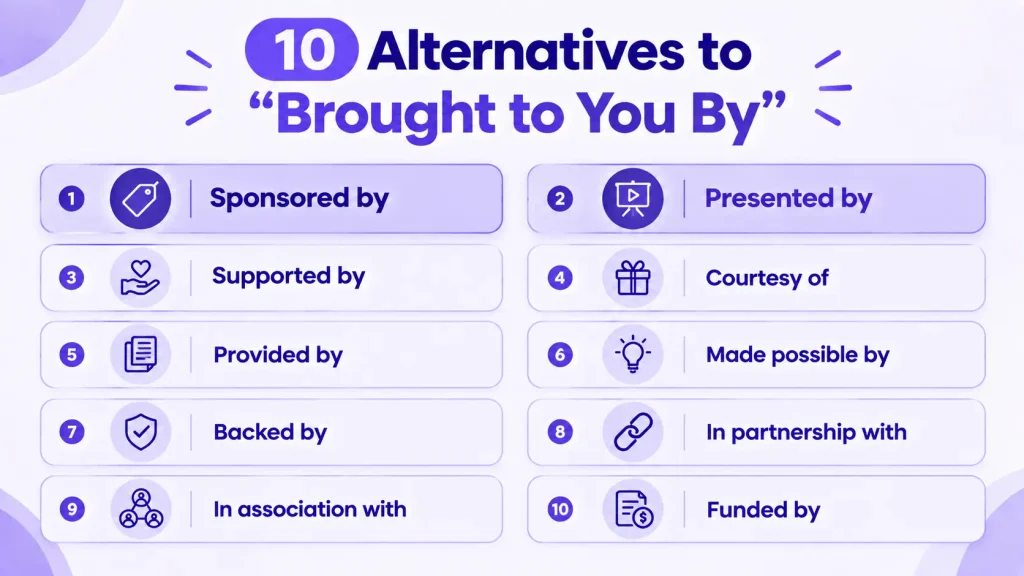
Direct answer: Common alternatives to “brought to you by” include “sponsored by,” “presented by,” “supported by,” “courtesy of,” “provided by,” “made possible by,” “backed by,” “in partnership with,” “in association with,” and “funded by.” The best choice depends on whether you mean sponsorship, financial support, collaboration, or simply credit.
Key Takeaways
- “Sponsored by” is the clearest choice when a company financially supports content or an event.
- “Presented by” works well for events, shows, programs, and special features.
- “Supported by” emphasizes assistance without necessarily suggesting full sponsorship.
- “Courtesy of” is useful when something is provided as a favor or contribution.
- “In partnership with” suggests collaboration rather than simple sponsorship.
- Some alternatives change the meaning slightly, so they should not be treated as exact synonyms.
What Does “Brought to You By” Mean?
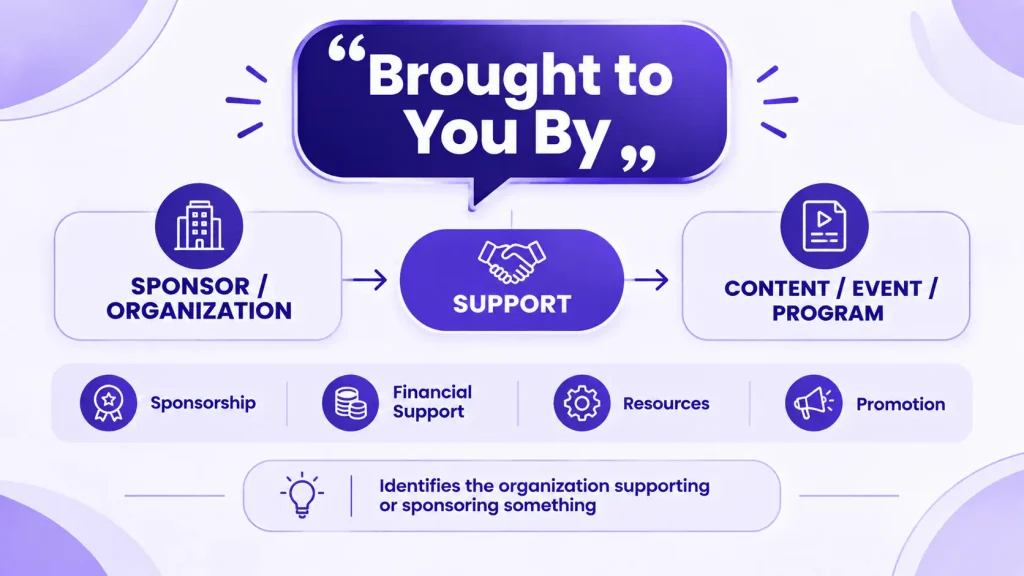
“Brought to you by” is commonly used to identify a company, organization, or person that sponsors, funds, supports, or helps provide a program, event, piece of content, or other experience.
For example:
This podcast is brought to you by Green Valley Coffee.
Here, the phrase usually tells the audience that Green Valley Coffee is connected to the production through sponsorship or financial support. The expression is especially common in television, radio, podcasts, events, newsletters, and digital content.
The exact relationship can vary, though. A sponsor may provide money, resources, or other support without actually creating the content. That’s why choosing a more specific alternative can sometimes make your meaning clearer.
10 Natural Alternatives to “Brought to You By”
1. Sponsored By
Best for: Advertising, events, podcasts, programs, newsletters, and sponsored content
“Sponsored by” is often the clearest alternative when an organization provides financial or promotional support.
Example:
This week’s podcast is sponsored by BrightPath Financial.
Usage tip: Use this when you want to make the sponsorship relationship explicit rather than using the softer “brought to you by.”
2. Presented By
Best for: Events, shows, performances, programs, and special features
“Presented by” is a polished alternative that is especially common in event and entertainment settings. It can indicate a sponsor or an organization taking a prominent presenting role. Sponsorship terminology can vary by organization and context.
Example:
The 2026 Summer Music Festival is presented by Riverstone Bank.
Usage tip: “Presented by” can sound more promotional or event-focused than “supported by.”
3. Supported By
Best for: Nonprofits, educational programs, community events, grants, and public-interest projects
“Supported by” emphasizes assistance rather than ownership or direct production.
Example:
The community art program is supported by several local businesses.
Usage tip: This is useful when a company or organization provides resources or funding but isn’t necessarily the main sponsor.
4. Courtesy Of
Best for: Gifts, complimentary services, products, information, or contributions
“Courtesy of” focuses on something being provided by someone as a favor or contribution.
Example:
Refreshments are provided courtesy of Lakeside Market.
Usage tip: This isn’t a perfect substitute for “brought to you by” in every sponsorship context. Use it when you’re emphasizing what was provided rather than who sponsored the entire project.
5. Provided By
Best for: Services, resources, information, materials, and practical support
“Provided by” directly identifies the person or organization supplying something.
Example:
This free workshop is provided by the City Library.
Usage tip: It works best when the named organization actually supplies the service, resource, or material.
6. Made Possible By
Best for: Fundraising, grants, nonprofits, community programs, and special projects
“Made possible by” highlights the contribution that allowed something to happen.
Example:
This educational program was made possible by a grant from the Horizon Foundation.
Usage tip: This phrase puts the focus on the sponsor’s contribution rather than simply labeling the organization as an advertiser.
7. Backed By
Best for: Financial support, business projects, startups, initiatives, and major campaigns
“Backed by” suggests meaningful financial, organizational, or institutional support.
Example:
The new research initiative is backed by several technology companies.
Usage tip: It can imply stronger or broader support than a simple sponsorship, so don’t use it when the relationship is only a small advertising placement.
8. In Partnership With
Best for: Collaborations, joint projects, events, campaigns, and organizational relationships
“In partnership with” suggests that two or more parties are working together rather than one simply paying for exposure.
Example:
The workshop was created in partnership with the local business association.
Usage tip: Don’t use this phrase if there is no genuine collaborative relationship. A sponsorship alone doesn’t necessarily mean the organizations are partners. Some organizations explicitly distinguish a “partner” relationship from ordinary sponsorship.
9. In Association With
Best for: Collaborative projects, productions, events, and formal affiliations
“In association with” is another way to show that an organization is connected to a project or production.
Example:
The documentary was produced in association with the National Film Archive.
Usage tip: This tends to sound more formal than “brought to you by” and may describe an association rather than direct financial sponsorship.
10. Funded By
Best for: Grants, research, nonprofit projects, public programs, and clearly identified financial support
“Funded by” is very direct. It tells readers who provided the money behind a project or program.
Example:
The study was funded by the Green Energy Research Foundation.
Usage tip: Use it only when the organization actually provides funding. Don’t use “funded by” simply because a company advertised alongside the content.
Quick Comparison
| Alternative | Main Meaning | Tone | Best Context |
| Sponsored by | Provides sponsorship | Clear, direct | Ads, media, events |
| Presented by | Presents or sponsors | Polished | Events, shows |
| Supported by | Provides support | Neutral | Programs, nonprofits |
| Courtesy of | Provides something as a favor | Friendly | Gifts, services, refreshments |
| Provided by | Supplies something | Neutral | Services, resources |
| Made possible by | Enables something to happen | Appreciative | Grants, projects |
| Backed by | Provides strong support | Confident | Business, initiatives |
| In partnership with | Collaborates with | Professional | Joint projects |
| In association with | Has a formal connection | Formal | Productions, events |
| Funded by | Provides funding | Direct | Research, programs |
Which Alternative Should You Use?
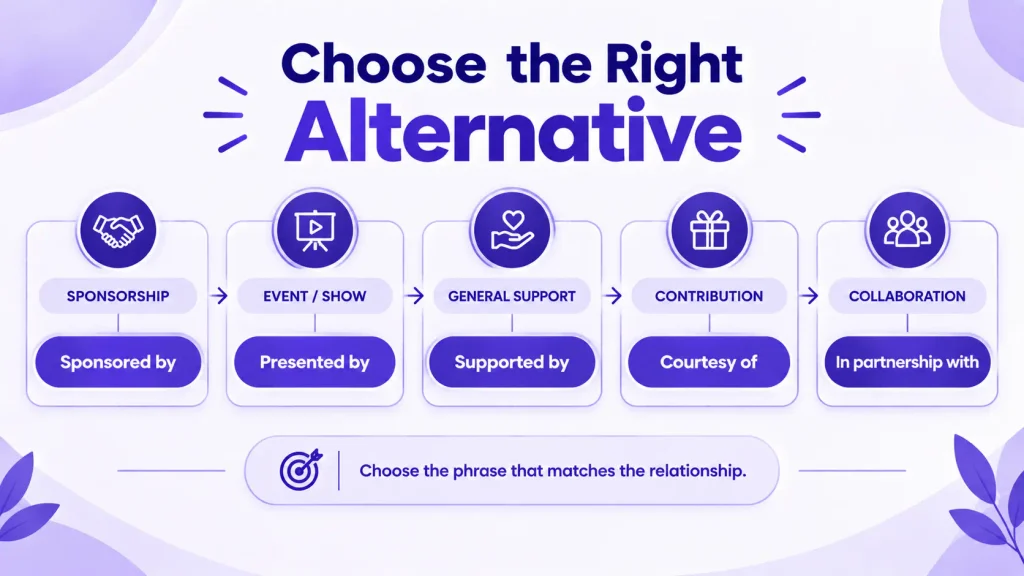
The best replacement depends on what you actually mean.
For a sponsor
Use “sponsored by.”
This newsletter is sponsored by Northstar Insurance.
For an event or show
Use “presented by.”
The annual awards ceremony is presented by Westfield Bank.
For general financial or organizational support
Use “supported by.”
The community program is supported by local businesses.
For a contribution or complimentary item
Use “courtesy of.”
Dinner tonight is courtesy of our event sponsor.
For a collaboration
Use “in partnership with.”
The campaign was created in partnership with several community organizations.
For funding
Use “funded by.”
The research project was funded by the Green Energy Foundation.
This distinction matters because these expressions don’t all communicate the same relationship. For example, “sponsored by” and “in partnership with” can suggest very different roles. Likewise, “provided by” tells readers who supplied something, while “funded by” specifically identifies financial backing.
“Brought to You By” vs. “Sponsored By”
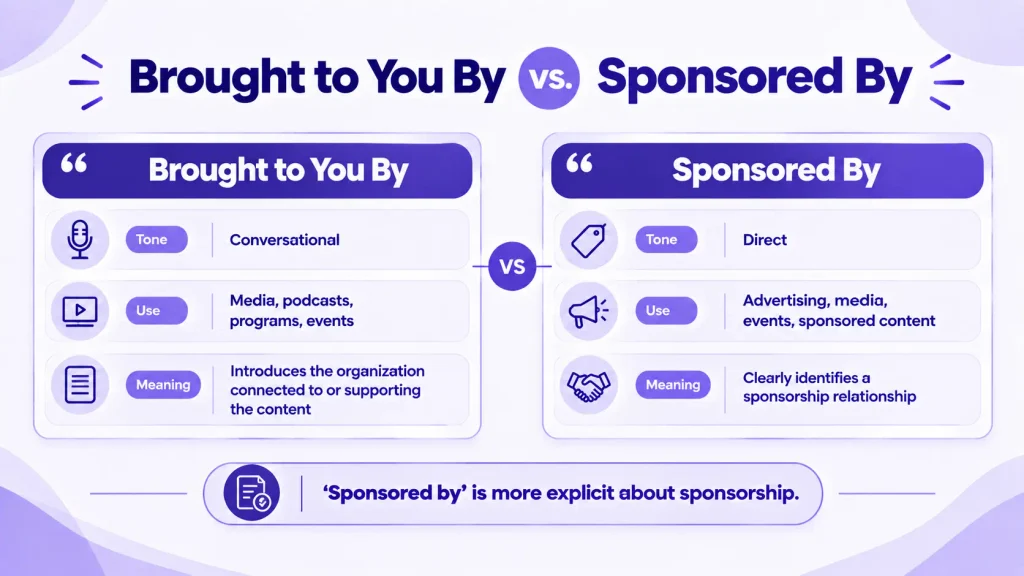
These two phrases are often used in similar situations, especially in media and advertising.
Brought to you by sounds more conversational and promotional:
Tonight’s game is brought to you by Mountain Fresh.
Sponsored by is more direct:
Tonight’s game is sponsored by Mountain Fresh.
If your priority is clarity about a commercial relationship, “sponsored by” is usually more explicit. Advertising and publishing guidance has also treated phrases such as “brought to you by,” “presented by,” and “sponsored by” as expressions audiences may interpret as indicating that an advertiser funded or underwrote content.
Common Mistakes to Avoid
Using “in partnership with” for ordinary sponsorship
A sponsor isn’t automatically a partner. If a company simply paid for advertising or sponsorship, “sponsored by” may be more accurate.
Using “funded by” without actual funding
“Funded by” has a specific financial meaning. Don’t use it just because an organization is associated with a project.
Using “courtesy of” for every sponsor
“Courtesy of” usually emphasizes a contribution or something being provided. It isn’t always a direct replacement for a sponsorship credit.
Treating every alternative as an exact synonym
“Presented by,” “supported by,” “provided by,” and “in partnership with” can overlap with “brought to you by,” but each highlights a different relationship.
Using vague language for sponsored content
If readers need to understand that content is commercial, a vague phrase may not provide enough clarity on its own. U.S. advertising guidance has emphasized that disclosures should be understandable and clear in context.
Frequently Asked Questions
What is the most professional way to say “brought to you by”?
“Sponsored by” is often the most direct professional option when you mean that a company or organization financially supports content, an event, or a program.
Is “presented by” the same as “brought to you by”?
Not always. Both can identify a sponsor or prominent supporting organization, but “presented by” often emphasizes the presenting role, particularly for events and programs.
What is a formal alternative to “brought to you by”?
Depending on the relationship, formal alternatives include “supported by,” “presented by,” “in association with,” “funded by,” and “in partnership with.”
What is a casual way to say “brought to you by”?
“Courtesy of” can sound friendly and conversational when something is provided as a contribution. “From” can also work in some contexts, but it does not necessarily communicate sponsorship.
Can I say “provided by” instead of “brought to you by”?
Yes, when the organization actually provides the service, resource, product, or information. It isn’t always appropriate when the organization is only sponsoring the content.
Is “backed by” the same as “sponsored by”?
Not exactly. “Backed by” emphasizes support and can suggest substantial financial or organizational backing. “Sponsored by” specifically identifies a sponsorship relationship.
What is the best phrase for a sponsored event?
“Sponsored by” and “presented by” are common choices. The right option depends on the organization’s relationship with the event and how the sponsorship is structured.
Final Takeaway
If you’re looking for another way to say “brought to you by,” start with “sponsored by” when you mean sponsorship. Use “presented by” for events or programs, “supported by” for general assistance, “courtesy of” for contributions, and “in partnership with” when the parties genuinely collaborated.
The key is not simply finding a phrase that sounds similar. Choose the expression that accurately describes the relationship between the organization and the content.

Role: Language Editor
Caleb Mercer is a Language Editor at RepublicsPress, focusing on grammar, sentence structure, professional writing, and English usage. He helps ensure that language guides are clear, accurate, natural, and easy to follow.