How to Say “I Disagree” Politely: 10 Better Alternatives
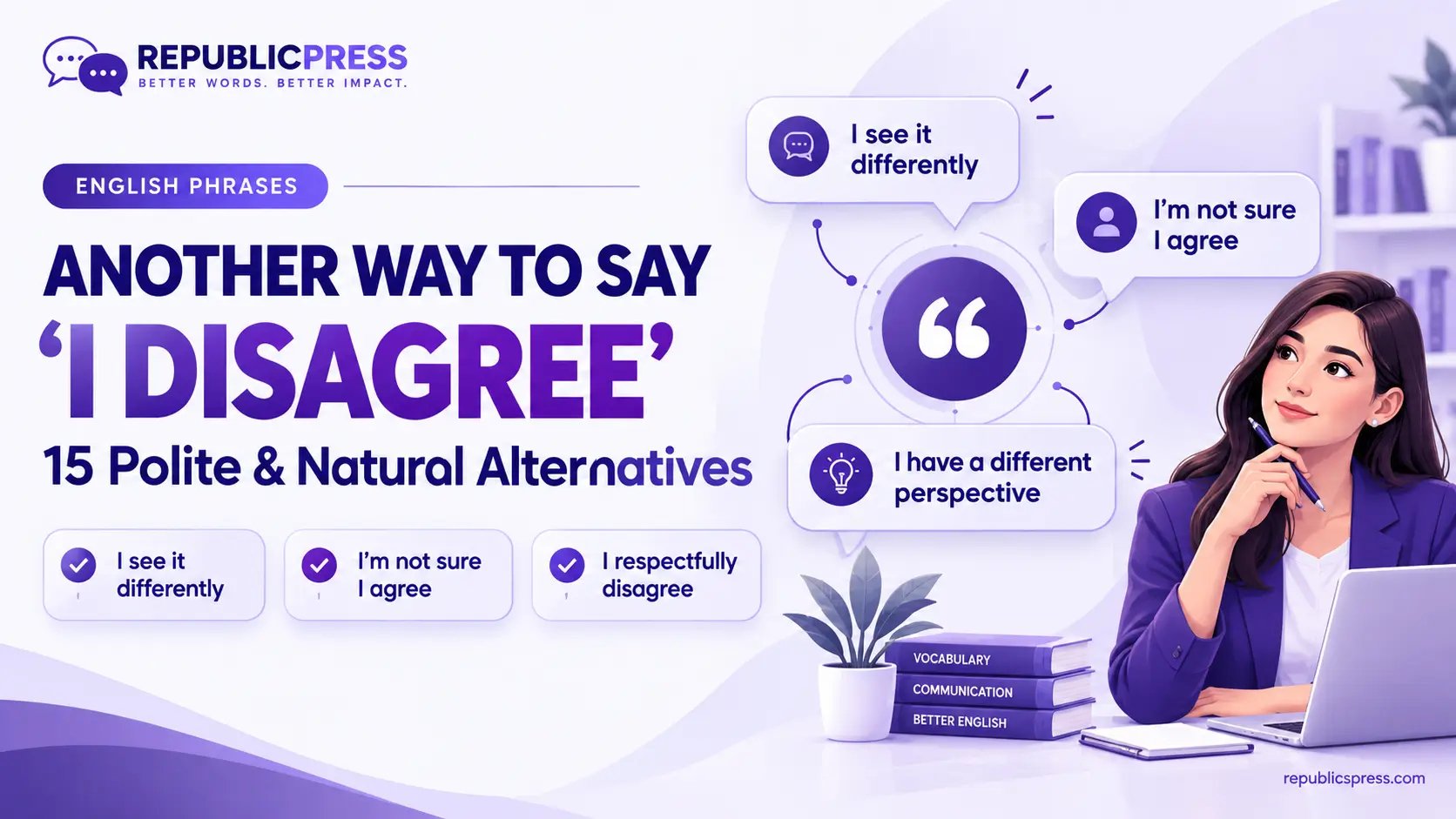
If you need another way to say “I disagree,” you have plenty of options depending on how direct, polite, formal, or casual you want to sound. For example, you can say “I see it differently,” “I’m not sure I agree,” “I have a different perspective,” “I respectfully disagree,” or “I don’t think that’s quite right.”
Key Takeaways
- “I see it differently” is a polite, natural way to disagree without sounding confrontational.
- “I respectfully disagree” works well when you want to be direct but courteous.
- “I’m not sure I agree” softens disagreement and is useful in conversations.
- “I have a different perspective” sounds thoughtful and professional.
- “That’s not how I see it” is conversational and moderately direct.
- The best alternative depends on your relationship with the listener and how strongly you disagree.
What Does “I Disagree” Mean?
“I disagree” means that you do not share the same opinion, belief, interpretation, or conclusion as another person.
For example:
“I think the project should be delayed.”
“I disagree. I think we can finish it on time.”
The phrase is grammatically correct and widely used in American English. However, “I disagree” can sometimes sound quite direct, especially when it is used by itself.
If you want to disagree while keeping the conversation friendly or respectful, a softer alternative may be more appropriate.
Another Way to Say “I Disagree”
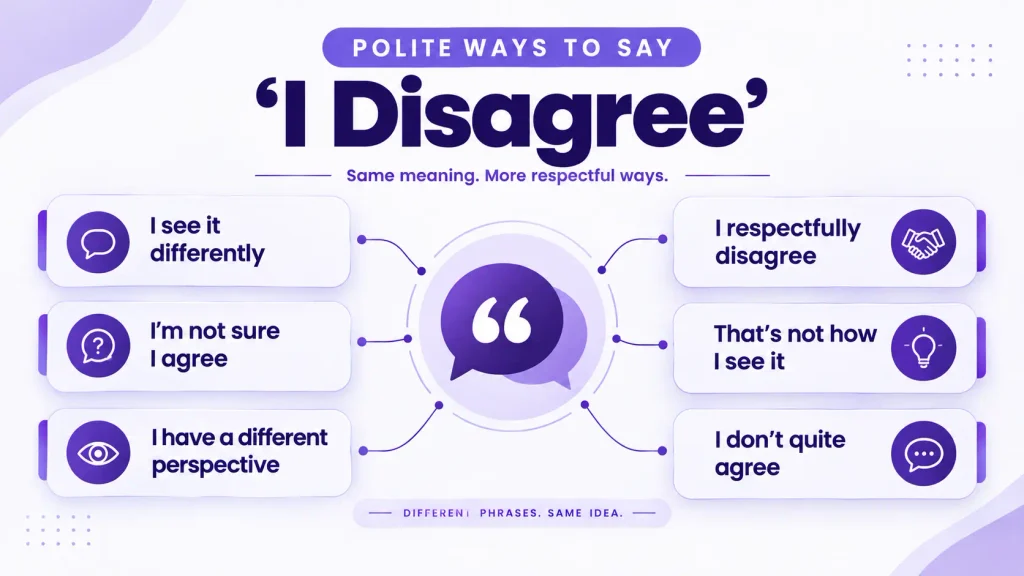
Here are some natural alternatives, ranging from polite and indirect to more direct:
| Alternative | Tone | Best Context |
| I see it differently. | Polite, neutral | Everyday conversations |
| I’m not sure I agree. | Soft, diplomatic | Discussions and disagreements |
| I have a different perspective. | Professional, thoughtful | Work and discussions |
| I respectfully disagree. | Direct, courteous | Formal or serious discussions |
| That’s not how I see it. | Conversational | Everyday disagreements |
| I don’t quite agree. | Mild, polite | Casual or professional settings |
| I have to disagree. | Direct but controlled | Conversations and debates |
| I’m afraid I disagree. | Polite, formal | Formal discussions |
| I don’t think that’s quite right. | Gentle, corrective | Correcting an opinion or claim |
| We may have different views on that. | Diplomatic | Sensitive discussions |
1. I See It Differently
“I see it differently” is one of the most natural ways to disagree without making the disagreement sound personal.
Example:
“I understand your point, but I see it differently. I think the changes will benefit the team.”
Best for: everyday conversations, meetings, discussions, and polite disagreements.
It focuses on the difference in perspective rather than directly telling the other person that they are wrong.
2. I’m Not Sure I Agree
“I’m not sure I agree” is a softer alternative to “I disagree.” It gives you room to express a different opinion without sounding overly forceful.
Example:
“I’m not sure I agree. I think we should consider the other option first.”
This phrase works especially well when you want to challenge an idea while keeping the conversation constructive.
3. I Have a Different Perspective
“I have a different perspective” sounds thoughtful and professional. Instead of directly rejecting someone’s opinion, you introduce your own point of view.
Example:
“I have a different perspective on the issue. I think customer feedback should come first.”
This is useful in workplace discussions, group projects, meetings, and other situations where maintaining a respectful tone matters.
4. I Respectfully Disagree
“I respectfully disagree” makes your disagreement clear while signaling that you still respect the other person’s position.
Example:
“I respectfully disagree with that conclusion. The available information suggests something different.”
It is more formal and direct than “I see it differently.”
5. That’s Not How I See It
“That’s not how I see it” is a natural conversational alternative.
Example:
“I understand why you think that, but that’s not how I see it.”
It works well when discussing opinions, decisions, experiences, or interpretations.
6. I Don’t Quite Agree
Adding “quite” makes the disagreement sound less absolute.
Example:
“I don’t quite agree with that assessment. There may be another explanation.”
This is useful when you disagree with part of someone’s statement rather than rejecting everything they have said.
7. I Have to Disagree
“I have to disagree” is more direct, but it does not necessarily sound hostile.
Example:
“I have to disagree. I think the original plan is still the most practical option.”
It is appropriate when you want to make your position clear rather than simply suggesting that you have another perspective.
8. I’m Afraid I Disagree
“I’m afraid I disagree” is a polite, somewhat formal expression of disagreement.
Here, “I’m afraid” does not mean that you are frightened. It softens the statement.
Example:
“I’m afraid I disagree with that interpretation.”
This expression is more common in formal or traditional styles of English than in casual American conversation.
9. I Don’t Think That’s Quite Right
Use “I don’t think that’s quite right” when you believe something is incorrect or inaccurate.
Example:
“I don’t think that’s quite right. The meeting actually starts at 10 a.m.”
This is particularly useful when correcting information because it sounds less confrontational than simply saying, “You’re wrong.”
10. We May Have Different Views on That
“We may have different views on that” is a diplomatic way to acknowledge a disagreement.
Example:
“We may have different views on that, but I think we can still find a solution.”
This works well when the goal is to keep the conversation positive instead of turning the disagreement into an argument.
Polite Ways to Say “I Disagree”
If you want to disagree without sounding rude, try phrases such as:
- I see it differently.
- I’m not sure I agree.
- I have a different perspective.
- I don’t quite agree.
- I understand your point, but I see it differently.
- I can see why you feel that way, but I have a different view.
- We may have different views on that.
A useful approach is to acknowledge the other person’s point before presenting your own.
For example:
“I understand where you’re coming from, but I see it differently.”
This sounds less confrontational than simply saying:
“I disagree.”
Professional Ways to Say “I Disagree”
In a workplace or professional discussion, the goal is usually to communicate disagreement clearly without making it personal.
Good choices include:
- I have a different perspective on this.
- I respectfully disagree.
- I see the situation differently.
- I’m not sure I agree with that approach.
- I have some concerns about that conclusion.
- I would look at it another way.
- I think there may be another way to approach this.
For example:
“I have a different perspective on this. I think we should review the customer data before making a final decision.”
This is often more constructive than:
“You’re wrong.”
Casual Ways to Say “I Disagree”
In everyday conversations with friends, family, or people you know well, you can use more relaxed expressions:
- I don’t see it that way.
- I see it differently.
- I don’t think so.
- I’m not sure about that.
- I don’t really agree.
- I have to disagree.
- That’s not how I see it.
For example:
“I don’t see it that way. I actually think the movie was pretty good.”
These expressions sound natural in ordinary American conversation.
Stronger Ways to Say “I Disagree”
Sometimes you need to make your disagreement unmistakably clear. In those situations, more direct phrases may be appropriate:
- I strongly disagree.
- I completely disagree.
- I don’t agree with that at all.
- I strongly disagree with that conclusion.
- I think that’s incorrect.
- I don’t think that’s accurate.
These expressions communicate stronger opposition, so they should be used carefully when the relationship or situation calls for diplomacy.
For example:
“I strongly disagree with the claim that the policy had no effect.”
This is much stronger than:
“I see it differently.”
How to Choose the Right Alternative
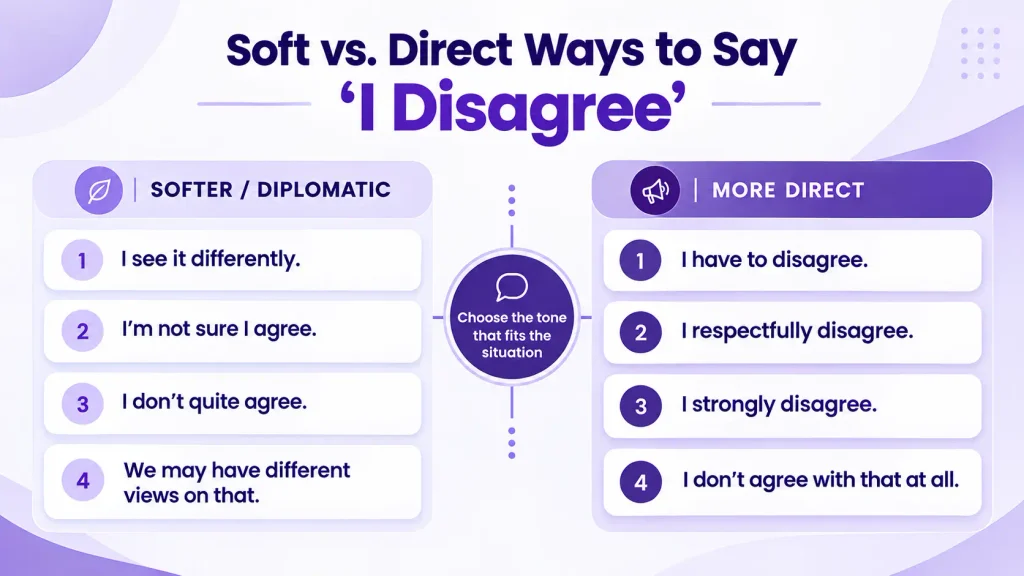
The best replacement for “I disagree” depends on what you want your statement to accomplish.
If you want to sound polite
Use:
“I see it differently.”
It communicates disagreement without directly challenging the other person.
If you want to sound diplomatic
Use:
“I’m not sure I agree.”
This softens your position and leaves room for discussion.
If you want to sound professional
Use:
“I have a different perspective.”
It works particularly well in meetings and workplace discussions.
If you want to be respectful but direct
Use:
“I respectfully disagree.”
Your position remains clear while the wording stays courteous.
If you want to correct something
Use:
“I don’t think that’s quite right.”
This is useful when the disagreement involves a fact, interpretation, or specific claim.
If you strongly oppose an idea
Use:
“I strongly disagree.”
This leaves little doubt about the strength of your position.
“I Disagree” vs. “I See It Differently”
These expressions are similar, but they have different tones.
“I disagree” is more direct:
“I disagree with your conclusion.”
“I see it differently” is softer:
“I see it differently. I think the decision could have another outcome.”
Neither phrase is incorrect. The difference is mainly one of tone and emphasis.
If maintaining a calm conversation is important, “I see it differently” can be a useful choice.
Common Mistakes When Expressing Disagreement
Using “You’re Wrong” Too Quickly
“You’re wrong” may be grammatically correct, but it can sound personal or confrontational.
Instead, try:
“I don’t think that’s quite right.”
This keeps the focus on the statement rather than the person.
Treating Every Alternative as an Exact Synonym
Not every phrase above has exactly the same strength as “I disagree.”
For example, “I’m not sure I agree” expresses uncertainty or softened disagreement, while “I strongly disagree” expresses firm opposition.
Choose based on the strength of your actual opinion.
Using Formal Language in Casual Conversations
Phrases such as “I’m afraid I disagree” may sound overly formal in a relaxed conversation with a friend.
A simpler option would be:
“I don’t really agree.”
Making Disagreement Personal
Instead of:
“You never understand this.”
Try:
“I see the situation differently.”
The second version challenges the idea without attacking the person.
Frequently Asked Questions
What is a polite way to say “I disagree”?
“I see it differently” is a natural and polite option. You can also say “I’m not sure I agree” or “I have a different perspective.”
What is a professional way to say “I disagree”?
Try “I have a different perspective,” “I respectfully disagree,” or “I’m not sure I agree with that approach.” The best choice depends on how direct you need to be.
What is a softer way to say “I disagree”?
“I’m not sure I agree” and “I see it differently” are both softer alternatives. They communicate a different opinion without sounding unnecessarily confrontational.
How can I disagree without sounding rude?
Acknowledge the other person’s point before explaining your own. For example:
“I understand your point, but I see it differently.”
This approach keeps the focus on the idea rather than the individual.
Is “I respectfully disagree” polite?
Yes. “I respectfully disagree” clearly communicates opposition while explicitly signaling respect. It is more formal and direct than “I see it differently.”
What is another way to say “I strongly disagree”?
You can say “I completely disagree,” “I strongly disagree with that,” or “I don’t agree with that at all.” These expressions communicate a firm position.
Is “I don’t agree” the same as “I disagree”?
They are very similar in meaning. “I disagree” is a standard, direct expression, while “I don’t agree” can sound slightly more conversational depending on the context.
Final Thoughts
There is no single replacement for “I disagree” that works in every situation. If you want a polite, everyday option, “I see it differently” is a strong choice. For professional conversations, “I have a different perspective” works well, while “I respectfully disagree” is useful when you need to be clear and direct.
The key is to match your wording to the situation. A disagreement does not have to sound like a confrontation; the right phrase can make your position clear while keeping the conversation respectful.

Role: Language & Content Specialist
Tessa Holloway creates language-focused content covering phrases, idioms, expressions, vocabulary, and natural American English. Her work helps readers choose words and expressions that fit different everyday, academic, and professional situations.