Another Way to Say Fit In: 15 Natural Alternatives for Different Contexts
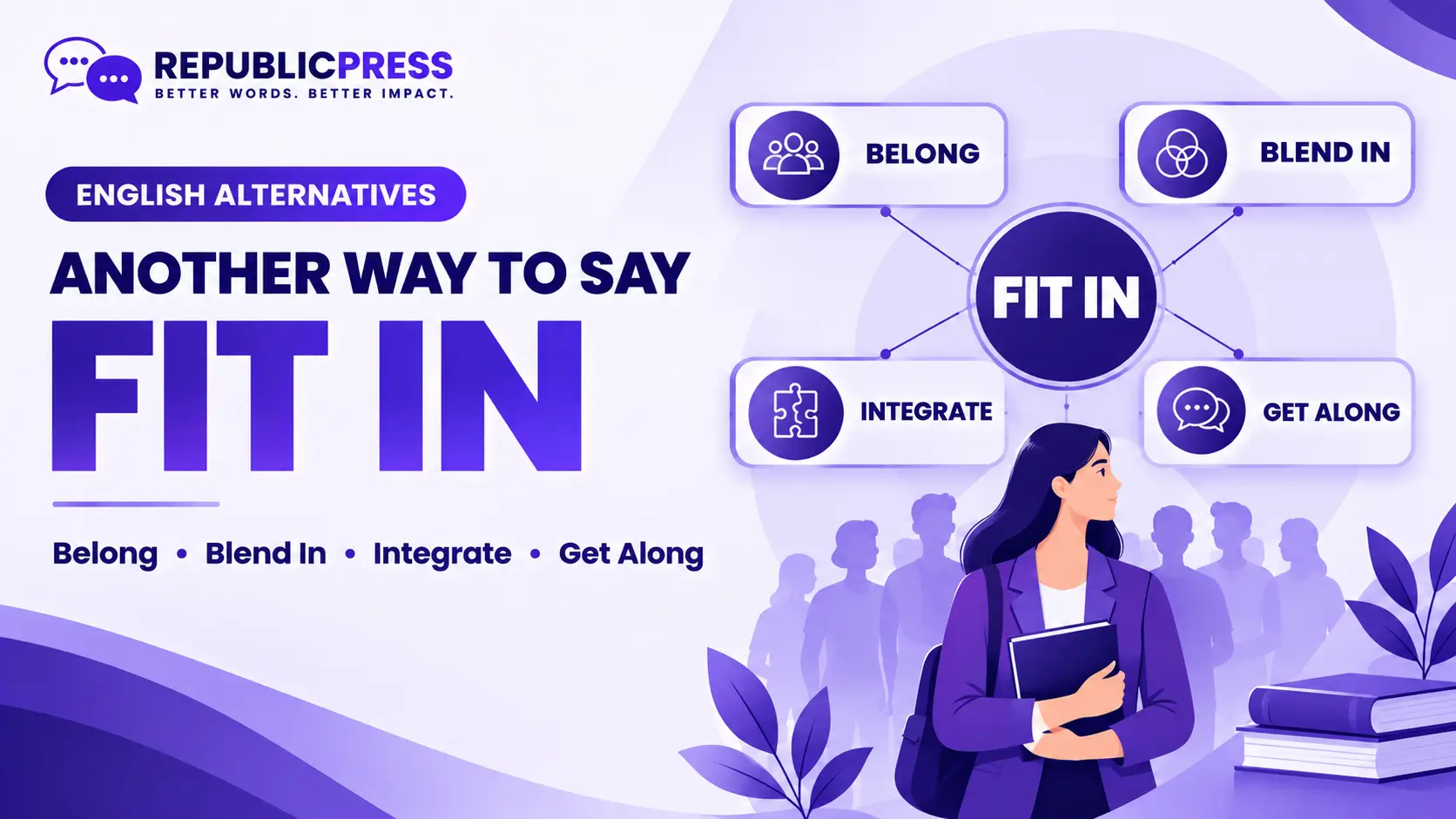
“Fit in” can mean different things depending on the context. If you mean feeling accepted by a group, natural alternatives include belong, blend in, integrate, get along, and feel at home. If you mean making room for something, better choices include accommodate, make room for, or squeeze in. The right alternative depends on the meaning you intend.
Key Takeaways
- Belong is one of the closest alternatives when “fit in” means feeling accepted.
- Blend in emphasizes looking or behaving similarly to the surrounding group or environment.
- Integrate works well in formal, professional, and social contexts.
- Get along focuses on having a good relationship with other people rather than becoming part of a group.
- Accommodate is more appropriate when “fit in” means making room for a person, object, or activity.
- Squeeze in is useful when you mean finding limited space or time for something.
What Does “Fit In” Mean?
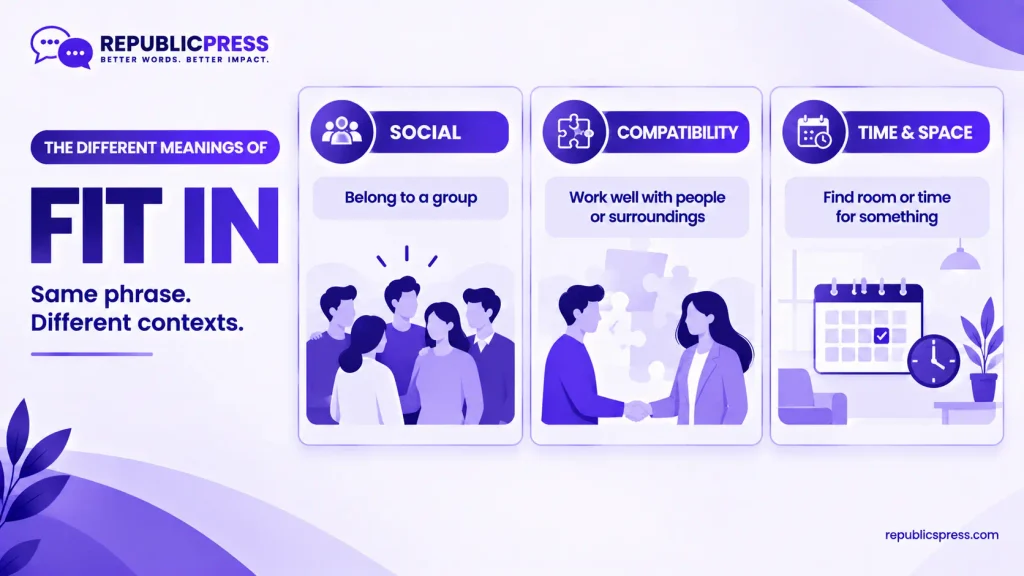
The phrase “fit in” has several meanings in American English, so there isn’t one perfect replacement for every situation.
When talking about people, fit in usually means to feel accepted by a group or to function comfortably within a particular social environment. For example:
She was nervous at first, but she quickly fit in with her new classmates.
In this sense, the phrase can be replaced with words such as belong, blend in, integrate, or feel comfortable.
“Fit in” can also describe whether something is suitable or works well with something else:
The new chairs don’t fit in with the rest of the room.
Here, alternatives such as match, complement, coordinate with, or go well with may be more natural.
There is another common meaning: finding enough time or space for someone or something. For example:
Can you fit me in for an appointment tomorrow?
In this situation, accommodate, make room for, or squeeze in may be better choices.
Major English dictionaries recognize these different uses, including belonging with a group, being suitable with something else, finding time for someone or something, and having enough physical space.
15 Natural Ways to Say “Fit In”
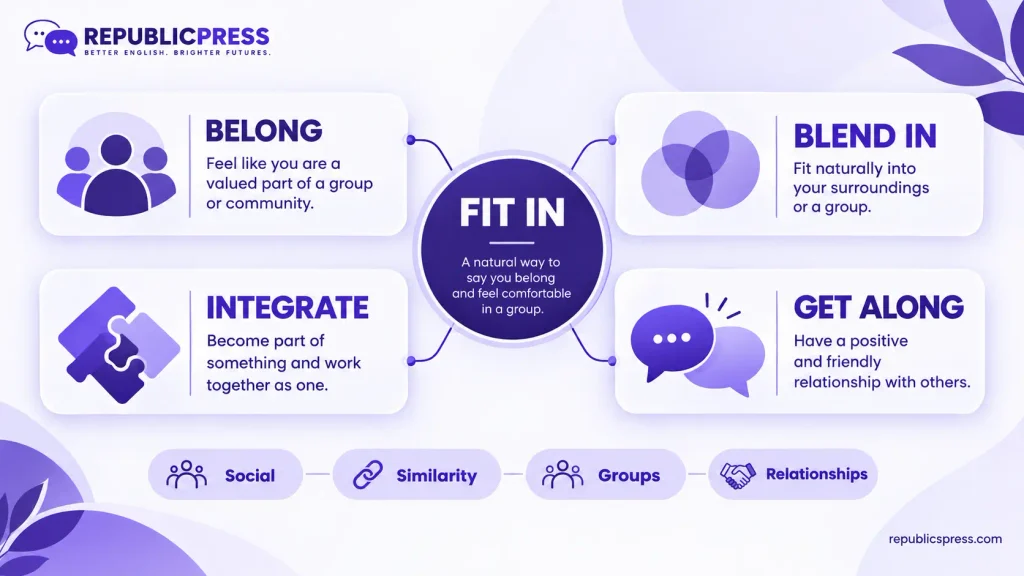
1. Belong
Best for: Social situations, relationships, and groups
Belong is one of the closest alternatives when “fit in” means feeling like a genuine member of a group.
I finally feel like I belong at my new school.
Unlike “fit in,” belong can place more emphasis on feeling accepted or feeling that you have a natural place within a group.
2. Blend In
Best for: Social situations, appearance, surroundings, and environments
Blend in means to become difficult to distinguish from the people or things around you.
He wore neutral clothes so he could blend in with the crowd.
It can suggest similarity or avoiding attention, so it isn’t always identical to “fit in.”
3. Integrate
Best for: Professional, academic, and formal contexts
Integrate means becoming part of a group, organization, community, or system.
The new employees integrated quickly into the team.
This is more formal than “fit in,” making it useful in professional or academic writing.
4. Get Along
Best for: Friendships and personal relationships
Get along focuses on having a good relationship with other people.
I get along well with everyone on my team.
It isn’t an exact synonym for “fit in.” Someone can get along with people without necessarily feeling that they belong to the group.
5. Feel at Home
Best for: Warm, friendly, and personal situations
Feel at home suggests feeling comfortable, relaxed, and welcome in a place or around a group of people.
After a few weeks, she started to feel at home in the new neighborhood.
This phrase is warmer and more personal than “fit in.”
6. Adapt
Best for: New environments, situations, workplaces, or routines
Adapt means adjusting to new circumstances.
It took him a few months to adapt to his new workplace.
Adaptation may be part of fitting in, but the words aren’t interchangeable in every sentence. “Adapt” focuses on adjusting to change, while “fit in” focuses more on belonging or compatibility.
7. Adjust
Best for: New situations, routines, environments, and expectations
Adjust is useful when someone needs to change their behavior or expectations to work comfortably in a new environment.
She needed some time to adjust to college life.
It is slightly broader than “fit in” and does not necessarily imply social acceptance.
8. Conform
Best for: Following group expectations or standards
Conform means behaving according to accepted rules, standards, or expectations.
He felt pressured to conform to the group’s expectations.
Be careful with this alternative. Conform can suggest pressure to change yourself, whereas “fit in” can be neutral.
9. Mesh
Best for: People, personalities, ideas, plans, or working relationships
Mesh means to work or fit well together.
Her personality meshes well with the rest of the team.
This is a natural choice when you want to emphasize compatibility rather than simple acceptance.
10. Connect
Best for: Social and personal relationships
Connect means to form a meaningful relationship or share an understanding with someone.
She connected with her new coworkers right away.
“Connect” does not mean exactly the same thing as “fit in,” but it can be a useful alternative when the main idea is forming relationships.
11. Be Accepted
Best for: Clear, direct, and formal writing
Be accepted directly expresses the social meaning behind “fit in.”
He wanted to be accepted by his new classmates.
This phrase is particularly useful when clarity matters more than conversational style.
12. Make Yourself at Home
Best for: Friendly and informal situations
Make yourself at home is commonly used to tell someone to relax and feel comfortable in a place.
Come in and make yourself at home.
It is not a direct replacement for every use of “fit in,” but it works when the intended meaning is becoming comfortable in a place.
13. Accommodate
Best for: Space, schedules, needs, and practical arrangements
When “fit in” means finding room or time for something, accommodate can be a useful alternative.
The schedule can accommodate one more meeting.
This is especially useful in professional or formal writing.
14. Make Room For
Best for: Physical space, time, or opportunities
Make room for means creating enough space or capacity for someone or something.
We need to make room for the new equipment.
It can also be used figuratively:
I’m trying to make room for more family time in my schedule.
15. Squeeze In
Best for: Limited time or space; casual conversation
Squeeze in suggests finding room or time despite having limited availability.
Can you squeeze me in for an appointment this afternoon?
It is natural and conversational, but it is not appropriate when “fit in” means belonging to a social group.
Quick Comparison: Which Alternative Should You Use?
| Alternative | Main Meaning | Tone | Best Context |
| Belong | Feel like a genuine member | Neutral | Social, personal |
| Blend in | Become similar to the surroundings | Neutral | Social, appearance |
| Integrate | Become part of a group or system | Formal | Workplace, academic |
| Get along | Have a good relationship | Casual/neutral | Friends, coworkers |
| Feel at home | Feel comfortable and welcome | Warm | Social, personal |
| Adapt | Adjust to a new situation | Neutral | Work, school, life changes |
| Adjust | Become comfortable with change | Neutral | Routines, environments |
| Conform | Follow group expectations | Formal/neutral | Social, academic |
| Mesh | Work or fit well together | Casual/neutral | Teams, personalities |
| Connect | Form a relationship | Neutral | Social, professional |
| Be accepted | Receive approval or acceptance | Neutral/formal | Social, formal writing |
| Accommodate | Provide enough room or capacity | Formal | Work, schedules, space |
| Make room for | Create space or time | Neutral | Space, schedules |
| Squeeze in | Find limited time or space | Casual | Appointments, schedules |
“Fit In” Alternatives for Different Situations
At School
Instead of:
I want to fit in at my new school.
You could say:
I want to belong at my new school.
Or:
I want to feel comfortable around my new classmates.
Belong works especially well when the focus is acceptance and connection.
At Work
Instead of:
She fits in well with the team.
You could say:
She works well with the team.
Or:
She integrated well into the team.
For workplace writing, “integrated well” sounds more formal, while “works well with” is straightforward and natural.
With a Group of Friends
Instead of:
I don’t think I fit in with them.
You could say:
I don’t think I belong with them.
A more natural conversational option may be:
I don’t really connect with them.
The best choice depends on whether the problem is lack of acceptance, lack of shared interests, or difficulty forming relationships.
With Clothing or Appearance
If you’re talking about becoming less noticeable, blend in may be better:
I wanted to blend in with everyone else.
“Fit in” can also work, but “blend in” specifically highlights similarity to the surrounding people or environment.
With Furniture or Decor
When you mean that something looks suitable with its surroundings, use match, complement, or go well with.
This sofa doesn’t fit in with the rest of the room.
Could become:
This sofa doesn’t match the rest of the room.
Or:
This sofa doesn’t go well with the rest of the decor.
Here, “belong” or “integrate” would not be the natural choices.
With a Busy Schedule
When “fit in” means finding time, try make time for, accommodate, or squeeze in.
I need to fit in a doctor’s appointment this week.
Natural alternatives include:
I need to make time for a doctor’s appointment this week.
I need to squeeze in a doctor’s appointment this week.
I’ll see if my schedule can accommodate an appointment this week.
The last option is more formal.
“Fit In” vs. “Fit Into”
These phrases are closely related but can be used differently.
Fit in can stand alone:
I don’t fit in here.
It can also be followed by with when talking about compatibility:
She fits in well with the team.
Fit into is often used when referring to a particular place, group, system, or situation:
He fits into the team very well.
It can also refer to physical space:
The box won’t fit into the cabinet.
English dictionaries distinguish these uses, including social compatibility, physical space, and finding room or time.
Common Mistakes When Replacing “Fit In”
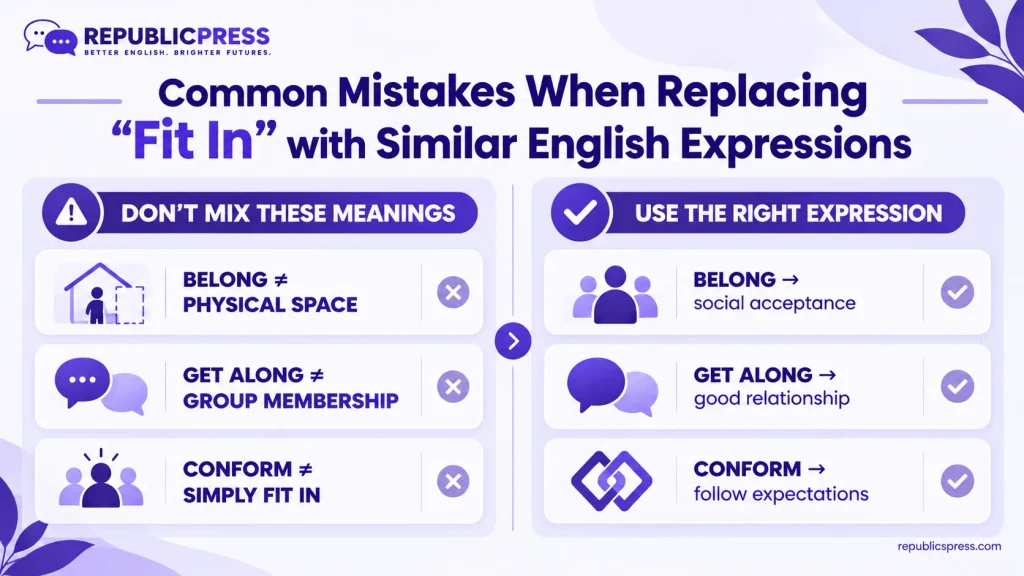
Using “Belong” for physical space
Don’t replace:
The chair won’t fit in the car.
with:
The chair won’t belong in the car.
“Belong” refers to suitability or membership, not simply whether an object can physically fit.
Using “Conform” as if it always means “fit in”
“Conform” can imply following rules, standards, or group expectations.
She changed her style to fit in.
does not necessarily mean:
She changed her style to conform.
The second sentence can suggest stronger pressure to behave like others.
Using “Get Along” to mean group membership
I get along with my coworkers.
means you have a good relationship with them.
It does not necessarily mean:
I feel like I belong to the group.
The two ideas often overlap, but they are not identical.
Using “Squeeze In” for social acceptance
“Squeeze in” is appropriate for limited time or space:
Can you squeeze in another appointment?
It would not normally replace the social meaning of “fit in.”
How to Choose the Right Alternative
A simple way to choose the right phrase is to ask what “fit in” means in your sentence.
- If you mean being accepted, use belong or be accepted.
- If you mean looking similar to your surroundings, use blend in.
- If you mean becoming part of a group or organization, use integrate.
- If you mean having a good relationship, use get along or connect.
- If you mean adjusting to a new situation, use adapt or adjust.
- If you mean working well together, use mesh.
- If you mean following group expectations, use conform.
- If you mean finding physical space, use make room for or accommodate.
- If you mean finding limited time, use squeeze in or make time for.
This distinction matters because “fit in” is a multi-use phrasal verb rather than a phrase with only one fixed meaning.
Frequently Asked Questions
What is another word for “fit in” socially?
Belong is usually one of the closest choices. Depending on the exact meaning, blend in, integrate, connect, or be accepted can also work.
What is a professional way to say “fit in”?
For a professional context, integrate, work well with, adapt to, or become part of may sound more appropriate than the casual phrase “fit in.”
Is “blend in” the same as “fit in”?
Not exactly. Blend in emphasizes becoming similar to the people or surroundings around you. Fit in more often emphasizes belonging, acceptance, or compatibility.
Is “belong” the same as “fit in”?
They are close when discussing social groups. Belong often emphasizes having a genuine place within a group, while fit in can emphasize adapting comfortably or being accepted.
What is another way to say “fit in with the group”?
You could say belong to the group, integrate into the group, blend in with the group, or get along with the group, depending on what you mean.
What is another way to say “fit in” at work?
Natural options include integrate into the team, work well with the team, adapt to the workplace, or become part of the team.
What is another way to say “fit in” when talking about time?
Use make time for, squeeze in, accommodate, or schedule.
For example:
I need to fit in a meeting.
can become:
I need to squeeze in a meeting.
or:
I need to make time for a meeting.
Final Takeaway
The best alternative to “fit in” depends on what you mean. For social acceptance, belong is often the closest choice. For becoming part of a group, integrate works well. For similarity, use blend in. For good relationships, try get along or connect. When “fit in” refers to time or space, accommodate, make room for, or squeeze in are more precise.
Choosing the alternative based on the intended meaning will make your writing sound more natural and accurate than simply replacing “fit in” with a random synonym

Role: English Content Writer
Maren Whitlock writes practical English language content for RepublicsPress, with a focus on vocabulary, word alternatives, everyday expressions, and clear communication. Her articles are designed to make difficult or confusing language easier to understand, with simple explanations and useful examples readers can apply in real situations.