Another Way to Say Similar: 25 Natural Alternatives
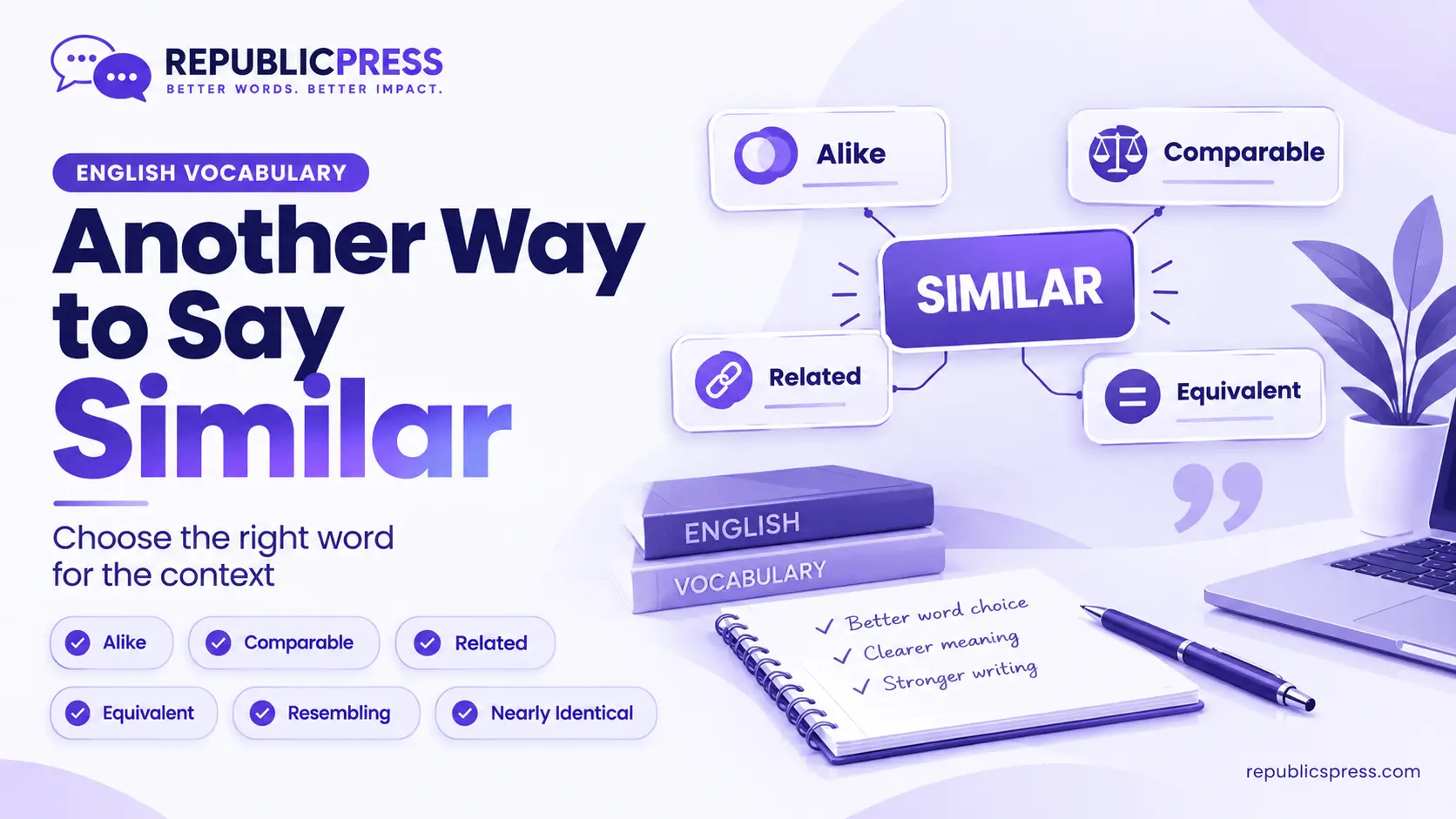
The best alternatives to “similar” include alike, comparable, nearly identical, related, equivalent, and resembling. The right choice depends on what you mean. Use alike for things that share features, comparable for things that can be fairly compared, and nearly identical when two things are almost the same.
Key Takeaways
- Alike is a natural choice for describing people or things that share features.
- Comparable works well when comparing quality, size, value, or performance.
- Nearly identical emphasizes that two things have very few differences.
- Related describes things that have a connection but may not look alike.
- Equivalent means equal in value, function, or meaning.
- Resembling is useful when describing how one person or thing looks like another.
What Does “Similar” Mean?
The word similar describes two or more people, things, ideas, or situations that share features but are not necessarily exactly the same.
For example:
- These two dresses are similar in style.
- We have similar opinions about the project.
- The new phone has features similar to those of my old phone.
In each sentence, the things share certain qualities, but they may differ in other ways.
When choosing another word for similar, consider which features the things have in common. Some alternatives emphasize appearance, while others focus on function, meaning, or overall quality.
25 Other Ways to Say Similar
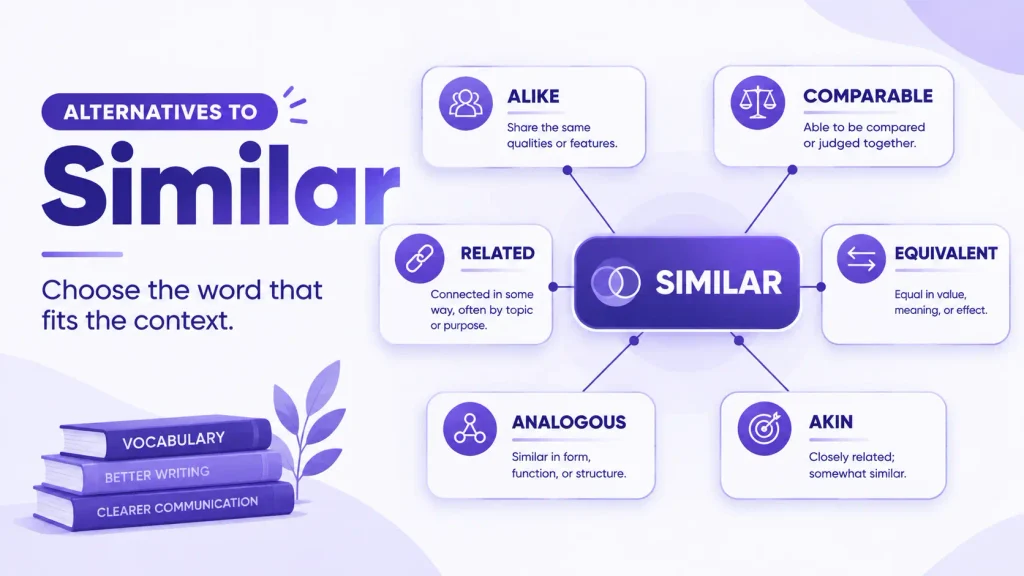
Here are 25 useful alternatives, with examples to help you choose the right expression.
1. Alike
Meaning: Having similar features, qualities, or characteristics.
Best for: Everyday conversations and general descriptions.
Example: The two sisters look very much alike.
Alike is one of the most natural alternatives when describing people or things that share noticeable characteristics.
2. Comparable
Meaning: Similar enough in quality, size, value, or another feature to be compared fairly.
Best for: Professional writing, product comparisons, and evaluations.
Example: This laptop offers performance comparable to that of more expensive models.
Use comparable when the focus is on how two things measure up against each other.
3. Nearly Identical
Meaning: Almost exactly the same, with very few differences.
Best for: Describing designs, products, documents, or appearances.
Example: The two reports contain nearly identical information.
This expression is stronger than similar. It suggests that the differences between the two things are minor.
4. Much the Same
Meaning: Almost the same in nature, condition, or result.
Best for: Everyday conversations and informal writing.
Example: The two apartments are much the same in size and layout.
This phrase sounds natural when you want to emphasize that the differences are not important.
5. Comparable in Nature
Meaning: Similar in basic qualities or characteristics.
Best for: Explanatory and formal writing.
Example: The challenges faced by both companies are comparable in nature.
This phrase is useful when comparing the general characteristics of two situations rather than their exact details.
6. Resembling
Meaning: Looking like or having features in common with someone or something.
Best for: Descriptions of appearance, design, and physical features.
Example: The building has a design resembling a traditional European home.
Resembling often focuses on appearance, although it can describe other noticeable characteristics.
7. Analogous
Meaning: Similar in certain ways, especially in how things work or relate to one another.
Best for: Academic, technical, and analytical writing.
Example: The human brain is sometimes compared to a computer because certain functions are analogous.
Use analogous when the relationship between two things matters more than their outward appearance.
8. Equivalent
Meaning: Equal in value, meaning, function, or effect.
Best for: Technical writing, education, and professional communication.
Example: This certificate is equivalent to a two-year qualification in the program.
Equivalent is not simply another word for similar. It suggests equality in a particular respect.
9. Closely Related
Meaning: Having a strong connection or sharing important characteristics.
Best for: Ideas, subjects, events, and concepts.
Example: Sleep quality and daily energy levels are closely related.
Choose this expression when two things are connected, even if they are not alike in every way.
10. Kindred
Meaning: Sharing similar qualities, interests, or characteristics.
Best for: Literary, thoughtful, or expressive writing.
Example: She found a kindred spirit in her new colleague.
Kindred often describes people, ideas, or things that share a natural connection.
11. Analogous to
Meaning: Similar to something in a particular way, especially in function or relationship.
Best for: Explanations and comparisons.
Example: The role of a manager is analogous to that of a coach.
This expression is useful when explaining an unfamiliar concept through a familiar comparison.
12. In the Same Vein
Meaning: Similar in style, approach, subject, or character.
Best for: Conversations, creative work, and writing.
Example: Her latest novel is in the same vein as her earlier books.
Use this phrase when two things share a recognizable style or approach.
13. Along the Same Lines
Meaning: Similar in idea, method, or general approach.
Best for: Conversations, planning, and professional discussions.
Example: We should develop a marketing plan along the same lines as last year’s campaign.
This phrase is particularly useful when comparing ideas or strategies.
14. Corresponding
Meaning: Matching or relating to something in a particular position, role, or way.
Best for: Formal writing, data, and structured comparisons.
Example: Each department has a corresponding section in the annual report.
Corresponding often indicates a specific relationship between matching parts rather than general resemblance.
15. Homogeneous
Meaning: Made up of parts that are alike or consistent in important characteristics.
Best for: Scientific, statistical, and technical contexts.
Example: The researchers selected a homogeneous group of participants.
This is a specialized term. It is most appropriate when the members of a group share relevant characteristics.
16. Uniform
Meaning: Consistent or the same throughout.
Best for: Standards, appearance, processes, and results.
Example: The company maintains uniform quality across all its locations.
Uniform emphasizes consistency, which is stronger and more specific than general similarity.
17. Closely Matched
Meaning: Similar in ability, quality, size, or another relevant feature.
Best for: Sports, competitions, comparisons, and evaluations.
Example: The two teams are closely matched in skill.
Use this phrase when two people, groups, or things are so similar in a particular area that neither has a clear advantage.
18. Parallel
Meaning: Similar in development, structure, or circumstances.
Best for: Academic writing, business analysis, and explanations.
Example: The two companies experienced parallel growth over the same period.
Parallel highlights similarities between developments or situations.
19. Of the Same Kind
Meaning: Belonging to the same general type or category.
Best for: Everyday explanations and classification.
Example: These two problems are of the same kind, although their causes differ.
This phrase describes shared type or category, not necessarily identical features.
20. Much Alike
Meaning: Sharing many of the same characteristics.
Best for: Casual conversations and descriptions.
Example: The neighbors are much alike in their interests and values.
This is a simple, natural alternative when emphasizing several shared qualities.
21. Near-identical
Meaning: Almost exactly alike.
Best for: Product descriptions, designs, and detailed comparisons.
Example: The two versions have near-identical layouts.
Near-identical is a concise alternative to nearly identical. Both are natural in American English.
22. Of a Similar Nature
Meaning: Sharing the same general type or character.
Best for: Formal explanations and professional writing.
Example: The two complaints were of a similar nature.
This phrase is useful when comparing issues, events, or experiences.
23. In Common
Meaning: Shared by two or more people or things.
Best for: Everyday conversations and discussions of shared traits.
Example: The two candidates have several professional interests in common.
Use in common to focus on the qualities or experiences that two people or things share.
24. Respective Counterparts
Meaning: The corresponding people or things that serve similar roles in different groups or systems.
Best for: Formal, business, and organizational writing.
Example: The regional managers met with their respective counterparts overseas.
This is a contextual alternative, not a direct synonym. It emphasizes corresponding roles rather than general resemblance.
25. Not Unlike
Meaning: Somewhat similar to or sharing characteristics with something else.
Best for: Literary, conversational, and occasionally formal writing.
Example: Her approach to teaching is not unlike her mentor’s.
This expression is indirect and can sound more formal or literary than simply saying similar to.
Best Alternatives to “Similar” by Context
The most natural replacement depends on what you are describing. Use this guide to choose an expression that fits your sentence.
| Context | Best alternative | Example |
| Everyday conversation | Alike | The two designs look alike. |
| Professional writing | Comparable | The results are comparable. |
| Academic writing | Analogous | The processes are analogous. |
| Appearance | Resembling | The pattern resembles marble. |
| Shared interests | Have in common | We have several interests in common. |
| Almost exactly the same | Nearly identical | The copies are nearly identical. |
| Equal in function or value | Equivalent | Both methods are equivalent. |
| Connected ideas | Closely related | The topics are closely related. |
| Similar style | In the same vein | The new design is in the same vein. |
| Consistent throughout | Uniform | The standards are uniform. |
How to Choose the Right Word for “Similar”
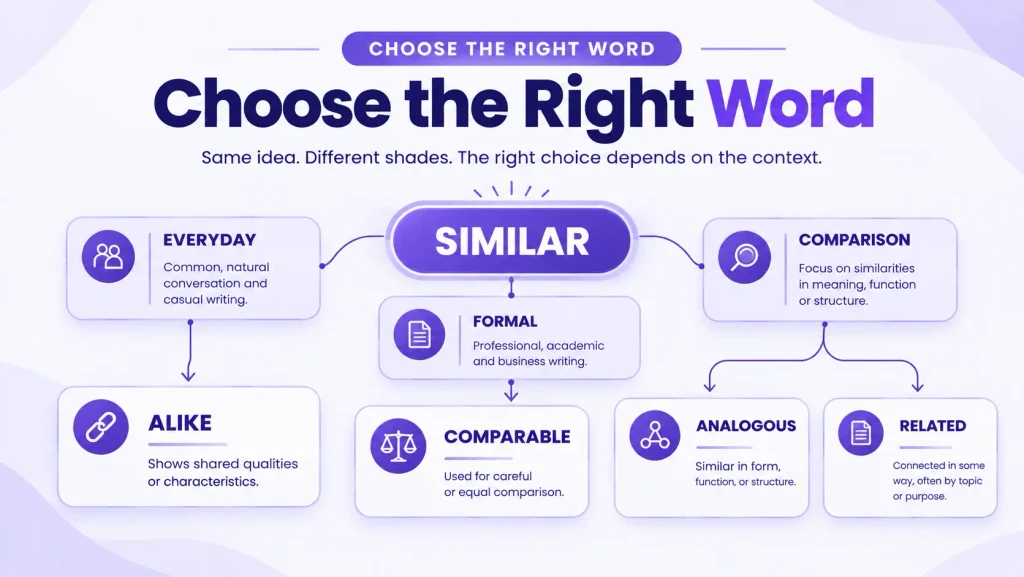
Although these expressions overlap, they are not interchangeable in every sentence.
Use “Alike” for General Resemblance
Alike is a good choice when two people or things share noticeable qualities.
- Original: The two paintings are similar.
- Alternative: The two paintings are alike.
Both sentences sound natural and communicate nearly the same idea.
Use “Comparable” for Fair Comparisons
Comparable works best when the things being compared have enough in common to make the comparison meaningful.
- Original: The two products are similar in quality.
- Alternative: The two products are comparable in quality.
The alternative emphasizes that their quality can be fairly compared.
Use “Equivalent” for Equality
Equivalent is appropriate when two things have the same value, function, or meaning in a specific context.
- Original: These two measurements are similar.
- Alternative: These two measurements are equivalent.
The second sentence suggests that the measurements represent the same amount or value, not merely that they are close.
Use “Nearly Identical” for Very Strong Similarity
When two things have almost no meaningful differences, nearly identical is more precise.
- Original: The two documents are similar.
- Alternative: The two documents are nearly identical.
The alternative communicates a much stronger degree of resemblance.
Use “Closely Related” for Connections
When two subjects are connected but are not necessarily alike, closely related may be more accurate.
- Original: These two topics are similar.
- Alternative: These two topics are closely related.
The alternative emphasizes their connection rather than claiming that their characteristics are alike.
Common Mistakes When Replacing “Similar”
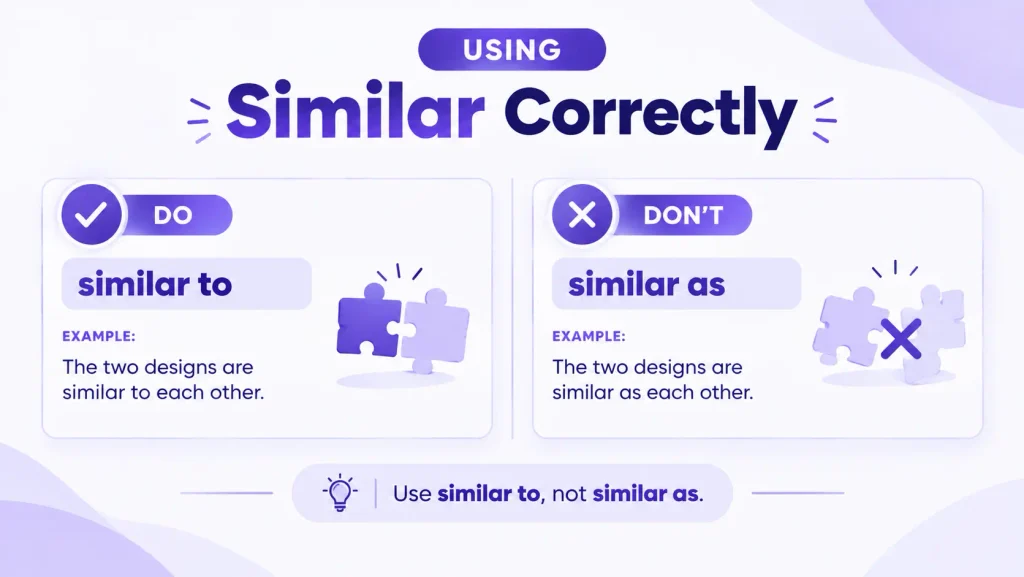
Choosing a synonym without considering its meaning can change your sentence.
1. Using “identical” when you mean “similar”
Identical means exactly the same in the relevant respects. If two products share several features but differ in others, similar or comparable is more accurate.
2. Using “equivalent” for things that are merely alike
Two services may offer similar features without providing equal value or functionality. Use equivalent only when the relevant value, function, or effect is equal.
3. Using “analogous” for simple visual resemblance
Analogous usually highlights a relationship, function, or pattern. For a simple comparison of appearance, alike or resembling is often more natural.
4. Using “homogeneous” in everyday conversation
Although the word is correct in certain contexts, it can sound overly technical when describing two ordinary objects or people. Similar or alike is usually clearer.
5. Forgetting the correct sentence structure
Some alternatives require different grammar.
- Similar to: Her approach is similar to mine.
- Alike: Our approaches are alike.
- Resembling: Her approach resembles mine.
- Comparable to: This model is comparable to the previous one.
Pay attention to the words that follow each expression.
Frequently Asked Questions
What is the most common synonym for “similar”?
Alike is one of the most common and natural alternatives. It works well when describing people or things that share characteristics. For example, “The two houses look alike.”
What is a more professional word for “similar”?
Comparable is often a good professional alternative, especially when discussing performance, quality, costs, or results. Equivalent is appropriate when two things have equal value or function.
What is another way to say “very similar”?
You can say nearly identical, almost the same, closely resembling, or much alike. Use nearly identical when the differences are extremely small.
What is another way to say “similar to”?
Natural alternatives include like, comparable to, resembling, and analogous to. The best option depends on the sentence.
Examples:
- This fabric is similar to silk.
- This fabric resembles silk.
- This fabric is comparable to silk in appearance.
The last example limits the comparison to appearance rather than suggesting that the materials are equal in every respect.
Is “similar” the same as “identical”?
No. Similar means sharing some characteristics, while identical means exactly the same in the relevant respects. Two similar objects can still have noticeable differences.
What is a formal synonym for “similar”?
Comparable, analogous, and corresponding can work in formal writing, depending on the meaning. Comparable is useful for evaluations, while analogous emphasizes a relationship between things.
Can I use “same” instead of “similar”?
Only when the meaning supports it. Same suggests identity, while similar allows for differences. If two shirts have the same color but different designs, they are similar in color, not the same.
Conclusion
The best alternative to “similar” depends on the quality or relationship you want to describe. Choose alike for general resemblance, comparable for fair comparisons, nearly identical for very strong similarity, and equivalent when two things have equal value or function. For connected ideas, closely related may be the most accurate choice.
Focus on the meaning of your sentence rather than replacing similar with the first synonym you find. The right expression will sound more natural and communicate your point more clearly.

Role: Language Editor
Caleb Mercer is a Language Editor at RepublicsPress, focusing on grammar, sentence structure, professional writing, and English usage. He helps ensure that language guides are clear, accurate, natural, and easy to follow.