Another Way to Say “Stood Out”: 12+ Powerful Alternatives for Any Situation
If you need another way to say “stood out,” the best choice depends on what you mean. For something that was easy to notice, use was noticeable, caught attention, or drew attention. For something that was different or distinctive, try was distinctive, set itself apart, or distinguished itself. If you mean something performed better than others, excelled or outperformed may be more precise.
Key Takeaways
- “Stood out” usually means that something was noticeable, different, memorable, or better than comparable things.
- Caught my attention works well when something made you notice it.
- Was distinctive emphasizes unique or recognizable qualities.
- Distinguished itself works well in professional and formal writing.
- Excelled should be used when something performed exceptionally well.
- Set itself apart is useful when explaining how something differs from its competitors or peers.
What Does “Stood Out” Mean?
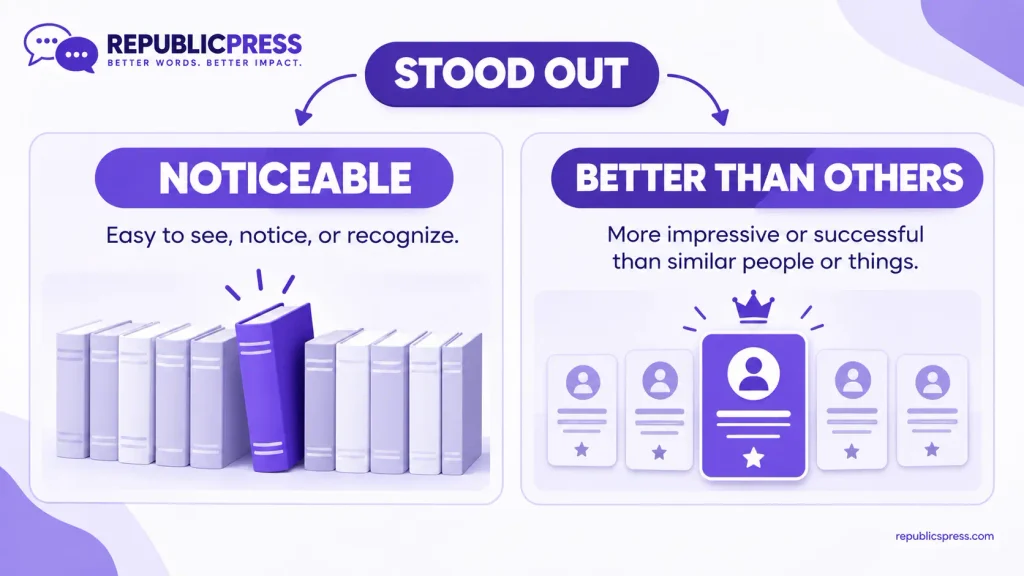
“Stood out” is a common phrasal verb used when someone or something is more noticeable, distinctive, memorable, or impressive than what surrounds it.
For example:
Her presentation stood out from the rest.
This could mean her presentation was more interesting, more polished, more original, or simply more noticeable. The exact meaning comes from the context.
That is why there isn’t one perfect replacement for “stood out” in every sentence. A phrase such as caught my attention focuses on noticing something, while excelled suggests superior performance. Was distinctive focuses on uniqueness without necessarily saying that something was better.
The most useful alternative depends on the idea you want to express.
Best Alternatives to “Stood Out”
1. Caught My Attention
Meaning: Made me notice something.
Best for: Everyday conversation, reviews, observations, and personal writing.
Example:
The unusual design immediately caught my attention.
This is a natural choice when you want to explain that something attracted your notice. It doesn’t necessarily mean that the thing was better than everything else.
2. Drew My Attention
Meaning: Caused me to notice or focus on something.
Best for: Neutral, professional, and descriptive writing.
Example:
The sudden change in his tone drew my attention.
“Drew my attention” is slightly more deliberate than “caught my attention.” It works especially well when something caused you to focus on a particular detail.
3. Was Noticeable
Meaning: Was easy to see, hear, recognize, or detect.
Best for: Neutral and straightforward writing.
Example:
The difference in quality was noticeable from the beginning.
This is one of the safest alternatives because it does not automatically suggest that something was impressive or positive.
4. Was Distinctive
Meaning: Had qualities that made it easy to recognize as different from others.
Best for: Design, branding, writing, products, people, and general description.
Example:
The restaurant has a distinctive interior that customers remember.
“Distinctive” focuses on recognizable differences. It does not necessarily mean that something is better than its competitors.
5. Distinguished Itself
Meaning: Became noticeable or impressive because of particular qualities or achievements.
Best for: Professional, academic, and formal writing.
Example:
The research team distinguished itself through careful analysis and clear reporting.
This phrase is stronger and more formal than “stood out.” It is especially useful when the subject became notable because of quality, achievement, or expertise.
6. Set Itself Apart
Meaning: Became different from or more noticeable than similar people or things.
Best for: Business, marketing, careers, products, and competitive situations.
Example:
The company set itself apart by offering faster customer support.
“Set itself apart” is useful when you want to explain why something was different from its competitors or peers.
7. Was Striking
Meaning: Was unusually noticeable, impressive, or memorable.
Best for: Descriptions, visual writing, reviews, and formal or creative contexts.
Example:
The contrast between the old building and the modern tower was striking.
“Striking” is stronger than simply saying something was noticeable. It often suggests that the difference or appearance made a strong impression.
8. Attracted Attention
Meaning: Caused people to notice or focus on something.
Best for: Marketing, presentations, advertising, design, and general writing.
Example:
The bold headline attracted attention from visitors.
This phrase focuses on visibility rather than quality. Something can attract attention without necessarily being good or impressive.
9. Made an Impression
Meaning: Had a noticeable or memorable effect on someone.
Best for: People, experiences, performances, interviews, and personal reactions.
Example:
Her thoughtful response made a strong impression on the interview panel.
Use this when the important point is not simply that something was noticeable, but that it affected someone’s opinion or memory.
10. Was Remarkable
Meaning: Was unusual, impressive, or worthy of attention.
Best for: General writing, achievements, experiences, and descriptions.
Example:
The team’s improvement over the season was remarkable.
“Remarkable” often carries a positive meaning. It is therefore not a perfect substitute when “stood out” simply means “was visible.”
11. Was Prominent
Meaning: Was important, noticeable, or positioned so that it was easy to see.
Best for: Formal, academic, business, and descriptive writing.
Example:
The issue became prominent during the final stage of the discussion.
“Prominent” can describe visibility or importance, so make sure the surrounding sentence makes the intended meaning clear.
12. Excelled
Meaning: Performed exceptionally well.
Best for: Work, school, sports, business, and measurable achievements.
Example:
She excelled in customer service and consistently received positive feedback.
“Excelled” is not a general synonym for “stood out.” It works when the original sentence means that someone or something performed better than others.
“Stood Out” Alternatives by Meaning
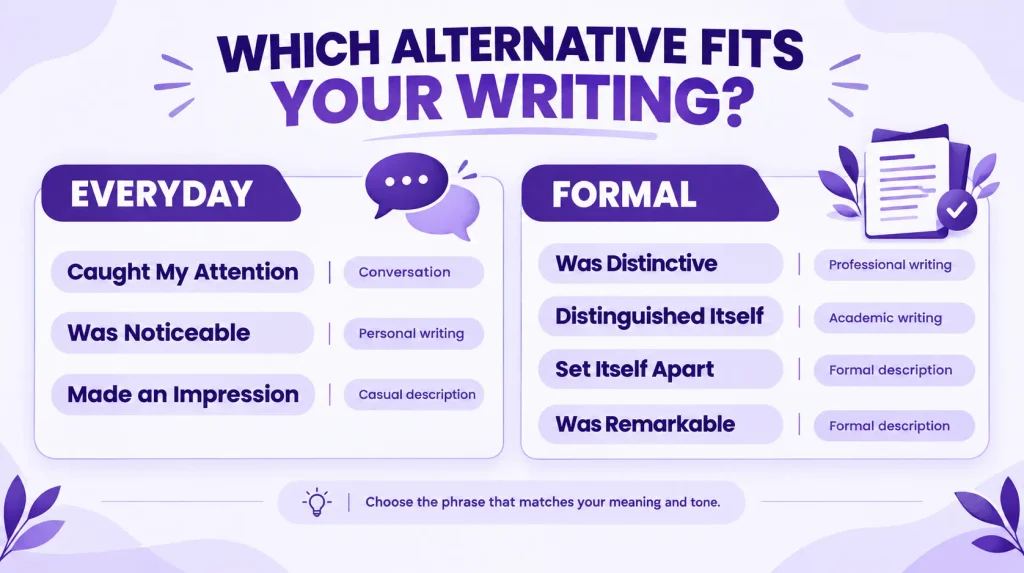
Because “stood out” can express several ideas, choosing an alternative by meaning is more accurate than simply replacing the phrase with a synonym.
| What you mean | Best alternative | Example |
| Easy to notice | Was noticeable | The difference was noticeable. |
| Got your attention | Caught my attention | The headline caught my attention. |
| Made you focus | Drew my attention | The unusual sound drew my attention. |
| Clearly different | Was distinctive | The design was distinctive. |
| Made a strong impression | Was striking | The contrast was striking. |
| Memorable effect | Made an impression | Her speech made an impression. |
| Different from competitors | Set itself apart | The brand set itself apart. |
| Notable because of quality | Distinguished itself | The team distinguished itself through its work. |
| Performed exceptionally | Excelled | She excelled in mathematics. |
| Better than competitors | Outperformed | The new model outperformed its predecessor. |
How to Choose the Right Alternative
Ask yourself what “stood out” means in your sentence.
If you mean “I noticed it”
Use:
- Caught my attention
- Drew my attention
- Caught my eye
- Was noticeable
Example:
The bright yellow door stood out.
Better alternatives:
The bright yellow door caught my eye.
The bright yellow door was immediately noticeable.
If you mean “It was different”
Use:
- Was distinctive
- Was unique
- Was different
- Set itself apart
Example:
Her writing style stood out from the others.
Better:
Her writing style was distinctive.
Or:
Her writing style set itself apart from the others.
If you mean “It was impressive”
Use:
- Was striking
- Was remarkable
- Made a strong impression
- Impressed me
Example:
His confidence stood out during the interview.
Better:
His confidence made a strong impression during the interview.
If you mean “It performed better”
Use:
- Excelled
- Outperformed
- Surpassed
- Exceeded expectations
Example:
The new product stood out among the other models.
If the meaning is specifically about performance, you could write:
The new product outperformed the other models.
This is more precise because it explains that the product actually performed better rather than merely being noticeable.
Another Way to Say “Stood Out” in Professional Writing
In professional writing, avoid choosing a more complicated phrase simply because it sounds formal. The best alternative should explain what made the person, product, or result notable.
Useful choices include:
- Distinguished itself
- Set itself apart
- Demonstrated exceptional performance
- Earned recognition
- Exceeded expectations
- Outperformed competitors
- Made a strong impression
- Demonstrated a clear advantage
For example, instead of:
She stood out as a strong candidate.
You could write:
She distinguished herself through her project management experience.
Even better, when evidence is available:
She distinguished herself by completing the project two weeks ahead of schedule.
The second version is more informative because it shows the reader why she was notable.
Another Way to Say “Stood Out” in an Essay
For an essay, the best choice depends on whether you are discussing an argument, piece of evidence, literary work, or personal observation.
Consider:
- Was particularly notable
- Was distinctive
- Was striking
- Distinguished itself
- Was especially significant
- Demonstrated originality
- Differed from
- Was particularly prominent
Example:
Informal:
One part of the study stood out from the rest.
More precise:
One finding was particularly notable because it differed from earlier results.
The second version tells the reader exactly what made the finding important.
Another Way to Say “Stood Out” on a Resume
On a resume, “stood out” can be vague. Employers usually benefit more from a specific achievement or measurable result.
Instead of:
Stood out as a top-performing employee.
Try:
Exceeded the quarterly sales target by 18%.
Instead of:
Stood out as a team leader.
Try:
Led a five-person team through a successful product launch.
Instead of:
Stood out for excellent customer service.
Try:
Earned consistently high customer satisfaction ratings.
The strongest resume language shows what you achieved rather than simply claiming that you stood out.
Common Mistakes When Replacing “Stood Out”
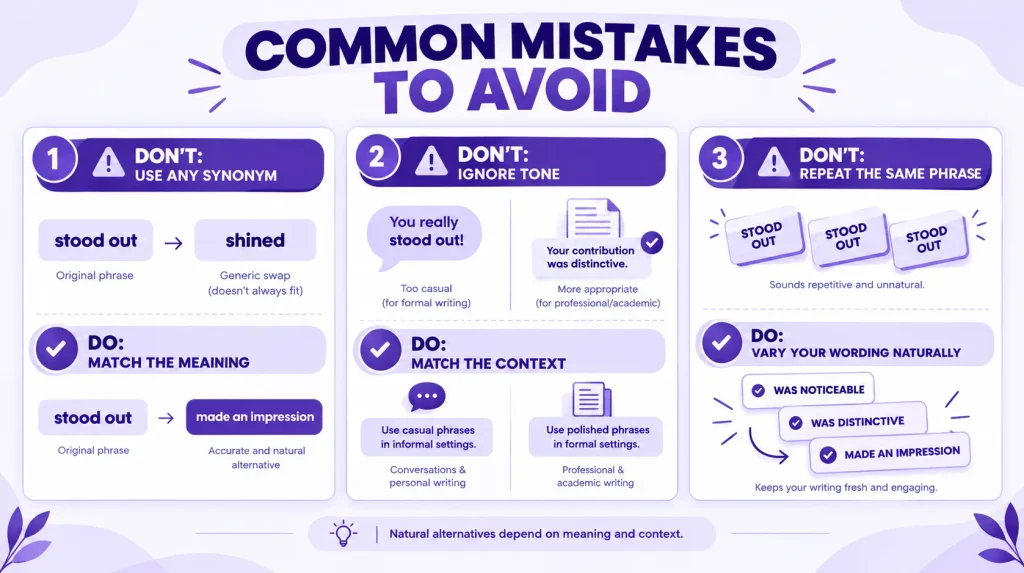
Using “excelled” for simple visibility
“Excelled” means performed exceptionally well. It should not replace “stood out” when something was merely easy to notice.
Not ideal:
The red sign excelled against the white wall.
Better:
The red sign stood out against the white wall.
Or:
The red sign was highly noticeable against the white wall.
Using “unique” too freely
“Unique” can imply that something is one of a kind. If you only mean that something is noticeably different, distinctive may be safer.
Instead of:
Her approach was completely unique.
Consider:
Her approach was distinctive.
Using “attracted attention” when you mean “performed well”
Something can attract attention without being successful.
For example:
The controversial advertisement attracted attention.
This does not necessarily mean the advertisement was effective. It only means that people noticed it.
Choosing a formal phrase that sounds unnatural
“Stood out” is already natural English. There is no need to replace it every time.
For example, in everyday conversation:
Your presentation really stood out.
sounds more natural than:
Your presentation distinguished itself significantly.
Use the alternative only when it gives you a more precise meaning or better matches the tone.
Frequently Asked Questions
What is a positive way to say “stood out”?
Depending on the context, you can say distinguished itself, was remarkable, was striking, made a strong impression, or set itself apart. If you mean strong performance, excelled is often a better choice.
What is another way to say “stood out from the crowd”?
Common alternatives include set itself apart, distinguished itself, was distinctive, and rose above the competition. “Set itself apart” is usually the safest general option.
Is “stood out” formal or informal?
“Stood out” is standard and natural English, but it is less formal than alternatives such as distinguished itself or was particularly notable. It works well in conversation, general writing, and many professional contexts.
Can “caught my eye” replace “stood out”?
Yes, when the meaning is that something attracted your visual attention. For example, “The blue jacket stood out” can become “The blue jacket caught my eye.” However, “caught my eye” does not necessarily suggest that the jacket was better or more impressive.
What is the best alternative to “stood out” in a resume?
Use a specific achievement whenever possible. Depending on the situation, phrases such as exceeded expectations, earned recognition, distinguished myself, led, or outperformed can be stronger than simply saying “stood out.”
What is the opposite of “stood out”?
Possible opposites include blended in, went unnoticed, remained unnoticed, faded into the background, and was indistinguishable. The best choice depends on whether you mean low visibility, similarity, or lack of attention.
Is “unique” the same as “stood out”?
Not always. “Unique” emphasizes being unlike anything else, while “stood out” can simply mean being more noticeable or distinctive than the surrounding people or things. Distinctive is often a better choice when you want to describe noticeable differences without making an absolute claim.
Final Thoughts
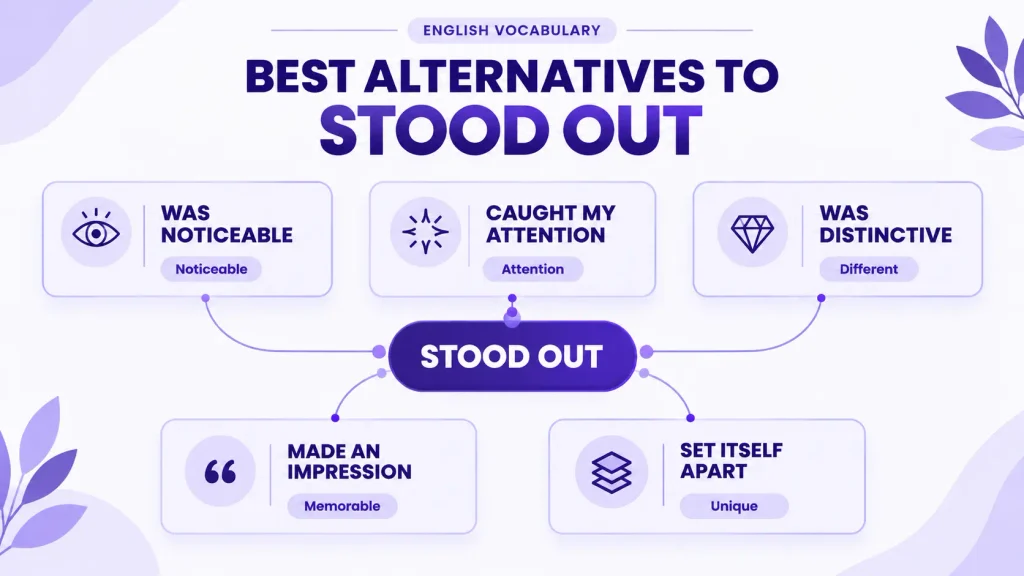
The best way to replace “stood out” is to identify the exact idea behind it. Use caught my attention when something made you notice it, was distinctive when it was noticeably different, made an impression when it was memorable, set itself apart when it differed from competitors, and excelled when it performed exceptionally well.
In many situations, “stood out” is already the most natural choice. Replace it when another phrase gives the reader a clearer idea of why something was noticeable, different, memorable, or successful.

Role: Language Editor
Caleb Mercer is a Language Editor at RepublicsPress, focusing on grammar, sentence structure, professional writing, and English usage. He helps ensure that language guides are clear, accurate, natural, and easy to follow.