10 Natural Alternatives for Simpler, Clearer Language
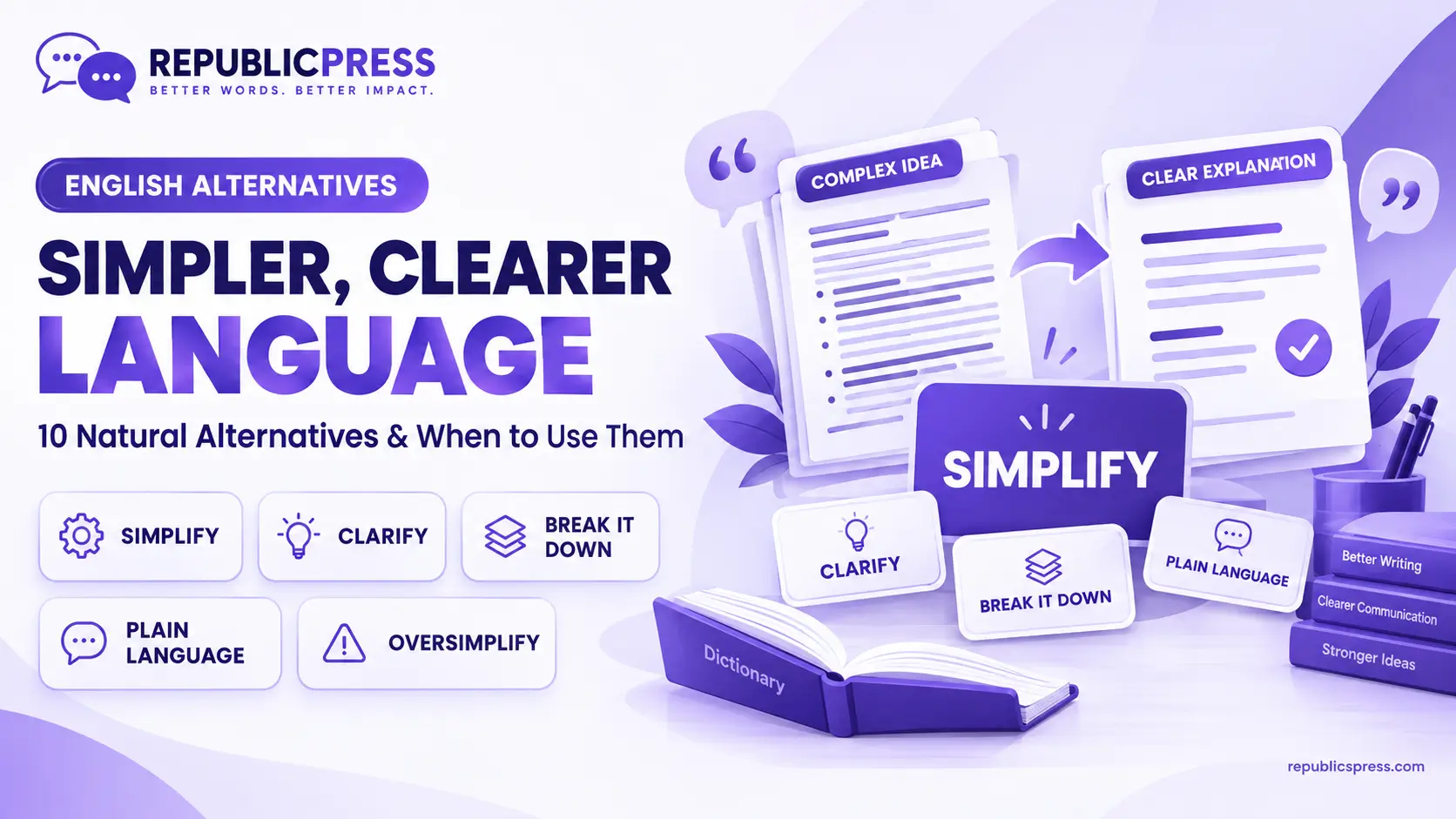
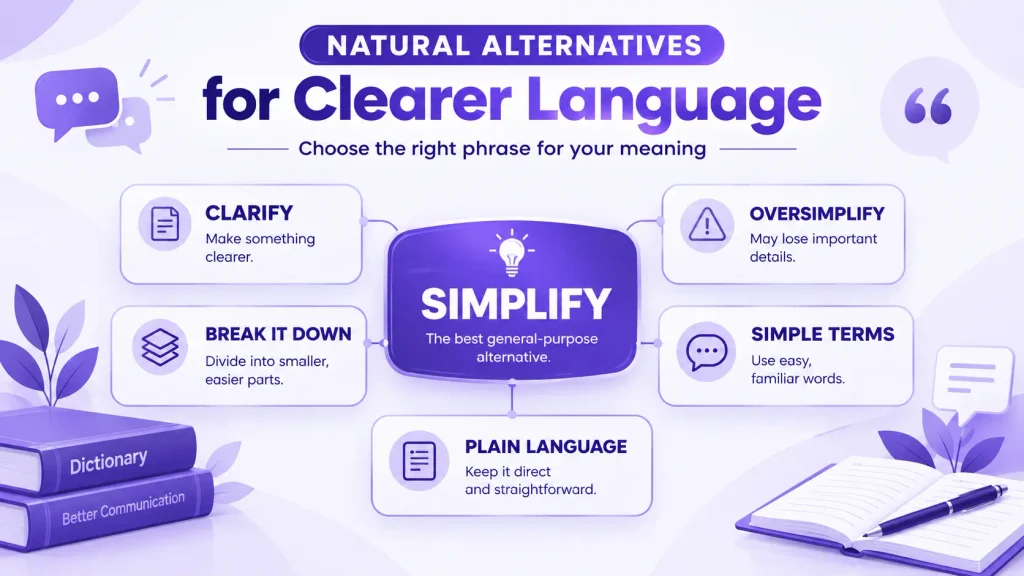
If you want to describe making something easier to understand, there are many natural options. You can say simplify, oversimplify, make it easier to understand, break it down, explain in simple terms, clarify, or put it into plain language. The best choice depends on what you mean.
Key Takeaways
- Simplify is the best general choice.
- Oversimplify means making something too simple.
- Make it easier to understand is clear and natural.
- Break it down works well for step-by-step explanations.
- Explain in simple terms is useful for hard topics.
- Plain language works well when jargon is the main problem.
- Make more accessible is a good choice for professional content.
What Does This Expression Mean?
The expression behind this topic means making something less complex or easier to understand. It may involve using simpler words, shorter explanations, or fewer difficult details.
However, the meaning can change based on the situation. Sometimes, simplifying information helps people understand it better. In other cases, too much simplification can remove useful details.
For that reason, it helps to choose your words carefully. For example, simplify sounds neutral. By contrast, oversimplify suggests that something has become too simple.
10 Natural Alternatives
1. Simplify
Meaning: Make something easier or less complex.
Example:
We simplified the instructions so customers could follow them easily.
Best for: Work, school, business, and everyday conversation.
Why use it: This is the most useful general choice. It sounds natural and does not suggest that important information should be removed.
2. Oversimplify
Meaning: Make something too simple by leaving out important details.
Example:
We should not oversimplify the issue because several factors affect it.
Best for: School, work, analysis, and serious discussions.
Why use it: Use this word when you want to show that something has been made simpler than it should be.
3. Make It Easier to Understand
Meaning: Change something so people can understand it more easily.
Example:
Can you make this section easier to understand?
Best for: Everyday and professional communication.
This phrase is simple and direct. It works well when your main goal is better understanding.
4. Break It Down
Meaning: Explain a difficult subject in smaller parts.
Example:
Let’s break down the process into three simple steps.
Best for: Teaching, conversation, tutorials, and guides.
Instead of removing information, this phrase often means presenting it in a clearer order. As a result, the reader can follow each part more easily.
5. Explain in Simple Terms
Meaning: Use clear and familiar words to explain something.
Example:
Could you explain the new policy in simple terms?
Best for: Technical, business, school, and work settings.
This option is helpful when a topic is difficult because of complex words or technical terms. It lets you keep the main idea while making the wording easier to follow.
6. Put It Into Plain Language
Meaning: Use simple, direct words instead of complex or technical language.
Example:
The guide puts the new rules into plain language.
Best for: Business, legal, government, technical, and public content.
For example, a company may use plain language when writing instructions for customers. The goal is to make the message clear without leaving out important facts.
7. Clarify
Meaning: Make something clearer or easier to understand.
Example:
The editor clarified the instructions before publishing the guide.
Best for: School, work, reports, and formal writing.
Keep in mind that clarify does not always mean making something simpler. Instead, it means making the meaning clearer.
8. Make More Accessible
Meaning: Make information easier for a wider group of people to understand or use.
Example:
The team redesigned the website to make the information more accessible.
Best for: Education, business, websites, public information, and professional writing.
This phrase is useful when you want more people to understand or use the information. It focuses on access rather than removing detail.
9. Make Less Complicated
Meaning: Reduce the number of steps or the amount of difficulty involved.
Example:
We need to make the registration process less complicated.
Best for: Work, websites, instructions, and everyday situations.
This is a simple and direct choice. Therefore, it works well when you are talking about a process or system.
10. Make More User-Friendly
Meaning: Make something easier to use, understand, or navigate.
Example:
The company redesigned the software to make it more user-friendly.
Best for: Websites, apps, software, products, and instructions.
This phrase focuses on the user’s experience. It does not necessarily mean that the information itself is too difficult.
Quick Comparison
| Alternative | Meaning | Tone | Best Context |
| Simplify | Make less complex | Neutral | Almost any situation |
| Oversimplify | Make too simple | Critical | Analysis and discussion |
| Make it easier to understand | Improve clarity | Neutral | Everyday and work |
| Break it down | Explain in smaller parts | Casual | Teaching and conversation |
| Explain in simple terms | Use clear words | Neutral | Technical and school |
| Put into plain language | Use simple wording | Professional | Business and public content |
| Clarify | Make the meaning clearer | Neutral | School and work |
| Make more accessible | Help more people understand | Professional | Education and public content |
| Make less complicated | Reduce difficulty | Neutral | Processes and systems |
| Make more user-friendly | Improve ease of use | Professional | Websites and software |
Simplify vs. Oversimplify
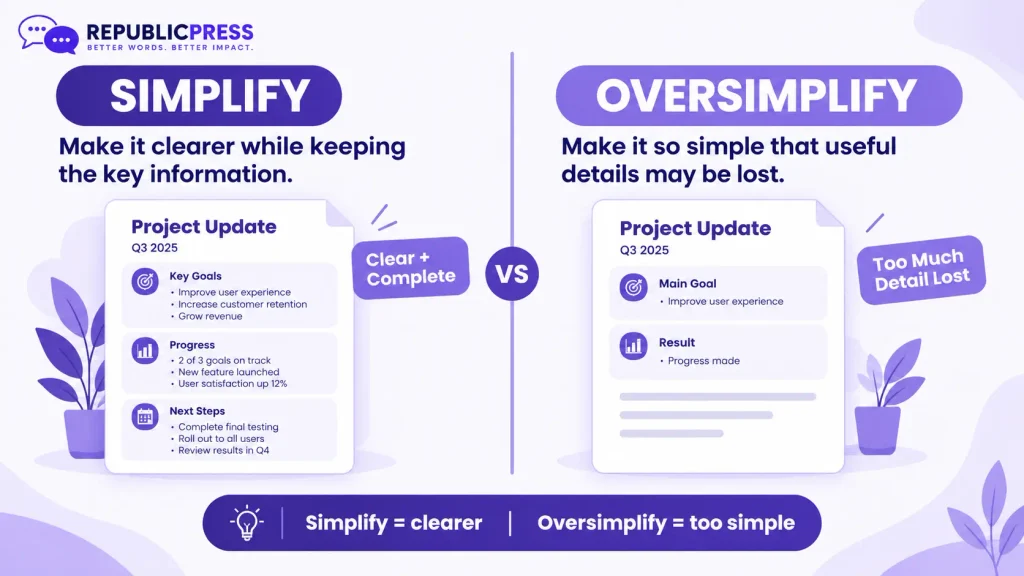
These two words are close, but they have different meanings.
Simplify means making something easier while keeping the main information.
We simplified the instructions without removing any important details.
On the other hand, oversimplify means making something so simple that useful details may be lost.
The article oversimplifies a complicated issue.
Therefore, use simplify when you want a neutral word. Choose oversimplify when you want to show that something has become too simple.
Which Alternative Should You Use?
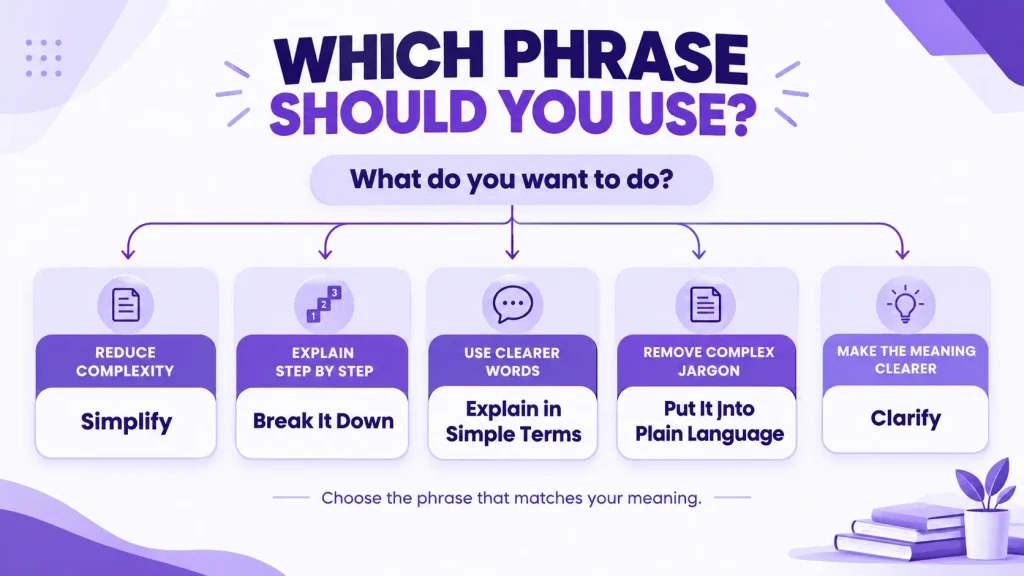
The best option depends on your goal.
- Want to reduce complexity? → Simplify
- Want to show that something is too simple? → Oversimplify
- Want clearer information? → Make it easier to understand
- Want to explain something step by step? → Break it down
- Want to use simple words? → Explain in simple terms
- Want to remove difficult jargon? → Put it into plain language
- Want to make the meaning clearer? → Clarify
- Want more people to understand the information? → Make it more accessible
- Want to reduce difficulty in a process? → Make it less complicated
- Want a website or product to be easier to use? → Make it more user-friendly
When Should You Use a Neutral Alternative?
A neutral word is often better in professional and school writing. It can also make your message sound clearer and more respectful.
For example, you could write:
We need to simplify the training material for new employees.
If you think too much detail has been removed, you could say:
We should avoid oversimplifying the material because some important details may be missing.
In both cases, the wording tells the reader exactly what you mean. As a result, there is less chance of confusion.
Common Mistakes to Avoid
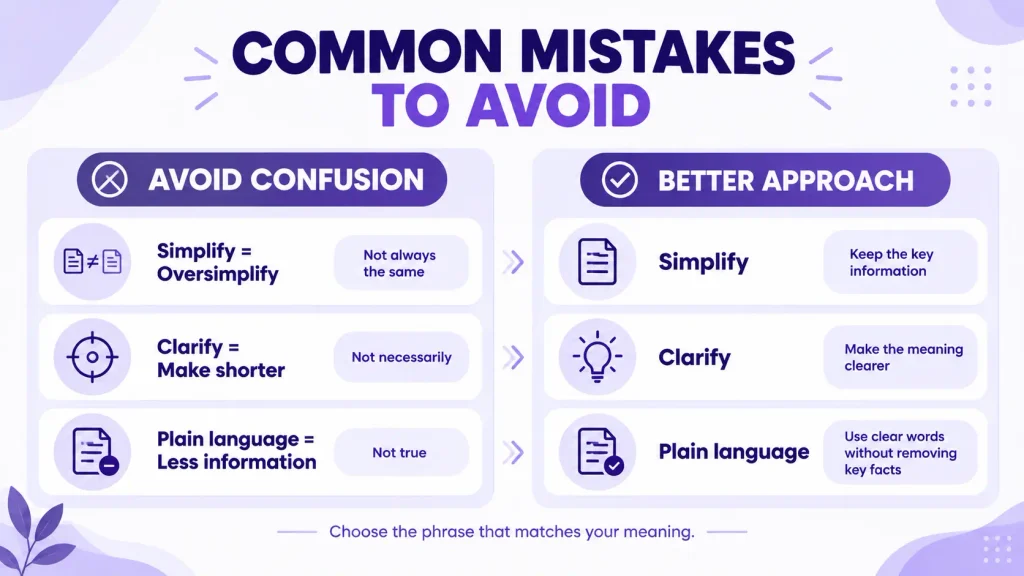
Treating “Simplify” and “Oversimplify” as the Same
These words are not exact synonyms. Simplify is usually neutral. Oversimplify suggests that something has become too simple.
Using “Clarify” When You Mean “Make Simpler”
Clarifying something makes its meaning easier to understand. However, it does not always reduce the amount of information.
Using “Break It Down” in Formal Writing
“Break it down” sounds natural in conversation. Still, it can sound casual in a formal report. In that case, explain in clear steps may work better.
Thinking Plain Language Means Less Information
Plain language does not mean removing important facts. Instead, it means using clear words and simple sentence structures.
Choosing a Phrase Without Thinking About Context
The right phrase depends on your audience. For example, a casual phrase may work well in a conversation. A more formal option may be better in a report or school paper.
FAQs
What is a polite alternative?
Good choices include simplify, make easier to understand, clarify, and explain in simple terms. If you mean that something has become too simple, oversimplify is more accurate.
What is the most professional alternative?
Simplify is usually the most flexible choice. In addition, make more accessible and put into plain language work well in professional writing.
Is “oversimplify” the same as this expression?
Not exactly. Oversimplify means making something too simple, often by leaving out useful details or important differences.
What is another way to say “make something easier to understand”?
You can use simplify it, clarify it, break it down, explain it in simple terms, or put it into plain language. The best option depends on the situation.
How can I describe simplifying technical information?
You can say explain in simple terms, put into plain language, make easier to understand, or make more accessible.
What is the opposite of oversimplifying something?
Depending on the situation, you can say add more detail, provide more context, explain the nuances, expand on the topic, or give a more detailed explanation.
Which option works best for academic writing?
Simplify and clarify are both useful choices. Also, explain in accessible language works well when writing for a broad audience. If too much detail has been removed, oversimplify is more precise.
Conclusion
There are many natural ways to describe making information easier to understand. Simplify is the best general choice. Meanwhile, oversimplify is better when something has become too simple.
For other situations, you can use break it down, explain in simple terms, put it into plain language, clarify, or make it more accessible. Each phrase has a slightly different use.
Therefore, think about your audience and your exact meaning before choosing an alternative. A small change in wording can make your writing clearer and more natural.

Role: English Content Writer
Maren Whitlock writes practical English language content for RepublicsPress, with a focus on vocabulary, word alternatives, everyday expressions, and clear communication. Her articles are designed to make difficult or confusing language easier to understand, with simple explanations and useful examples readers can apply in real situations.