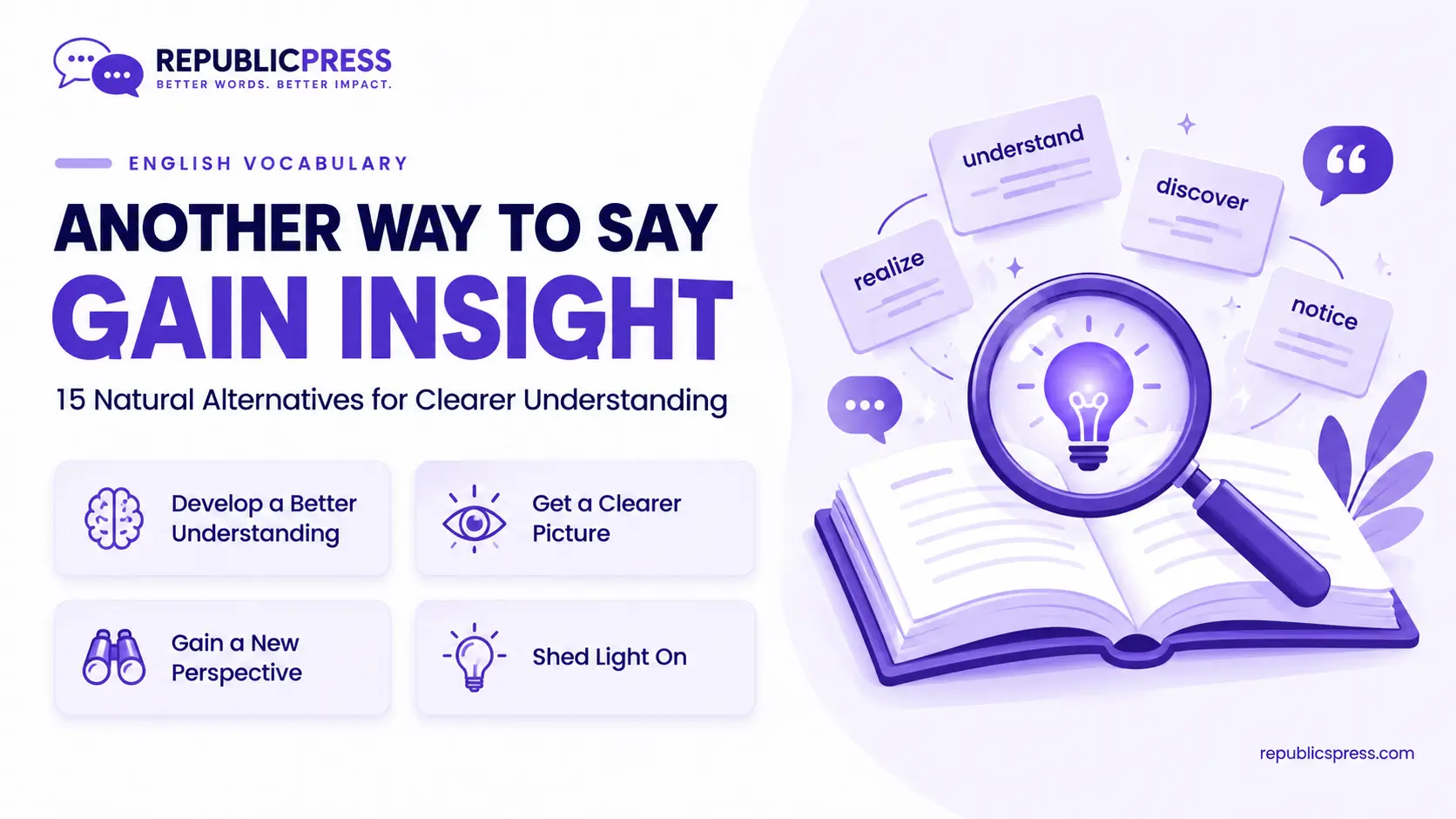
Another Way to Say Gain Insight: 15 Natural Alternatives
To say “gain insight” in a different way, you can use develop a better understanding, learn more about, get a clearer picture, discover, uncover, or deepen your understanding. The best choice depends on what you mean. Some phrases emphasize learning, while others suggest finding hidden information, recognizing a pattern, or understanding a complex issue more clearly.
Key Takeaways
- Develop a better understanding works well in professional, academic, and everyday contexts.
- Get a clearer picture is a natural choice for conversations and business discussions.
- Learn more about is simple, direct, and widely useful.
- Uncover suggests discovering information that was previously hidden or unknown.
- Deepen your understanding emphasizes building on knowledge you already have.
- Draw insights from is useful when discussing research, data, reports, or experience.
What Does “Gain Insight” Mean?
“Gain insight” means to develop a deeper or clearer understanding of a person, situation, subject, or problem. It often involves learning something that helps you see the reasons behind an event or recognize something you had not understood before.
Collins English Dictionary
For example:
- Original: Talking with customers helped us gain insight into their needs.
- Alternative: Talking with customers helped us develop a better understanding of their needs.
Both sentences describe learning more about customers, but the second sounds more direct and conversational.
The phrase commonly appears in research, education, business discussions, personal reflection, and everyday conversations. The most suitable replacement depends on whether you want to emphasize understanding, discovery, awareness, or a new perspective.
15 Other Ways to Say “Gain Insight”
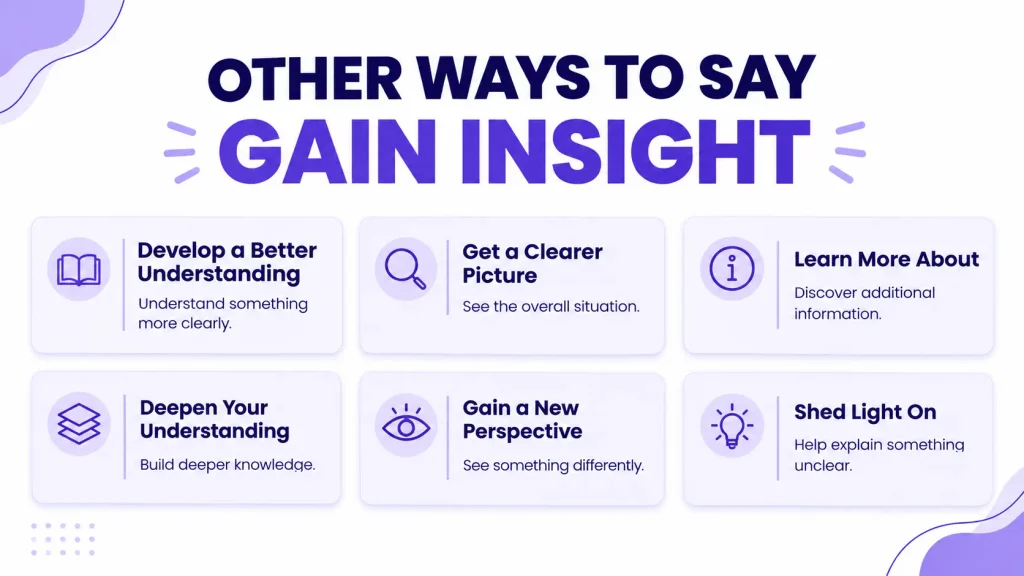
1. Develop a Better Understanding
This is one of the closest and most versatile alternatives. It suggests building a clearer understanding of a subject, often through learning, research, or experience.
Best for: Professional writing, education, and everyday communication.
Example: The training program helped new employees develop a better understanding of company policies.
2. Get a Clearer Picture
Use this conversational expression when you want to understand a situation more fully after receiving additional information.
Best for: Meetings, discussions, planning, and informal communication.
Example: After reviewing the budget, we got a clearer picture of the project’s financial needs.
Usage tip: This phrase emphasizes seeing the overall situation rather than discovering a deep or hidden meaning.
3. Learn More About
This simple alternative works when you want to emphasize gaining knowledge about a subject, person, or issue.
Best for: Everyday English, educational content, and general writing.
Example: The interview helped me learn more about the challenges faced by small business owners.
It is especially useful when the original phrase sounds too formal for the sentence.
4. Deepen Your Understanding
This phrase means developing a more detailed or meaningful understanding of something you already know about.
Best for: Academic writing, professional development, and thoughtful discussions.
Example: Reading different research papers can deepen your understanding of human behavior.
Unlike “learn more about,” it places greater emphasis on the depth of your knowledge.
5. Gain a New Perspective
Use this expression when new information or another person’s viewpoint changes how you see a situation.
Best for: Personal growth, teamwork, education, and problem-solving.
Example: Speaking with the design team gave me a new perspective on the customer’s experience.
Usage tip: A new perspective is a changed or additional viewpoint. It does not always mean you have discovered a fact or reached a deeper understanding.
6. Discover
“Discover” emphasizes finding information, a fact, or an idea that was previously unknown to you.
Best for: Research, exploration, learning, and storytelling.
Example: The survey helped us discover why customers were leaving the website.
Choose this word when the important part is finding something new, not simply improving your general understanding.
7. Uncover
“Uncover” suggests revealing something hidden, overlooked, or not immediately obvious.
Best for: Investigations, data analysis, research, and problem-solving.
Example: The audit uncovered the main reasons for the company’s rising expenses.
It is stronger and more discovery-focused than “learn more about.” Use it when there is something specific to reveal.
8. Shed Light On
This expression means to help explain something that is confusing, unclear, or difficult to understand.
Best for: Reports, discussions, journalism, and explanations.
Example: The new evidence shed light on the cause of the unexpected results.
Usage tip: The subject usually provides the explanation. For example, a report sheds light on a problem, while a reader gains insight from the report.
9. Get a Better Grasp Of
This natural expression means to understand a topic or concept more clearly.
Best for: Everyday conversations, learning, and practical problem-solving.
Example: After completing the course, I had a better grasp of how search engines rank web pages.
It is less formal than “deepen your understanding” and works well when discussing a skill, process, or concept.
10. Become More Aware Of
Use this phrase when the main result is increased awareness of an issue, condition, or behavior.
Best for: Education, health awareness, workplace training, and social topics.
Example: The workshop helped employees become more aware of online security risks.
Awareness and insight are related but not identical. You can become aware of an issue without fully understanding its causes.
11. Recognize a Pattern
This phrase works when you notice a repeated trend, connection, or behavior that helps explain a situation.
Best for: Research, analytics, business decisions, and problem-solving.
Example: By comparing monthly sales reports, the team recognized a pattern in customer demand.
Use it when your insight comes from identifying relationships among pieces of information.
12. Figure Out
“Figure out” is an informal way to describe reaching an understanding or finding the answer to a question or problem.
Best for: Casual conversations, troubleshooting, and practical tasks.
Example: We analyzed the customer feedback to figure out why the checkout process was confusing.
It often suggests solving a specific problem rather than gaining broad knowledge about a subject.
13. Get to the Bottom Of
This expression means investigating a problem to discover its real cause or what actually happened.
Best for: Troubleshooting, investigations, workplace discussions, and everyday problem-solving.
Example: The support team is reviewing the error logs to get to the bottom of the login issue.
It is more focused on finding the root cause than “gain insight,” so it is not a direct replacement in every sentence.
14. Draw Conclusions From
Use this phrase when you interpret information or evidence and decide what it suggests.
Best for: Research, academic writing, data analysis, and reports.
Example: Researchers drew conclusions from the survey responses and identified three common concerns.
Usage tip: Drawing conclusions means interpreting evidence, not merely learning about a topic. Avoid presenting uncertain conclusions as proven facts.
15. Understand the Underlying Causes
This phrase emphasizes identifying the deeper reasons behind an event, behavior, or problem.
Best for: Analytical writing, business reports, research, and problem-solving.
Example: Customer interviews helped us understand the underlying causes of low satisfaction scores.
It is especially useful when “gain insight” feels vague and you want to explain exactly what the new understanding involves.
Which Alternative Should You Choose?
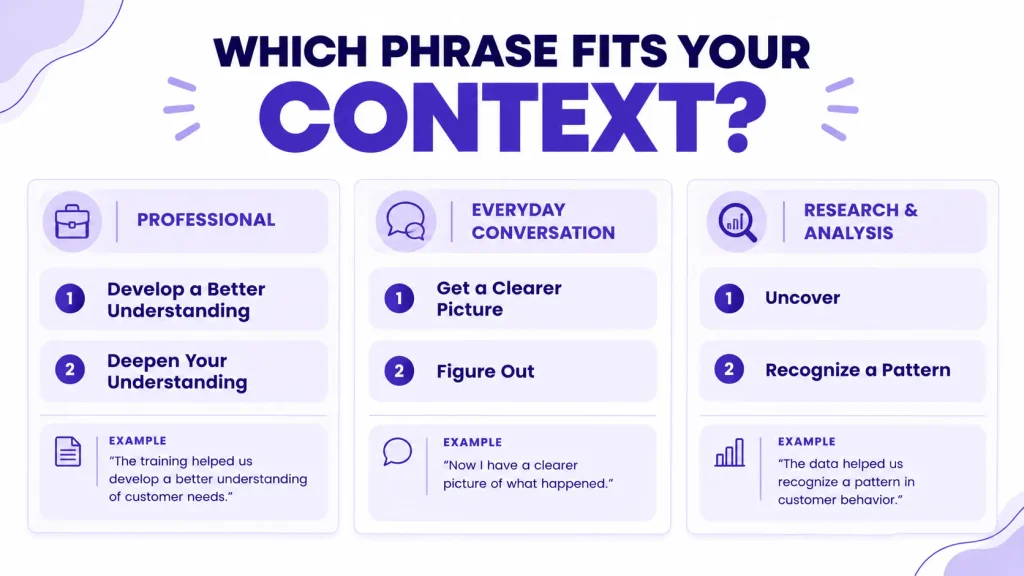
The best replacement depends on what you want to communicate. Use this table to compare the most useful options.
| Alternative | Main emphasis | Tone | Best context |
| Develop a better understanding | Clearer knowledge | Neutral | General writing |
| Get a clearer picture | Overall situation | Conversational | Meetings and discussions |
| Learn more about | New information | Simple, neutral | Everyday English |
| Deepen your understanding | Greater depth | Formal or neutral | Education and research |
| Gain a new perspective | Different viewpoint | Neutral | Personal growth and teamwork |
| Discover | Finding something new | Neutral | Research and exploration |
| Uncover | Revealing hidden information | Direct | Investigations and analysis |
| Shed light on | Explaining something unclear | Neutral or formal | Reports and explanations |
| Get a better grasp of | Clearer comprehension | Conversational | Learning and problem-solving |
| Become more aware of | Increased awareness | Neutral | Training and education |
| Recognize a pattern | Identifying a trend | Analytical | Data and research |
| Figure out | Solving or understanding | Informal | Everyday problem-solving |
| Get to the bottom of | Finding the real cause | Conversational | Troubleshooting |
| Draw conclusions from | Interpreting evidence | Formal | Research and reports |
| Understand the underlying causes | Finding deeper reasons | Analytical | Complex problems |
How to Use “Gain Insight” in Different Contexts
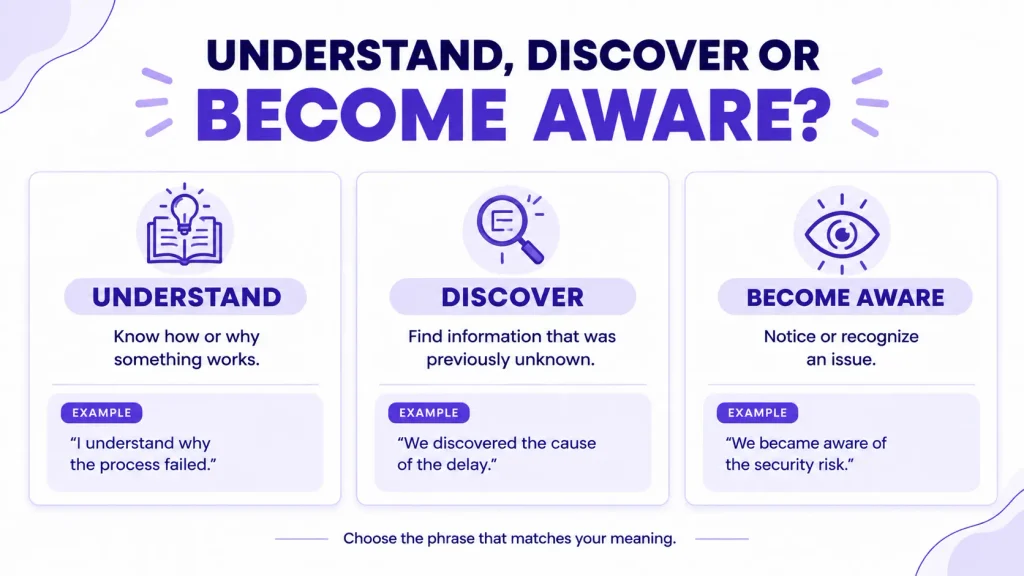
The original phrase is suitable for many situations, but a more specific expression can make your writing clearer.
In professional and business writing
Use phrases that communicate what you learned or discovered without sounding vague.
- Instead of: We gained insight into customer behavior.
- Try: We developed a better understanding of customer behavior.
- Or: Our analysis revealed a pattern in customer behavior.
The second alternative emphasizes understanding. The third highlights a finding supported by analysis.
In academic writing
Choose language that reflects the actual research process.
- Instead of: The study helped us gain insight into language learning.
- Try: The study deepened our understanding of language learning.
- Or: The findings shed light on the factors that affect language learning.
Use “shed light on” when the research helps explain an issue. Use “deepen our understanding” when you want to emphasize increased knowledge.
In everyday conversations
Simple, familiar phrases often sound more natural than formal expressions.
- Instead of: I gained insight into why she was upset.
- Try: I got a clearer picture of why she was upset.
- Or: I figured out why she was upset.
The first alternative suggests a fuller understanding of the situation. The second suggests that you reached an answer.
When analyzing data or solving problems
Choose an expression that describes the specific result of your analysis.
- Instead of: We gained insight into the drop in sales.
- Try: We uncovered the main reasons for the drop in sales.
- Or: We identified a pattern in the sales data.
“Uncovered” emphasizes discovering reasons, while “identified a pattern” emphasizes recognizing a trend.
Common Mistakes to Avoid
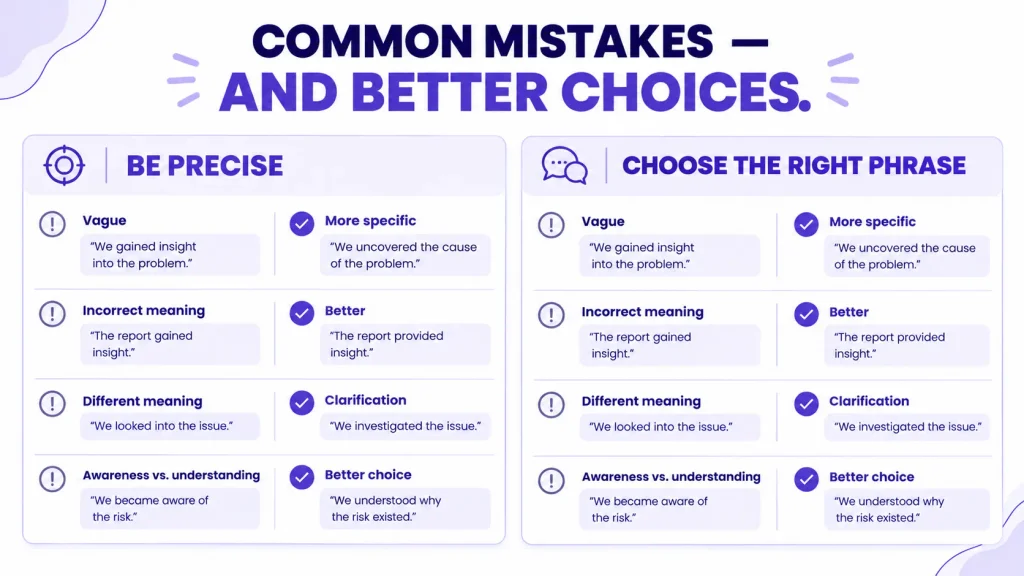
A phrase can be related to “gain insight” without having exactly the same meaning. Keep these distinctions in mind.
- Using “provide insight” when you mean “gain insight.” A report provides insight to its readers; the readers gain insight from the report.
- Using “look into” as if it means understanding something. “Look into” means to investigate or examine. The investigation may lead to insight, but the two expressions describe different stages.
- Treating awareness as deep understanding. Becoming aware of a problem does not necessarily mean understanding why it exists.
- Using “draw conclusions” for simple learning. This phrase implies interpreting information or evidence to reach a judgment.
- Choosing overly formal language for casual situations. “Develop a deeper understanding” may be appropriate in a report, while “get a clearer picture” often sounds more natural in conversation.
Frequently Asked Questions
What is the closest synonym for “gain insight”?
“Develop a better understanding” is one of the closest alternatives. It communicates the idea of learning more about a subject and understanding it more clearly.
What is a professional way to say “gain insight”?
“Develop a deeper understanding,” “identify key findings,” and “shed light on” can work in professional writing. Choose the phrase that accurately describes the result you want to communicate.
What is a casual way to say “gain insight”?
“Get a clearer picture,” “learn more about,” and “figure out” are natural choices. Use “figure out” when you mean reaching an answer or solving a problem.
Can I use “understand” instead of “gain insight”?
Yes, in many sentences. However, “gain insight” often emphasizes developing a deeper understanding or recognizing something meaningful, while “understand” can refer to comprehension in general.
What is another way to say “gain insight into customer behavior”?
You could say “develop a better understanding of customer behavior,” “learn more about customer preferences,” or “identify patterns in customer behavior.” The last option is best when you are specifically discussing patterns in data.
Is “gain insight” formal or informal?
“Gain insight” is neutral to formal. It is common in business, research, education, and general informational writing. More conversational alternatives include “get a clearer picture” and “figure out.”
Should I write “gain insight” or “gain insights”?
Both forms are correct. “Gain insight” often refers to a deeper understanding, while “gain insights” commonly refers to multiple findings or useful understandings. The appropriate choice depends on the sentence.
Conclusion
The best alternative to “gain insight” depends on the meaning you want to convey. “Develop a better understanding” is a reliable all-purpose choice, while “get a clearer picture” suits conversations, “uncover” emphasizes discovery, and “deepen your understanding” highlights greater knowledge. In analytical writing, a specific phrase such as “identify a pattern” or “understand the underlying causes” may communicate your point more clearly than a general expression.

Role: Language & Content Specialist
Tessa Holloway creates language-focused content covering phrases, idioms, expressions, vocabulary, and natural American English. Her work helps readers choose words and expressions that fit different everyday, academic, and professional situations.