Another Way to Say Keep Track Of: 15 Natural Alternatives
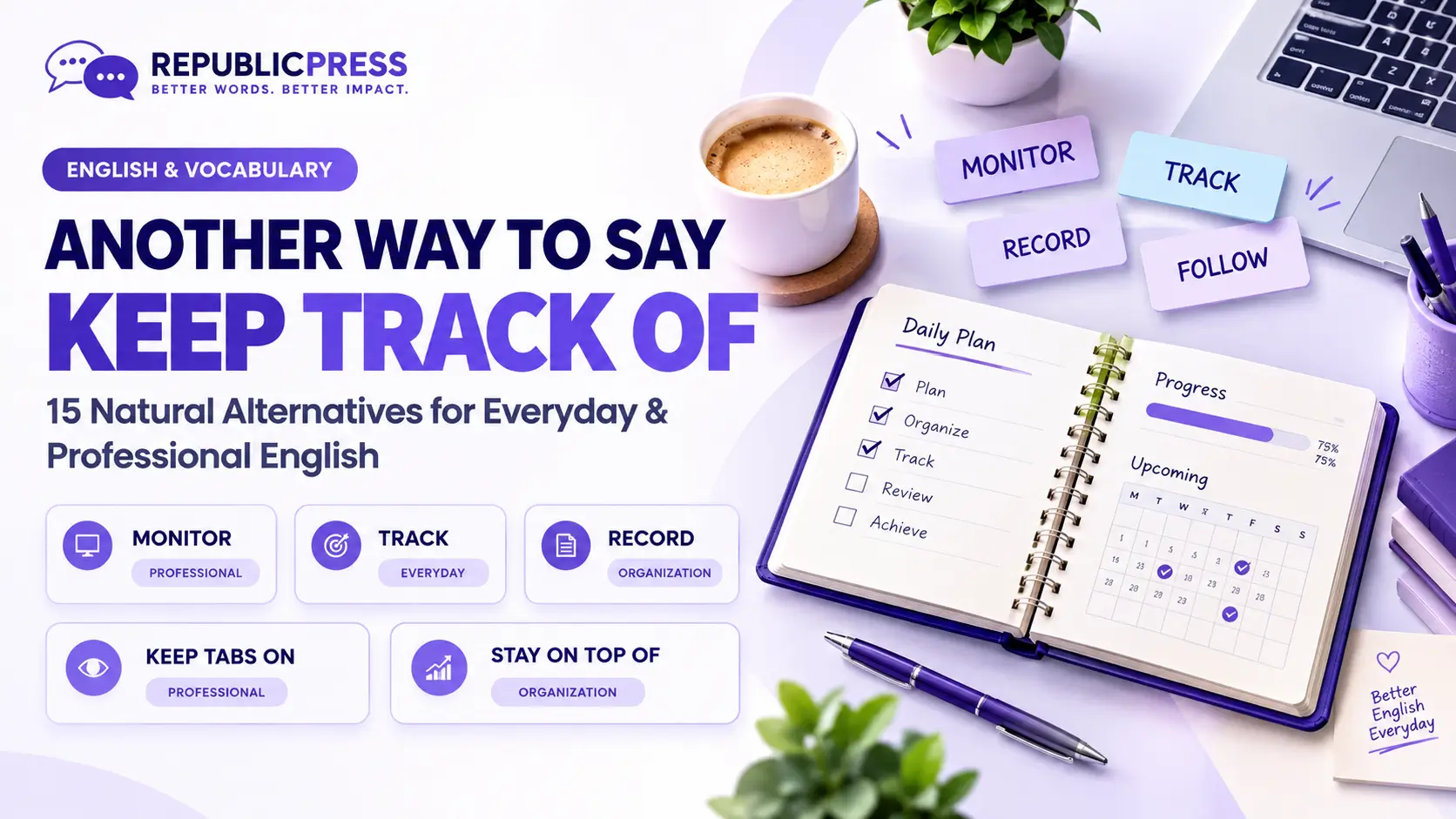
“Keep track of” means to monitor, record, or stay aware of information, activities, changes, or progress over time. The best alternative depends on what you are tracking. For example, you can monitor progress, record expenses, keep tabs on a project, or stay informed about updates.
Key Takeaways
- Monitor works well for watching progress, activity, or changes.
- Track is a direct, concise choice for progress, tasks, and results.
- Keep tabs on is a casual alternative for staying informed.
- Record means to write down or save information.
- Stay on top of suggests remaining informed and in control.
- Follow up on means checking the status of something that needs attention.
15 Other Ways to Say Keep Track Of
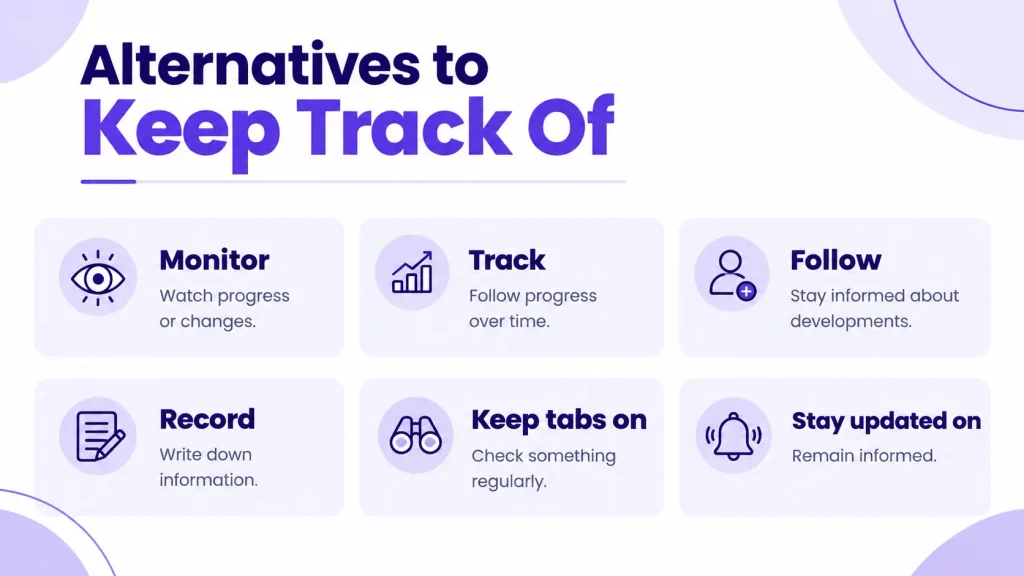
These alternatives have slightly different meanings, so choose one that fits your sentence.
1. Monitor
Use “monitor” when you regularly watch something for changes, problems, or progress. It is common in professional, technical, and everyday settings.
Example: We monitor website traffic to see which pages attract the most visitors.
Best for: Performance, activity, health, systems, and progress.
2. Track
“Track” is a direct alternative when you want to follow progress, movement, results, or changes over time.
Example: Our team tracks each order from shipment to delivery.
Best for: Tasks, goals, orders, expenses, and performance.
3. Keep Tabs On
This casual expression means staying informed about someone or something.
Example: I’ll keep tabs on the project while you’re away.
Best for: Everyday conversations, informal workplace chats, and ongoing situations.
Usage tip: Avoid it in highly formal writing when “monitor” or “oversee” would sound more appropriate.
4. Record
Use “record” when you write down or save information so you can refer to it later.
Example: Please record every payment in the spreadsheet.
Best for: Expenses, transactions, measurements, and important details.
5. Log
“Log” means to enter information into a record, journal, or digital system.
Example: The technician logs each repair in the service database.
Best for: Work hours, errors, activities, and technical records.
6. Keep an Eye On
This phrase means watching something carefully, often to notice changes or problems.
Example: Keep an eye on the delivery status in case the arrival date changes.
Best for: Short-term monitoring, potential issues, and everyday situations.
7. Stay on Top Of
Use this expression when you want to remain informed, organized, and in control of tasks or responsibilities.
Example: I use a daily checklist to stay on top of my deadlines.
Best for: Workloads, deadlines, responsibilities, and ongoing tasks.
8. Follow
“Follow” works when you regularly check developments, updates, or progress.
Example: We follow the company’s sales figures throughout the quarter.
Best for: News, trends, progress, and ongoing developments.
9. Keep a Record Of
This phrase emphasizes maintaining information for future reference, documentation, or proof.
Example: Keep a record of all client requests and completed changes.
Best for: Business records, agreements, expenses, and documentation.
10. Stay Informed About
Use this phrase when the main goal is to remain aware of new information or developments.
Example: Employees should stay informed about changes to the company’s policies.
Best for: News, policies, industry developments, and announcements.
11. Oversee
“Oversee” means to supervise or manage an activity, process, or group. It can replace “keep track of” when monitoring is part of a broader responsibility.
Example: Maria oversees the website redesign and checks each stage of the project.
Best for: Projects, teams, operations, and management.
Usage tip: “Oversee” implies responsibility or supervision, not simply observing something.
12. Check On
This expression means looking at the current status or condition of something.
Example: I’ll check on the application tomorrow to see whether it has been approved.
Best for: Applications, orders, tasks, and pending requests.
13. Follow Up On
Use “follow up on” when you return to an issue, request, or task to check its status or take the next step.
Example: I’ll follow up on the invoice if we don’t receive payment by Friday.
Best for: Emails, client requests, payments, and unfinished tasks.
Usage tip: This is not a direct synonym in every situation. It focuses on taking further action rather than continuously monitoring something.
14. Measure
“Measure” means assessing the amount, level, or degree of something. It is useful when tracking involves evaluating results.
Example: We measure customer satisfaction every three months.
Best for: Growth, performance, progress, and results.
15. Maintain a Running Record Of
This phrase means keeping an ongoing record that you update as new information becomes available.
Example: The project manager maintains a running record of completed tasks and outstanding issues.
Best for: Detailed reports, project documentation, expenses, and long-term records.
Comparison Table: Choosing the Right Alternative
| Alternative | Main meaning | Tone |
|---|---|---|
| Monitor | Watch for changes | Professional |
| Track | Follow progress or results | Neutral |
| Keep tabs on | Stay informed | Casual |
| Record | Save information | Neutral |
| Log | Enter information systematically | Technical or professional |
| Keep an eye on | Watch carefully | Casual |
| Stay on top of | Remain organized and in control | Conversational |
| Follow | Check ongoing developments | Neutral |
| Keep a record of | Preserve information | Professional |
| Stay informed about | Remain aware of updates | Professional |
| Oversee | Supervise or manage | Professional |
| Check on | Check the current status | Neutral |
| Follow up on | Return to an issue or task | Professional |
| Measure | Assess a level or result | Analytical |
| Maintain a running record of | Keep an updated record | Formal |
How to Choose the Best Phrase for Your Context
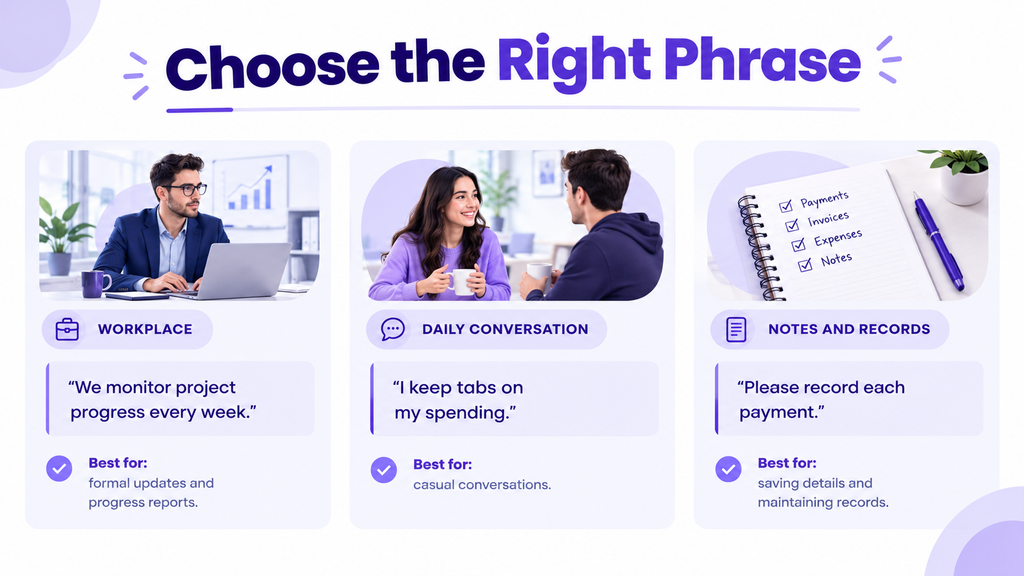
The most natural alternative depends on what you want to communicate.
At Work
For projects, deadlines, and team responsibilities, use “monitor,” “track,” or “stay on top of.”
- Original: I need to keep track of our project deadlines.
- Alternative: I need to stay on top of our project deadlines.
The revised sentence emphasizes staying organized and meeting responsibilities.
For Money and Expenses
Use “record,” “log,” or “keep a record of” when you need to document financial information.
- Original: I keep track of my monthly expenses.
- Alternative: I record my monthly expenses.
“Record” makes it clear that you write down or save the information.
For Updates and News
Use “follow” or “stay informed about” when you want to know about new developments.
- Original: She keeps track of industry news.
- Alternative: She stays informed about industry news.
For Tasks and Pending Requests
Use “check on” or “follow up on” when you need to find out what has happened with something.
- Original: I’ll keep track of the client’s request.
- Alternative: I’ll follow up on the client’s request tomorrow.
The alternative suggests a specific action to check its status.
Common Mistakes to Avoid
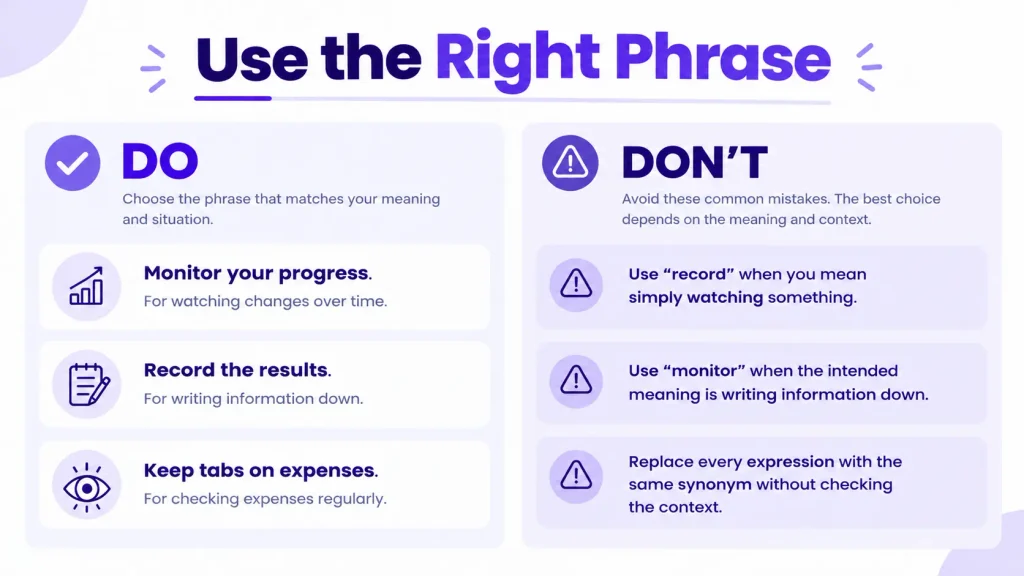
- Using “oversee” for simple observation: Overseeing usually involves supervision or responsibility.
- Using “record” when you mean to watch: Recording saves information; monitoring involves observing it.
- Using “follow up on” for continuous monitoring: Follow-up usually means returning to something to check its status or take action.
- Using “measure” for every kind of tracking: Measurement involves assessing an amount, level, or result.
- Using “keep tabs on” in every professional document: It is natural in conversation but can sound too casual in formal reports.
Frequently Asked Questions
What is the most professional way to say “keep track of”?
“Monitor,” “track,” and “maintain a record of” are strong professional choices. Use “monitor” for observing changes, “track” for following progress, and “maintain a record of” for documenting information.
What is a casual way to say “keep track of”?
“Keep tabs on” and “keep an eye on” are common casual alternatives. “Keep tabs on” emphasizes staying informed, while “keep an eye on” emphasizes watching for changes or problems.
Is “monitor” the same as “keep track of”?
They overlap, but they are not always interchangeable. “Monitor” emphasizes watching something over time, while “keep track of” can also mean recording details or remembering information.
Can I use “track” in a professional email?
Yes. “Track” is clear, concise, and widely used in professional communication.
For example: “I’ll track the project’s progress and share an update on Friday.”
What is another way to say “keep track of progress”?
You can say “monitor progress,” “track progress,” “measure progress,” or “follow progress.” Choose “measure progress” when you are evaluating results and “monitor progress” when you are watching developments over time.
What is another way to say “keep track of expenses”?
You can say “record expenses,” “log expenses,” or “maintain a record of expenses.” These phrases emphasize documenting financial information rather than simply observing it.
What is another way to say “keep track of someone”?
Depending on your meaning, you could say “keep tabs on someone,” “keep an eye on someone,” or “stay in touch with someone.” The first two involve monitoring or watching, while “stay in touch” means maintaining communication.
Conclusion
The best alternative to “keep track of” depends on your purpose. Use “monitor” to watch for changes, “record” to save information, “keep tabs on” for casual conversations, and “stay on top of” to emphasize organization. Choosing the phrase that matches your intended meaning will make your writing clearer and more natural.

Role: Language & Content Specialist
Tessa Holloway creates language-focused content covering phrases, idioms, expressions, vocabulary, and natural American English. Her work helps readers choose words and expressions that fit different everyday, academic, and professional situations.