Another Way to Say You Are Happy to Do Something: 25 Natural Alternatives
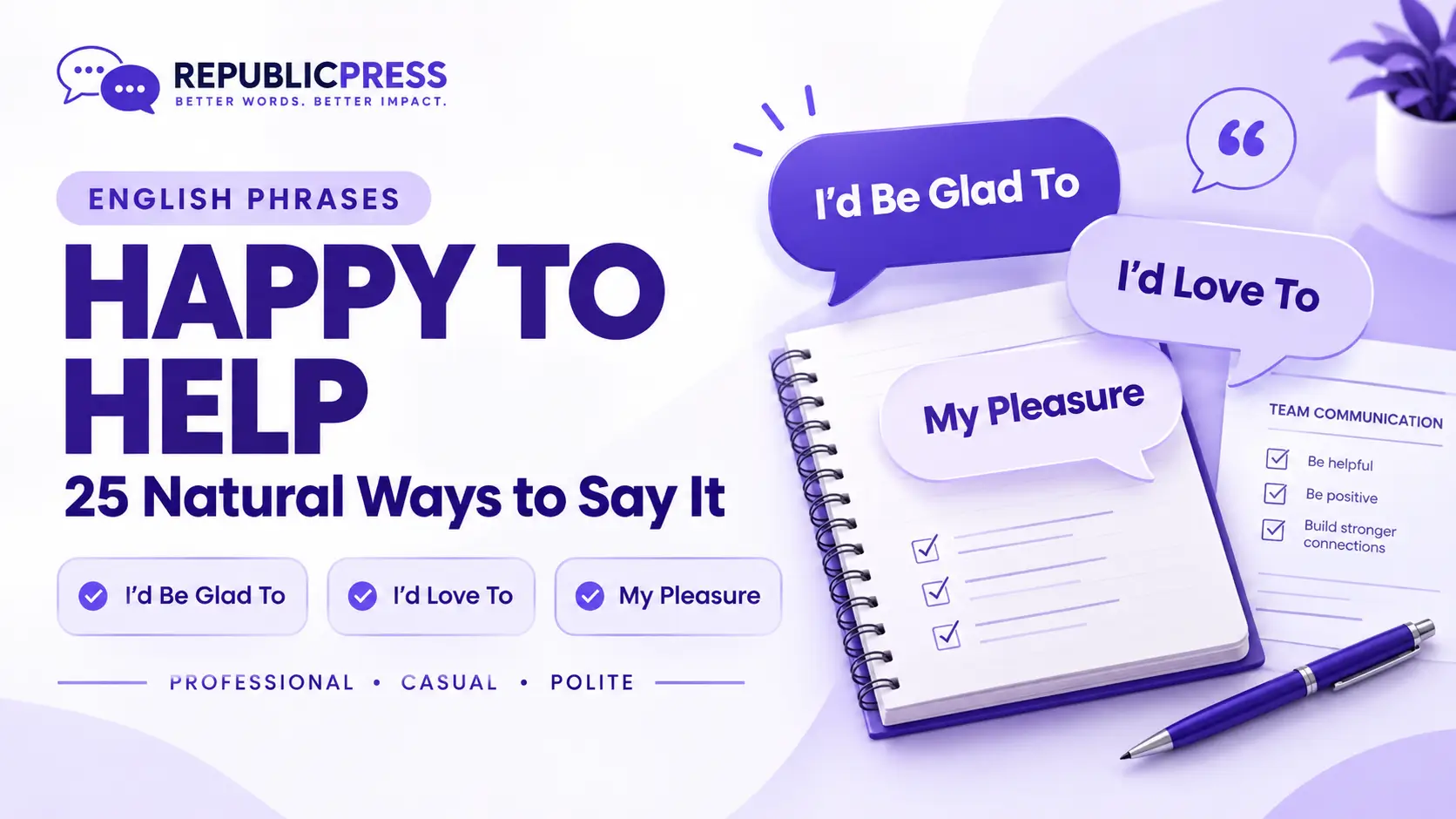
If you want another way to say you are happy to do something, you can use phrases such as “I’d be glad to,” “I’d be happy to help,” “I’d love to,” “my pleasure,” or “I’d be delighted to.” The best choice depends on the situation. Some phrases sound professional and polite, while others feel warm, friendly, or enthusiastic.
Key Takeaways
- Professional: “I’d be glad to,” “I’d be happy to assist,” and “certainly.”
- Friendly: “I’d love to,” “of course,” and “no problem.”
- Formal: “I’d be delighted to” and “it would be my pleasure.”
- Helpful and polite: “I’m more than happy to” and “I’d be happy to take care of that.”
- After helping someone: “My pleasure” and “happy to help” work especially well.
- Most natural choice: Match the phrase to your relationship with the person and the situation.
25 Alternatives to Say You Are Happy to Do Something
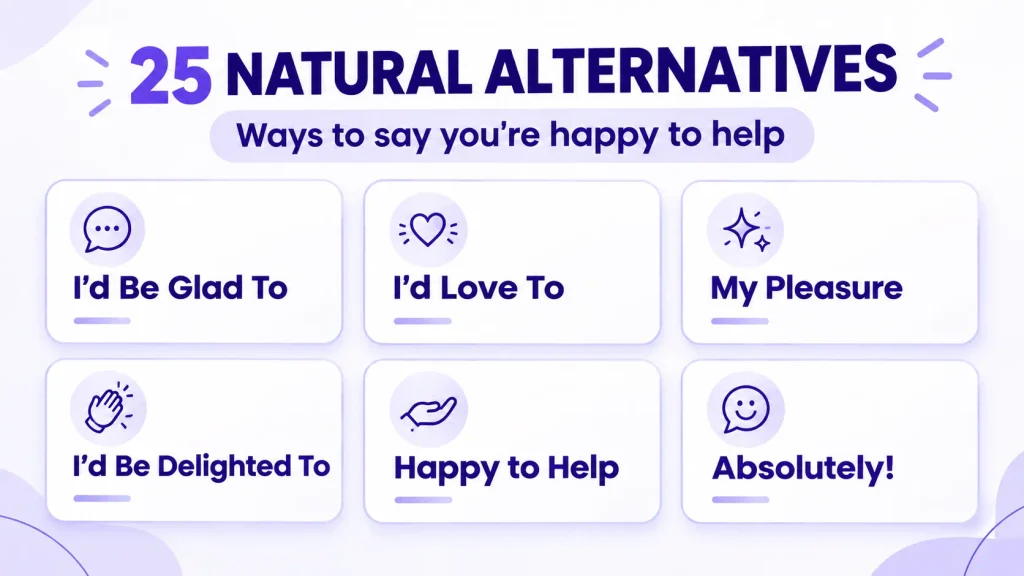
Here are 25 natural expressions you can use to show willingness, enthusiasm, or a positive attitude toward doing something.
1. I’d Be Glad To
This phrase expresses a polite willingness to help or complete a task. It works well in professional and everyday conversations.
Example: “Could you review this document?” “I’d be glad to.”
Best for: Professional emails, workplace conversations, and polite requests.
2. I’d Love To
Use this expression when you genuinely feel excited about an invitation, activity, or opportunity.
Example: “Would you like to join us for dinner?” “I’d love to!”
Best for: Friends, invitations, social plans, and activities you look forward to.
Usage tip: “I’d love to” usually sounds warmer and more enthusiastic than “I’d be glad to.”
3. My Pleasure
“My pleasure” communicates that helping someone was enjoyable or that you were happy to assist. It is especially common as a response to thanks.
Example: “Thank you for helping me prepare for the interview.” “My pleasure!”
Best for: Customer service, polite conversations, and professional interactions.
4. I’d Be Delighted To
This phrase expresses strong enthusiasm in a polished, courteous way.
Example: “Would you be available to speak at our event?” “I’d be delighted to.”
Best for: Formal invitations, business communication, and special occasions.
5. Of Course
“Of course” shows that you are willing to help and that the request is acceptable to you.
Example: “Could you send me the meeting notes?” “Of course. I’ll send them shortly.”
Best for: Everyday requests, friendly conversations, and workplace communication.
6. Absolutely
Use “absolutely” to give an enthusiastic and confident response to a request or suggestion.
Example: “Can you help us organize the presentation?” “Absolutely!”
Best for: Teamwork, casual conversations, and situations where you want to sound positive.
7. No Problem
This casual expression tells someone that you are willing to help or that a request is not an inconvenience.
Example: “Could you pick up a few things on your way home?” “No problem.”
Best for: Friends, family, and informal workplace conversations.
Usage tip: In very formal situations, “I’d be happy to help” may sound more polished.
8. I’m More Than Happy To
This phrase emphasizes your willingness to do something. It suggests that you are especially comfortable with the request.
Example: “Would you be able to explain the process again?” “I’m more than happy to.”
Best for: Reassuring colleagues, helping clients, and offering support.
9. I’d Be Happy to Help
This is a direct, friendly way to show that you are willing to assist someone.
Example: “I’m having trouble setting up my account.” “I’d be happy to help.”
Best for: Customer support, emails, work conversations, and everyday requests.
10. Certainly
“Certainly” is a polite and confident way to agree to a request. It sounds slightly more formal than “sure.”
Example: “Could you arrange a meeting for Thursday?” “Certainly. I’ll check everyone’s availability.”
Best for: Professional emails, business conversations, and customer service.
11. With Pleasure
“With pleasure” communicates that you are willing to do something gladly. It is polite and can sound somewhat formal, depending on the setting.
Example: “Would you mind showing me around the office?” “With pleasure.”
Best for: Courteous conversations, formal requests, and hospitality settings.
12. Happy to Help
This shorter expression communicates willingness without sounding overly formal.
Example: “Thanks for answering all my questions.” “Happy to help!”
Best for: Friendly emails, customer service, team chats, and everyday interactions.
13. I’d Be More Than Glad To
This phrase adds emphasis to your willingness to help. It is understandable and natural, although “I’d be more than happy to” is often the smoother choice in American English.
Example: “Could you look over my application?” “I’d be more than glad to.”
Best for: Friendly, polite conversations where you want to emphasize your willingness.
14. Sure, I’d Be Happy To
This combines a relaxed agreement with a clear expression of willingness.
Example: “Can you explain how this software works?” “Sure, I’d be happy to.”
Best for: Everyday workplace conversations and informal requests.
15. I’d Be Happy to Take Care of That
Use this phrase when you are volunteering to handle a task or responsibility.
Example: “Someone needs to update the client records.” “I’d be happy to take care of that.”
Best for: Workplace communication, project coordination, and customer service.
16. Consider It Done
This confident expression tells someone that you intend to handle the task. It conveys assurance more than happiness itself.
Example: “Please make sure the invitations go out today.” “Consider it done.”
Best for: Team discussions, familiar colleagues, and tasks you can confidently complete.
Usage tip: Only use it when you can reasonably commit to completing the task.
17. I’d Be More Than Happy To
This is a warm, emphatic way to express willingness. It can reassure someone that their request is welcome.
Example: “Could you stay a little longer to help us finish?” “I’d be more than happy to.”
Best for: Supportive conversations, professional assistance, and friendly offers.
18. I’d Be Thrilled To
This phrase communicates excitement, not just willingness. Use it when the opportunity genuinely appeals to you.
Example: “Would you like to collaborate on our next project?” “I’d be thrilled to.”
Best for: Exciting opportunities, invitations, and positive professional responses.
19. I’d Be Honored To
This expression shows that you consider the opportunity meaningful or important.
Example: “Would you be willing to introduce the guest speaker?” “I’d be honored to.”
Best for: Ceremonies, special responsibilities, and significant invitations.
20. I’d Gladly Do That
This phrase clearly communicates that you are willing to perform a task without reluctance.
Example: “Could you help me carry these boxes?” “I’d gladly do that.”
Best for: Helpful offers and straightforward conversations.
21. I’m Happy to Do That
This is one of the closest alternatives to the original expression. It directly communicates a positive willingness to complete a specific task.
Example: “Could you make those changes before Friday?” “I’m happy to do that.”
Best for: Professional emails, daily conversations, and simple requests.
22. I’d Be Happy to Lend a Hand
“Lend a hand” is an idiom meaning to help someone. This phrase sounds friendly and cooperative.
Example: “We need another person to prepare the decorations.” “I’d be happy to lend a hand.”
Best for: Group activities, events, household tasks, and teamwork.
23. I’d Love to Help Out
This phrase combines enthusiasm with a friendly offer of assistance.
Example: “We’re looking for volunteers for the school event.” “I’d love to help out.”
Best for: Community events, friends, family, and informal volunteering.
24. It’s No Trouble at All
This expression reassures someone that helping them is not an inconvenience.
Example: “Sorry for asking you to print these pages.” “It’s no trouble at all.”
Best for: Reassuring someone who feels apologetic about asking for help.
25. I’d Be Delighted to Assist
This polished expression conveys a willingness to help in a formal or professional setting.
Example: “Could you assist us with the registration process?” “I’d be delighted to assist.”
Best for: Formal business emails, client communication, and professional service.
Comparison Table: Which Alternative Should You Choose?
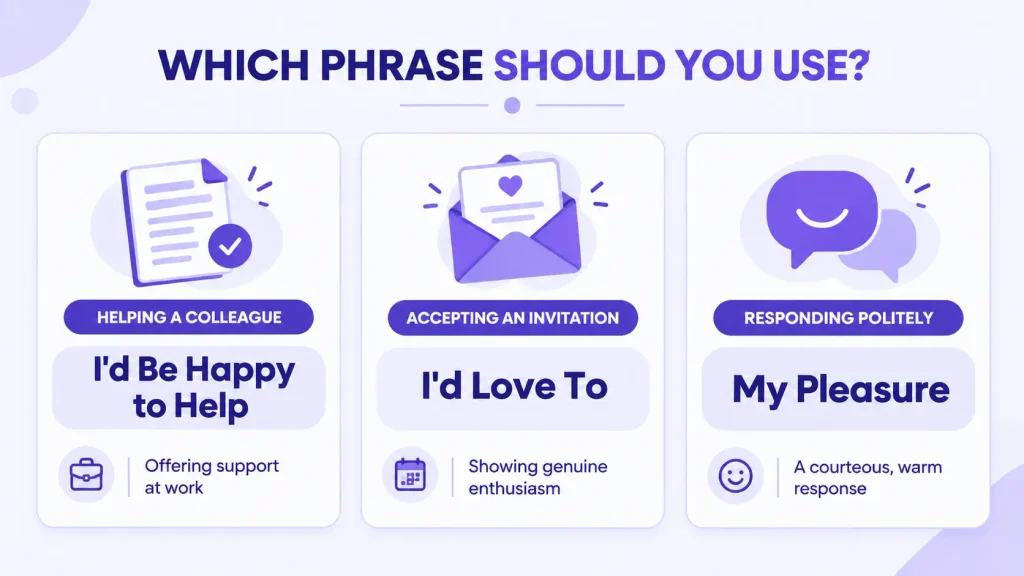
| Alternative | Tone | Best Context |
| I’d be glad to | Polite | Work and everyday requests |
| I’d love to | Enthusiastic | Invitations and social plans |
| My pleasure | Courteous | Responding to thanks |
| I’d be delighted to | Formal, warm | Special invitations |
| Of course | Natural, friendly | Everyday requests |
| Absolutely | Confident | Teamwork and agreement |
| No problem | Casual | Friends and informal work chats |
| I’d be happy to help | Warm, professional | Offering assistance |
| Certainly | Formal, confident | Business communication |
| Consider it done | Assured | Specific tasks and commitments |
| I’d be thrilled to | Very enthusiastic | Exciting opportunities |
| I’d be honored to | Respectful | Meaningful responsibilities |
| I’d love to help out | Friendly | Volunteering and teamwork |
| It’s no trouble at all | Reassuring | Responding to apologies |
| I’d be delighted to assist | Formal | Client communication |
How to Say You Are Happy to Do Something in Different Situations
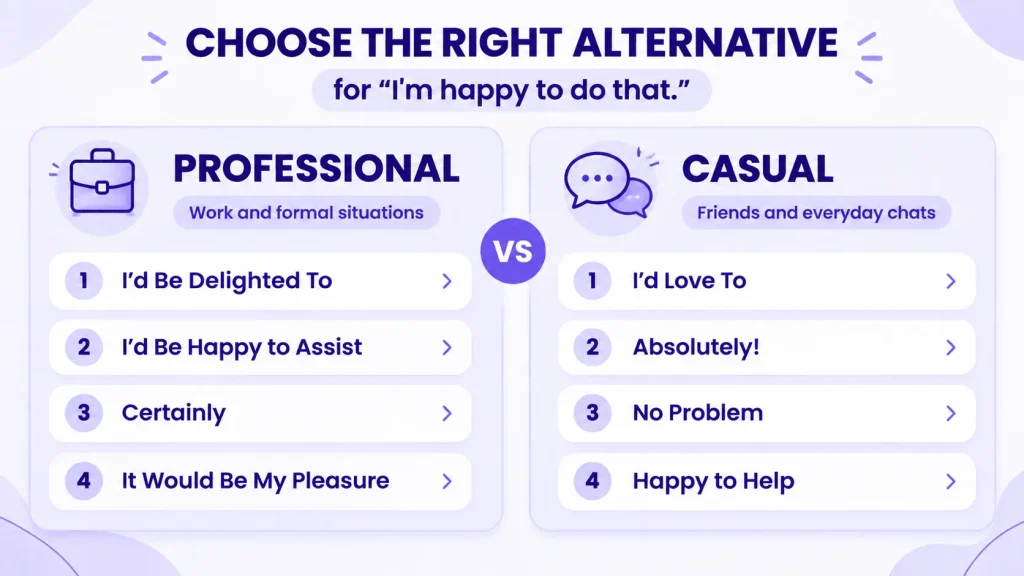
The right expression depends on whether you are responding to a request, accepting an invitation, or reassuring someone.
In a Professional Email
Choose language that sounds cooperative, clear, and respectful.
Examples:
- “I’d be happy to review the proposal.”
- “I’d be glad to assist with the project.”
- “Certainly, I’ll take care of that.”
- “I’d be delighted to discuss this further.”
For most workplace emails, “I’d be happy to” is a safe, natural choice. It sounds professional without being stiff.
In Casual Conversations
Use relaxed expressions that sound natural between friends or people you know well.
Examples:
- “Sure, I’d love to!”
- “Of course!”
- “No problem.”
- “Happy to help!”
These phrases are friendly and direct. Use “I’d love to” when you want to show enthusiasm, rather than simple agreement.
When Someone Thanks You
If you have already helped someone, you can acknowledge their thanks without repeating that you are willing to help.
Examples:
- “My pleasure.”
- “Happy to help.”
- “Anytime!”
- “You’re welcome.”
“Anytime!” suggests that you would be willing to help again, so it works best when you genuinely mean it.
When Accepting an Invitation
Show that you are pleased about the opportunity.
Examples:
- “I’d love to join you.”
- “That sounds wonderful!”
- “I’d be delighted to attend.”
- “Absolutely, count me in!”
The first three are suitable for different levels of formality. “Count me in” is more casual and enthusiastic.
When Reassuring Someone
If someone apologizes for asking you to do something, make it clear that their request is not a burden.
Examples:
- “It’s no trouble at all.”
- “Don’t worry about it.”
- “I’m more than happy to help.”
- “It’s really no problem.”
These phrases focus on reducing the other person’s concern rather than simply agreeing to a task.
Common Mistakes to Avoid
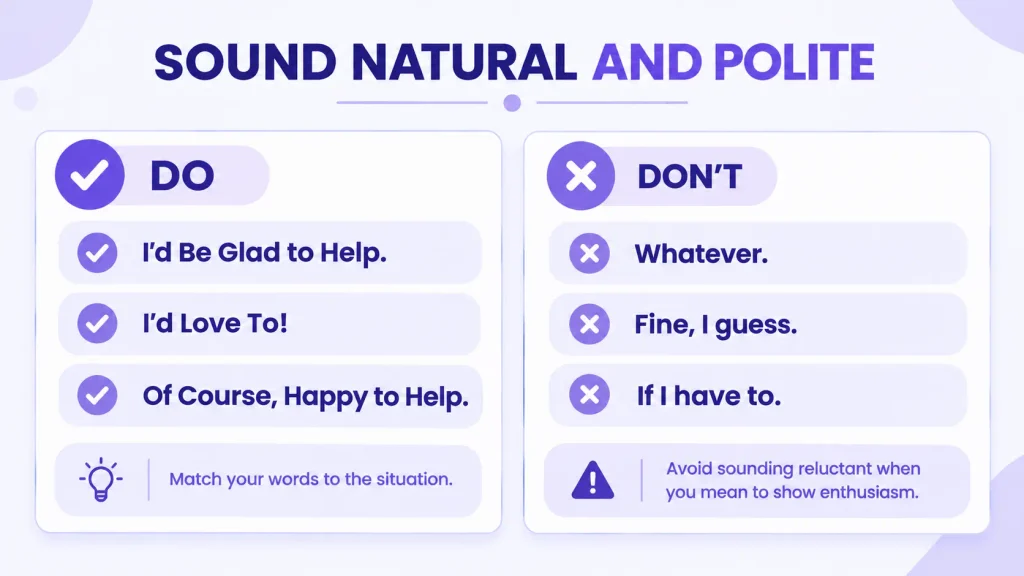
- Using “my pleasure” before doing the task: It usually works best after someone thanks you or when you are describing the pleasure of helping.
- Using “I’d be honored to” for every small request: This phrase can sound too serious for ordinary tasks.
- Treating “no problem” as formal language: It is common in American English, but “I’d be happy to assist” may suit a formal client email better.
- Confusing enthusiasm with willingness: “I’d be thrilled to” expresses stronger excitement than “I’d be glad to.”
- Promising too much: “Consider it done” signals a commitment. Avoid it if you are unsure you can finish the task.
- Using incomplete phrases without context: “I’d love to” often works as a complete response to an invitation, but in writing, make sure the surrounding conversation makes your meaning clear.
Frequently Asked Questions
What is the most professional way to say you are happy to do something?
“I’d be happy to assist” and “I’d be glad to help” are both professional and natural. For example, “I’d be happy to review the document and share my feedback by Friday.”
What is a more formal way to say “I’d be happy to”?
You can say “I’d be delighted to,” “It would be my pleasure,” or “I’d be pleased to.” These expressions sound polished, although “I’d be pleased to” can feel more reserved.
How do you say you are happy to help without sounding repetitive?
Vary your response based on the situation. Try “Certainly,” “Of course,” “My pleasure,” “I’d be glad to,” or “I’m happy to take care of that.” Each phrase communicates a slightly different shade of meaning.
Is “I’d love to” the same as “I’d be happy to”?
Not exactly. Both express willingness, but “I’d love to” usually shows stronger personal enthusiasm. “I’d be happy to” is more neutral and works well for routine requests.
Is “happy to help” professional?
Yes. “Happy to help” is common in American workplace communication, including emails and team messages. For a more formal tone, use “I’d be happy to assist.”
How do you respond when someone asks you for a favor?
You can say “Of course,” “I’d be glad to,” “Sure, no problem,” or “I’d be happy to help.” Choose the response that matches your actual willingness and the size of the favor.
What is a polite way to say you are willing to do something?
“I’d be glad to,” “I’d be happy to,” and “Certainly” are polite choices. They communicate cooperation without sounding overly casual or excessively formal.
Can you say “I’m more than happy to do that” in a work email?
Yes. It is natural American English and emphasizes your willingness. For a simple request, “I’m happy to do that” is often enough; use “more than happy” when you want to sound especially reassuring.
Conclusion
The best alternative to saying you are happy to do something depends on the tone you want to convey. Use “I’d be happy to help” for a versatile, professional response, “I’d love to” for enthusiasm, “my pleasure” when responding to thanks, and “I’d be delighted to” for formal occasions.
Choose the expression that reflects your real feelings and fits the conversation. A natural, sincere response is usually more effective than an overly elaborate one.

Role: English Content Writer
Maren Whitlock writes practical English language content for RepublicsPress, with a focus on vocabulary, word alternatives, everyday expressions, and clear communication. Her articles are designed to make difficult or confusing language easier to understand, with simple explanations and useful examples readers can apply in real situations.