Another Way to Say So Many: 25+ Better Alternatives
Sometimes, the phrase “so many” feels too simple or repetitive. You may want a more professional expression for an email, a stronger phrase for an essay, or a natural alternative for everyday conversation.
Fortunately, you have plenty of options. The best another way to say so many depends on what you want to describe, such as people, things, opportunities, problems, or experiences.
For example, you can say “a large number of,” “countless,” “numerous,” or “a wide variety of.” However, each expression has a slightly different meaning. Some emphasize quantity, while others highlight variety or the size of a group.
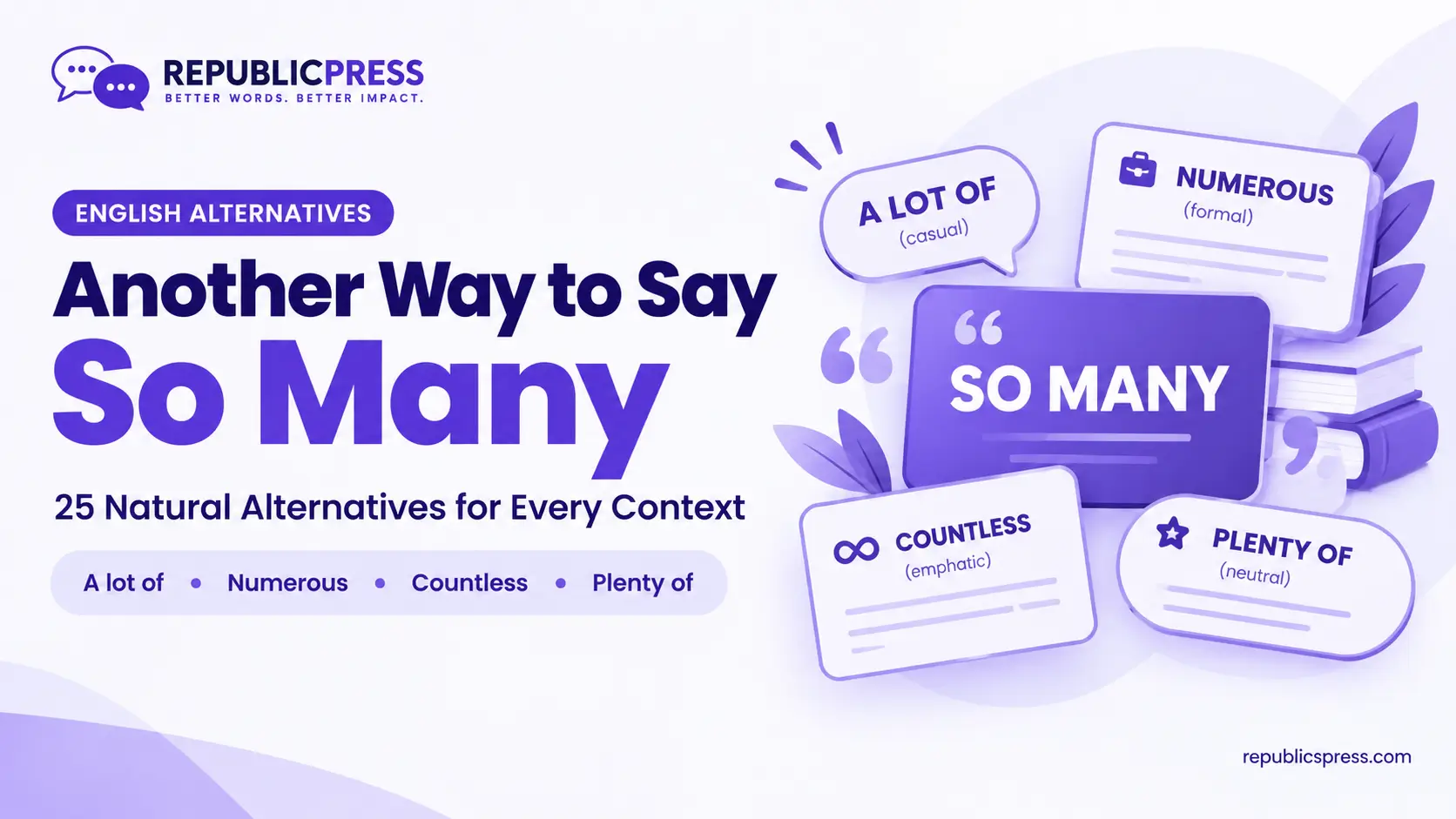
In this guide, you will discover more than 25 alternatives to “so many,” along with simple definitions, practical examples, and tips for choosing the right expression.
What Is Another Way to Say So Many?
The best alternatives to “so many” include numerous, countless, a large number of, a great many, a wide range of, and an abundance of.
Each phrase works in a different situation. For instance, “numerous” sounds professional, while “countless” suggests a quantity that feels too large to count easily. Similarly, “a wide range of” highlights variety rather than quantity alone.
Here are some quick examples:
- Original: There are so many reasons to learn English.
- Professional: There are numerous reasons to learn English.
- Emphatic: There are countless reasons to learn English.
- Conversational: There are a lot of reasons to learn English.
- Variety-focused: There is a wide range of reasons to learn English.
Therefore, choose an alternative that matches your meaning, audience, and tone.
25+ Alternatives to Say So Many
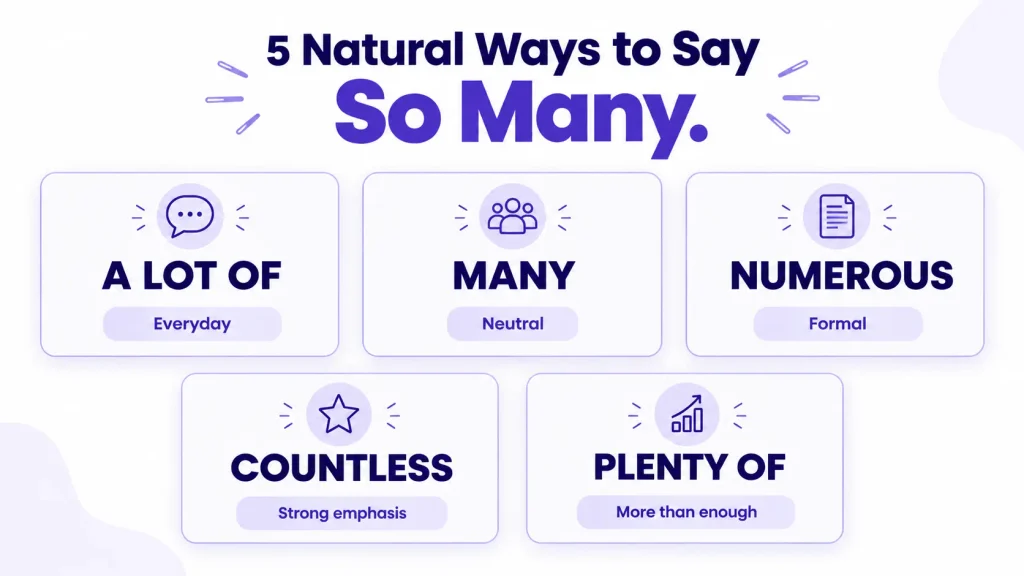
The following expressions can help you make your writing clearer, more varied, and more natural.
1. Numerous
“Numerous” means many or a large number of something. It works especially well in professional writing, reports, essays, and formal emails.
Examples:
- The company received numerous applications.
- Numerous studies highlight the benefits of regular exercise.
- We have numerous reasons to consider this proposal.
Best for: Professional, academic, and formal writing.
2. Countless
“Countless” describes an extremely large number that seems impossible or unnecessary to count.
Examples:
- She has helped countless people throughout her career.
- We created countless memories during our trip.
- Countless opportunities await those who keep learning.
Best for: Emphasis, storytelling, and emotional writing.
3. A Lot of
“A lot of” is one of the most natural alternatives in everyday English. It works with both countable and uncountable nouns.
Examples:
- We have a lot of work to finish today.
- A lot of people enjoy watching movies.
- He has a lot of experience in web development.
Best for: Casual conversations, messages, and everyday writing.
4. A Large Number of
Use “a large number of” when you want to emphasize the quantity of countable things or people.
Examples:
- A large number of students attended the event.
- The store received a large number of orders.
- A large number of visitors explored the website.
Best for: Reports, business writing, and factual statements.
5. A Great Many
“A great many” means a very large number. It can sound slightly more formal or literary than “a lot of.”
Examples:
- A great many people supported the idea.
- She has read a great many books about history.
- A great many customers requested the same feature.
Best for: Formal prose and emphasis.
6. A Wide Range of
This phrase emphasizes variety, diversity, or different types of something rather than quantity alone.
Examples:
- The store offers a wide range of products.
- Students can choose from a wide range of courses.
- Our website covers a wide range of topics.
Best for: Product descriptions, websites, marketing, and informative articles.
7. An Abundance of
“An abundance of” describes a plentiful supply of something. It often creates a positive impression, although you can also use it in neutral contexts.
Examples:
- The region has an abundance of natural beauty.
- The internet provides an abundance of learning resources.
- The garden produces an abundance of fresh vegetables.
Best for: Descriptive writing, marketing, and positive statements.
8. Plenty of
“Plenty of” means more than enough or a sufficient amount. It sounds friendly and natural.
Examples:
- We have plenty of time to complete the project.
- There are plenty of ways to improve your writing.
- You have plenty of opportunities to practice English.
Best for: Conversations, advice, and reassuring statements.
9. A Great Number of
This expression emphasizes a large quantity and can suit formal or descriptive writing.
Examples:
- A great number of visitors arrived early.
- A great number of businesses now operate online.
- A great number of readers found the guide helpful.
Best for: Formal writing and reports.
10. Many Different
Use “many different” when you want to emphasize both quantity and variety.
Examples:
- We explored many different solutions.
- She enjoys many different types of music.
- The platform supports many different devices.
Best for: Everyday, educational, and technical writing.
11. Loads of
“Loads of” is an informal expression that means a lot of something.
Examples:
- We have loads of things to discuss.
- There are loads of restaurants in this area.
- He has loads of ideas for the new website.
Best for: Casual speech, friendly messages, and informal content.
12. Tons of
“Tons of” is another informal phrase that emphasizes a large amount or number.
Examples:
- I have tons of work this week.
- There are tons of videos about this subject.
- We received tons of positive feedback.
Best for: Casual conversations and social media.
13. A Multitude of
“A multitude of” refers to a very large number of people or things. It sounds more formal than “a lot of.”
Examples:
- The internet offers a multitude of resources.
- A multitude of factors can affect the outcome.
- The city provides a multitude of entertainment options.
Best for: Formal essays, descriptive writing, and presentations.
14. Numerous Different
This expression emphasizes that there are many items or options and that they differ from one another.
Examples:
- Numerous different approaches can solve this problem.
- The company serves numerous different industries.
- Numerous different factors influence consumer behavior.
Best for: Reports, explanations, and analytical writing.
15. An Extensive Number of
This phrase can communicate a substantial quantity, although “a large number of” often sounds more natural in everyday English.
Examples:
- The database contains an extensive number of records.
- The survey collected an extensive number of responses.
Best for: Technical or formal contexts where the quantity is substantial.
16. A Wealth of
“A wealth of” describes a rich supply of valuable things, such as information, knowledge, or opportunities.
Examples:
- The website offers a wealth of information.
- She has a wealth of experience in marketing.
- The library contains a wealth of historical resources.
Best for: Professional bios, educational content, and promotional writing.
17. An Array of
“An array of” means a varied collection or selection of things.
Examples:
- The restaurant serves an array of international dishes.
- The program offers an array of useful features.
- Visitors can enjoy an array of outdoor activities.
Best for: Marketing, product descriptions, and formal writing.
18. A Plethora of
“A plethora of” means a very large or excessive number of something. It is more formal and can sometimes suggest that there are too many options.
Examples:
- The website contains a plethora of helpful resources.
- Consumers face a plethora of choices.
- The report identifies a plethora of possible solutions.
Best for: Formal writing and situations where you want to emphasize an abundance.
19. Heaps of
“Heaps of” is an informal expression, particularly common in British and Australian English.
Examples:
- We have heaps of time before the meeting.
- She has heaps of ideas for the project.
- There are heaps of things to do this weekend.
Best for: Informal conversations and friendly writing.
20. A Vast Number of
“A vast number of” emphasizes an exceptionally large quantity.
Examples:
- A vast number of users access the website daily.
- A vast number of stars fill the night sky.
- A vast number of applications entered the system.
Best for: Reports, research, and descriptive writing.
21. A Substantial Number of
This phrase refers to a considerable quantity. It works well when you want a measured, professional tone.
Examples:
- A substantial number of employees attended the training.
- A substantial number of customers renewed their subscriptions.
- The survey included a substantial number of responses.
Best for: Business reports, research, and formal communication.
22. An Enormous Number of
Use “an enormous number of” when the quantity is extremely large.
Examples:
- An enormous number of people watched the event.
- The platform processes an enormous number of requests.
- An enormous number of messages arrived overnight.
Best for: Strong emphasis and descriptive statements.
23. An Endless Number of
This phrase suggests that the options or items seem to have no end. In many situations, “endless possibilities” sounds more natural than “an endless number of possibilities.”
Examples:
- The internet offers endless opportunities to learn.
- There seem to be endless ways to approach the task.
- The story explores endless possibilities.
Best for: Creative writing, motivational content, and expressive language.
24. More Than Enough
Use “more than enough” when you mean that the quantity exceeds what is needed. It does not simply mean “many.”
Examples:
- We have more than enough supplies for the event.
- There is more than enough evidence to support the claim.
- She has more than enough experience for the role.
Best for: Reassurance and situations involving sufficiency.
25. A Great Deal of
“A great deal of” refers to a large amount of something uncountable, such as time, effort, or information. It does not normally replace “so many” before plural countable nouns.
Examples:
- We spent a great deal of time preparing.
- The project requires a great deal of effort.
- She has gained a great deal of knowledge.
Best for: Formal writing and uncountable nouns.
26. Countless Numbers of
This phrase emphasizes an extremely large quantity, but it can sound redundant because “countless” already communicates a number that is difficult to count.
Example:
- Better: Countless people attended the celebration.
- Less concise: Countless numbers of people attended the celebration.
Best for: Use “countless” on its own for clearer, more concise writing.
27. A Host of
“A host of” means a large group or number of people or things. It often appears in formal or journalistic writing.
Examples:
- The new policy introduces a host of changes.
- The team considered a host of possible solutions.
- The event attracted a host of talented performers.
Best for: Professional articles, reports, and presentations.
28. A Plethora of Options
When discussing choices specifically, “a plethora of options” can replace “so many options.” However, it may imply an overwhelming selection.
Examples:
- Customers have a plethora of options to consider.
- The software provides a plethora of customization options.
- Students can choose from a plethora of online courses.
Best for: Product comparisons, technology, and discussions about choices.
Best Alternatives to So Many by Context
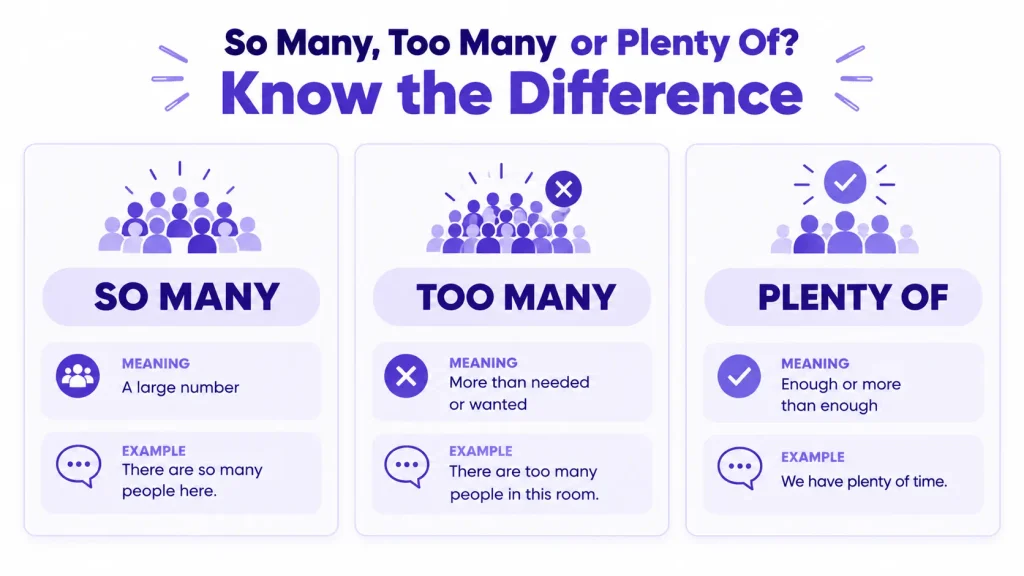
Not every expression fits every situation. Therefore, use the following table to choose a phrase that matches your audience and purpose.
| Situation | Alternative | Example |
|---|---|---|
| Professional writing | Numerous | We received numerous requests. |
| Academic writing | A substantial number of | A substantial number of participants responded. |
| Casual conversation | A lot of | I have a lot of things to do. |
| Strong emphasis | Countless | Countless people benefit from education. |
| Product descriptions | A wide range of | We offer a wide range of products. |
| Positive description | An abundance of | The area has an abundance of wildlife. |
| Reassurance | Plenty of | There is plenty of time. |
| Research reports | A large number of | A large number of responses supported the trend. |
| Formal descriptions | A multitude of | A multitude of factors affect the result. |
| Expressive writing | Endless | There are endless possibilities. |
| Business reports | Numerous | Numerous customers renewed their plans. |
| Informal speech | Tons of | We have tons of ideas. |
Another Way to Say So Many in Professional Writing
In professional communication, your word choice should sound clear, polite, and precise. Although “so many” works in everyday speech, a more specific phrase can make a report or email sound more polished.
Consider these alternatives:
- Numerous: We received numerous requests from clients.
- A large number of: A large number of applicants met the requirements.
- A substantial number of: A substantial number of customers expressed interest.
- Several: Several team members contributed to the project.
- A wide range of: The company provides a wide range of services.
For example, instead of writing, “We have so many customers waiting for a response,” you could write, “Numerous customers are waiting for a response.”
Similarly, replace “There are so many issues with the current process” with “The current process has several issues.”
However, choose the word carefully. “Several” usually suggests a smaller number than “numerous,” while “a substantial number of” emphasizes the significance of the quantity.
Another Way to Say So Many in an Email
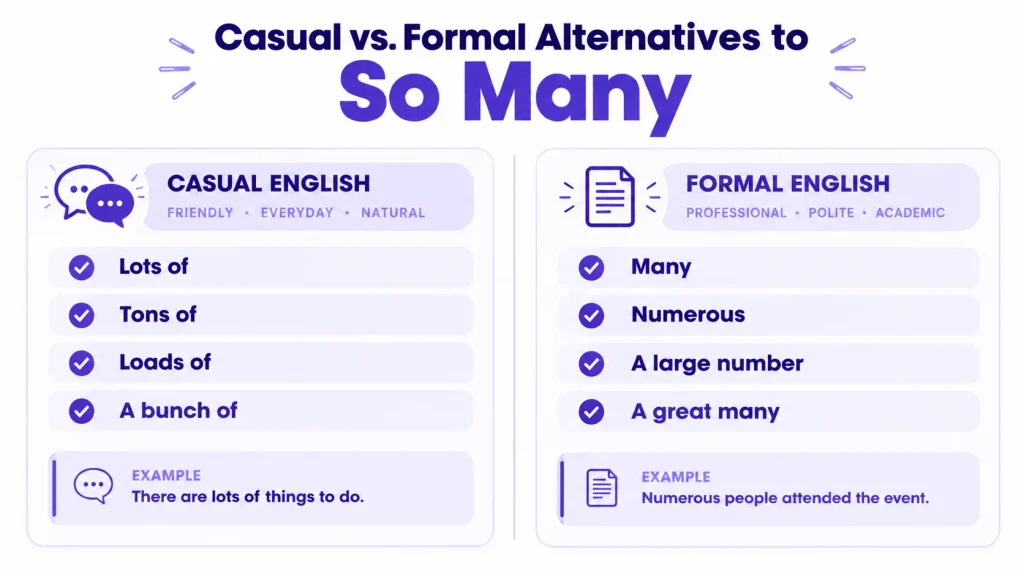
Emails benefit from direct and natural language. Therefore, you do not need to use complicated vocabulary just to sound professional.
Here are some useful replacements:
Instead of: We received so many questions about the update.
Write: We received numerous questions about the update.
Instead of: There are so many things we need to discuss.
Write: There are several important topics we need to discuss.
Instead of: We have so many tasks to complete.
Write: We have a large number of tasks to complete.
Instead of: You have so many options to choose from.
Write: You have several options to consider.
Instead of: Thank you for so many helpful suggestions.
Write: Thank you for the many helpful suggestions.
In addition, remember that simple language often works best in business emails. Use “many,” “several,” or “a lot of” whenever those phrases express your meaning clearly.
Another Way to Say So Many People
When describing a crowd, audience, team, or group, choose an expression that fits the size and context.
Here are some alternatives:
- Numerous people
- Countless people
- A large number of people
- A great many people
- A vast number of people
- A crowd of people
- A multitude of people
- Thousands of people, when the number is accurate
- A large audience
- Many individuals
Examples:
- Original: So many people attended the concert.
- Alternative: A large number of people attended the concert.
- Stronger: Thousands of people attended the concert, if the figure is supported.
- More expressive: Countless people gathered to celebrate.
- More concise: A huge crowd attended the concert.
Use “countless” for emphasis rather than a precise count. Likewise, do not use “thousands” unless you have a reasonable basis for that number.
Another Way to Say So Many Things
When you refer to objects, tasks, ideas, or general items, the right alternative depends on what you want to emphasize.
Examples include:
- Numerous things
- A lot of things
- A wide variety of items
- A multitude of options
- Several important matters
- Countless possibilities
- A large number of tasks
- An abundance of resources
For example:
- Original: I have so many things to do today.
- Natural: I have a lot of things to do today.
- Professional: I have numerous tasks to complete today.
- Concise: I have several tasks to finish today.
- Emphatic: I have countless responsibilities to manage.
In many cases, replacing the general word “things” with a more precise noun improves the sentence even more. Instead of “so many things to learn,” try “many valuable skills to learn.”
Another Way to Say So Many Times
When you want to describe a repeated action, use a phrase that communicates frequency rather than quantity alone.
Useful alternatives include:
- Many times
- Numerous times
- Repeatedly
- Time and again
- Over and over
- On many occasions
- Again and again
- Frequently
Examples:
- Original: I have told you so many times.
- Natural: I have told you many times.
- Stronger: I have told you repeatedly.
- Formal: I have explained this on numerous occasions.
- Conversational: I have told you time and again.
Notice that “repeatedly” and “frequently” focus on how often something happens. As a result, they often sound more natural than “so many times.”
Another Way to Say So Many Opportunities
When discussing chances for growth, career development, or success, choose a positive phrase that fits your message.
Consider these options:
- Numerous opportunities
- Plenty of opportunities
- A wealth of opportunities
- Countless opportunities
- A wide range of opportunities
- Endless possibilities
- Many promising prospects
Examples:
- Original: There are so many opportunities to grow online.
- Professional: There are numerous opportunities for online growth.
- Positive: There are plenty of opportunities to develop your skills.
- Expressive: The digital world offers endless possibilities.
- Variety-focused: The industry provides a wide range of career opportunities.
For professional content, “numerous opportunities” and “a wide range of opportunities” often work particularly well.
How to Choose the Right Alternative
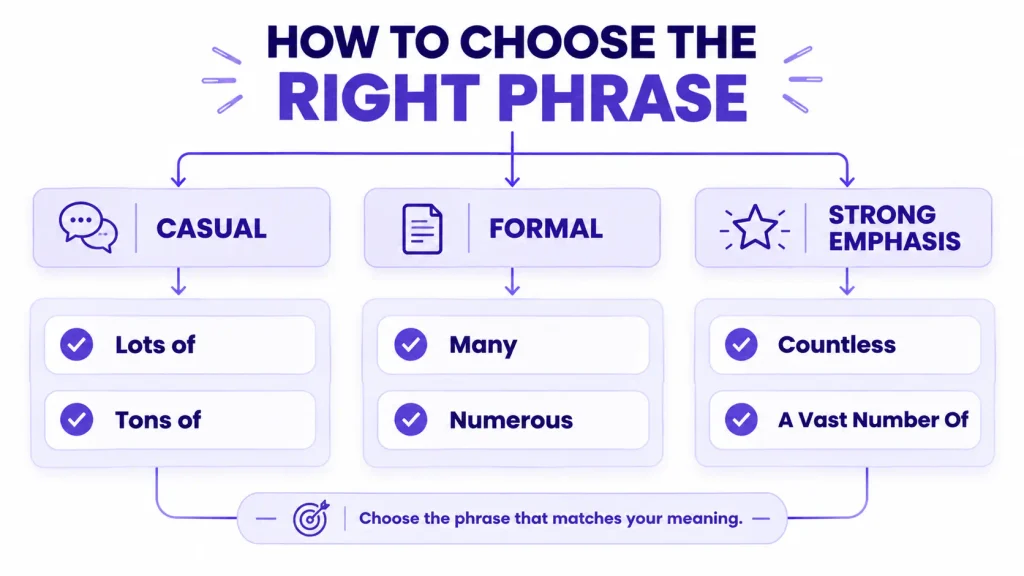
Choosing a synonym involves more than replacing one phrase with another. You should also consider the noun, the tone, and the message.
Consider the noun
First, determine whether the noun is countable or uncountable.
Use “numerous” with plural countable nouns:
- Numerous books
- Numerous questions
- Numerous opportunities
Use “a great deal of” with uncountable nouns:
- A great deal of time
- A great deal of effort
- A great deal of information
Likewise, “a large number of” usually refers to countable items, while “a large amount of” refers to uncountable substances or quantities.
Match the tone
Next, think about your audience.
For casual conversations, “a lot of,” “loads of,” and “tons of” sound natural. For business documents, “numerous,” “several,” and “a substantial number of” often work better.
However, avoid unnecessarily complicated language. A clear phrase usually communicates your point more effectively than an elaborate one.
Decide what you want to emphasize
Different expressions communicate different ideas.
- Use “numerous” to emphasize quantity.
- Use “countless” to suggest an extremely large number.
- Use “a wide range of” to emphasize variety.
- Use “plenty of” to suggest an adequate or generous supply.
- Use “a wealth of” to emphasize valuable resources.
- Use “a plethora of” when you want to suggest a very large selection, sometimes an overwhelming one.
Therefore, select the phrase that communicates your exact meaning.
Keep your sentence natural
Finally, read the sentence aloud. Does the alternative sound natural in context?
For example, “There are numerous reasons to exercise” sounds polished. However, “There are a plethora of reasons to brush your teeth” may sound unnecessarily formal in ordinary conversation.
The goal is not to use the most impressive word. Instead, choose the clearest and most appropriate expression.
Common Mistakes When Replacing So Many
Even a correct synonym can make a sentence awkward if you use it in the wrong context. Avoid these common mistakes.
Using a formal phrase in casual conversation
You would rarely say, “I have a multitude of chores to complete” to a close friend. Instead, say, “I have a lot of chores to do.”
Confusing quantity with variety
“Numerous products” emphasizes how many products exist. In contrast, “a wide range of products” emphasizes the variety available.
Although the phrases can overlap, they do not always communicate the same thing.
Using countable and uncountable nouns incorrectly
Say “numerous opportunities,” not “numerous time.” Instead, say “a great deal of time.”
Similarly, use “many questions” for countable items and “much information” for an uncountable noun.
Choosing an exaggerated expression
“Countless,” “endless,” and “enormous” communicate strong emphasis. However, they may exaggerate the facts if the quantity is actually small.
Use precise language when writing reports, research summaries, or business documents.
Replacing a simple phrase with a complicated one
Sometimes, “many” is the best choice. You do not need to replace every familiar word with a formal synonym.
Good writing prioritizes meaning, accuracy, and readability.
Frequently Asked Questions
What is the best synonym for so many?
“Numerous” is a strong choice for formal writing, while “a lot of” works well in everyday conversation. You can also use “countless” for emphasis or “a wide range of” when you want to highlight variety.
What is a professional way to say so many?
Professional alternatives include “numerous,” “a large number of,” “a substantial number of,” and “a considerable number of.” Choose the expression that best fits your sentence and the facts you want to communicate.
What is a simple way to say so many?
The simplest alternatives are “many,” “a lot of,” “lots of,” and “plenty of.” These expressions work well in everyday conversation, although “plenty of” can suggest that there is more than enough.
What is another word for so many people?
You can say “numerous people,” “countless people,” “a large crowd,” or “a multitude of people.” If you know the actual number, a precise description may be more informative.
What is another way to say so many times?
Useful alternatives include “many times,” “repeatedly,” “time and again,” “over and over,” and “on numerous occasions.” Choose one based on whether you want a casual, formal, or emphatic tone.
Can I use numerous instead of so many?
Yes. “Numerous” often replaces “so many” before plural countable nouns. For example, “We received so many emails” can become “We received numerous emails.” However, “numerous” may sound more formal than the original phrase.
Is plethora a synonym for so many?
Yes. “Plethora” refers to a very large or excessive number or amount. For example, “The website offers a plethora of resources” means that the website offers a great many resources. In everyday writing, “many” or “a lot of” may sound more natural.
Is a lot of formal or informal?
“A lot of” is common in everyday English and works in many informal and neutral contexts. For more formal reports or academic writing, “numerous,” “many,” or “a substantial number of” may fit better.
Conclusion
Finding another way to say so many becomes easier when you understand the differences between common alternatives. “Numerous” suits professional writing, “a lot of” fits everyday conversation, and “countless” adds emphasis. Meanwhile, “a wide range of” highlights variety, and “plenty of” suggests an adequate or generous supply.
Ultimately, the best alternative depends on your sentence, audience, and intended meaning. Choose words that sound natural, communicate the right amount, and help your readers understand your message.

Role: English Content Writer
Maren Whitlock writes practical English language content for RepublicsPress, with a focus on vocabulary, word alternatives, everyday expressions, and clear communication. Her articles are designed to make difficult or confusing language easier to understand, with simple explanations and useful examples readers can apply in real situations.