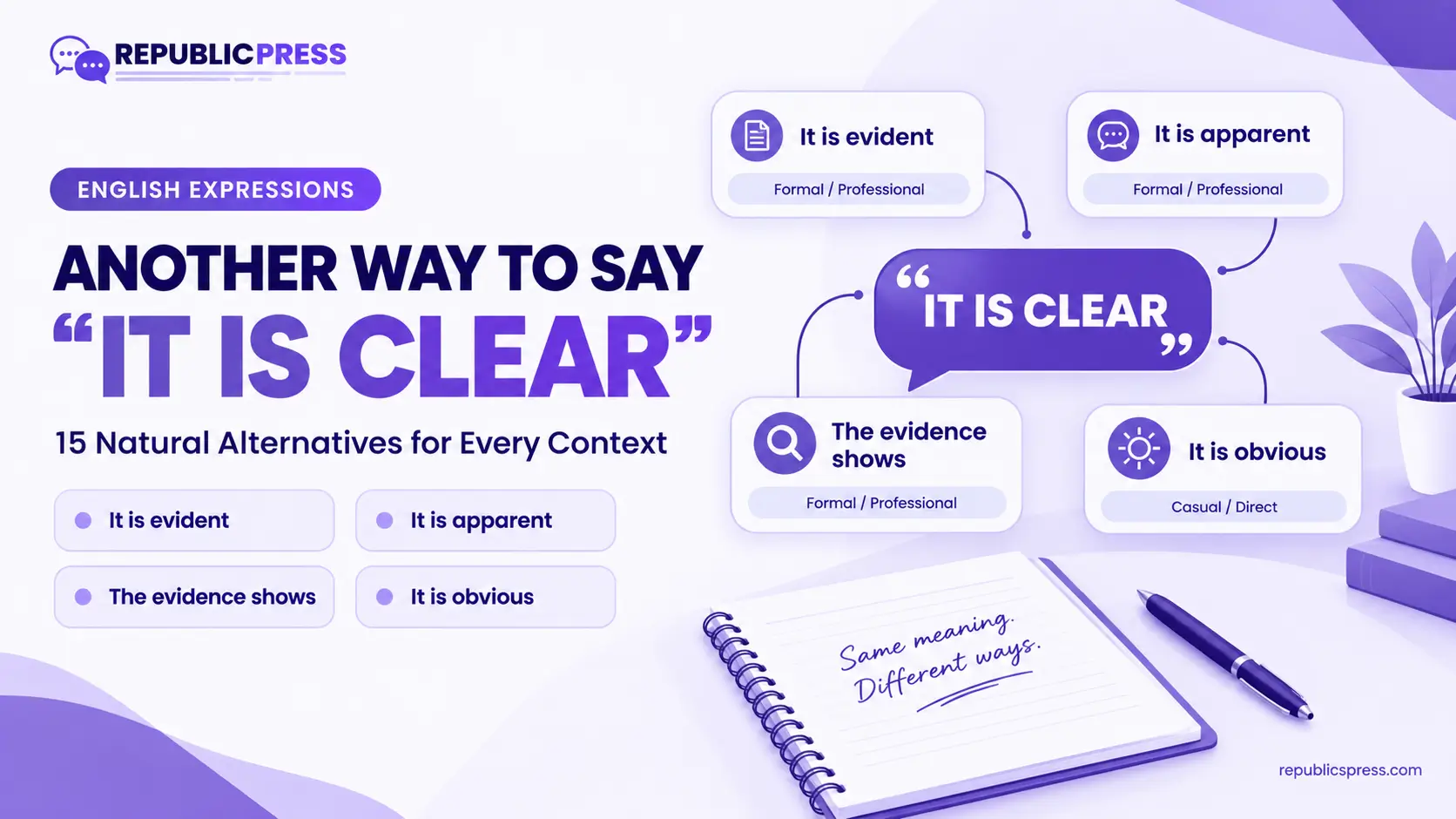
Another Way to Say It Is Clear: 15 Natural Alternatives
Looking for another way to say “it is clear”? You can use phrases such as “it is evident,” “it is obvious,” “it is apparent,” “the evidence shows,” and “the point is clear.” The best choice depends on your meaning, tone, and audience.
Key Takeaways
- “It is evident” works well in formal and professional writing.
- “It is obvious” sounds more direct and conversational.
- “It is apparent” is a good choice for work and reports.
- “The evidence shows” works best when facts support your point.
- “It is unmistakable” gives your statement more force.
- In some cases, you can remove “it is clear” and state the fact directly.
What Does “It Is Clear” Mean?
“It is clear” means that something is easy to understand, see, or recognize.
For example:
It is clear that the team needs more time.
This sentence tells the reader that the need for more time is easy to understand from the situation.
The phrase works in everyday speech, emails, reports, essays, and presentations. Still, using it again and again can make your writing feel repetitive. A simple alternative can make your sentence sound more natural and precise.
15 Alternatives to “It Is Clear”
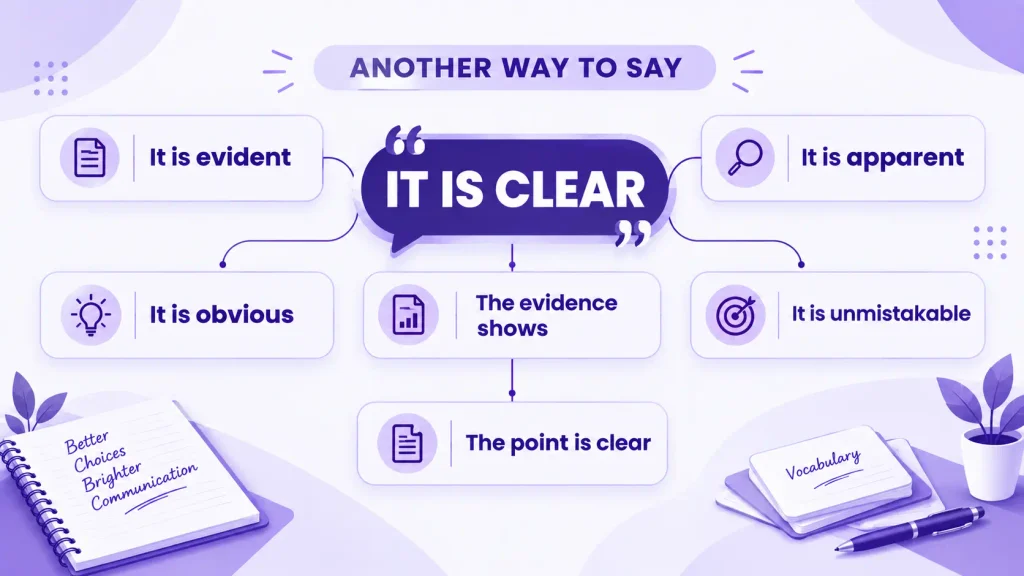
1. It Is Evident
“It is evident” means that something is easy to see or understand from the facts or situation.
Best for: Formal, academic, and professional writing
Example:
It is evident that the new plan has improved customer service.
This is one of the closest formal alternatives to “it is clear.”
2. It Is Apparent
“It is apparent” means that something seems clear from what you can see or understand.
Best for: Reports, work emails, and analysis
Example:
It is apparent that customer needs have changed.
This phrase sounds professional without being too strong.
3. It Is Obvious
“It is obvious” means that something is very easy to see or understand.
Best for: Casual conversation and direct statements
Example:
It is obvious that she worked hard on the project.
However, be careful with this phrase at work. It can sometimes sound as if you think the answer should have been easy for everyone to see.
4. It Is Plain
“It is plain” means that something is easy to understand or recognize.
Best for: Direct and formal statements
Example:
It is plain that the current plan needs to change.
This phrase is correct, but it can sound more formal than “it is clear.”
5. It Is Unmistakable
“It is unmistakable” means that something is so clear that it cannot easily be misunderstood.
Best for: Strong emphasis
Example:
It is unmistakable that the company has changed its plans.
Use this phrase when you want to make your point stronger.
6. The Evidence Shows
“The evidence shows” is useful when facts, records, or research support your statement.
Best for: Reports, research, and professional writing
Example:
The evidence shows that regular training improved employee performance.
This option is often better than “it is clear” because it tells the reader what supports your point.
7. The Facts Show
“The facts show” points to facts that support a conclusion.
Best for: Reports, arguments, and factual writing
Example:
The facts show that the project stayed within its budget.
Use this phrase only when you have facts to support the statement.
8. It Is Undeniable
“It is undeniable” means that something is very difficult to argue against.
Best for: Strong statements and persuasive writing
Example:
It is undeniable that technology has changed how people communicate.
This phrase is stronger than “it is clear.” Therefore, use it only when your claim has strong support.
9. It Is Easy to See That
“It is easy to see that” tells the reader that a conclusion is simple to understand.
Best for: Explanations, presentations, and casual writing
Example:
It is easy to see that the new design is easier to use.
This phrase sounds friendly and natural in many situations.
10. The Point Is Clear
“The point is clear” focuses on an idea, message, or argument.
Best for: Discussions, presentations, and explanations
Example:
After reading the proposal, the point is clear: we need a simpler plan.
Unlike “it is evident,” this phrase focuses more on understanding the main message.
11. There Is No Doubt That
“There is no doubt that” shows a high level of confidence.
Best for: Formal and persuasive writing
Example:
There is no doubt that the decision changed the company.
Because this phrase is strong, avoid using it for claims that are still uncertain.
12. Clearly
“Clearly” is a short way to express the same basic idea.
Best for: Short statements, speech, and general writing
Example:
Clearly, the current system needs improvement.
It is natural and useful. However, using “clearly” too often can make your writing sound repetitive.
13. It Is Self-Evident
“It is self-evident” means that something seems true without needing much explanation.
Best for: Very formal writing
Example:
The need for accurate records is self-evident.
This phrase is quite formal. For everyday writing, a simpler option will usually sound better.
14. The Conclusion Is Clear
“The conclusion is clear” works well when you have reviewed information and reached a result.
Best for: Reports and analysis
Example:
After reviewing the results, the conclusion is clear: the first plan worked better.
This phrase focuses on the result of your review.
15. The Results Show
“The results show” is useful when test results, research, or other findings support your point.
Best for: Reports, research, and data-based writing
Example:
The results show that the new method saved time.
This option is more specific than “it is clear” because it points directly to the results.
Quick Comparison
| Alternative | Tone | Best Context |
| It is evident | Formal | Academic and professional writing |
| It is apparent | Professional | Reports and analysis |
| It is obvious | Direct | Casual conversation |
| It is plain | Formal | Direct statements |
| It is unmistakable | Strong | Emphasis |
| The evidence shows | Factual | Research and reports |
| The facts show | Direct | Arguments and reports |
| It is undeniable | Very strong | Persuasive writing |
| It is easy to see that | Friendly | Explanations |
| The point is clear | Neutral | Discussions |
| There is no doubt that | Strong | Persuasive writing |
| Clearly | Simple | General writing |
| It is self-evident | Very formal | Formal writing |
| The conclusion is clear | Professional | Reports and analysis |
| The results show | Factual | Research and data |
Which Alternative Should You Use?
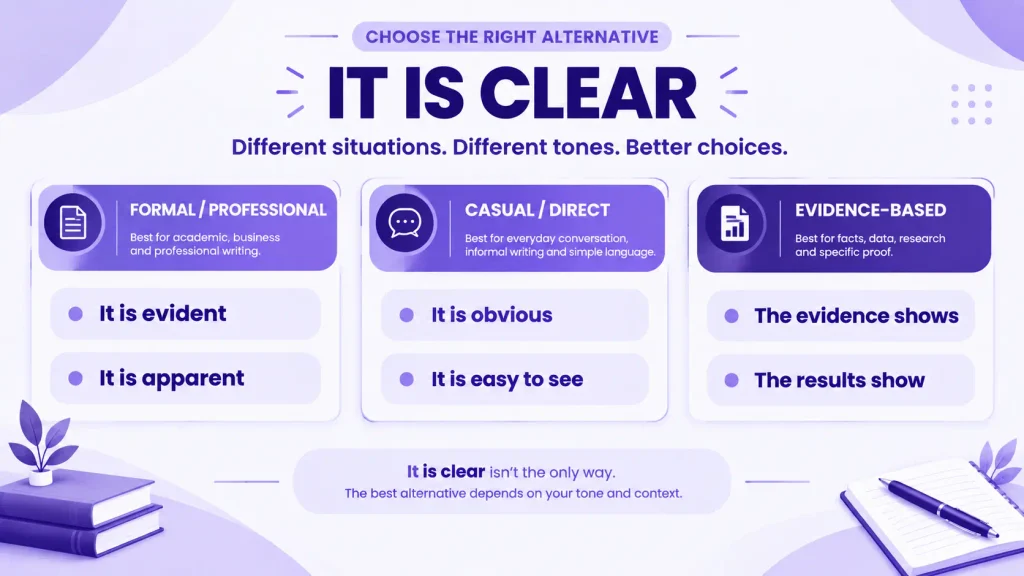
The right phrase depends on your situation. Think about your audience and how strong you want your statement to sound.
For Professional Writing
Use “it is evident,” “it is apparent,” or “the evidence shows.”
For example:
It is evident that the team needs more resources.
These options sound clear and professional without being too casual.
For Academic Writing
Academic writing often works better when you show the reason behind your claim.
Instead of:
It is clear that the results support the theory.
You could write:
The results support the theory.
Or:
The evidence suggests that the results support the theory.
The second version gives the reader more information about the basis for your statement.
For Casual Conversation
Try “it is obvious,” “it is easy to see,” or “clearly.”
For example:
It is obvious that Jake is excited about the trip.
You could also say:
You can easily see why Jake is excited about the trip.
Both options sound natural in everyday English.
For Strong Emphasis
Use “it is unmistakable,” “it is undeniable,” or “there is no doubt that.”
For example:
There is no doubt that the decision changed the company.
These phrases show strong confidence. As a result, they should only be used when the facts support that level of certainty.
Sometimes You Can Remove “It Is Clear”
You do not always need to replace “it is clear” with another phrase.
Consider this sentence:
It is clear that sales increased in June.
A shorter version is:
Sales increased in June.
The second sentence is more direct. It gives the reader the information without adding extra words.
Here is another example:
It is clear that the meeting ended at 4 p.m.
You can simply write:
The meeting ended at 4 p.m.
This approach often makes professional and academic writing stronger.
Common Mistakes to Avoid
Using “Obvious” in a Sensitive Situation
“Obvious” can sometimes sound rude or dismissive.
For example:
Obviously, you entered the wrong information.
A kinder option is:
It looks like the information was entered incorrectly.
The second sentence gives the same basic message without blaming the reader.
Using “Undeniable” Without Strong Evidence
“Undeniable” is a very strong word.
Instead of:
It is undeniable that this is the best option.
If the evidence is not strong enough, try:
The evidence suggests that this is the best option.
This wording leaves room for other views.
Using Formal Phrases in Casual Speech
Some alternatives can sound too formal in everyday conversation.
For example, “it is self-evident” may sound unnatural when talking with a friend. In that situation, “it is obvious” or “you can see that” will usually sound better.
Treating Every Alternative as an Exact Synonym
These phrases are related, but they do not all mean exactly the same thing.
For example, “the evidence shows” points to supporting facts. On the other hand, “the point is clear” focuses on understanding an idea.
So, choose the phrase that matches your exact meaning.
Frequently Asked Questions
What is the most professional way to say “it is clear”?
“It is evident” and “it is apparent” are good professional choices. If facts support your statement, “the evidence shows” may be even more useful.
What is a simple alternative to “it is clear”?
“It is obvious” is a simple choice. However, it can sometimes sound too strong or dismissive. “It is apparent” is a more neutral option.
What is a formal way to say “it is clear”?
You can use “it is evident,” “it is apparent,” or “it is unmistakable.” The best choice depends on how strong you want the statement to be.
Can I use “it is clear” in academic writing?
Yes. However, academic writing is often stronger when you explain what supports your claim. For example, you can use “the results show” or “the evidence suggests.”
Is “it is obvious” the same as “it is clear”?
They are similar, but “obvious” can sound stronger. It can also sound dismissive in some situations. “It is clear” is usually more neutral.
What is a stronger way to say “it is clear”?
Try “it is unmistakable,” “it is undeniable,” or “there is no doubt that.” These phrases show greater confidence.
Can I use “clearly” instead of “it is clear”?
Yes. For example:
Clearly, the plan needs more work.
“Clearly” is shorter and works well in both speech and writing.
What should I use when facts support my statement?
Try “the evidence shows,” “the facts show,” or “the results show.” These phrases connect your statement to the information that supports it.
Final Thoughts
There are many natural ways to say “it is clear.” For formal writing, “it is evident” and “it is apparent” are strong choices. In casual situations, “it is obvious” or “it is easy to see” may sound better. When facts support your point, “the evidence shows” is often more precise.
Most importantly, you do not always need an alternative. If the fact speaks for itself, simply state it. Direct writing is often the clearest choice.

Role: English Content Writer
Maren Whitlock writes practical English language content for RepublicsPress, with a focus on vocabulary, word alternatives, everyday expressions, and clear communication. Her articles are designed to make difficult or confusing language easier to understand, with simple explanations and useful examples readers can apply in real situations.