Another Way to Say “Difficult”: 10 Natural Alternatives & Examples
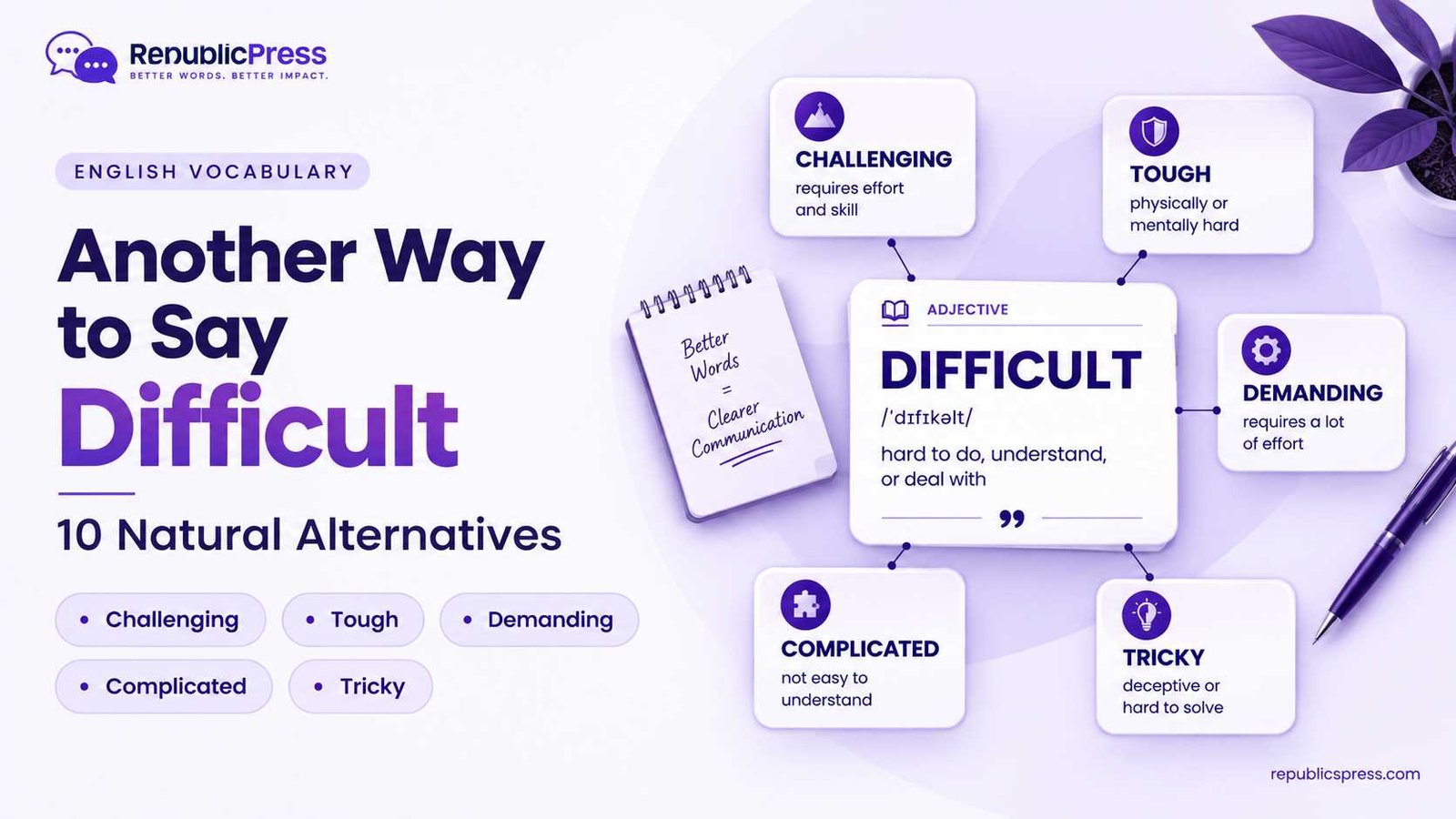
If you need another way to say “difficult,” some natural alternatives include challenging, tough, demanding, complicated, hard, tricky, strenuous, arduous, problematic, and complex. The best choice depends on why something is difficult and whether you want your sentence to sound casual, neutral, professional, or formal.
Key Takeaways
- Challenging is one of the most natural alternatives to “difficult.”
- Tough works especially well in casual American English.
- Demanding suggests that something requires considerable time, energy, or attention.
- Complicated focuses on complexity rather than effort.
- Tricky describes something that requires extra care or judgment.
- Arduous and strenuous are stronger and more formal choices.
- The most accurate alternative depends on the specific situation.
What Does “Difficult” Mean?
The word “difficult” describes something that is not easy to do, understand, solve, manage, or achieve. It can describe tasks, problems, decisions, situations, subjects, or experiences.
For example:
The final exam was difficult.
In this sentence, “difficult” means the exam required considerable knowledge, thought, or effort.
Because the word has a broad meaning, a more specific alternative can sometimes make your writing clearer. A difficult assignment might be challenging, while a difficult schedule might be demanding. A difficult set of instructions might be complicated, while a difficult question might be tricky.
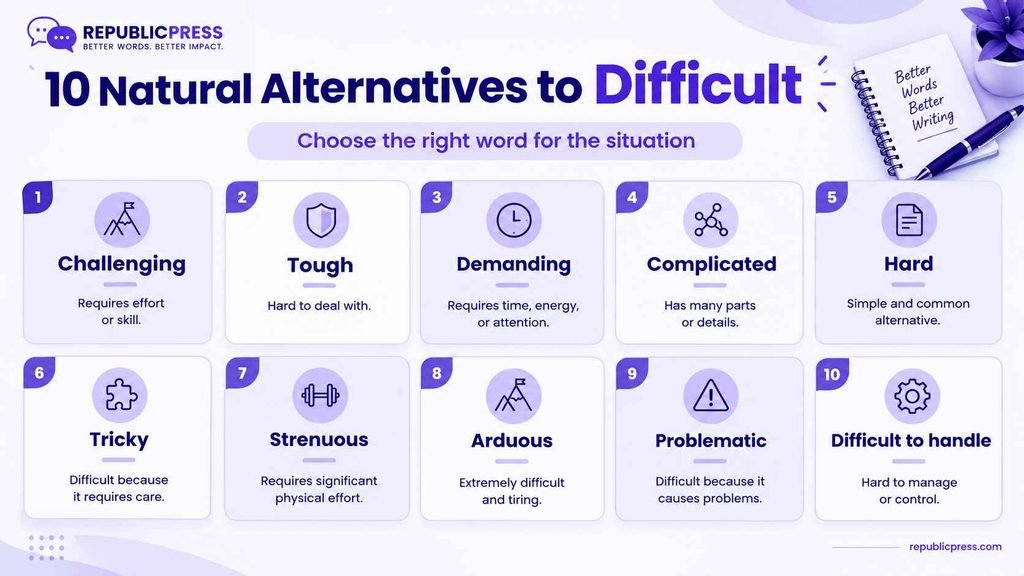
10 Natural Alternatives to “Difficult”
1. Challenging
Challenging is one of the best general alternatives to “difficult.” It describes something that requires effort, skill, concentration, or determination.
It can also give the sentence a more positive tone because a challenge may be demanding without being discouraging.
Example:
The new project was challenging, but I learned a lot from it.
Best for: Work, school, personal goals, projects, and situations where you want a constructive tone.
2. Tough
Tough is a common alternative in everyday American English. It can describe something that is mentally, physically, emotionally, or practically difficult.
Example:
It was a tough decision, but we knew it was the right one.
Best for: Casual conversations, difficult decisions, personal situations, and emotional experiences.
Tough often sounds more conversational than difficult, making it a natural choice in spoken English.
3. Demanding
Demanding describes something that requires a significant amount of time, energy, concentration, patience, or effort.
Example:
Working full-time while attending college can be demanding.
Best for: Jobs, schedules, responsibilities, projects, and activities that require sustained effort.
Unlike “complicated,” demanding does not necessarily mean something has many parts. The focus is on how much the task requires from you.
4. Complicated
Complicated is useful when something is difficult because it contains many details, steps, parts, or relationships.
Example:
The application process was more complicated than I expected.
Best for: Instructions, systems, procedures, problems, and situations involving multiple details.
Something can be complicated without requiring a lot of physical effort. Its difficulty may come mainly from the amount of information involved.
5. Hard
Hard is one of the simplest and most common alternatives to “difficult.” In many everyday situations, the two words can be used interchangeably.
Example:
This class is hard, but the material is interesting.
Best for: Everyday conversations, school subjects, tasks, problems, and general situations.
Hard is especially natural in casual speech. In professional or academic writing, a more specific word may sometimes communicate the idea more clearly.
6. Tricky
Tricky describes something that is difficult because it requires care, judgment, or attention to avoid making a mistake.
Example:
The last question was tricky because two answers looked correct.
Best for: Questions, decisions, instructions, problems, and situations involving subtle details.
Tricky often suggests that something is not necessarily extremely difficult. Instead, it can be easy to get wrong if you are not careful.
7. Strenuous
Strenuous describes something that requires a great deal of physical or mental effort.
Example:
The hikers prepared for a strenuous climb.
Best for: Exercise, physical activities, demanding work, and tasks that require intense effort.
Strenuous is more formal than hard or tough and is particularly useful when describing physical exertion.
8. Arduous
Arduous describes something that requires a great deal of effort, especially when the work continues for a long time.
Example:
Completing the restoration project was an arduous process.
Best for: Formal writing, lengthy projects, demanding processes, and tasks requiring persistence.
Arduous is stronger and more formal than common words such as hard or tough, so it may sound unusual in casual conversation.
9. Problematic
Problematic can be used when something is difficult because it creates problems, obstacles, or complications.
Example:
The lack of reliable data made the research process problematic.
Best for: Academic writing, professional communication, analytical writing, and formal discussions.
Problematic is not an exact replacement for “difficult” in every sentence. It focuses more on the problems something creates than on how much effort it requires.
10. Challenging to Handle
Challenging to handle is a useful phrase when something is difficult to manage, control, or deal with.
Example:
The customer complaint was challenging to handle.
Best for: Workplace communication, customer service, interpersonal situations, and professional contexts.
This phrase is more specific than simply saying something is difficult because it tells the reader that the challenge involves managing or dealing with something.
How to Choose the Right Alternative
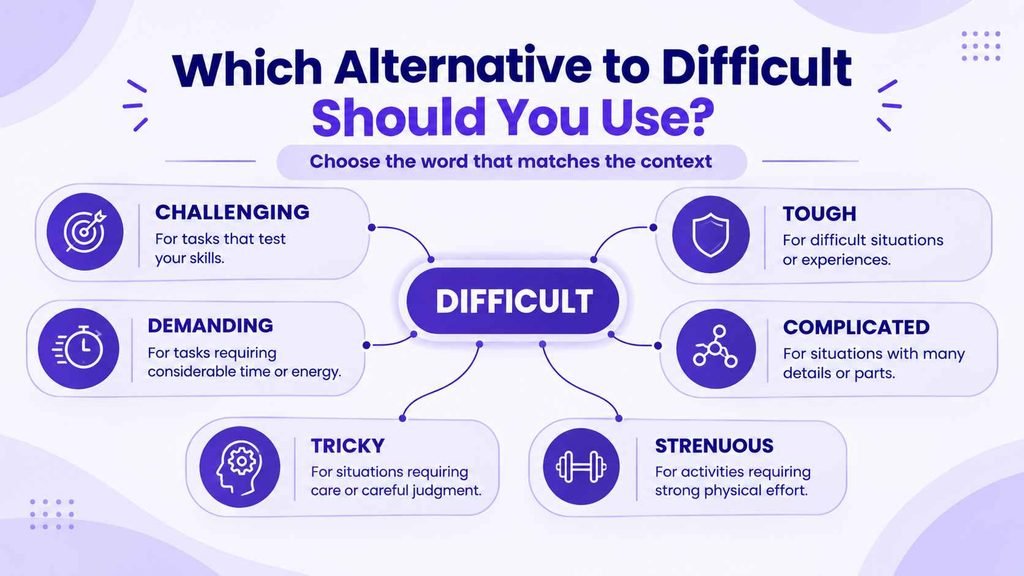
The best alternative depends on what makes something difficult.
If something requires skill or effort, challenging is usually a strong choice.
If something is hard to deal with emotionally or casually, tough may sound more natural.
If something requires a lot of time, energy, or responsibility, demanding is more precise.
If something has many complicated details or steps, complicated is a better fit.
If something requires careful judgment because it could easily lead to a mistake, tricky works well.
For long and exhausting tasks, arduous can be appropriate in formal writing.
For intense physical effort, strenuous is usually more precise.
If something creates problems or obstacles, problematic may communicate the idea more accurately.
“Difficult” vs. “Challenging”
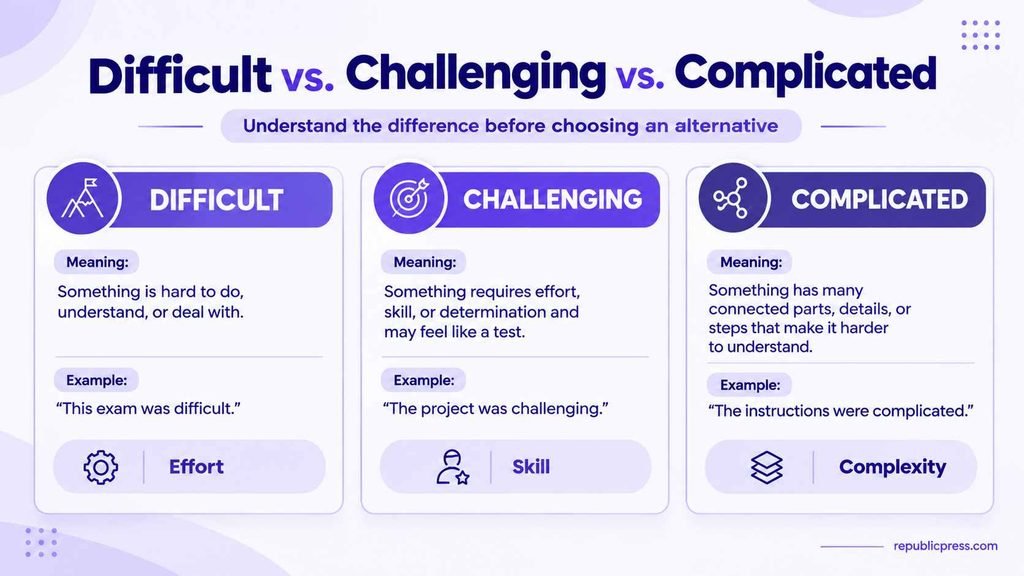
Difficult and challenging are closely related, but they can create slightly different impressions.
Difficult is neutral. It simply tells the reader that something is not easy.
Challenging can sound more constructive and may suggest that the difficulty provides an opportunity to learn, improve, or develop a skill.
Compare these sentences:
The assignment was difficult.
The assignment was challenging.
The first sentence focuses directly on the difficulty. The second can suggest that the assignment was demanding but worthwhile.
For professional and educational writing, challenging is often a useful alternative when you want to avoid an overly negative tone.
“Difficult” vs. “Complicated”
Difficult and complicated should not always be treated as exact synonyms.
Difficult describes the level of ease or effort involved.
Complicated describes complexity.
For example:
The workout was difficult.
This means the workout required considerable effort.
The workout instructions were complicated.
This means the instructions were difficult to understand because they involved several details or steps.
A task can therefore be complicated without being physically difficult, and something can be difficult without being complicated.
“Difficult” vs. “Demanding”
Demanding focuses on what something requires from a person.
For example:
She has a difficult job.
This simply means her job is not easy.
She has a demanding job.
This suggests that her job requires a lot of time, energy, attention, or responsibility.
For workplace writing, demanding can therefore be more precise when the main issue is workload or responsibility.
Common Mistakes When Replacing “Difficult”
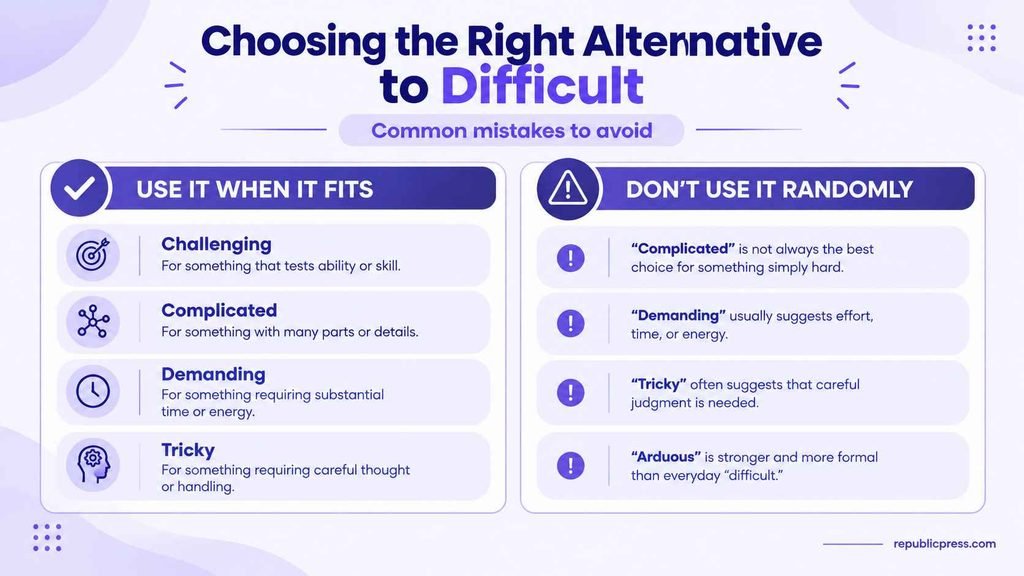
Using “complicated” for every difficult situation
Not everything that is difficult is complicated. A simple task can still require a lot of physical or mental effort.
For example, lifting a heavy object may be difficult but not complicated.
Using formal words in casual conversations
Words such as arduous and strenuous are correct, but they can sound overly formal in everyday conversation.
Instead of:
That was an arduous day.
A casual speaker would usually say:
That was a tough day.
Choosing a word that changes the meaning
Not every word associated with difficulty is a direct synonym.
Problematic emphasizes problems or obstacles. Complicated emphasizes complexity. Demanding emphasizes requirements. Strenuous emphasizes intense effort.
Choosing the word that matches the specific type of difficulty will make your sentence more accurate.
Using “challenging” when something is actually confusing
Challenging and complicated are not always interchangeable.
If something requires skill or effort, challenging may be appropriate. If the main problem is that something has too many details or is difficult to understand, complicated may be more accurate.
FAQs About Another Way to Say “Difficult”
What is the most common synonym for “difficult”?
Hard is one of the most common everyday alternatives to “difficult.” Challenging is another natural option, especially when you want the sentence to sound more constructive.
What is a professional way to say “difficult”?
Challenging, demanding, complex, or problematic can work in professional writing, depending on the context. The best choice should describe the specific reason something is difficult.
What is a positive way to say “difficult”?
Challenging is usually the best choice when you want to describe difficulty in a positive or constructive way.
What is a formal word for “difficult”?
Arduous is a formal word that describes something requiring considerable and often prolonged effort. Demanding and challenging are also useful in formal contexts.
Is “hard” the same as “difficult”?
Hard and difficult have very similar meanings in many everyday sentences. However, difficult can sound slightly more neutral or formal, while hard is extremely common in conversational English.
Can “complicated” mean difficult?
Yes, but complicated specifically suggests that something is difficult because it has many details, parts, or steps. It is not a perfect substitute for difficult in every situation.
What is another way to say “a difficult situation”?
Depending on the context, you could say “a challenging situation,” “a tough situation,” “a complicated situation,” or “a problematic situation.” The best option depends on what makes the situation difficult.
What is another way to say “a difficult task”?
Natural alternatives include “a challenging task,” “a demanding task,” “a tough task,” or “an arduous task.” Challenging is usually the most versatile choice.
Conclusion
There are many natural ways to replace “difficult,” but the best alternative depends on the exact meaning you want to express. Challenging works well for general situations, while tough sounds natural in casual American English. Demanding emphasizes effort and responsibility, complicated focuses on complexity, and tricky suggests that something requires extra care.
For more formal writing, arduous, strenuous, or problematic may be appropriate when they accurately describe the situation. Choosing a specific alternative can make your writing clearer, more natural, and more precise.

Role: Language & Content Specialist
Tessa Holloway creates language-focused content covering phrases, idioms, expressions, vocabulary, and natural American English. Her work helps readers choose words and expressions that fit different everyday, academic, and professional situations.