
Another Way to Say Well Known: 15 Natural Alternatives
If you need another way to say “well known,” the best choice depends on what you mean. For general use, “famous,” “widely recognized,” “renowned,” and “notable” are useful alternatives. More specific choices such as “prominent,” “acclaimed,” “high-profile,” or “legendary” add different shades of meaning.
Key Takeaways
- “Famous” is the most common direct alternative to “well known.”
- “Renowned” suggests a strong reputation, usually for something positive.
- “Notable” emphasizes importance or distinction rather than fame alone.
- “Prominent” often describes someone or something important and well known within a particular field.
- “High-profile” is useful when someone or something receives significant public or media attention.
- “Legendary” is much stronger than “well known” and suggests exceptional fame or status.
What Does “Well Known” Mean?
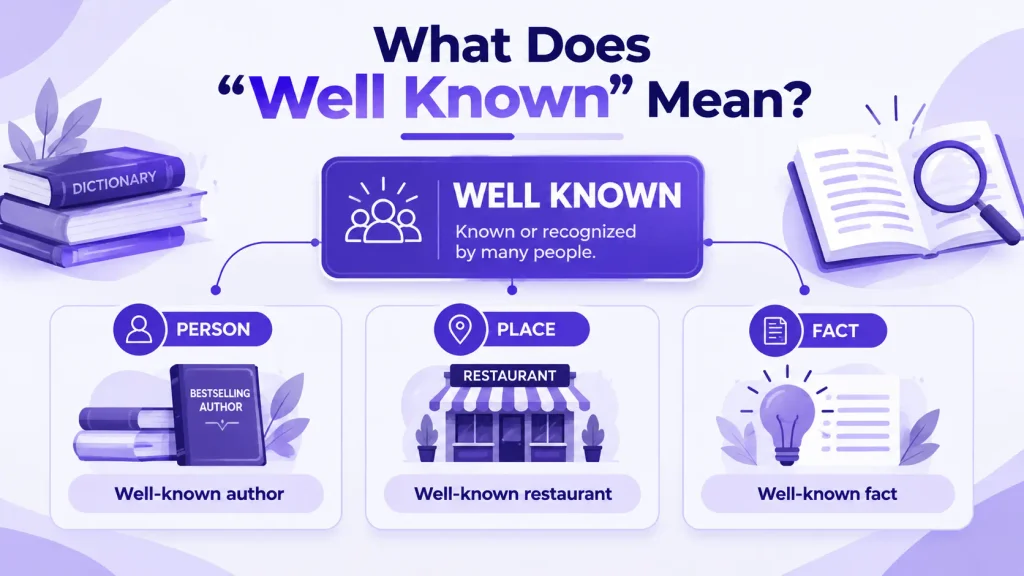
“Well known” generally means known or recognized by many people. It can describe a person, place, company, product, idea, fact, or work. For example, you might say, “She is a well-known author” or “The restaurant is well known for its seafood.”
The phrase can also describe something that is generally known or accepted, as in “It is a well-known fact.” In that situation, replacing “well known” with “famous” would not always work.
So, the right alternative depends on the sentence.
15 Other Ways to Say “Well Known”
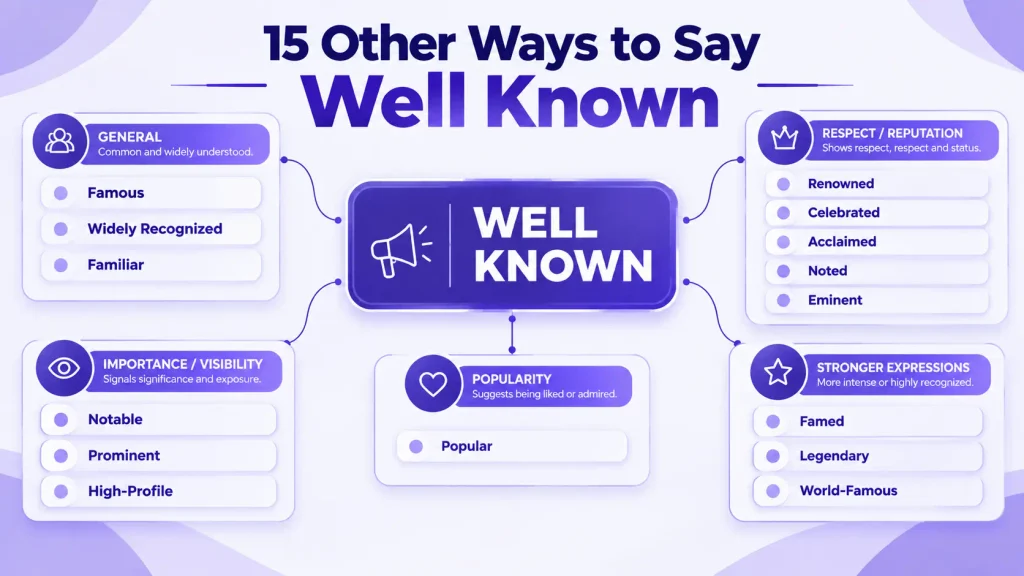
1. Famous
“Famous” is the most straightforward alternative when you mean that many people know or recognize someone or something.
Example:
She is a famous actress who has appeared in several award-winning films.
Best for: General conversation, writing, media, and everyday English.
“Famous” can sometimes sound stronger than “well known” because it suggests a higher level of public recognition. Cambridge defines “famous” as known and recognized by many people.
2. Widely Recognized
“Widely recognized” emphasizes that many people acknowledge or identify someone or something. It works especially well in professional, academic, and formal writing.
Example:
She is widely recognized as an expert in environmental policy.
Best for: Professional, academic, and formal writing.
Unlike “famous,” this phrase does not necessarily suggest celebrity. Someone can be widely recognized within a particular profession without being famous to the general public.
3. Renowned
“Renowned” means well known and respected, usually because of a particular quality, achievement, or area of expertise.
Example:
The university is renowned for its medical research.
Best for: Formal, professional, and academic writing.
Use “renowned” when the reputation is generally positive. Cambridge notes that “renowned” is commonly used for someone or something well known for a positive quality.
4. Notable
“Notable” means worthy of attention or deserving recognition. It does not always mean extremely famous.
Example:
The museum features several notable works by American artists.
Best for: Formal writing, journalism, academic contexts, and general descriptions.
“Notable” is a good choice when you want to emphasize importance or distinction rather than popularity.
5. Prominent
“Prominent” describes someone or something that is important, influential, or highly visible within a particular area.
Example:
She is a prominent figure in the technology industry.
Best for: Professional writing, journalism, business, and public affairs.
“Prominent” is not an exact replacement for “well known” in every sentence. It often adds the idea of importance or influence. Cambridge describes “prominent” as meaning well known and important.
6. Celebrated
“Celebrated” means famous and admired, often because of notable achievements.
Example:
The celebrated novelist spoke at the literary festival.
Best for: Formal writing, arts, literature, journalism, and biographical writing.
It often sounds more polished than “famous” and is particularly natural when discussing artists, writers, performers, or major achievements.
7. Acclaimed
“Acclaimed” describes someone or something that has received strong praise or approval.
Example:
The acclaimed director returned with a new film.
Best for: Reviews, entertainment, arts, literature, and professional writing.
“Acclaimed” focuses more on praise and critical recognition than simply being known by many people. That makes it a near-synonym rather than a perfect replacement.
8. Noted
“Noted” can mean well known or respected, especially because of a particular achievement, field, or quality.
Example:
He is a noted historian who has written several books on the subject.
Best for: Formal, academic, professional, and literary writing.
It is especially useful when introducing someone’s professional reputation without implying celebrity.
9. High-Profile
“High-profile” describes someone or something that attracts substantial public or media attention.
Example:
The company hired a high-profile attorney to handle the case.
Best for: News, business, politics, entertainment, and public affairs.
This phrase focuses on visibility and public attention. Someone can be high-profile without being famous in the traditional sense. Cambridge specifically distinguishes “high-profile” as referring to people or things that attract considerable media interest.
10. Popular
“Popular” means liked, accepted, or enjoyed by many people. It can sometimes replace “well known,” but the meanings are not identical.
Example:
The restaurant is popular with both locals and tourists.
Best for: Products, places, entertainment, food, brands, and everyday conversation.
Be careful with this one. A restaurant may be well known without being popular, and something can be popular within a small community without being widely known.
11. Familiar
“Familiar” works when you mean that people recognize or have encountered someone or something before.
Example:
Her name may sound familiar to many readers.
Best for: Everyday conversation and situations involving recognition.
“Familiar” is usually weaker than “famous.” It suggests recognition rather than widespread fame.
12. Famed
“Famed” means famous or widely known, usually for a particular quality or achievement.
Example:
The city is famed for its historic architecture.
Best for: Descriptive, literary, travel, and formal writing.
It is often followed by “for,” as in “famed for its beaches” or “famed for her research.”
13. Eminent
“Eminent” describes someone who is highly respected and distinguished, especially in a particular profession or field.
Example:
The conference brought together several eminent scientists.
Best for: Academic, professional, and formal writing.
“Eminent” should not be used simply because someone is famous. It adds the idea of distinction and respect within a field.
14. Legendary
“Legendary” is a much stronger expression than “well known.” It describes someone or something with extraordinary fame, reputation, or status.
Example:
The legendary musician influenced generations of performers.
Best for: Entertainment, sports, history, storytelling, and enthusiastic descriptions.
Because it is highly emphatic, “legendary” can sound exaggerated if the person or thing is merely well known.
15. World-Famous
“World-famous” means known internationally or across much of the world.
Example:
The city is home to a world-famous museum.
Best for: Travel, entertainment, sports, brands, landmarks, and major public figures.
Use it only when the level of recognition genuinely supports the claim. Calling something “world-famous” is much stronger than simply calling it “well known.”
Quick Comparison: Alternatives to “Well Known”
| Alternative | Meaning/Use | Tone | Best Context |
|---|---|---|---|
| Famous | Known by many people | Neutral | Everyday, general |
| Widely recognized | Recognized by many people | Formal | Professional, academic |
| Renowned | Well known and respected | Formal | Professional, academic |
| Notable | Worthy of attention | Formal | Writing, journalism |
| Prominent | Well known and important | Formal | Business, professional |
| Celebrated | Famous and admired | Polished | Arts, literature |
| Acclaimed | Strongly praised | Formal | Reviews, arts |
| Noted | Recognized for achievement or expertise | Formal | Academic, professional |
| High-profile | Receives public or media attention | Neutral/Formal | News, business |
| Popular | Liked or favored by many | Neutral | Products, places |
| Familiar | Recognized or known to someone | Neutral | Everyday English |
| Famed | Famous for something | Formal | Descriptive writing |
| Eminent | Highly respected in a field | Formal | Academic, professional |
| Legendary | Exceptionally famous or admired | Strong | Sports, entertainment |
| World-famous | Known internationally | Strong | Travel, brands, public figures |
Which Alternative Should You Use?
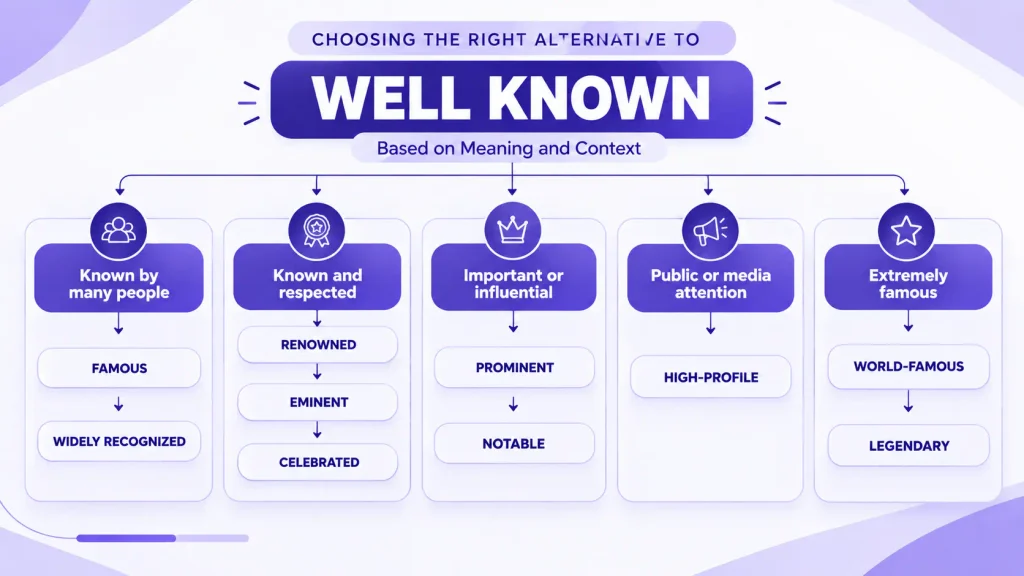
The best replacement depends on what you want to emphasize.
If you simply mean “known by many people”
Use:
- Famous
- Widely recognized
- Well recognized
Example:
“She is a famous author.”
If you mean “known and respected”
Use:
- Renowned
- Eminent
- Celebrated
- Noted
Example:
“He is a renowned surgeon.”
If you mean “important and influential”
Use:
- Prominent
- Notable
- Leading
Example:
“She is a prominent researcher in the field.”
If you mean “receiving lots of public attention”
Use:
- High-profile
- Prominent
- Widely publicized
Example:
“The company was involved in a high-profile lawsuit.”
If you mean “extremely famous”
Use:
- World-famous
- Legendary
- Famed
Example:
“The stadium is world-famous for its historic matches.”
“Well Known” vs. “Famous”
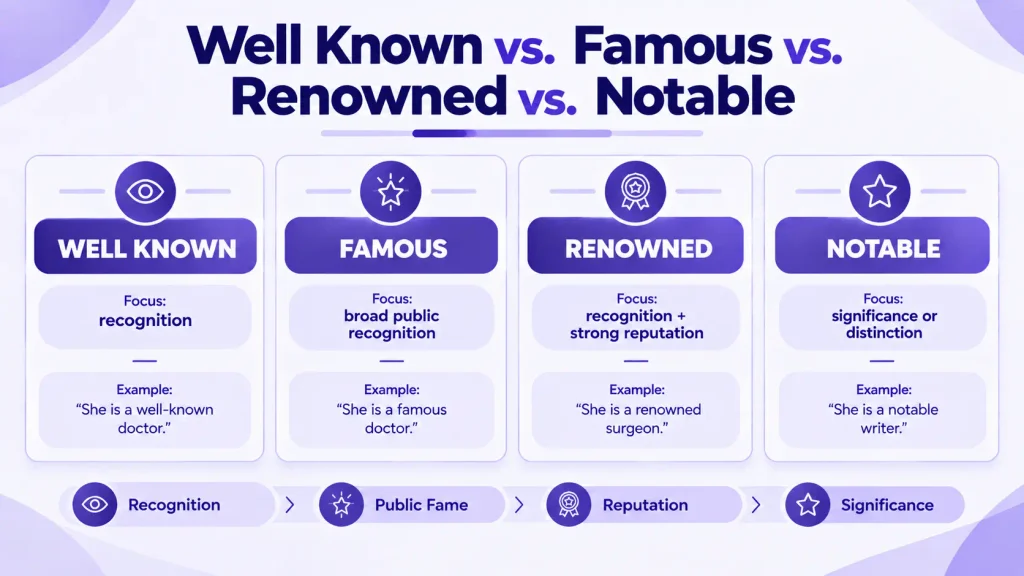
“Famous” is usually the closest simple substitute for “well known,” but the two are not always interchangeable.
Compare these examples:
- “She is a well-known doctor.”
- “She is a famous doctor.”
The first sentence simply says many people know who she is. The second can suggest a much higher level of public recognition.
For a neutral tone, “well known” or “widely recognized” may be better. For stronger public recognition, “famous” works naturally.
“Well Known” vs. “Renowned”
These phrases are also slightly different.
- “Well known” focuses on recognition.
- “Renowned” usually suggests recognition plus a strong reputation.
For example:
The university is well known for its engineering program.
This tells readers that many people recognize the university for engineering.
The university is renowned for its engineering program.
This suggests that the university has an especially strong or respected reputation in that area.
“Well Known” vs. “Notable”
“Notable” emphasizes significance rather than fame.
For example:
She is a well-known writer.
This focuses on how many people know her.
She is a notable writer.
This emphasizes that she is significant or worthy of attention.
That distinction makes “notable” especially useful in formal and academic writing.
Common Mistakes When Replacing “Well Known”
Using “popular” as an exact synonym
“Popular” means liked or favored by many people. It does not simply mean known by many people.
A product can be well known but unpopular.
Using “legendary” too casually
“Legendary” is highly emphatic. It suggests exceptional fame, achievement, or reputation.
If you only mean that many people know someone, “famous” is usually more accurate.
Using “renowned” without a positive reputation
“Renowned” generally carries a positive sense of reputation. It is not the best choice when you only want to state that someone is widely known.
Using “high-profile” to mean famous
“High-profile” focuses on public visibility or media attention. It does not necessarily mean universally famous.
Forgetting the second meaning of “well-known”
“Well known” can also describe information or facts that are generally known or accepted.
For example:
It is a well-known fact that regular exercise benefits overall health.
In this context, alternatives such as “famous” or “renowned” would not make sense. “Widely known” or “generally recognized” would be more appropriate.
FAQs About Another Way to Say “Well Known”
What is the most common synonym for “well known”?
“Famous” is the most common direct alternative when you mean that a person or thing is known and recognized by many people.
What is a formal way to say “well known”?
Depending on the context, “renowned,” “widely recognized,” “notable,” “prominent,” “eminent,” or “celebrated” can work. The best choice depends on whether you want to emphasize reputation, importance, expertise, or recognition.
What is another way to say “well known for”?
You can use phrases such as “famous for,” “renowned for,” “noted for,” “recognized for,” or “famed for.”
For example:
- The region is well known for its wine.
- The region is renowned for its wine.
- The region is famous for its wine.
Is “renowned” stronger than “well known”?
Usually, yes. “Renowned” generally suggests that someone or something is not only widely known but also respected or admired for a particular quality or achievement.
Can “popular” replace “well known”?
Sometimes, but not always. “Popular” means liked or favored by many people, while “well known” focuses on recognition. The two words describe different ideas.
What is a professional way to say “well known”?
“Widely recognized,” “renowned,” “prominent,” “notable,” and “well-established” may work depending on the sentence. For professional writing, choose the phrase that accurately describes why the person or organization is known.
What is a stronger word for “well known”?
“Famous,” “world-famous,” “celebrated,” or “legendary” can be stronger, but they do not have exactly the same meaning or intensity. “Legendary” is especially strong and should be used when the reputation is exceptional.
Final Thoughts
There is no single replacement for “well known” that works in every sentence. “Famous” is the easiest general alternative, while “renowned” adds respect, “prominent” adds importance, “high-profile” emphasizes public attention, and “notable” highlights significance.
Choose the word that matches the exact idea you want to communicate. A precise alternative will usually sound more natural than simply choosing the strongest synonym.

Role: Language Editor
Caleb Mercer is a Language Editor at RepublicsPress, focusing on grammar, sentence structure, professional writing, and English usage. He helps ensure that language guides are clear, accurate, natural, and easy to follow.