Tell Me Another Way to Say Hi in Another Language
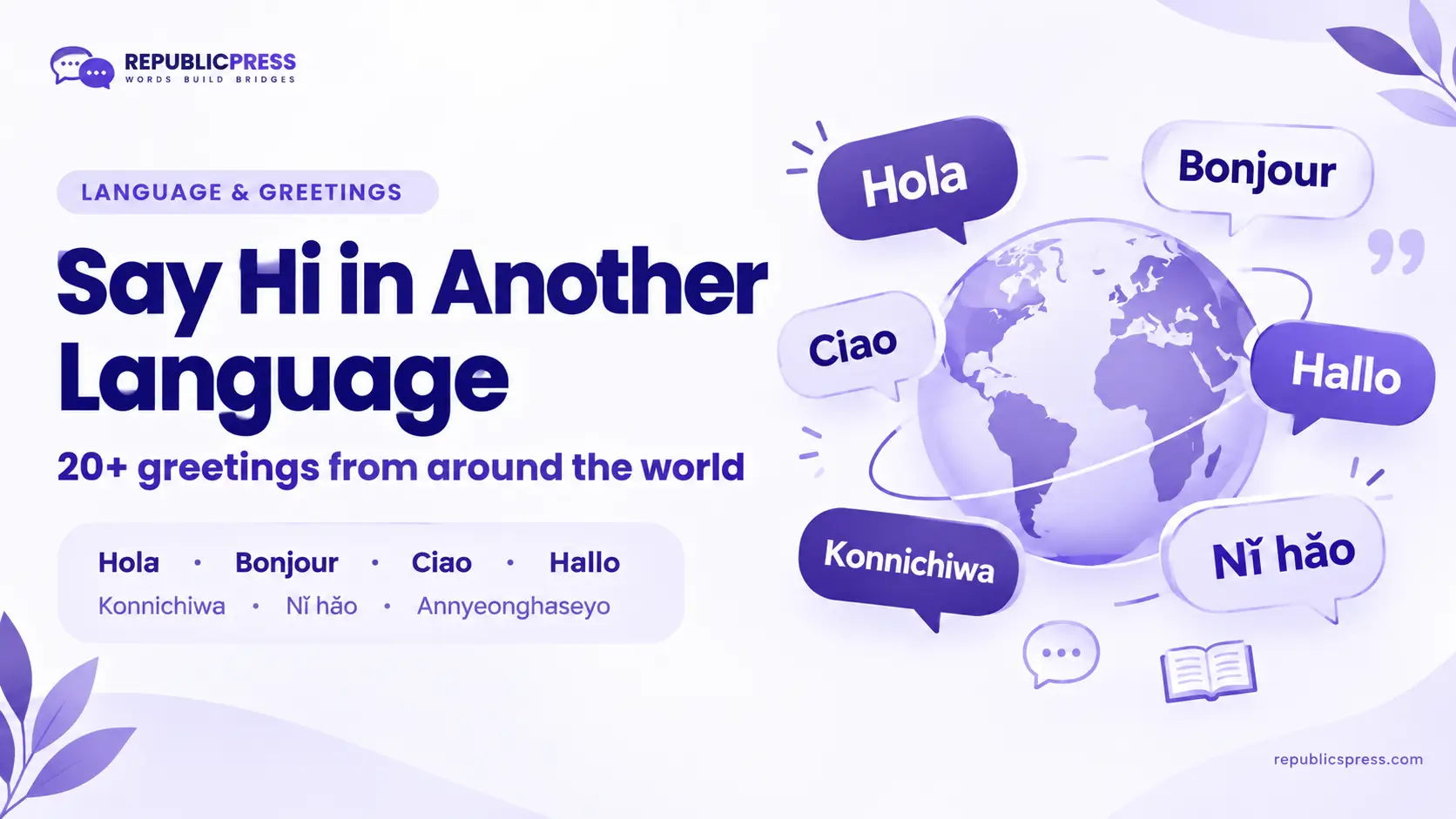
If you want to say “hi” in another language, the best choice depends on the language, setting, and level of formality. Common options include hola in Spanish, bonjour in French, ciao in Italian, hallo in German, and こんにちは (konnichiwa) in Japanese. Some languages also have casual greetings that are better suited to friends.
Key Takeaways
- “Hi” has different natural equivalents across languages.
- Some translations are casual, while others are more polite or formal.
- Hola, ciao, and salut are common informal greetings in several widely spoken languages.
- The appropriate greeting can depend on who you are speaking to and the situation.
- Some languages use different greetings depending on the time of day or social context.
How to Say “Hi” in Different Languages
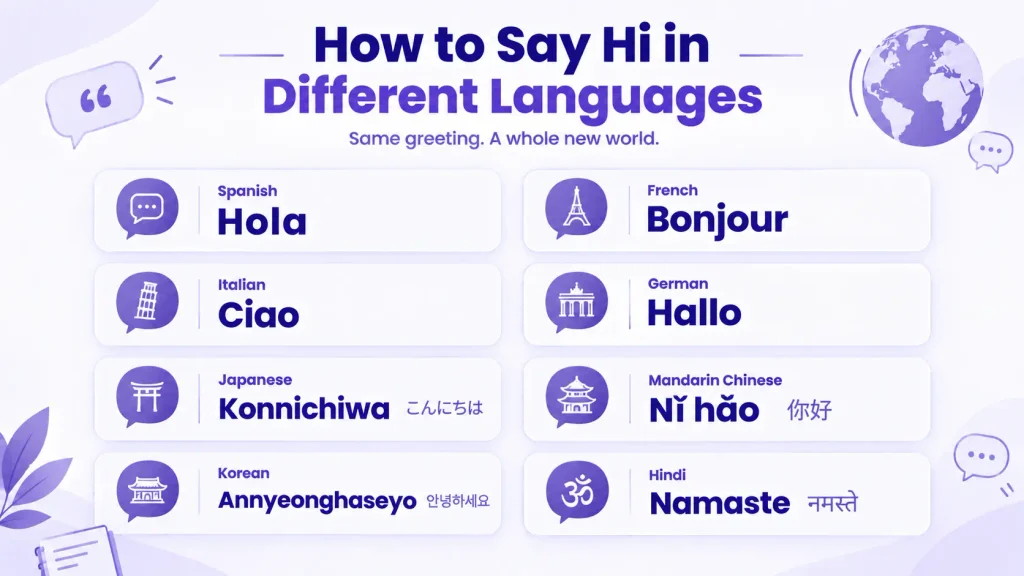
Here are natural ways to greet someone in several commonly spoken languages.
| Language | Way to Say “Hi” | Pronunciation | Typical Tone |
|---|---|---|---|
| Spanish | Hola | OH-lah | Casual / neutral |
| French | Salut | sah-LUU | Casual |
| French | Bonjour | bon-ZHOOR | Polite / neutral |
| Italian | Ciao | chow | Casual |
| German | Hallo | HAH-loh | Casual / neutral |
| Portuguese | Olá | oh-LAH | Neutral |
| Japanese | こんにちは (Konnichiwa) | koh-nee-chee-wah | Polite / neutral |
| Korean | 안녕하세요 (Annyeonghaseyo) | an-nyeong-ha-se-yo | Polite |
| Chinese | 你好 (Nǐ hǎo) | nee how | Neutral / polite |
| Arabic | مرحبًا (Marhaban) | MAR-ha-ban | Neutral |
| Hindi | नमस्ते (Namaste) | nuh-muh-stay | Polite / respectful |
| Turkish | Merhaba | mehr-hah-bah | Neutral |
| Dutch | Hallo | HAH-loh | Casual / neutral |
| Russian | Привет (Privet) | pree-VYET | Casual |
| Greek | Γεια σου (Yia sou) | yah soo | Casual / singular |
| Swedish | Hej | hay | Casual / neutral |
1. Spanish: “Hola”
Hola is the standard Spanish greeting equivalent to “hi” or “hello.”
Example:
“¡Hola! ¿Cómo estás?”
“Hi! How are you?”
It works in many everyday situations and is one of the easiest greetings to remember.
2. French: “Salut” or “Bonjour”
Salut is an informal way to say “hi” and is commonly used with friends and people you know.
Bonjour is more polite and can mean “hello” or “good morning.”
Example:
“Salut, Marie!” — “Hi, Marie!”
For a stranger, professional situation, or more formal interaction, bonjour is generally more appropriate.
3. Italian: “Ciao”
Ciao is a very common informal greeting in Italian. It can mean both “hi” and “bye.”
Example:
“Ciao, Luca!”
“Hi, Luca!”
Because it is informal, you would generally use it with friends, family, or people in casual settings.
4. German: “Hallo”
Hallo is a straightforward German greeting that can be used much like “hi” or “hello” in English.
Example:
“Hallo! Wie geht’s?”
“Hi! How are you?”
German also has more formal greetings, so the relationship and situation can affect which greeting sounds most appropriate.
5. Japanese: “Konnichiwa”
こんにちは (konnichiwa) is a common Japanese greeting traditionally associated with “hello” or “good afternoon.”
Example:
“こんにちは!お元気ですか?”
“Hello! How are you?”
Japanese greetings can be strongly influenced by formality and social relationships, so konnichiwa is not simply interchangeable with every casual use of “hi.”
6. Korean: “Annyeonghaseyo”
안녕하세요 (annyeonghaseyo) is a polite Korean greeting commonly used when meeting someone.
Example:
“안녕하세요!”
“Hello!”
A shorter form, 안녕 (annyeong), is more casual and is commonly used among friends or people in informal relationships.
7. Chinese: “Nǐ hǎo”
In Mandarin Chinese, 你好 (nǐ hǎo) is a common way to greet someone.
Example:
“你好!”
“Hello!”
The pronunciation and tone matter in Mandarin, so hearing the phrase spoken can be helpful when learning it.
8. Arabic: “Marhaban”
مرحبًا (marhaban) is a general Arabic greeting that can be translated as “hello” or “hi.”
Another widely recognized greeting is as-salamu alaykum, which has a more specific cultural and religious usage and is traditionally answered with wa alaykum as-salam.
9. Hindi: “Namaste”
नमस्ते (namaste) is a respectful greeting used in Hindi and several other South Asian languages.
Example:
“नमस्ते! आप कैसे हैं?”
“Hello! How are you?”
It can be used when greeting someone and often carries a more respectful tone than casual English “hi.”
Casual Ways to Say “Hi” Around the World
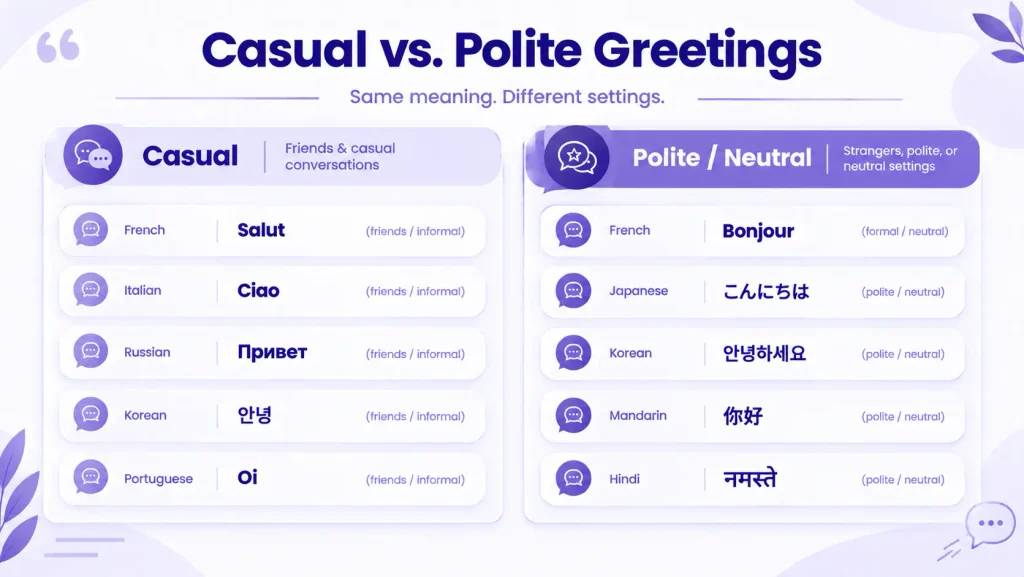
If you’re looking for greetings that feel especially casual, these are useful examples:
- Spanish: Hola
- French: Salut
- Italian: Ciao
- German: Hallo
- Russian: Привет (Privet)
- Swedish: Hej
- Turkish: Selam
- Dutch: Hoi
- Korean: 안녕 (Annyeong)
- Portuguese: Oi
Keep in mind that “casual” does not mean exactly the same thing in every culture. A greeting that is perfectly normal among friends may not be appropriate for a teacher, employer, customer, or stranger.
Polite Ways to Greet Someone in Another Language
If you’re meeting someone for the first time or want to sound respectful, consider greetings such as:
- French: Bonjour
- Japanese: Konnichiwa
- Korean: Annyeonghaseyo
- Chinese: Nǐ hǎo
- Arabic: Marhaban
- Hindi: Namaste
- German: Guten Tag
The exact choice depends on the language and social situation.
“Hi” vs. “Hello” in Other Languages
Not every language has a perfect one-word equivalent for the English “hi.” English distinguishes between hi and hello, but another language may use one common greeting for both.
For example, hola can work for both “hi” and “hello” in Spanish. In French, salut is generally more casual, while bonjour is more neutral or polite.
That is why a literal dictionary translation is not always the best choice. Context matters as much as the word itself.
How to Choose the Right Greeting
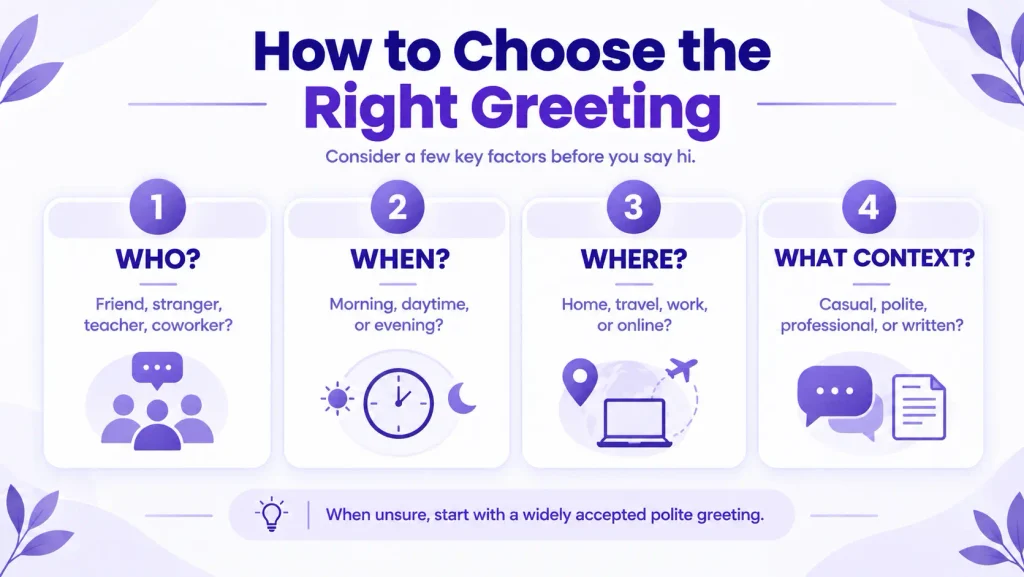
Use these simple guidelines:
With a friend: Choose the language’s casual greeting, such as ciao, salut, or annyeong.
With a stranger: A neutral or polite greeting is usually safer.
At work: Use a professional or culturally appropriate greeting rather than slang.
When traveling: Learn the standard greeting used locally and pay attention to how native speakers use it.
Online: Casual greetings are often more acceptable, but the platform and relationship still matter.
Common Mistakes When Saying “Hi” in Another Language
Assuming every translation has the same level of formality
A dictionary may give you a translation without explaining whether native speakers use it with friends, strangers, or colleagues.
Using a casual greeting with everyone
Words such as ciao or salut can be informal. They may not be the right choice for every situation.
Ignoring pronunciation
A correctly written greeting can still sound unfamiliar if its pronunciation is far off. Listening to native speakers can help.
Treating cultural greetings as exact translations
Some greetings carry cultural, social, or religious meanings that go beyond the simple English word “hi.”
Frequently Asked Questions
What is the most common way to say “hi” in another language?
There isn’t one universal translation because every language has its own greeting system. Hola, bonjour, ciao, hallo, and nǐ hǎo are examples of widely recognized greetings in different languages.
How do you say “hi” in Spanish?
You say hola. It is a common Spanish greeting that can mean “hi” or “hello.”
How do you say “hi” in French?
For a casual “hi,” use salut. For a more neutral or polite greeting, bonjour is commonly used.
How do you say “hi” in Italian?
Ciao is the common informal way to say “hi” in Italian. It can also mean “bye.”
How do you say “hi” in Japanese?
こんにちは (konnichiwa) is a common Japanese greeting meaning “hello.” The appropriate greeting can vary depending on the situation and time of day.
What is a casual way to say “hi” in Korean?
Among friends and in casual situations, 안녕 (annyeong) can be used. 안녕하세요 (annyeonghaseyo) is a more polite greeting.
Is “hello” the same as “hi” in every language?
No. Some languages have separate casual and formal greetings, while others use one expression across several situations. The closest natural equivalent depends on context.
Conclusion
If you want to say “hi” in another language, start with the greeting that native speakers normally use in the situation you’re entering. Hola, salut, ciao, hallo, nǐ hǎo, and konnichiwa are useful examples, but formality and cultural context matter. Learning when to use a greeting is just as important as learning the translation itself.

Role: English Content Writer
Maren Whitlock writes practical English language content for RepublicsPress, with a focus on vocabulary, word alternatives, everyday expressions, and clear communication. Her articles are designed to make difficult or confusing language easier to understand, with simple explanations and useful examples readers can apply in real situations.