Another Way to Say Roll Up Your Sleeves
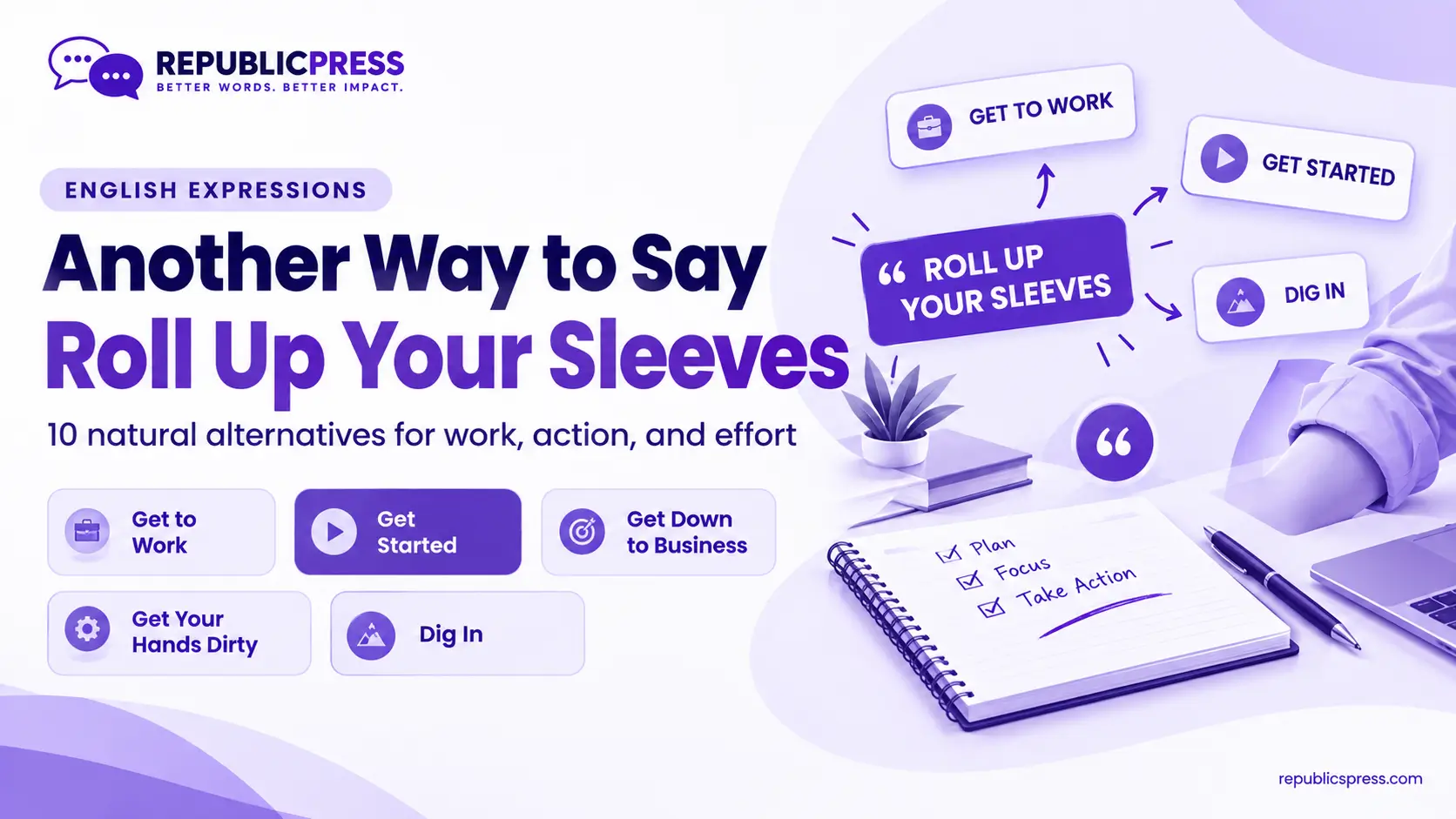
Looking for another way to say “roll up your sleeves”? Depending on the context, you can say get to work, get down to business, get to it, get stuck in, prepare to work, or get your hands dirty. The best choice depends on whether you want a casual, professional, motivational, or figurative tone.
Key Takeaways
- “Roll up your sleeves” is an idiom that means preparing to work hard or deal with a difficult task.
- “Get to work” is one of the clearest and most direct alternatives.
- “Get down to business” works well in professional or serious situations.
- “Get your hands dirty” suggests doing practical or difficult work yourself.
- “Get to it” is short, casual, and action-focused.
- Not every alternative has exactly the same tone or meaning, so context matters.
What Does “Roll Up Your Sleeves” Mean?
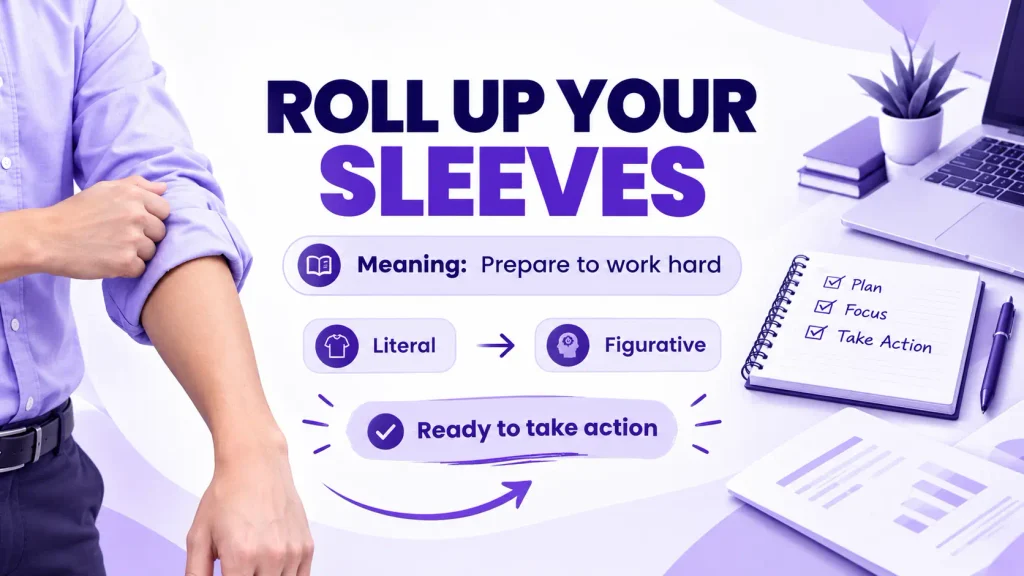
“Roll up your sleeves” is an idiomatic expression that means to prepare to work hard, especially when a task requires effort, focus, or practical involvement.
The phrase comes from the literal action of rolling up your shirt sleeves before doing physical work. In modern American English, it is often used figuratively.
For example:
We have a lot to finish today, so let’s roll up our sleeves and get started.
Here, the speaker is not necessarily asking anyone to physically roll up their sleeves. The phrase creates a sense of readiness and determination.
It can be used for physical work, office projects, problem-solving, or any situation that requires serious effort.
Best Alternatives to “Roll Up Your Sleeves”
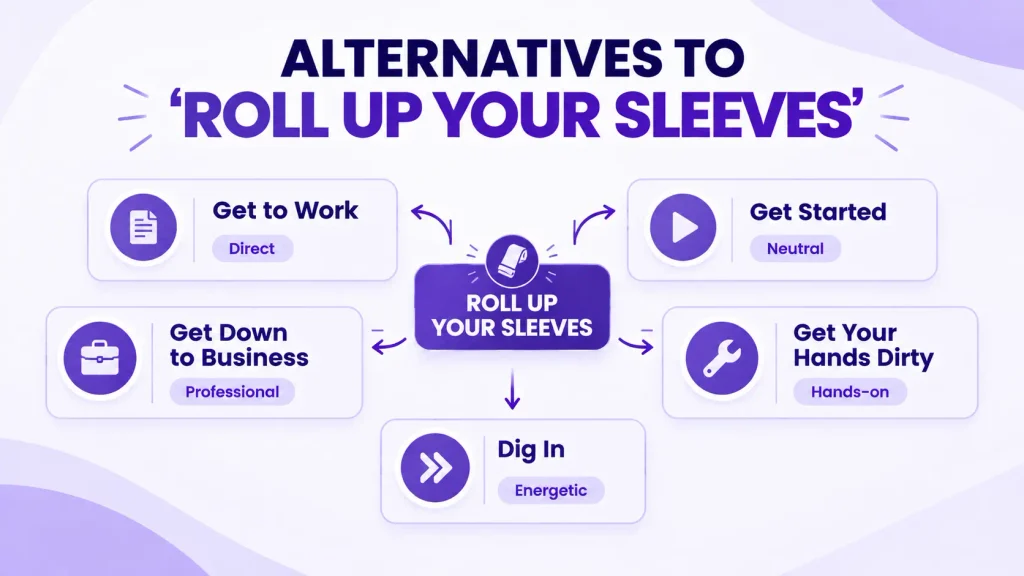
The right alternative depends on the tone you want. Here are some of the most natural options.
1. Get to Work
“Get to work” is one of the closest and simplest alternatives.
It means to stop preparing or talking and begin working.
Example:
We have a deadline tomorrow, so let’s get to work.
Best for: Everyday, workplace, and direct situations.
Unlike “roll up your sleeves,” “get to work” is more direct and less colorful.
2. Get Down to Business
“Get down to business” means to start dealing seriously with the main task or issue.
Example:
We’ve finished introductions, so let’s get down to business.
Best for: Professional meetings, serious discussions, and formal situations.
This phrase focuses more on beginning serious work or discussion than on physical effort.
3. Get to It
“Get to it” is a short, casual way to tell someone to start doing something.
Example:
We’ve talked about the problem long enough. Let’s get to it.
Best for: Casual conversations and action-oriented situations.
It is less motivational than “roll up your sleeves,” but it clearly communicates the idea of taking action.
4. Get Started
“Get started” is a neutral alternative that simply means to begin.
Example:
We have everything we need, so let’s get started.
Best for: Professional, academic, and everyday situations.
This option is especially useful when you want a straightforward phrase without the figurative tone of “roll up your sleeves.”
5. Get Your Hands Dirty
“Get your hands dirty” means to become directly involved in practical, messy, or difficult work.
Example:
If we want to fix this problem, we’re going to have to get our hands dirty.
Best for: Practical work, problem-solving, hands-on tasks, and figurative challenges.
This is similar to “roll up your sleeves,” but it can suggest a stronger willingness to deal directly with difficult details.
6. Get Stuck In
“Get stuck in” means to start working with energy and enthusiasm.
Example:
We’ve got a big project ahead of us, so let’s get stuck in.
Best for: Informal English and energetic situations.
This expression is common in British English and may sound less natural to some American readers. For a general American audience, “get to work” or “get started” is usually a safer choice.
7. Dig In
“Dig in” can mean to begin working with determination, especially when a task is challenging or time-consuming.
Example:
We have several hours of work ahead of us, so let’s dig in.
Best for: Casual, motivational, and challenging situations.
“Dig in” can also mean to start eating, so context matters.
8. Get Down to Work
“Get down to work” means to begin working seriously and with focus.
Example:
After a short break, everyone got down to work.
Best for: Workplace, academic, and focused situations.
It is slightly more formal and serious than “get to it.”
9. Tackle the Task
“Tackle the task” means to approach a task directly, especially when it may be difficult.
Example:
Let’s tackle the task one step at a time.
Best for: Professional, academic, and problem-solving contexts.
This phrase emphasizes dealing with a challenge rather than simply beginning work.
10. Get Down to the Nitty-Gritty
“Get down to the nitty-gritty” means to focus on the practical details of a matter.
Example:
We’ve discussed the big picture. Now let’s get down to the nitty-gritty.
Best for: Discussions, planning, business, and detailed problem-solving.
This is not a perfect synonym for “roll up your sleeves.” It is better when you mean getting into the important practical details.
Quick Comparison of Alternatives
| Alternative | Main Meaning | Tone | Best Context |
| Get to work | Start working | Direct | Everyday, workplace |
| Get down to business | Start serious work or discussion | Professional | Meetings, business |
| Get to it | Start taking action | Casual | Everyday conversations |
| Get started | Begin | Neutral | Almost any context |
| Get your hands dirty | Become directly involved | Informal | Practical or difficult work |
| Get stuck in | Start with energy | Informal | Casual conversation |
| Dig in | Begin with determination | Casual | Challenging tasks |
| Get down to work | Start working seriously | Neutral/formal | Work, school |
| Tackle the task | Approach a difficult task | Neutral | Work, study, problem-solving |
| Get down to the nitty-gritty | Focus on practical details | Casual/neutral | Planning and discussion |
Which Alternative Is Best for Your Situation?
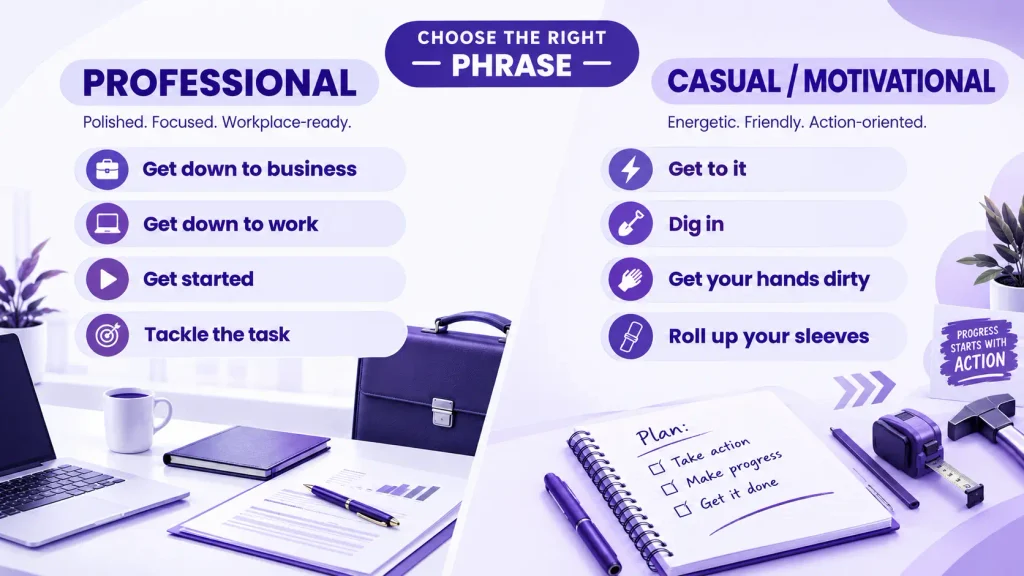
There isn’t one replacement that works perfectly in every sentence.
For a Professional Setting
Use:
- Get down to business
- Get down to work
- Get started
- Tackle the task
For example:
Let’s get down to business and review the proposal.
This sounds more professional than:
Let’s roll up our sleeves and review the proposal.
The original idiom is still perfectly acceptable at work, but the alternatives can sound more direct or neutral.
For Casual Conversation
Use:
- Get to it
- Get started
- Dig in
- Get to work
For example:
We’ve got a lot to do, so let’s get to it.
This sounds natural and conversational.
For a Motivational Tone
Use:
- Roll up our sleeves
- Dig in
- Tackle the task
- Get your hands dirty
For example:
It’s going to be challenging, but we’re ready to tackle the task.
These expressions emphasize effort and determination.
When You Mean Hands-On Work
“Get your hands dirty” is often the strongest choice.
For example:
A good manager shouldn’t be afraid to get their hands dirty and help the team.
The expression can be literal, but it is often figurative. It suggests personally becoming involved instead of simply supervising from a distance.
“Roll Up Your Sleeves” vs. “Get to Work”
These expressions are similar, but they are not identical.
“Get to work” simply means to begin working.
“Roll up your sleeves” adds a sense of preparation, effort, and determination.
Compare:
Let’s get to work.
This is straightforward.
Let’s roll up our sleeves and solve this problem.
This sounds more energetic and suggests that the work may require serious effort.
“Roll Up Your Sleeves” vs. “Get Your Hands Dirty”
These expressions overlap, but there is an important difference.
“Roll up your sleeves” emphasizes readiness to work hard.
“Get your hands dirty” emphasizes direct involvement in difficult, practical, or messy work.
For example:
We need to roll up our sleeves and finish the project.
This means everyone needs to put in serious effort.
We need to get our hands dirty and figure out what’s causing the problem.
This suggests personally investigating and handling the difficult details.
Common Mistakes to Avoid
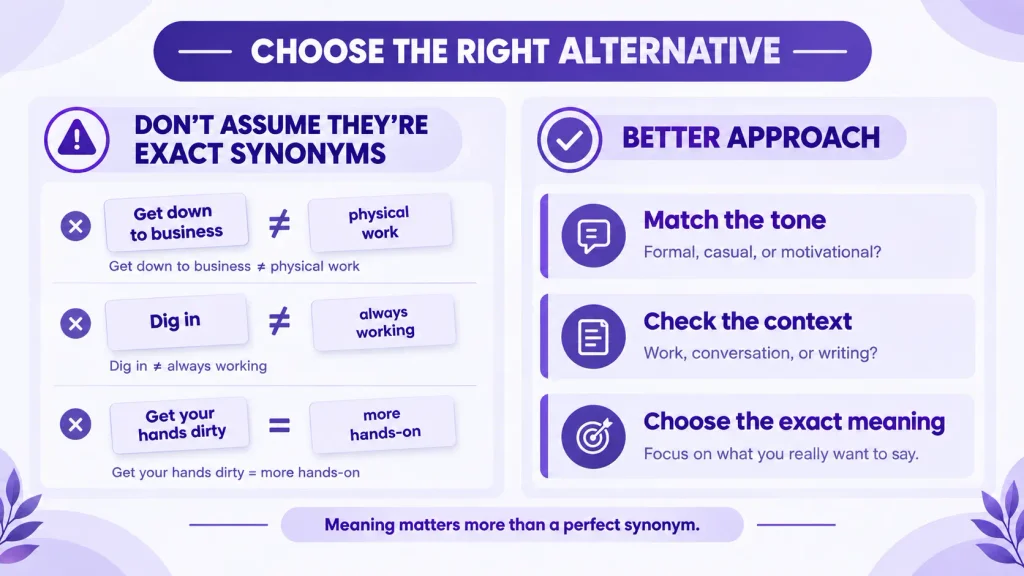
Treating Every Alternative as an Exact Synonym
Expressions such as “get started,” “get down to business,” and “get your hands dirty” are related, but they do not have exactly the same meaning.
Choose the phrase based on what you actually want to communicate.
Using “Get Stuck In” Without Considering Your Audience
“Get stuck in” is natural English, but it is more strongly associated with British English than American English.
For an American audience, “get to work,” “get started,” or “dig in” may sound more familiar.
Using “Get Down to Business” for Physical Work
“Get down to business” usually refers to beginning serious work or discussion.
For physical or hands-on work, “roll up your sleeves” or “get your hands dirty” may be more appropriate.
Assuming “Dig In” Always Means Working
“Dig in” has more than one meaning. It can also mean to start eating.
For example:
Dinner is ready. Dig in!
So use context to make your intended meaning clear.
Frequently Asked Questions
What is another way to say “roll up your sleeves” at work?
Good workplace alternatives include “get down to business,” “get down to work,” “get started,” and “tackle the task.” The best choice depends on whether you want to emphasize starting work, serious discussion, or dealing with a difficult task.
Is “get to work” the same as “roll up your sleeves”?
They are similar, but “roll up your sleeves” has a stronger sense of readiness and determination. “Get to work” is more direct and simply tells someone to begin working.
Is “get your hands dirty” a synonym for “roll up your sleeves”?
It can be a close alternative in some contexts, especially when the speaker means becoming directly involved in difficult or practical work. However, it can imply hands-on involvement more strongly than “roll up your sleeves.”
What is a professional way to say “roll up your sleeves”?
For professional writing, “get down to business,” “get down to work,” or “begin tackling the task” are useful choices. They are clear without sounding overly casual.
What is a casual way to say “roll up your sleeves”?
“Get to it,” “get to work,” and “dig in” can work well in casual conversation. The best choice depends on the situation and the level of energy you want to convey.
Is “roll up your sleeves” formal or informal?
“Roll up your sleeves” is a common idiom that can work in both casual and professional communication. It has a conversational and motivational feel, so it may be less suitable than a direct phrase in highly formal writing.
Can “roll up your sleeves” be used literally?
Yes. Literally, it means to move your shirt sleeves upward, usually to keep them out of the way while working. More commonly, the expression is used figuratively to mean preparing to work hard.
Final Thoughts
“Roll up your sleeves” is a useful idiom because it combines the ideas of preparation, effort, and determination. If you want a simple replacement, “get to work” or “get started” works well. For a professional setting, try “get down to business.” If you want to emphasize hands-on effort, “get your hands dirty” is a stronger choice.
The best alternative isn’t always the closest synonym. Choose the expression that matches the tone, audience, and kind of work you want to describe.

Role: Editorial Contributor
Graham Ellis contributes practical English and communication guides to RepublicsPress. His content focuses on vocabulary, writing techniques, word usage, and clear communication, with an emphasis on straightforward explanations and real-world examples.