Another Way to Say Thankful: 15 Natural Alternatives
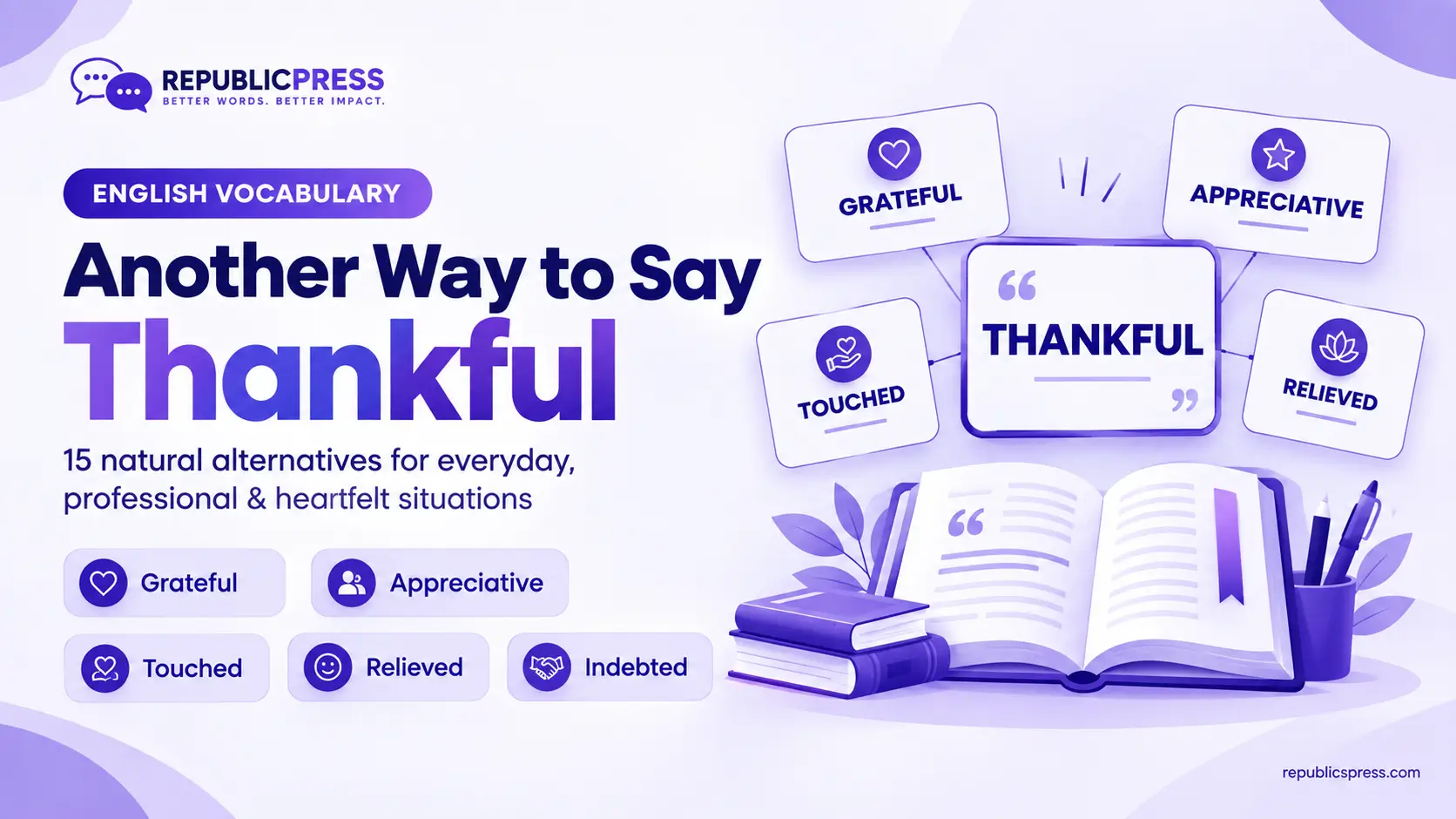
If you’re looking for another way to say “thankful,” the best choice depends on your tone and situation. Natural alternatives include “grateful,” “appreciative,” “obliged,” “touched,” “relieved,” and “indebted.” Some work well in everyday conversation, while others are better for professional, emotional, or formal writing.
Key Takeaways
- “Grateful” is the closest and most widely useful alternative to “thankful.”
- “Appreciative” works especially well when recognizing someone’s help or effort.
- “Touched” expresses emotional gratitude rather than simple appreciation.
- “Relieved” can replace “thankful” when gratitude comes from a positive outcome after worry or uncertainty.
- “Indebted” suggests that someone has helped you so much that you feel you owe them.
- The best alternative depends on what you are thankful for and the tone you want to convey.
What Does “Thankful” Mean?
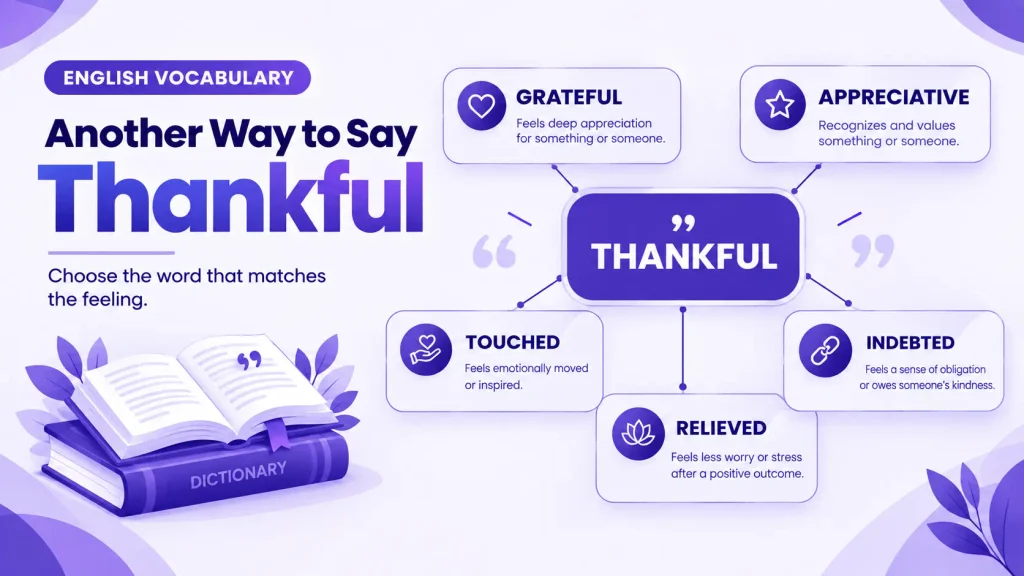
“Thankful” means feeling or expressing gratitude for something positive that happened or for something another person did.
For example:
I’m thankful for your help with the project.
The word can describe both a general feeling of gratitude and a reaction to a specific situation.
I’m thankful that everyone arrived safely.
In this sentence, “thankful” is closer to feeling relieved or grateful about a positive outcome.
Because of these different uses, not every synonym works in every sentence.
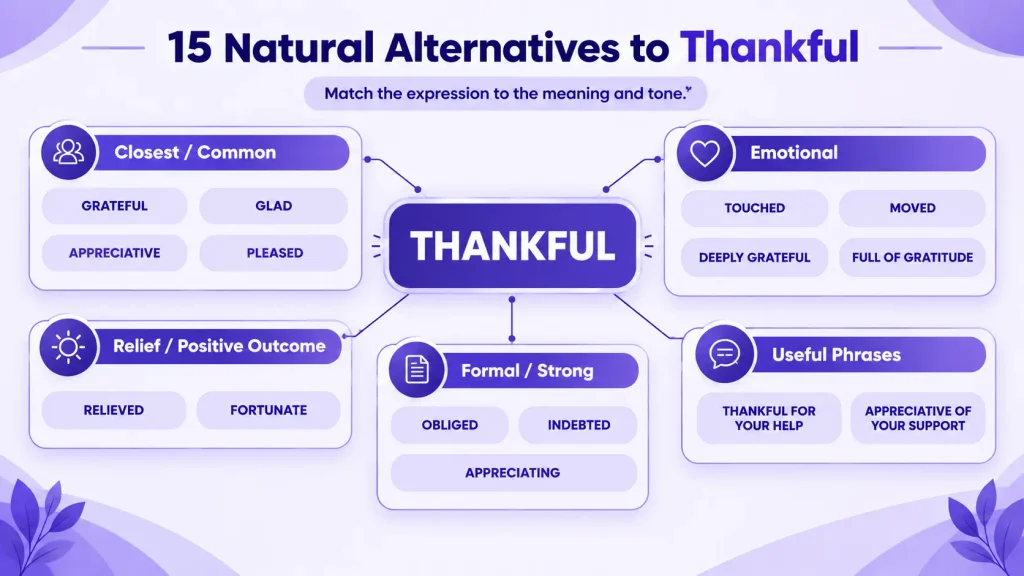
15 Natural Ways to Say “Thankful”
1. Grateful
“Grateful” is the closest general alternative to “thankful.” It expresses sincere appreciation for something someone has done or for something positive in your life.
Best for: Everyday, professional, and heartfelt situations
Example:
I’m grateful for everything you’ve done for me.
“Grateful” often sounds slightly more heartfelt than “thankful,” especially when describing appreciation for someone’s support.
2. Appreciative
“Appreciative” means recognizing and valuing someone’s help, effort, kindness, or contribution.
Best for: Professional and everyday communication
Example:
We’re very appreciative of your continued support.
This is especially useful in emails, workplace messages, and situations where you want to acknowledge someone’s effort.
3. Thankful for Your Help
Sometimes the most natural alternative isn’t a single synonym. “I appreciate your help” or “I’m grateful for your help” can sound more specific and polished than simply saying “I’m thankful.”
Best for: Professional and personal communication
Example:
I really appreciate your help with this project.
4. Appreciative of Your Support
This phrase is useful when someone has helped you emotionally, professionally, or practically.
Best for: Professional, personal, and supportive situations
Example:
I’m truly appreciative of your support during this process.
It focuses on the value of someone’s support rather than simply stating that you feel thankful.
5. Touched
“Touched” describes a positive emotional response to someone’s kindness, thoughtfulness, or generosity.
Best for: Personal and emotional situations
Example:
I was really touched by your thoughtful message.
Use “touched” when you want to emphasize how deeply someone’s action affected you emotionally.
6. Moved
“Moved” can express a strong emotional reaction to someone’s kindness, words, or actions.
Best for: Emotional and heartfelt situations
Example:
I was deeply moved by your generosity.
This is stronger and more emotional than simply saying “thankful.”
7. Obliged
“Obliged” can mean grateful or appreciative, particularly in formal or traditional expressions.
Best for: Formal or somewhat old-fashioned language
Example:
I’m much obliged for your assistance.
This phrase is less common in casual modern American English, so “grateful” or “appreciative” will usually sound more natural.
8. Indebted
“Indebted” suggests that someone has helped you so much that you feel you owe them a debt of gratitude.
Best for: Formal, serious, or deeply appreciative situations
Example:
I’m deeply indebted to everyone who supported me.
It conveys stronger appreciation than “thankful” and can suggest a lasting sense of gratitude.
9. Relieved
“Relieved” is appropriate when you feel thankful because a difficult, stressful, or uncertain situation ended positively.
Best for: Situations involving worry or uncertainty
Example:
I’m relieved to hear that you made it home safely.
“Relieved” isn’t a direct synonym for “thankful,” but it can express the specific feeling behind “I’m thankful that everything worked out.”
10. Glad
“Glad” is a simple, natural alternative when you are happy about an outcome.
Best for: Casual and everyday conversation
Example:
I’m glad you were able to come.
This sounds more conversational than “I’m thankful you were able to come.”
11. Pleased
“Pleased” expresses satisfaction or happiness about something that happened.
Best for: Professional and formal communication
Example:
We’re pleased to have your support.
It doesn’t carry exactly the same emotional meaning as “thankful,” but it can work when the emphasis is on a positive outcome or response.
12. Fortunate
“Fortunate” works when you want to express gratitude for having a positive circumstance or opportunity.
Best for: Reflective, professional, and formal writing
Example:
I feel fortunate to have such supportive colleagues.
Rather than thanking someone directly, this word emphasizes how lucky or privileged you feel about the situation.
13. Appreciating
“Appreciating” can be useful when you want to emphasize that you recognize someone’s effort, kindness, or value.
Best for: Personal and professional communication
Example:
I hope you know how much I’m appreciating your support.
In many situations, however, “I really appreciate your support” sounds more natural in American English.
14. Deeply Grateful
“Deeply grateful” is a stronger version of “grateful” for situations involving significant help, kindness, or emotional support.
Best for: Heartfelt, formal, and serious situations
Example:
I’m deeply grateful for everything you’ve done.
This phrase is more emotionally expressive than a simple “thank you.”
15. Full of Gratitude
“Full of gratitude” emphasizes a strong overall feeling of appreciation.
Best for: Personal, reflective, and inspirational writing
Example:
I’m leaving this experience full of gratitude for everyone who supported me.
This expression is more literary and reflective than everyday “thankful.”
Thankful vs. Grateful vs. Appreciative
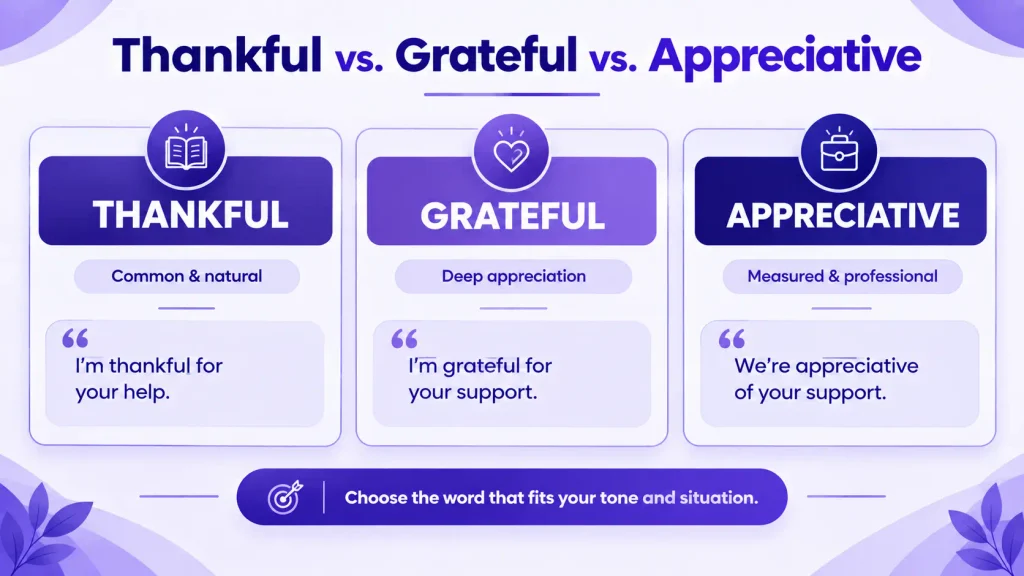
These three words are closely related, but they aren’t always interchangeable.
| Word | Main Meaning | Tone | Best Context |
| Thankful | Feeling gratitude or relief | Neutral and warm | Everyday situations |
| Grateful | Feeling sincere or deep gratitude | Warm and heartfelt | Personal, professional, formal |
| Appreciative | Recognizing someone’s value or effort | Polite and professional | Work and everyday communication |
| Touched | Emotionally affected by kindness | Emotional | Personal situations |
| Relieved | Thankful because something turned out well | Conversational | Stressful or uncertain situations |
| Indebted | Feeling that you owe someone because of their help | Strong and formal | Serious or significant help |
Which Alternative Should You Use?
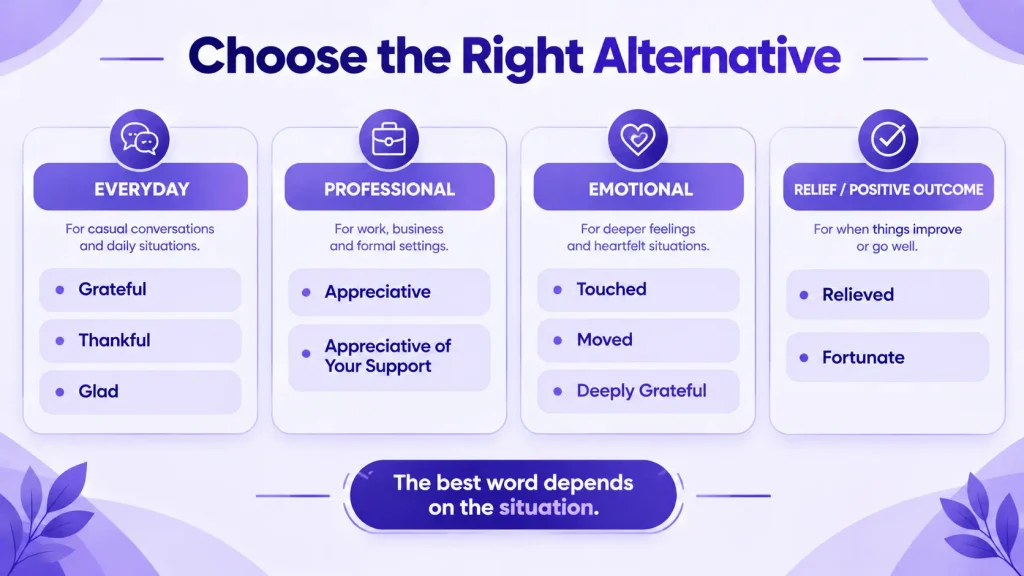
The right phrase depends on what you are trying to communicate.
For everyday conversation
Use:
- Grateful
- Glad
- Thankful
- Appreciate it
Example:
I’m really grateful you came to help.
For professional emails
Use:
- Appreciative
- Grateful
- Appreciate your support
- Thank you for your assistance
Example:
I really appreciate your assistance with this project.
For emotional situations
Use:
- Deeply grateful
- Touched
- Moved
- Full of gratitude
Example:
I was deeply moved by everyone’s kindness.
When something bad could have happened
Use:
- Relieved
- Glad
- Thankful
Example:
I’m so relieved that everyone is safe.
When someone gave you significant help
Use:
- Deeply grateful
- Indebted
- Extremely appreciative
Example:
I’m deeply grateful for everything you did during that difficult time.
“Thankful” in Different Sentences
The best replacement can change depending on the sentence.
Original:
I’m thankful for your support.
Natural alternatives:
- I’m grateful for your support.
- I really appreciate your support.
- I’m deeply appreciative of your support.
- I’m touched by your support.
Original:
I’m thankful that you’re here.
Natural alternatives:
- I’m glad you’re here.
- I’m grateful that you’re here.
- I’m relieved that you’re here.
The last three sentences have slightly different meanings, which is why choosing an alternative based only on a synonym list can produce awkward wording.
Common Mistakes When Replacing “Thankful”
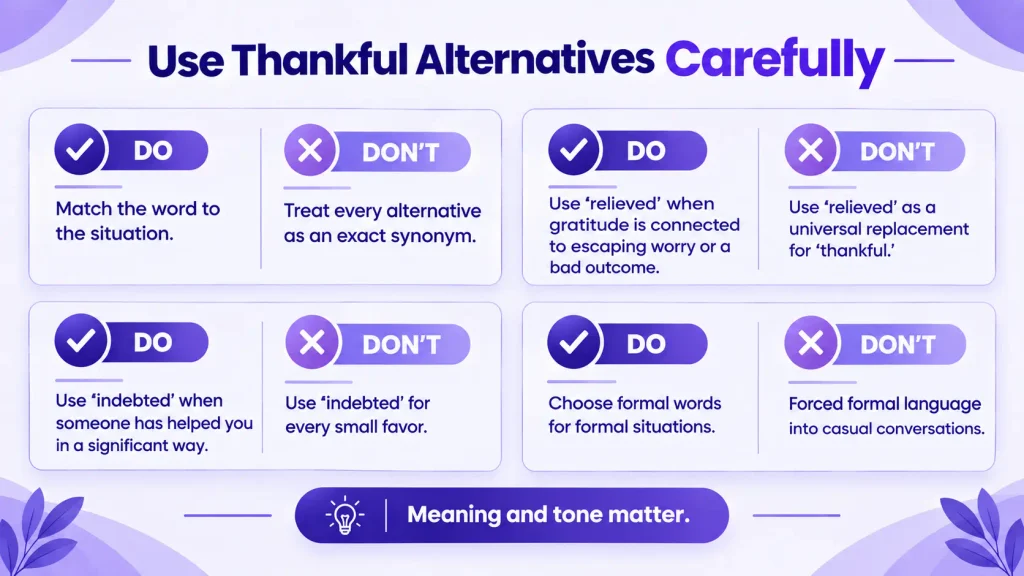
Using “relieved” as an exact synonym
“Relieved” usually involves the removal of worry, fear, or uncertainty.
I’m relieved that you got home safely.
This doesn’t mean exactly the same thing as:
I’m grateful for your kindness.
The first focuses on the end of worry; the second focuses on appreciation.
Using “indebted” for a small favor
“Indebted” can sound much stronger than “thankful.”
I’m indebted to you for helping me carry these boxes.
This may sound overly dramatic for a simple favor. “I really appreciate your help” would usually be more natural.
Using formal words in casual conversations
Words such as “obliged” and “indebted” may sound formal or old-fashioned in ordinary conversation.
For a casual text, something like this is more natural:
Thanks so much. I really appreciate it!
Assuming every synonym has the same emotional strength
“Thankful,” “grateful,” “touched,” “moved,” and “indebted” all relate to positive appreciation, but they communicate different shades of meaning.
Choose the word that matches the feeling you actually want to express.
Frequently Asked Questions
What is the best synonym for “thankful”?
“Grateful” is generally the closest and most versatile synonym for “thankful.” However, “appreciative,” “touched,” “relieved,” or “glad” may be more appropriate depending on the context.
Is “grateful” stronger than “thankful”?
Not always. Both words can express gratitude, but “grateful” often sounds more heartfelt or sincere, particularly when describing significant help or support.
What is a professional way to say “thankful”?
“Grateful” and “appreciative” are both natural professional choices. For example, “We’re grateful for your continued support” or “I really appreciate your assistance.”
What is a casual way to say “thankful”?
“Glad,” “grateful,” and “I really appreciate it” are natural choices in casual American English.
How do I say “thankful for your help” professionally?
You can say “I really appreciate your assistance,” “I’m grateful for your support,” or “Thank you for your help with this matter.”
What is a stronger word than “thankful”?
“Deeply grateful,” “moved,” or “indebted” can express stronger feelings, depending on the context. “Indebted” is particularly strong because it can imply that you feel you owe someone because of their help.
Is “appreciative” the same as “thankful”?
They overlap, but they aren’t identical. “Thankful” focuses on the feeling of gratitude, while “appreciative” often emphasizes recognizing and valuing someone’s effort, help, or contribution.
Final Thoughts
The most natural alternative to “thankful” is usually “grateful,” but the best choice depends on the situation. Use “appreciative” when recognizing someone’s effort, “touched” or “moved” for an emotional response, “relieved” when a worry has ended, and “indebted” when someone’s help has had a major impact.
Choosing the right alternative isn’t about finding a word that looks similar in a thesaurus. It’s about matching the meaning, tone, and situation.

Role: English Content Writer
Maren Whitlock writes practical English language content for RepublicsPress, with a focus on vocabulary, word alternatives, everyday expressions, and clear communication. Her articles are designed to make difficult or confusing language easier to understand, with simple explanations and useful examples readers can apply in real situations.