
Another Way to Say Real World: 10 Better Alternatives & Examples
Direct answer: Common alternatives to “real world” include real life, reality, everyday life, practical life, actual world, real-life setting, outside the virtual world, and in practice. The best choice depends on what you mean. For example, “real life” works well for everyday experiences, while “in practice” is better when contrasting theory with actual results.
Key Takeaways
- Real life is the most natural alternative in casual and everyday writing.
- Reality works when contrasting facts with ideas, expectations, or imagination.
- In practice is useful when comparing theory with what actually happens.
- Everyday life emphasizes ordinary experiences and routines.
- Real-life setting works well when describing an actual situation or environment.
- Not every alternative is interchangeable; the surrounding sentence matters.
What Does “Real World” Mean?
“Real world” generally refers to actual life, real situations, or practical circumstances rather than imagination, theory, simulation, or controlled environments.
For example:
- After college, you’ll need to adjust to the real world.
Here, “real world” means practical adult life. - This skill works well in the real world.
Here, it means actual situations outside theory or testing. - The character leaves the virtual world and enters the real world.
Here, it means the physical world outside a digital environment.
Because of these differences, the best replacement depends on what you are trying to say.
10 Natural Ways to Say “Real World”

1. Real Life
“Real life” is one of the closest and most natural alternatives to “real world.” It usually refers to actual experiences outside fiction, imagination, or online environments.
Best for: Casual, conversational, and general writing.
Example:
Social media doesn’t always reflect what happens in real life.
Usage tip: Use real life when you’re talking about people’s actual experiences rather than a theoretical or imaginary situation.
2. Reality
“Reality” refers to what actually exists or happens. It is especially useful when contrasting actual circumstances with expectations, assumptions, dreams, or fiction.
Best for: General, formal, and reflective writing.
Example:
The reality of running a business is often different from what people expect.
Usage tip: “Reality” can sound more serious than “real world,” particularly when discussing difficult facts or unexpected situations.
3. Everyday Life
“Everyday life” focuses on ordinary experiences, routines, responsibilities, and situations that people encounter regularly.
Best for: Lifestyle, education, social topics, and personal experiences.
Example:
Students should learn skills they can use in everyday life.
Usage tip: This isn’t always an exact synonym. Use it when “real world” means ordinary daily life, rather than reality in a broad philosophical sense.
4. In Practice
“In practice” is an excellent choice when you want to contrast an idea, theory, plan, or principle with what actually happens.
Best for: Academic, professional, technical, and educational writing.
Example:
The method looks simple in theory, but it’s more difficult in practice.
Usage tip: “In practice” describes how something works when actually applied. It shouldn’t replace “real world” when you’re simply talking about everyday life.
5. The Actual World
“The actual world” emphasizes what genuinely exists rather than something imagined, hypothetical, or simulated.
Best for: Formal, philosophical, technical, or explanatory contexts.
Example:
The model doesn’t always account for conditions in the actual world.
Usage tip: It is grammatically natural, but it can sound more formal than “real world.”
6. Real-Life Setting
“Real-life setting” describes an actual environment or situation in which something happens.
Best for: Education, research, training, case studies, and professional writing.
Example:
The course gives students opportunities to apply their skills in a real-life setting.
Usage tip: This is particularly useful when discussing whether a skill or idea works outside a classroom, laboratory, or controlled environment.
7. Practical Life
“Practical life” emphasizes the everyday responsibilities and useful skills involved in living and functioning independently.
Best for: Education, personal development, and life-skills discussions.
Example:
The program prepares teenagers for practical life after graduation.
Usage tip: This phrase has a narrower meaning than “real world,” so use it when practical skills or responsibilities are the focus.
8. Outside the Virtual World
When “real world” is being used to contrast physical life with online or digital environments, “outside the virtual world” can be much clearer.
Best for: Technology, gaming, social media, and digital culture.
Example:
It’s important to maintain friendships outside the virtual world.
Usage tip: This is a contextual alternative rather than a general synonym. Don’t use it unless the original sentence is specifically about digital or virtual experiences.
9. Actual Experience
“Actual experience” works when “real world” refers to what someone personally encounters rather than what they learn from theory or instruction.
Best for: Careers, education, training, and professional development.
Example:
Internships give students actual experience before they enter the workforce.
Usage tip: This phrase focuses on experience, not the physical world itself.
10. Outside the Classroom
When “real world” is used in an educational context, “outside the classroom” can be a more precise alternative.
Best for: Schools, colleges, training, and education.
Example:
The project teaches students how to use math outside the classroom.
Usage tip: This works only when the original meaning involves applying classroom knowledge to practical situations.
Which Alternative Should You Use?
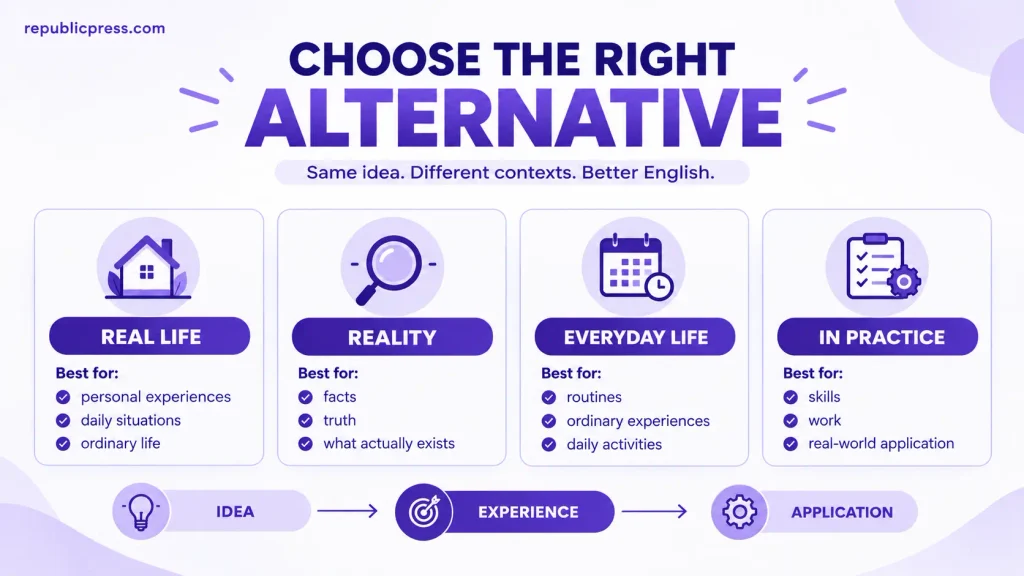
The best replacement depends on your sentence.
| Alternative | Main Meaning | Tone | Best Context |
| Real life | Actual life and experiences | Casual/neutral | Everyday conversation |
| Reality | What actually exists or happens | Neutral/formal | General and serious writing |
| Everyday life | Ordinary daily experiences | Neutral | Lifestyle and daily activities |
| In practice | What happens when applied | Formal/neutral | Work, education, theory |
| The actual world | What genuinely exists | Formal | Technical/philosophical writing |
| Real-life setting | An actual situation or environment | Neutral | Education and professional writing |
| Practical life | Practical responsibilities and skills | Neutral/formal | Life skills and education |
| Outside the virtual world | Physical life beyond digital spaces | Neutral | Technology and gaming |
| Actual experience | Experience gained through doing | Neutral | Careers and training |
| Outside the classroom | Practical situations beyond school | Neutral | Education |
“Real World” vs. “Real Life”
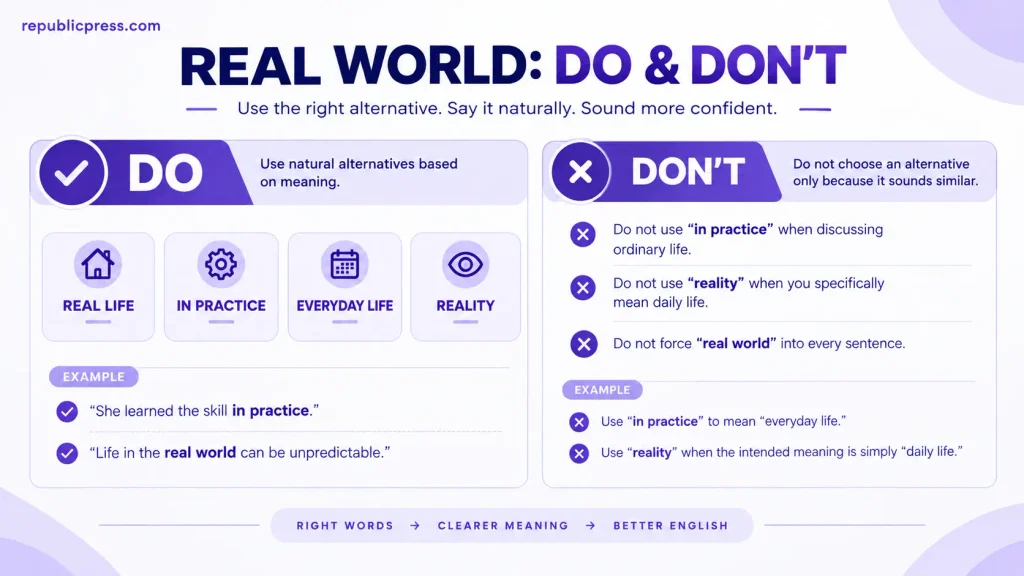
These phrases are close, but they aren’t always interchangeable.
Real life usually refers to people’s actual experiences:
They met online but eventually became friends in real life.
Real world often refers to practical circumstances, responsibilities, or situations:
The internship helped her understand how the real world of work operates.
A simple rule is:
- Use real life for personal experience.
- Use real world for practical circumstances or environments.
“Real World” vs. “Reality”
These are also closely related.
The movie is very different from reality.
Here, reality contrasts with fiction or imagination.
College prepared him for some aspects of the real world.
Here, real world refers more specifically to practical life and its challenges.
So, “reality” is broader, while “real world” often carries a practical or experiential meaning.
Formal Alternatives to “Real World”
If you’re writing an academic paper, business document, or professional article, some alternatives may sound more appropriate than “real world.”
Consider:
- In practice
- Actual circumstances
- Practical situations
- Real-life settings
- Actual conditions
- Practical applications
- Real-world conditions
For example:
Casual:
This skill is useful in the real world.
Professional:
This skill has practical applications in professional settings.
Academic:
The findings may differ when applied under actual conditions.
The right choice depends on what you are describing, rather than simply replacing “real world” word-for-word.
Common Mistakes When Replacing “Real World”
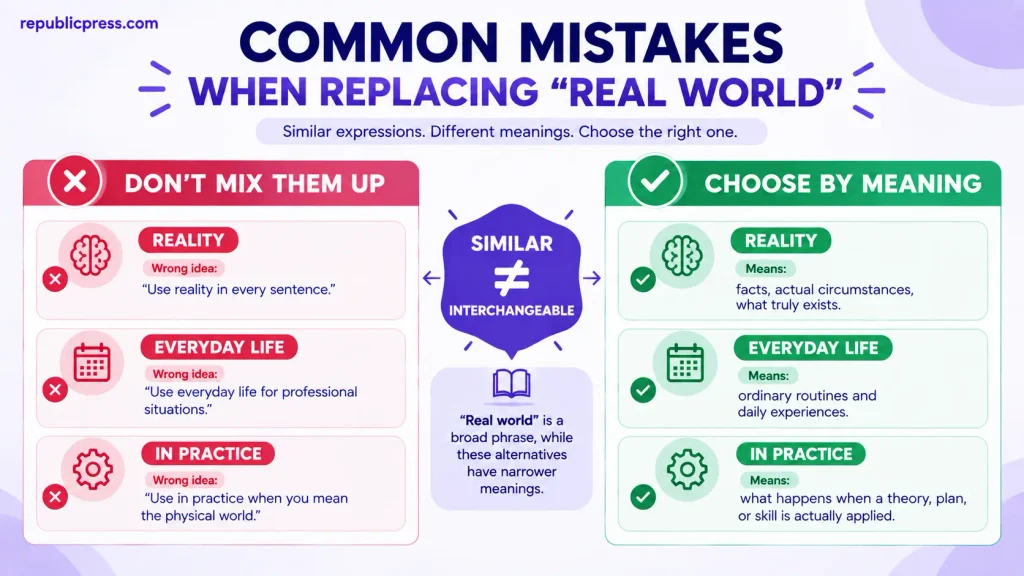
Using “reality” in every sentence
Although “reality” is related to “real world,” the two aren’t always interchangeable.
❌ This internship prepared me for reality of office work.
A more natural sentence would be:
✅ This internship prepared me for the realities of office work.
Or:
✅ This internship prepared me for the real world of office work.
Using “everyday life” for professional situations
“Everyday life” usually emphasizes ordinary daily activities.
The software was tested in everyday life.
That may sound vague if you mean professional environments.
Better:
The software was tested in real-world conditions.
Using “in practice” when talking about physical reality
“In practice” means when something is actually applied, not necessarily the physical world.
The theory works in practice.
This is different from:
The robot operates in the real world.
Assuming every alternative has exactly the same meaning
“Real world” is broad. Some alternatives focus on:
- actual life
- practical application
- daily experience
- physical environments
- professional situations
- experience gained through doing
Choose the phrase that preserves the specific meaning of your original sentence.
Frequently Asked Questions
What is the best synonym for “real world”?
“Real life” is usually the most natural alternative in everyday American English. However, “reality,” “in practice,” “everyday life,” or “real-life setting” may be better depending on the context.
What is another way to say “real world experience”?
Good alternatives include practical experience, hands-on experience, actual experience, real-life experience, and professional experience. The best choice depends on whether you’re emphasizing practice, personal experience, or employment.
What is a formal way to say “real world”?
For formal writing, consider actual circumstances, practical situations, real-life settings, actual conditions, or in practice. Choose based on the specific meaning rather than simply replacing the phrase.
Is “real life” the same as “real world”?
Not always. Real life usually refers to actual human experiences, while real world often refers to practical circumstances or situations outside theory, simulation, or controlled environments.
What is another way to say “real world” in academic writing?
Depending on the sentence, useful options include in practice, actual conditions, practical applications, real-life settings, and practical situations.
What is another way to say “real world” at work?
In workplace writing, you might use professional environment, workplace setting, practical environment, actual working conditions, or professional context.
What is another way to say “real world” in education?
Useful choices include real-life settings, practical situations, outside the classroom, practical applications, and everyday life.
Can I use “reality” instead of “real world”?
Sometimes. “Reality” works well when you’re contrasting what actually happens with an expectation, idea, or fictional situation. It may not work when “real world” specifically means a practical or professional environment.
Final Takeaway
The best way to replace “real world” is to first identify what you mean by it. For everyday experiences, real life is usually the simplest choice. For actual facts or circumstances, try reality. When contrasting theory with application, in practice is more precise. For ordinary routines, everyday life works well, while real-life setting is useful for actual situations or environments.
Choosing the right alternative isn’t about finding a word that looks similar in a thesaurus. It’s about preserving the meaning and tone of the original sentence.

Role: Editorial Contributor
Graham Ellis contributes practical English and communication guides to RepublicsPress. His content focuses on vocabulary, writing techniques, word usage, and clear communication, with an emphasis on straightforward explanations and real-world examples.