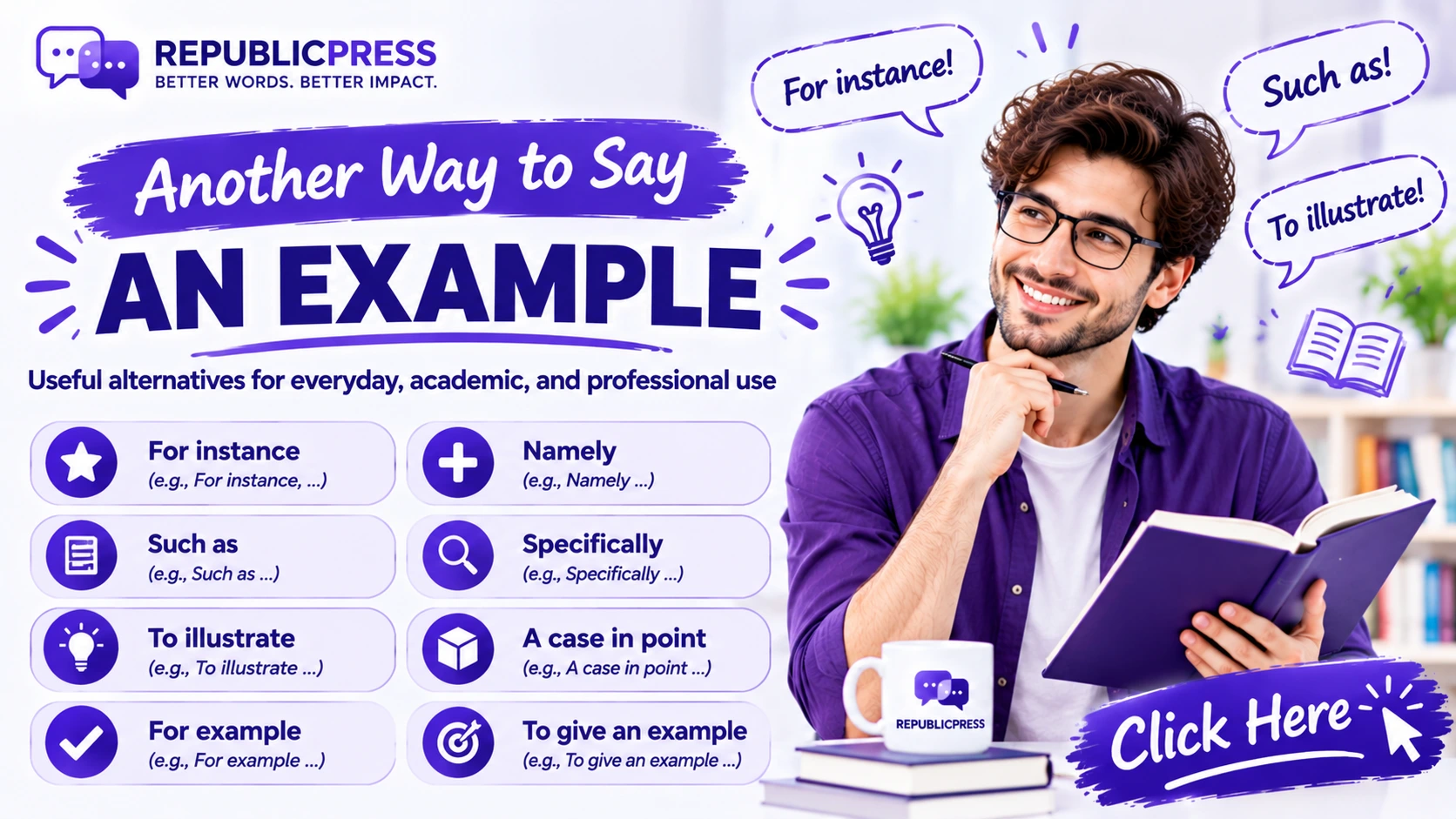
Another Way to Say an Example: 35+ Useful Alternatives
Sometimes, the phrase “an example” can sound repetitive in writing. Therefore, learning another way to say an example can make your sentences clearer, smoother, and more professional.
Whether you write essays, emails, reports, or everyday messages, the right alternative can improve your communication. However, not every phrase works in every situation. Some expressions suit formal writing, while others work better in casual conversations.
In this guide, you will discover useful alternatives, their meanings, and practical sentence examples.
What Is Another Way to Say an Example?
You can use several expressions instead of “an example.” The best choice depends on your sentence and writing style.
Here are some common alternatives:
| Alternative | Meaning |
|---|---|
| For instance | Introduces a specific case |
| For example | Shows an illustration |
| Such as | Introduces examples |
| A case in point | Highlights a relevant case |
| An illustration | Explains an idea visually or clearly |
| A sample | Shows a small part of something |
| A demonstration | Shows how something works |
| A specific case | Refers to one particular situation |
| A model | Shows something that others can follow |
| A representative case | Reflects a larger group |
For example, you can replace “Here is an example” with “Here is a case in point.”
35+ Other Ways to Say an Example
Below are useful alternatives for different writing situations. In addition, each phrase includes a sentence to help you understand how to use it.
1. For Instance
“For instance” works well in academic, professional, and everyday writing.
Example: Many fruits contain vitamin C. For instance, oranges and kiwis are good sources.
2. Such As
Use “such as” when you want to list specific items.
Example: You can learn creative skills such as writing, painting, and photography.
3. A Case in Point
This phrase highlights a situation that supports your statement.
Example: Many small businesses succeed online. This company is a case in point.
4. A Good Illustration
Use this phrase when something clearly explains an idea.
Example: Her recent project is a good illustration of teamwork.
5. A Sample
A sample represents a small part of a larger collection.
Example: Please review this sample before choosing the final design.
6. A Demonstration
This phrase works when someone shows how something operates.
Example: The teacher gave a demonstration of the new software.
7. A Specific Case
Use this expression when discussing one particular situation.
Example: This is a specific case of excellent customer service.
8. A Typical Example
This phrase describes something that represents a common situation.
Example: This mistake is a typical example of poor planning.
9. A Clear Illustration
Use it when an example makes an idea easier to understand.
Example: The chart provides a clear illustration of population growth.
10. One Example
This is a simple and natural alternative.
Example: One example of healthy food is fresh fruit.
Professional Alternatives to Say an Example
In business emails, reports, and workplace communication, professional expressions can make your writing sound more polished.
Consider these options:
| Professional phrase | Example sentence |
|---|---|
| A relevant case | This project is a relevant case for our discussion. |
| A practical illustration | The report provides a practical illustration of the process. |
| A representative case | This client represents a typical case. |
| A notable instance | This is a notable instance of successful teamwork. |
| A real-world example | The company offers a real-world example of innovation. |
| A working model | This system serves as a working model for future projects. |
| A reference point | The previous campaign provides a useful reference point. |
| A case study | The report includes a case study of a successful business. |
Moreover, these phrases help you avoid repeating the same expression throughout a document.
Academic Alternatives to Say an Example
Academic writing requires clear and precise language. Therefore, choose expressions that connect your evidence to your main argument.
Here are some useful options:
- For instance
- To illustrate
- As demonstrated by
- As shown by
- A relevant example
- A supporting case
- A practical illustration
- A notable instance
Example sentences:
- To illustrate, the study compares two different learning methods.
- As demonstrated by the research, regular practice improves performance.
- A relevant example appears in the final chapter.
- As shown by the results, students benefit from regular feedback.
However, use “as demonstrated by” only when evidence actually supports your statement.
Casual Alternatives to Say an Example
For everyday conversations, simple expressions often sound more natural.
| Alternative | Example |
|---|---|
| Like | I enjoy outdoor activities like hiking. |
| Take this case | Take this case: a student who studies daily. |
| Here’s one | Here’s one: my brother learned English online. |
| One good example | One good example is our local library. |
| Think about | Think about a person who practices every day. |
| Just imagine | Just imagine a business without customers. |
These phrases make conversations easier and more engaging. Nevertheless, avoid casual expressions in formal reports when a professional phrase would work better.
How to Choose the Right Alternative
The best alternative depends on your purpose. Before choosing a phrase, consider the following points.
1. Consider Your Audience
First, think about who will read your content. For academic readers, choose expressions such as “for instance” or “to illustrate.”
On the other hand, casual readers may prefer simple phrases such as “like” or “here’s one.”
2. Match the Meaning
Some alternatives introduce a list, while others describe a complete situation.
For example, “such as” introduces items, whereas “a case in point” highlights a relevant situation. Therefore, check the meaning before replacing a phrase.
3. Avoid Repetition
Moreover, repeating the same expression can make writing less interesting. Instead, use different alternatives when they fit naturally.
4. Keep Your Sentence Clear
Finally, choose the shortest phrase that communicates your meaning. Clear writing is more useful than complicated vocabulary.
Common Mistakes to Avoid
Writers sometimes use alternatives incorrectly. However, a few simple rules can help you avoid these mistakes.
- Do not use “such as” when you need a complete introductory sentence without changing its structure.
- Do not use “a case in point” for an unrelated situation.
- Avoid using casual expressions in formal academic writing.
- Do not add several examples when one strong example is enough.
- Choose phrases that match the meaning of your original sentence.
In addition, remember that an example should support your main point rather than distract readers.
Frequently Asked Questions
What is a professional way to say an example?
You can use “a relevant case,” “a practical illustration,” “a real-world example,” or “a representative case.” These expressions work well in professional documents.
What is another word for example in academic writing?
Common academic alternatives include “for instance,” “to illustrate,” “a relevant case,” and “as demonstrated by.” Choose the phrase that best fits your sentence.
Can I use “for instance” instead of “for example”?
Yes. Both expressions introduce specific examples and often have the same meaning. Therefore, you can use either phrase in most situations.
What is a short way to say an example?
You can use “case,” “sample,” “instance,” or “model.” However, each word has a slightly different meaning.
Is “such as” the same as “for example”?
They have similar purposes, but their grammar differs. “Such as” usually introduces examples within a sentence, while “for example” can introduce a separate statement.
Conclusion
Learning another way to say an example can make your writing more natural and professional. Expressions such as “for instance,” “such as,” “a case in point,” and “to illustrate” help you explain ideas without unnecessary repetition.
However, always consider your audience, sentence structure, and intended meaning before choosing an alternative. Ultimately, the best phrase is the one that makes your message clear and easy to understand.

The Republics Press Editorial Team researches, writes and reviews every article on this site, checks facts against reliable sources and updates pages when readers point out errors.