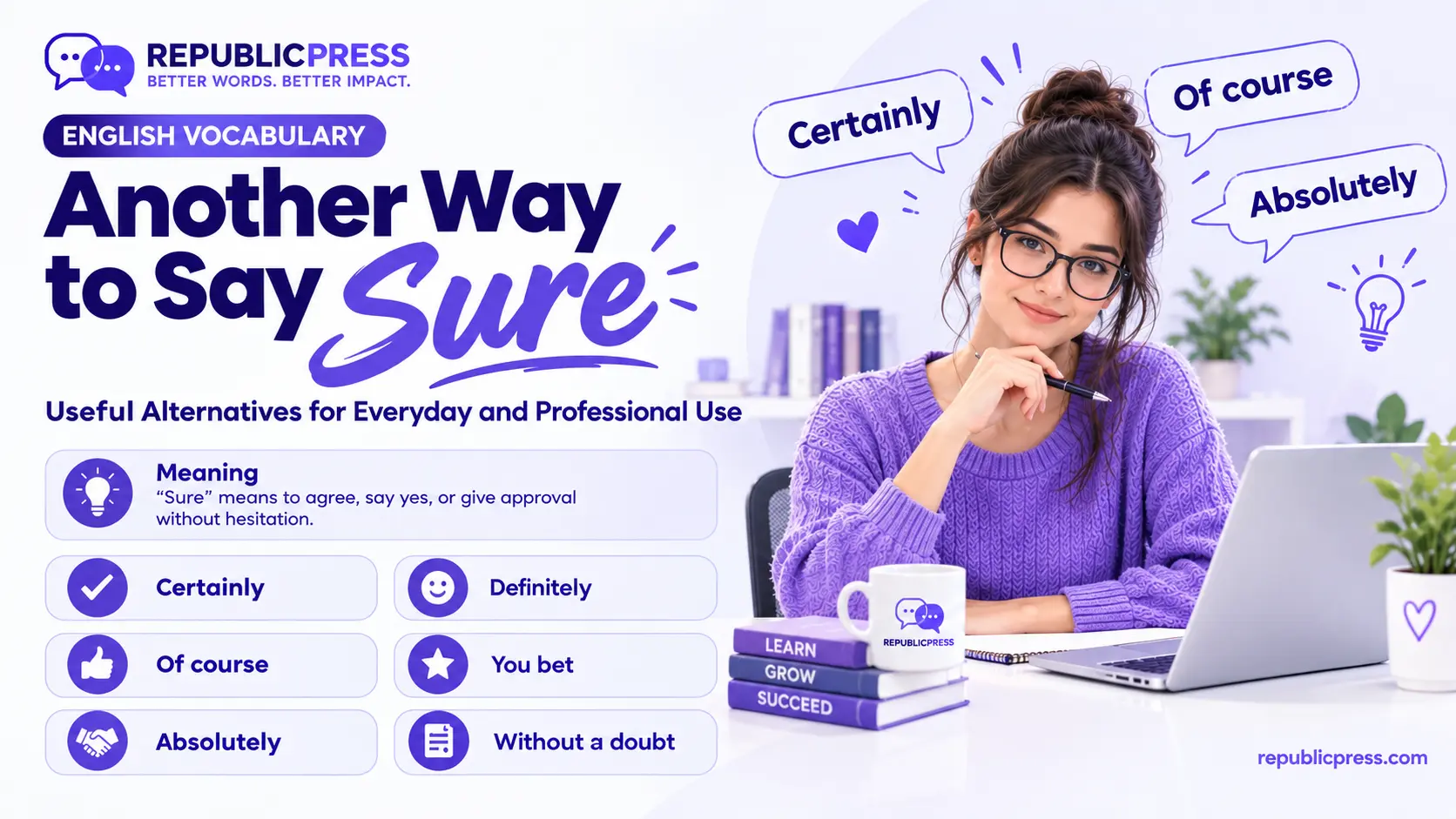
Another Way to Say Sure: 50+ Alternatives and Examples
Looking for another way to say sure in a conversation, text message, email, or professional setting? Words like “certainly,” “of course,” “absolutely,” and “no problem” can help you sound more natural and confident. However, the best alternative depends on the situation, your tone, and what you want to communicate.
In this guide, you’ll discover 50+ ways to say sure, along with meanings and practical examples. Whether you’re replying to a friend, agreeing with a coworker, or writing a professional email, these alternatives will help you choose the right expression.
What Is Another Way to Say Sure?
Another way to say sure is an alternative expression that communicates agreement, willingness, confirmation, or confidence. For example, you can say “absolutely” to express strong agreement or “certainly” to sound polite and professional.
However, “sure” can have different meanings depending on context. Sometimes it means yes, while other times it means that you feel confident about something.
Here are some common alternatives:
| Alternative | Best Used For |
|---|---|
| Absolutely | Strong agreement |
| Certainly | Polite or professional responses |
| Of course | Friendly agreement |
| Definitely | Clear confirmation |
| No problem | Casual agreement |
| You bet | Informal conversations |
| Without a doubt | Strong confidence |
| I’d be happy to | Willingness to help |
| Sounds good | Agreeing with a suggestion |
| For sure | Casual conversations |
| Indeed | Formal confirmation |
| Consider it done | Accepting a task |
| That’s fine | Giving approval |
| By all means | Giving permission |
| I agree | Expressing agreement |
Professional Ways to Say Sure
In professional communication, your choice of words can influence how polite, confident, and helpful you sound. Therefore, consider replacing “sure” with a more specific expression when replying to clients, managers, or colleagues.
1. Certainly
“Certainly” sounds polite and professional. Use it when you agree to a request or confirm that something is possible.
Example:
- Casual: Sure, I’ll send the report.
- Professional: Certainly, I’ll send the report this afternoon.
2. Absolutely
“Absolutely” communicates strong agreement and confidence. It works well in meetings, business emails, and workplace conversations.
Example: “Absolutely, I’ll review the proposal before the meeting.”
3. I’d Be Happy To
This phrase communicates willingness and a positive attitude. It works particularly well when someone asks you to help with a task.
Example: “I’d be happy to prepare the presentation for tomorrow.”
4. Of Course
“Of course” can sound friendly and professional when the context is appropriate.
Example: “Of course, I’ll share the updated document with you.”
5. Consider It Done
Use this expression when you accept responsibility for completing a task. It sounds confident, so use it when you can realistically deliver.
Example: “Consider it done. I’ll update the client records by noon.”
More Professional Alternatives
Here are additional expressions you can use at work:
- I’ll take care of it. — Accepting responsibility.
- I’ll get right on it. — Showing urgency.
- That works for me. — Agreeing with a plan.
- I can certainly do that. — Confirming your ability to help.
- I’d be glad to assist. — Offering professional support.
- Understood. — Acknowledging instructions.
- Approved. — Giving formal authorization when you have the authority.
- That is acceptable. — Confirming that something meets your requirements.
- I can confirm that. — Providing confirmation when you know the information is accurate.
- I’ll make the necessary arrangements. — Accepting responsibility for organizing something.
Choose the phrase that best reflects your actual response. For example, “Understood” acknowledges instructions but does not always mean you agree with them.
Casual Ways to Say Sure
When chatting with friends or family, you can use relaxed expressions that sound natural and friendly.
Here are some popular alternatives:
| Expression | Example |
|---|---|
| For sure | For sure, I’ll meet you there. |
| You bet | You bet! I’ll bring the snacks. |
| No problem | No problem, I can help you. |
| Sounds good | Sounds good! See you at six. |
| Definitely | Definitely! Count me in. |
| I’m in | I’m in! Let’s plan the trip. |
| Why not? | Why not? Let’s give it a try. |
| Works for me | Friday works for me. |
| Yep | Yep, I’ll be there soon. |
| Of course | Of course! You can borrow my book. |
| Sure thing | Sure thing, I’ll send it over. |
| All right | All right, let’s do it. |
These expressions are useful in text messages, informal emails, and everyday conversations. However, avoid very casual wording when a formal response is expected.
Another Way to Say Sure in a Text Message
Text messages often call for short, clear responses. Instead of repeatedly writing “sure,” you can choose an alternative that matches your mood and the conversation.
Friendly Text Replies
- Absolutely!
- Sounds great!
- For sure!
- No problem!
- You got it!
- Definitely!
- Sure thing!
- I’m in!
- That works!
- Of course!
Example conversation:
Friend: Can we meet for coffee tomorrow?
You: Absolutely! What time works for you?
This response sounds friendly and shows clear agreement.
Polite Text Replies
If someone asks for a favor, these responses sound helpful without being overly formal:
- I’d be happy to.
- Of course, no worries.
- Certainly!
- I’d love to help.
- That’s perfectly fine.
- No problem at all.
- Happy to help!
Example: “Could you check this document for me?”
Reply: “Of course! I’ll take a look this afternoon.”
Ways to Say Sure Without Saying Yes
Sometimes, you want to agree without using the word “yes.” In that case, choose an expression that communicates your intention clearly.
- Sounds good to me. — Agreeing with a suggestion.
- That works. — Accepting a plan or arrangement.
- I’m happy with that. — Expressing satisfaction.
- Let’s do it. — Showing enthusiasm.
- Count me in. — Agreeing to participate.
- I’m on board. — Supporting a plan or idea.
- That should work. — Indicating that something seems suitable.
- Works for me. — Accepting a proposed time or arrangement.
- You can count on me. — Promising support.
- I’m good with that. — Informally expressing agreement.
Example:
Instead of saying, “Yes, Friday is fine,” you could write, “Friday works for me.”
This alternative sounds natural and communicates your agreement directly.
Polite Ways to Say Sure
Politeness matters when you respond to someone you don’t know well, communicate with a customer, or answer a request from a senior colleague.
Consider these expressions:
- Certainly.
- Of course.
- I’d be happy to.
- I’d be glad to help.
- By all means.
- Not a problem at all.
- I’d be pleased to assist.
- That would be fine.
- Absolutely, I’d be happy to.
- Please feel free to proceed.
How to Choose a Polite Expression
The right phrase depends on the request.
For a simple favor, “Of course” sounds natural. For a customer request, “I’d be happy to help” sounds welcoming. Meanwhile, “Please feel free to proceed” works when you’re giving permission.
Avoid assuming that every phrase has the same meaning. For example, “That would be fine” may express acceptance without showing much enthusiasm.
Formal Alternatives to Sure in Emails
Professional emails benefit from clear, courteous language. Although “sure” is acceptable in many workplaces, a more specific phrase can make your response sound polished.
| Situation | Suggested Reply |
|---|---|
| Accepting a meeting invitation | Certainly, I’ll attend the meeting. |
| Agreeing to a request | I’d be happy to assist with this request. |
| Confirming instructions | Understood. I’ll follow the instructions provided. |
| Accepting a deadline | That timeline works for me. |
| Offering help | I’d be glad to help with the project. |
| Confirming a change | Certainly, I’ll make the requested changes. |
| Giving permission | Please feel free to proceed. |
| Accepting responsibility | I’ll take care of it. |
| Confirming availability | I’m available at that time. |
| Agreeing with a proposal | I agree with the proposed approach. |
Example of a Professional Email Reply
Original: Sure, I will send the files.
Improved: Certainly, I’ll send the files by the end of the day.
The improved version sounds courteous and includes a clear timeframe. However, only include a deadline when you can meet it.
Another Way to Say Sure When You Mean Certainly
Sometimes, “sure” means that you’re confident about a fact rather than agreeing to a request. In these situations, alternatives such as “certainly,” “definitely,” and “without a doubt” may be more appropriate.
For example:
- I’m certain. — I have confidence in my answer.
- Definitely. — I’m confident that something is true or will happen.
- Without a doubt. — I have very little or no doubt.
- I’m confident about that. — I trust my judgment or knowledge.
- There’s no question about it. — I’m expressing strong confidence.
- I’m quite certain. — I believe something is true.
- As far as I know. — I’m answering based on the information available to me.
- To the best of my knowledge. — I’m providing an answer based on what I know.
Be careful with these expressions because they communicate different levels of certainty. If you’re unsure, “As far as I know” is more accurate than making an absolute statement.
Alternatives to Sure for Giving Permission
When someone asks whether they can do something, “sure” often means that you permit or approve their request.
Here are some useful alternatives:
- Go ahead. — Giving permission to proceed.
- By all means. — Giving enthusiastic or polite permission.
- Feel free. — Making someone comfortable doing something.
- That’s fine. — Accepting a request.
- You have my permission. — Explicitly granting permission.
- Please proceed. — Giving formal approval to continue.
- Absolutely, go ahead. — Giving clear and positive permission.
- That’s perfectly okay. — Reassuring someone that their request is acceptable.
Example:
Question: Can I use your notes?
Reply: Of course! Feel free to use them.
Remember that permission-related phrases are not interchangeable with every form of agreement. Use them when someone is asking for approval.
Common Mistakes When Using Alternatives to Sure
Although these expressions can improve your communication, choosing the wrong one may change your intended meaning.
Using Casual Expressions in Formal Emails
Phrases such as “Yep” and “You bet” are suitable for many informal conversations. However, “Certainly” or “I’d be happy to help” may be more appropriate in a formal email.
Confusing Agreement With Certainty
“Absolutely” can express strong agreement, while “I’m certain” communicates confidence in a belief or fact. Therefore, choose a phrase that matches your intention.
Promising More Than You Can Deliver
“Consider it done” sounds like a firm commitment. Use it only when you can complete the task.
Sounding Unenthusiastic by Accident
A short response such as “Fine” may sound neutral or irritated, depending on the context. If you want to show enthusiasm, try “That sounds great!”
Repeating the Same Expression
Using “sure” in every conversation can make your replies feel repetitive. Instead, vary your wording naturally while keeping your meaning clear.
Frequently Asked Questions
What Is the Best Another Way to Say Sure?
Popular alternatives include “absolutely,” “certainly,” “of course,” “definitely,” and “no problem.” The best choice depends on whether you want to sound formal, friendly, enthusiastic, or confident.
What Is a Professional Way to Say Sure?
“Certainly,” “I’d be happy to assist,” and “I’ll take care of it” are useful professional alternatives. Choose the one that matches the request and your willingness to help.
How Can I Say Sure in a Text?
You can reply with “For sure,” “Sounds good,” “Absolutely,” “You got it,” or “No problem.” These expressions work well in casual conversations.
What Is a Polite Way to Agree With Someone?
You can say “I agree,” “That sounds reasonable,” “Certainly,” or “That works for me.” Each phrase communicates agreement in a slightly different way.
Is Sure a Professional Word?
Yes, “sure” is acceptable in many professional conversations. However, “certainly” or “I’d be happy to” may sound more polished in formal emails or customer communications.
What Is Another Word for Sure When Giving Permission?
“Go ahead,” “by all means,” “feel free,” and “please proceed” are useful alternatives when you want to give permission.
Does Sure Always Mean Yes?
No. “Sure” can express agreement, willingness, permission, or confidence. Its meaning depends on the conversation and the way the speaker uses it.
Conclusion
Finding another way to say sure can help you communicate more clearly in everyday conversations, text messages, and professional emails. Alternatives such as “absolutely,” “certainly,” “of course,” and “sounds good” allow you to express agreement in different tones.
Ultimately, choose the expression that fits your situation. Use friendly alternatives with people you know well, select polite wording for professional requests, and choose precise language when you want to communicate certainty. With the right words, even a short response can sound thoughtful and confident.

The Republics Press Editorial Team researches, writes and reviews every article on this site, checks facts against reliable sources and updates pages when readers point out errors.