Another Way to Say New: 15 Natural Alternatives for Every Context
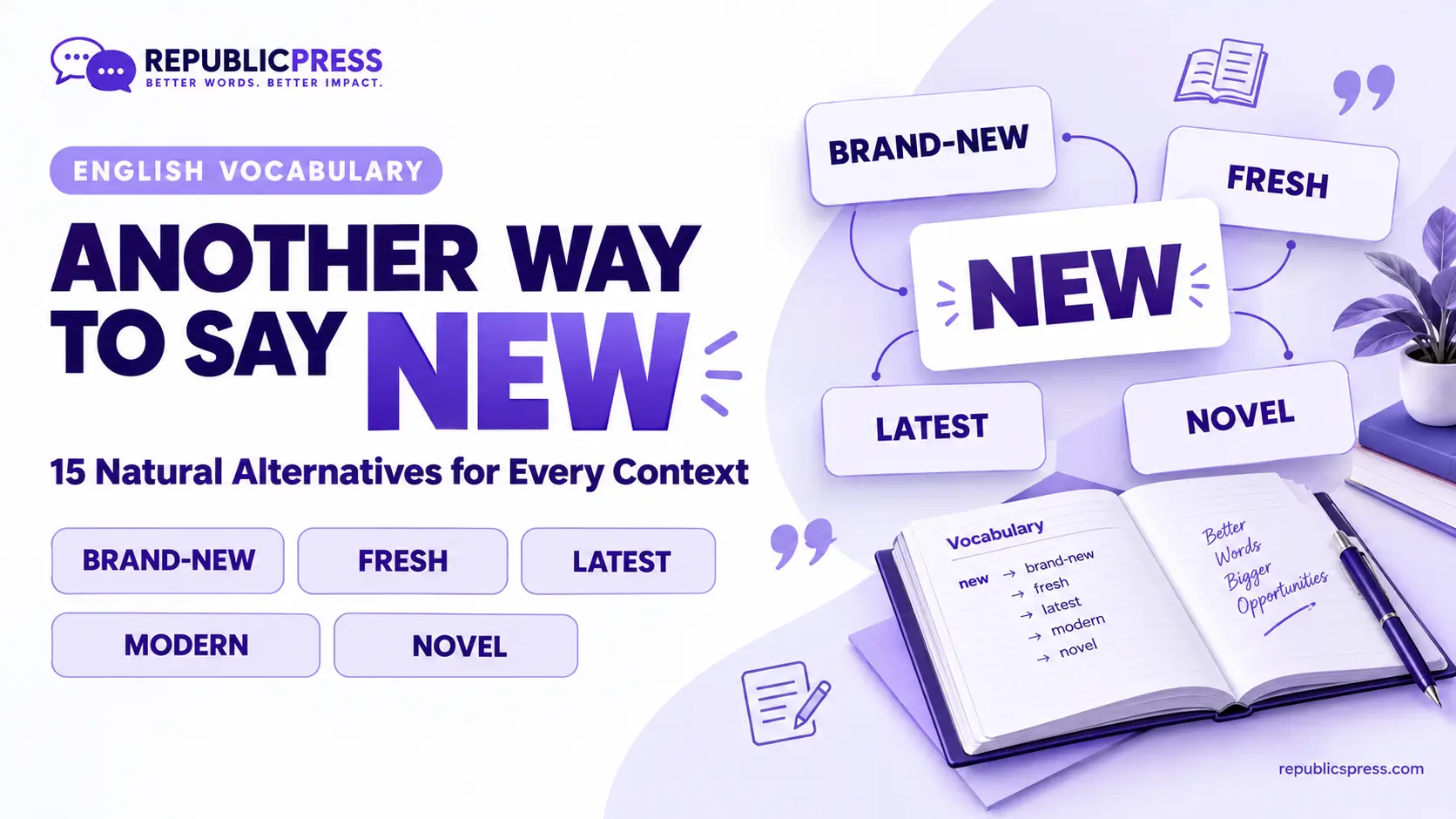
If you are looking for another way to say new, several natural alternatives can express the idea more clearly, depending on the context. Words like brand-new, fresh, recent, latest, modern, original, unused, and novel can replace new in certain situations. The best choice depends on whether you mean recently made, unfamiliar, unused, or different from what existed before.
Key Takeaways
- Use brand-new to emphasize that something has just been made or acquired.
- Choose recent or latest when talking about something that happened or appeared not long ago.
- Use fresh for something newly prepared, updated, or introduced.
- Choose unused when an item has never been used.
- Use modern to describe something associated with current styles, methods, or technology.
- Choose novel when describing an original or unfamiliar idea.
What Does “New” Mean?
The word “new” has several meanings in American English. It can describe something recently created, purchased, introduced, or discovered. It can also refer to something unfamiliar to a person or different from what existed before.
For example:
- I bought a new laptop yesterday.
- She has a new job.
- We need a new approach to this problem.
- This is a new experience for me.
Although all four sentences use the same word, they communicate different ideas. A recently purchased laptop is not the same as a new approach or an unfamiliar experience.
Understanding these differences helps you choose a more precise alternative instead of replacing new with a word that changes the meaning.
15 Natural Ways to Say New

Here are 15 useful alternatives, along with their meanings and examples.
1. Brand-New
Meaning: Completely new, recently made, or never used before.
Brand-new is one of the closest alternatives to new. It adds emphasis and often suggests that something has never been used.
Best for: Products, purchases, equipment, homes, and personal belongings.
Example: I finally bought a brand-new smartphone.
Usage tip: Use brand-new when you want to emphasize that an item is completely new rather than simply different or updated.
2. Fresh
Meaning: Recently made, prepared, introduced, or renewed.
Fresh works well when something has been recently created or brought into a new condition. It is especially common when discussing food, ideas, content, and perspectives.
Best for: Food, ideas, opportunities, starts, and creative work.
Example: The team came up with a fresh idea for the marketing campaign.
Usage tip: Fresh does not always mean recently manufactured. It often suggests renewed energy, originality, or a clean start.
3. Recent
Meaning: Happening, occurring, or appearing not long ago.
Recent is useful when referring to something that happened in the near past. Unlike new, it focuses more on timing.
Best for: Events, changes, developments, discoveries, and updates.
Example: The company announced several recent changes to its policies.
Usage tip: Recent usually describes something that happened or appeared in the past, rather than an object that is completely new.
4. Latest
Meaning: The most recent version, development, or addition.
Latest is an excellent choice when talking about the newest available information, technology, products, or updates.
Best for: News, software, technology, trends, and product releases.
Example: Have you tried the latest version of this software?
Usage tip: Latest emphasizes being the most recent in a sequence. It does not necessarily mean that something has never been used.
5. Modern
Meaning: Related to present-day styles, ideas, methods, or technology.
Modern is a good alternative when new refers to something contemporary rather than recently created.
Best for: Design, architecture, technology, lifestyles, and business methods.
Example: They redesigned the office with a modern layout.
Usage tip: Something can be modern without being newly made. For example, a building constructed several years ago may still have a modern design.
6. Novel
Meaning: Original, unusual, or different from what people have seen before.
Novel is particularly useful when discussing creative ideas, approaches, and solutions. It sounds more formal than new.
Best for: Research, academic writing, creative ideas, and innovative solutions.
Example: The researchers developed a novel method for solving the problem.
Usage tip: Novel emphasizes originality or unfamiliarity, not simply the fact that something was recently created.
7. Unfamiliar
Meaning: Not known, recognized, or experienced before.
Unfamiliar is useful when new describes something a person has not encountered previously.
Best for: Experiences, places, environments, subjects, and situations.
Example: Moving to another country introduced me to an unfamiliar culture.
Usage tip: Unfamiliar describes a person’s lack of knowledge or experience. It does not mean that something itself was recently created.
8. Newly Introduced
Meaning: Recently presented, launched, or made available.
This phrase works particularly well in professional, business, and informational writing.
Best for: Products, services, policies, features, and programs.
Example: The company announced its newly introduced customer support service.
Usage tip: Use this expression when you want to emphasize that something has recently become available to an audience.
9. Unused
Meaning: Not previously used or operated.
Unused is more precise than new when discussing the condition of an item.
Best for: Clothing, equipment, furniture, products, and supplies.
Example: The store sells unused office furniture at discounted prices.
Usage tip: An unused item is not necessarily newly manufactured. It may have been sitting in storage for years.
10. Up-to-Date
Meaning: Containing the most current information or following current standards.
Up-to-date is a useful alternative when new refers to updated information, records, methods, or technology.
Best for: Information, documents, software, records, and professional skills.
Example: Please make sure your contact information is up-to-date.
Usage tip: Up-to-date means current or updated, not necessarily recently created.
11. Innovative
Meaning: Introducing original ideas, methods, or improvements.
Innovative works well when describing something that brings a new approach or meaningful improvement.
Best for: Technology, products, business strategies, and creative solutions.
Example: The startup developed an innovative way to deliver its services.
Usage tip: Innovative suggests creativity and improvement. It is not a direct replacement for new when simply describing a recently purchased item.
12. First-Time
Meaning: Happening or being done for the first time.
First-time is useful when new describes someone’s initial experience or involvement in something.
Best for: Experiences, opportunities, visitors, users, and participants.
Example: The workshop offers a beginner-friendly experience for first-time visitors.
Usage tip: First-time describes an initial occurrence, not necessarily something recently created.
13. Replacement
Meaning: Something that takes the place of an existing person, object, or system.
Replacement is useful when new refers to something that takes over the role of an older or damaged item.
Best for: Equipment, products, employees, parts, and systems.
Example: We ordered a replacement printer after the old one stopped working.
Usage tip: Replacement is not an exact synonym for new. It explains the purpose of the item rather than its age or condition.
14. Upgraded
Meaning: Improved or replaced with a better version.
Upgraded is a suitable choice when something new offers better features, performance, or quality than an earlier version.
Best for: Devices, software, equipment, systems, and services.
Example: The company recently introduced an upgraded version of its mobile app.
Usage tip: Upgraded emphasizes improvement. A new item is not automatically an upgraded one.
15. Cutting-Edge
Meaning: Using the newest and most advanced ideas, technology, or methods.
Cutting-edge is a strong expression for describing advanced developments and modern innovations.
Best for: Technology, scientific research, equipment, and advanced solutions.
Example: The laboratory uses cutting-edge technology for medical research.
Usage tip: This phrase sounds more promotional and emphatic than new. Avoid using it for ordinary recently purchased products.
How to Choose the Best Alternative for Different Contexts

The right replacement depends on what you are describing. Here are some common situations and the expressions that sound most natural.
When Talking About New Products
When discussing something recently purchased, manufactured, or released, these alternatives work well:
- Brand-new
- Latest
- Newly introduced
- Unused
Example: We just installed the latest version of the security software.
When Describing New Ideas
If you are talking about creative thinking or a different approach, consider:
- Fresh
- Novel
- Innovative
- Original
Example: Our manager suggested an innovative approach to improve customer service.
When Talking About New Experiences
When describing something you have never experienced before, use:
- Unfamiliar
- First-time
- Unprecedented (when something has no previous example)
Example: Starting a business was an unfamiliar experience for her.
When Describing New Information
For information that has recently changed or become available, choose:
- Recent
- Latest
- Up-to-date
Example: The report includes the latest information about the project.
When Describing New Technology
For technology that is advanced, contemporary, or recently improved, consider:
- Modern
- Cutting-edge
- Upgraded
- Latest
Example: The company invested in cutting-edge equipment to improve production.
Comparison Table: Alternatives to New

| Alternative | Meaning or Use | Tone |
|---|---|---|
| Brand-new | Completely new | Emphatic, casual |
| Fresh | Recently created or renewed | Natural, friendly |
| Recent | Happened not long ago | Neutral |
| Latest | Most recent in a series | Neutral |
| Modern | Contemporary in style or method | Neutral |
| Novel | Original or unfamiliar | Formal |
| Unfamiliar | Not previously known | Neutral |
| Newly introduced | Recently made available | Professional |
| Unused | Never previously used | Neutral |
| Up-to-date | Current or updated | Professional |
| Innovative | Introducing original improvements | Professional |
| First-time | Happening for the first time | Neutral |
| Replacement | Taking the place of something else | Neutral |
| Upgraded | Improved to a better version | Neutral |
| Cutting-edge | Highly advanced or innovative | Promotional |
Common Mistakes When Replacing New
Some words are related to new but cannot be used in every situation.
Using Modern Instead of Brand-New
Modern describes something contemporary, while brand-new emphasizes that something has recently been made or acquired.
Incorrect context: I purchased a modern phone yesterday (if you specifically mean that the phone has never been used).
Better: I purchased a brand-new phone yesterday.
Using Recent Instead of Latest
Recent means something happened not long ago. Latest means the most recent item in a sequence.
For example:
- Recent update: An update that happened not long ago.
- Latest update: The newest update available.
Using Innovative for Ordinary New Products
Innovative suggests originality or improvement. A newly purchased chair is not necessarily innovative.
Better: I bought a brand-new chair.
Using Novel in Casual Conversation
Novel is grammatically correct, but it can sound overly formal in everyday situations.
Instead of saying, “I have a novel phone,” say, “I have a new phone.”
FAQs About Other Ways to Say New
1. What is the most common synonym for new?
Brand-new is one of the closest and most common alternatives when describing something recently made or acquired. Other choices include fresh, recent, and latest, depending on the context.
2. What is a more professional word for new?
Recently introduced, latest, up-to-date, and innovative can work in professional writing. Choose the expression based on whether you mean recently launched, current, or original.
3. What is another way to say brand-new?
You can use unused, newly purchased, recently made, or fresh, depending on the item and its condition. These expressions are not always interchangeable.
4. What is another word for new and improved?
Upgraded, enhanced, refined, and improved are useful alternatives. They emphasize that something has been made better rather than simply created recently.
5. What is a formal synonym for new?
Novel, recent, newly introduced, and innovative can work in formal writing. However, each has a slightly different meaning and should be selected according to context.
6. What is another way to say something is new to you?
You can say it is unfamiliar, something you have never experienced before, or a first-time experience.
For example: “Working with international clients is a new experience for me.”
7. What is another way to say a new beginning?
Fresh start, clean slate, and a new chapter are natural alternatives. Fresh start is especially common in everyday American English.
Conclusion
There are many ways to replace the word new, but the best alternative depends on what you want to communicate. Use brand-new for recently acquired items, latest for the newest version, fresh for renewed ideas, modern for contemporary styles, and novel for original concepts.
Choosing the right expression makes your writing more precise and helps you avoid repeating the same word. Instead of relying on one synonym, consider the meaning, tone, and context of your sentence.

The Republics Press Editorial Team researches, writes and reviews every article on this site, checks facts against reliable sources and updates pages when readers point out errors.