
Another Way to Say Free Time: 10 Natural Alternatives
If you’re looking for another way to say free time, common alternatives include spare time, leisure time, downtime, time off, and personal time. Each phrase has a slightly different meaning. Some describe time when you’re not busy, while others focus on relaxation, hobbies, or taking a break from work.
Key Takeaways
- Spare time is a natural choice for casual conversations.
- Leisure time emphasizes relaxation and enjoyable activities.
- Downtime refers to time spent resting or recovering from activity.
- Time off usually means a break from work, school, or regular duties.
- Personal time emphasizes time reserved for yourself.
- The best alternative depends on your sentence and intended meaning.
What Does Free Time Mean?
Free time is the part of your day when you don’t have work, school, chores, or other responsibilities to handle. You can use it to relax, spend time with friends, enjoy hobbies, or do whatever you like.
For example, you might read a book in your free time, watch a movie after dinner, or spend your weekend learning a new skill.
The phrase is neutral and works in both casual and formal conversations. However, choosing a more specific expression can help you explain how you spend your time or what kind of break you need.
10 Other Ways to Say Free Time

Here are 10 useful alternatives, along with their meanings and examples.
1. Spare Time
Meaning: Time available after you’ve finished your regular responsibilities.
Best for: Everyday conversations, hobbies, and casual writing.
“Spare time” is one of the most natural alternatives to “free time” in American English. It often suggests that you have some time left over after completing your main tasks.
Example: “I practice Spanish in my spare time.”
Usage tip: Use “spare time” when talking about activities you fit into your schedule. It doesn’t necessarily mean you have a large amount of time available.
2. Leisure Time
Meaning: Time available for relaxation, enjoyment, or activities you choose to do.
Best for: Formal writing, lifestyle articles, and discussions about hobbies.
“Leisure time” sounds slightly more formal than “spare time.” It emphasizes activities you enjoy rather than simply the absence of work.
Example: “She spends her leisure time gardening and reading.”
Usage tip: This phrase works particularly well when discussing recreation, hobbies, or how people balance work and personal life.
3. Downtime
Meaning: A period when you can rest, relax, or take a break from activity.
Best for: Casual conversations, workplace discussions, and conversations about rest.
“Downtime” often suggests slowing down after a busy period. It can also refer to periods when a machine, service, or system is not operating, so context matters.
Example: “I need some downtime after a hectic week.”
Usage tip: Choose “downtime” when the main idea is rest or recovery, rather than simply having an open schedule.
4. Time Off
Meaning: A period when you are not working or carrying out your usual duties.
Best for: Workplace conversations, school breaks, and vacation plans.
“Time off” is especially useful when you want to emphasize a break from work or another regular commitment. Unlike “free time,” it often suggests an intentional break.
Example: “I’m taking some time off next week to visit my family.”
Usage tip: Don’t use “time off” as a direct replacement in every sentence. Having free time after dinner is not necessarily the same as taking time off from work.
5. Personal Time
Meaning: Time reserved for your own needs, interests, or well-being.
Best for: Discussions about boundaries, self-care, and work-life balance.
“Personal time” highlights the importance of having space for yourself. You might use it to exercise, rest, read, or enjoy a quiet evening alone.
Example: “I set aside an hour of personal time every evening.”
Usage tip: This expression is particularly appropriate when explaining why you need time away from work, social obligations, or other responsibilities.
6. Time to Yourself
Meaning: Time when you can be alone or do things without other people interrupting you.
Best for: Personal conversations, relationships, and discussions about relaxation.
Unlike the broader phrase “free time,” “time to yourself” emphasizes privacy or independence. You can have free time while spending it with friends, but time to yourself usually means having some space of your own.
Example: “After a long day of meetings, I enjoy having some time to myself.”
Usage tip: This is a natural choice when you want to express a need for solitude without sounding unfriendly.
7. Free Hours
Meaning: Hours in your schedule that are not occupied by work or other commitments.
Best for: Scheduling, planning, and conversations about availability.
“Free hours” focuses on the amount of time available. It can be useful when discussing schedules, although “free time” is generally more natural in everyday conversation.
Example: “I have a few free hours on Saturday to work on my photography.”
Usage tip: Use this phrase when the length or timing of your available hours matters. For a general statement about hobbies, “spare time” may sound smoother.
8. Unscheduled Time
Meaning: Time that has not been assigned to a specific activity or appointment.
Best for: Time management, planning, and professional contexts.
“Unscheduled time” emphasizes that nothing has been planned for a particular period. It doesn’t automatically mean you are relaxing; you might use that time to handle unexpected tasks.
Example: “I leave some unscheduled time in my calendar for unexpected projects.”
Usage tip: This expression is useful when talking about calendars and productivity. It is less conversational than “free time.”
9. Recreation Time
Meaning: Time set aside for enjoyable activities, exercise, games, or other forms of recreation.
Best for: Fitness, community programs, school activities, and organized leisure.
“Recreation time” emphasizes activities that provide enjoyment or help you recharge. It is more specific than “free time” because it focuses on recreational pursuits.
Example: “The camp schedule includes recreation time after lunch.”
Usage tip: Use this phrase when describing planned activities rather than general availability. In casual conversations, “time for fun” may sound more natural.
10. Moments to Spare
Meaning: Small amounts of extra time available between tasks or activities.
Best for: Casual conversations and situations involving brief breaks.
“Moments to spare” is a useful expression when you have a little extra time rather than a long period of leisure.
Example: “If you have a moment to spare, could you help me choose a birthday gift?”
Usage tip: This phrase is often used to ask for someone’s brief attention. It doesn’t usually describe an entire afternoon or a regular period of relaxation.
Which Alternative Should You Use?

The right expression depends on what you want to communicate.
| Alternative | Main meaning | Best context |
|---|---|---|
| Spare time | Time left after responsibilities | Everyday conversation |
| Leisure time | Time for enjoyment | Hobbies and formal writing |
| Downtime | Time to rest or recover | Busy schedules and relaxation |
| Time off | A break from regular duties | Work and vacations |
| Personal time | Time for your own needs | Boundaries and self-care |
| Time to yourself | Time alone | Personal conversations |
| Free hours | Available hours | Scheduling |
| Unscheduled time | Time without a planned activity | Planning and productivity |
| Recreation time | Time for recreational activities | Sports and organized activities |
| Moments to spare | A brief amount of extra time | Quick favors and short breaks |
How to Choose the Right Phrase
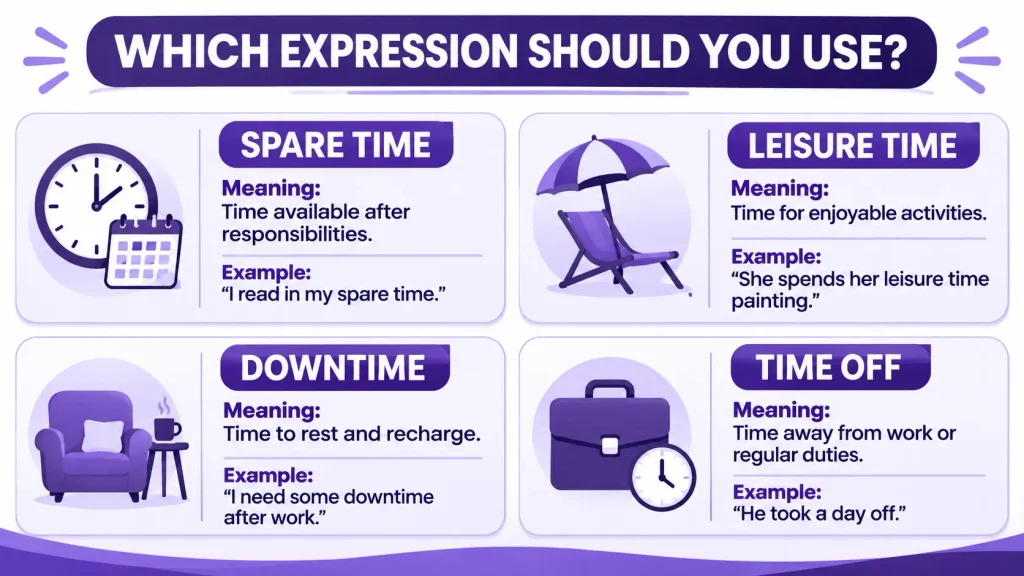
Not every alternative to “free time” fits every situation. Use these examples to choose a phrase that matches your meaning.
For Casual Conversations
Use “spare time” when discussing your hobbies or interests.
- Natural: “What do you do in your spare time?”
- Also natural: “What do you like to do in your free time?”
Both sentences are common and communicate essentially the same idea.
For Work and Professional Writing
Use “time off” when discussing a break from your job, and “personal time” when referring to time reserved for yourself.
- “I’d like to request two days off next month.”
- “I try to protect my personal time outside working hours.”
These phrases are more specific than “free time” in workplace situations.
For Relaxation and Self-Care
Choose “downtime” or “time to yourself” when the focus is on rest.
- “I need some downtime this weekend.”
- “A quiet walk gives me some time to myself.”
The first emphasizes recovery, while the second emphasizes personal space.
For Formal or Academic Writing
“Leisure time” is often a good choice when discussing recreation, hobbies, or how people use their nonworking hours.
For example: “Regular exercise can be an enjoyable way to spend leisure time.”
Use “unscheduled time” instead when your discussion focuses on planning or time management.
Common Mistakes When Replacing Free Time
A phrase may be related to free time without having exactly the same meaning. Watch out for these differences.
- Using “time off” for every situation: Time off usually refers to a break from work or regular duties. “Spare time” is often better for hobbies you enjoy after finishing your tasks.
- Confusing “downtime” with leisure: Downtime emphasizes rest or reduced activity. Leisure time can include active hobbies, sports, and social events.
- Using “personal time” when you mean availability: Personal time suggests time reserved for yourself, not simply any open slot in your calendar.
- Using “moments to spare” for long periods: The phrase usually refers to a short amount of extra time, not a full day off.
- Choosing overly formal wording for casual speech: “Leisure time” is correct, but “spare time” may sound more relaxed when chatting with friends.
Frequently Asked Questions
What is the most common synonym for free time?
“Spare time” is one of the most common and natural alternatives. For example, “I enjoy cooking in my spare time” means you enjoy cooking when you are not busy with other responsibilities.
What is a more formal way to say free time?
“Leisure time” is a good formal alternative, especially in essays, reports, and discussions about recreation or work-life balance.
What is another way to say free time at work?
Use “time off” when referring to a break from work. Use “downtime” when you mean a quieter period with fewer tasks, or “unscheduled time” when discussing an open calendar slot.
Is downtime the same as free time?
Not exactly. Both can describe periods without regular work, but downtime usually emphasizes rest or reduced activity. Free time is broader and can include almost any activity you choose.
How do you say free time in a sentence?
You can say, “I enjoy reading in my spare time,” “I spend my leisure time hiking,” or “I need some downtime this weekend.” Choose the phrase that best describes the activity or situation.
What is a casual way to say you have free time?
You can say, “I’m free this afternoon,” “I have some spare time,” or “My schedule is open.” These expressions communicate availability, although they are not interchangeable in every situation.
What is the difference between spare time and leisure time?
Spare time is time left after responsibilities, while leisure time emphasizes activities done for enjoyment or relaxation. The phrases overlap, but leisure time places more emphasis on how you use the time.
Conclusion
The best alternative to “free time” depends on your purpose. Use “spare time” for everyday conversations, “leisure time” for enjoyment and hobbies, “downtime” for rest, and “time off” for a break from regular duties. When you want to emphasize privacy, “time to yourself” is often the most natural choice.
Choosing the right phrase helps you communicate more clearly and makes your American English sound natural.

The Republics Press Editorial Team researches, writes and reviews every article on this site, checks facts against reliable sources and updates pages when readers point out errors.