

Another Way to Say “Deals With”: 15 Better Alternatives
Direct answer: Common alternatives to “deals with” include handles, manages, addresses, tackles, takes care of, attends to, copes with, discusses, covers, and explores. The best choice depends on what “deals with” means in your sentence. For example, a person may handle a complaint, while a book may cover a topic.
Key Takeaways
- Handles and manages are strong choices when someone is responsible for a task, problem, or situation.
- Addresses works especially well in professional, academic, and formal writing.
- Tackles suggests actively working on a difficult problem.
- Copes with emphasizes managing something difficult rather than solving it.
- Covers, discusses, and explores are better when “deals with” means that a book, article, report, or discussion is about a subject.
- There is no single replacement that works naturally in every sentence.
What Does “Deals With” Mean?
“Deals with” is a flexible phrasal verb with several meanings. It can mean to handle or manage a problem, task, person, or situation, but it can also mean to discuss or cover a particular subject. It may also describe doing business with a person or company.
For example:
- She deals with customer complaints. → She handles customer complaints.
- The report deals with climate change. → The report discusses or covers climate change.
- He deals with difficult situations well. → He manages or handles difficult situations well.
- We deal with several suppliers. → We do business with several suppliers.
Because the meaning changes with context, the most natural alternative also changes.
10 Natural Alternatives to “Deals With”
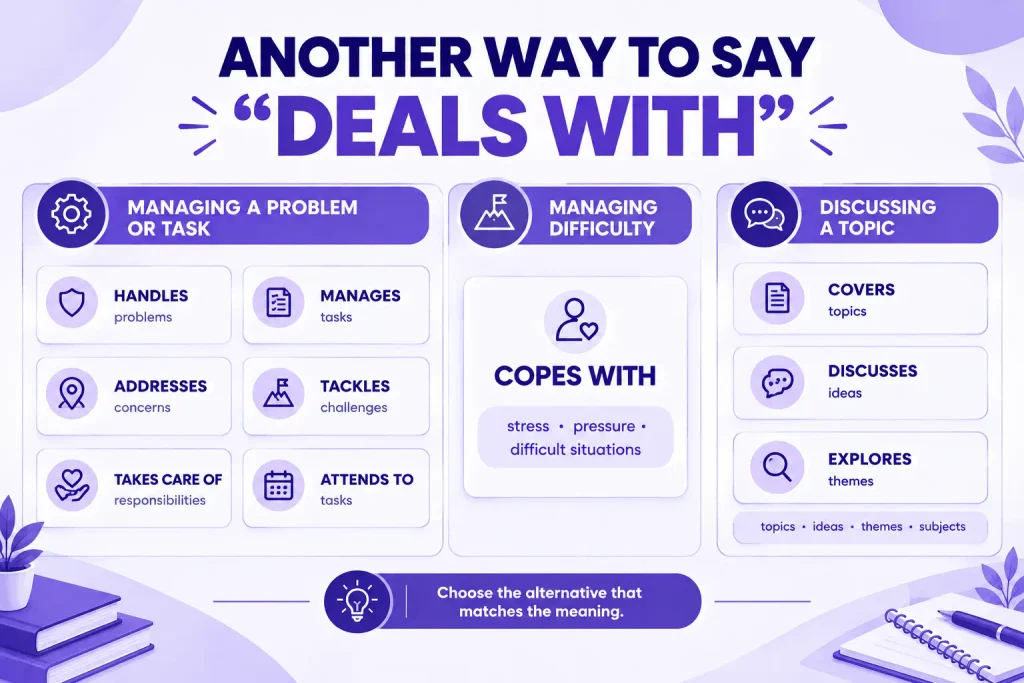
1. Handles
Best for: Problems, tasks, responsibilities, customers, complaints, and situations
“Handles” is one of the closest alternatives when “deals with” means taking responsibility for something and managing it.
Example:
Our customer service team handles complaints quickly.
Usage tip: “Handles” often suggests direct or practical management.
2. Manages
Best for: Responsibilities, situations, teams, tasks, and ongoing problems
“Manages” emphasizes controlling, organizing, or successfully dealing with something.
Example:
She manages several client accounts for the company.
It can also describe someone’s ability to deal with a difficult situation:
He manages stressful situations better than most people.
“Manages” is especially useful when the person has an ongoing responsibility.
3. Addresses
Best for: Problems, concerns, issues, needs, and topics
“Addresses” is a particularly useful alternative in professional and academic writing. It suggests giving attention to an issue or taking action to respond to it.
Example:
The new policy addresses several concerns raised by employees.
You can also use it when discussing a subject:
The article addresses the challenges of remote work.
Tone: Professional and formal.
4. Tackles
Best for: Difficult problems, challenges, and major issues
“Tackles” suggests actively trying to solve or improve a difficult situation.
Example:
The organization is tackling the city’s housing shortage.
It has a more energetic tone than “deals with.”
Compare:
- The report deals with unemployment. — Neutral
- The government tackles unemployment. — Emphasizes active action
5. Takes Care of
Best for: Tasks, responsibilities, errands, and practical matters
“Takes care of” is a natural everyday alternative when someone agrees to handle something.
Example:
Don’t worry about the reservation. I’ll take care of it.
It can sound warmer and more conversational than “deals with.”
Tone: Casual to neutral.
6. Attends To
Best for: Requests, duties, customers, matters, and tasks
“Attends to” means giving attention to something that needs to be handled.
Example:
The receptionist attended to the customer’s request.
It is correct and useful, but it can sound more formal than everyday alternatives such as “handles” or “takes care of.”
7. Copes With
Best for: Stress, pressure, difficulties, loss, and challenging situations
“Copes with” is different from “handles” because it focuses more on successfully managing something difficult rather than actively solving it.
Example:
She has learned to cope with the pressure of her new job.
You would not normally use “cope with” for every ordinary task.
Compare:
- She handles customer requests. ✓
- She copes with customer requests. ✗
But:
- She copes with stress very well. ✓
8. Covers
Best for: Books, articles, reports, lessons, presentations, and topics
When “deals with” means “is about” or “includes information about,” “covers” is often an excellent replacement.
Example:
The first chapter covers the basics of personal finance.
This meaning is different from “handles.”
Compare:
The report covers workplace safety.
This means workplace safety is a subject discussed in the report.
9. Discusses
Best for: Articles, essays, books, reports, speeches, and conversations
“Discusses” is appropriate when the subject is being examined or talked about.
Example:
The essay discusses the effects of social media on teenagers.
It is often more precise than “deals with” in academic writing.
10. Explores
Best for: Ideas, themes, questions, experiences, and complex subjects
“Explores” suggests examining a subject in greater depth or from different perspectives.
Example:
The documentary explores the relationship between technology and education.
It can sound more analytical or thoughtful than “deals with.”
Quick Comparison: Which Alternative Should You Use?

| Alternative | Main Meaning | Tone | Best Context |
| Handles | Manages something directly | Neutral | Problems, tasks, customers |
| Manages | Controls or organizes | Neutral | Responsibilities, situations |
| Addresses | Responds to an issue | Formal | Business, academic writing |
| Tackles | Actively works on a difficult problem | Neutral | Challenges, major issues |
| Takes care of | Handles a responsibility | Casual/neutral | Everyday tasks |
| Attends to | Gives attention to something | Formal | Requests, duties, customers |
| Copes with | Manages something difficult | Neutral | Stress, pressure, hardship |
| Covers | Includes a subject | Neutral | Books, reports, lessons |
| Discusses | Talks about or examines | Neutral/formal | Essays, articles, reports |
| Explores | Examines in depth | Neutral/formal | Ideas, themes, complex topics |
“Deals With” vs. “Handles”
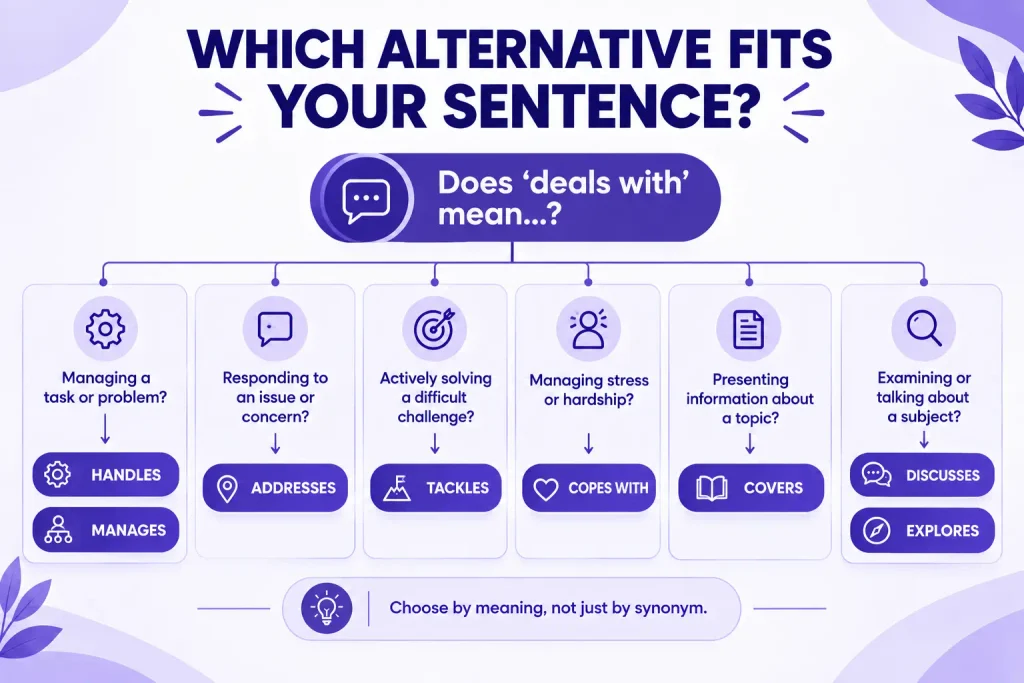
These two expressions overlap closely when talking about problems, tasks, people, or situations.
She deals with customer complaints.
She handles customer complaints.
Both sentences are natural. “Handles” can put slightly more emphasis on direct management or responsibility, while “deals with” is broader.
However, they are not interchangeable in every context.
The book deals with American history. ✓
The book handles American history. ✗/awkward
When a text is about a subject, covers, discusses, examines, or explores are usually better choices.
“Deals With” vs. “Addresses”
Use addresses when you want a more professional or formal tone.
The report deals with employee concerns.
The report addresses employee concerns.
The second sentence sounds more deliberate and professional.
“Addresses” is particularly useful when the subject is a problem, concern, issue, question, or need.
“Deals With” vs. “Copes With”
These phrases can overlap, but they emphasize different things.
Deal with often suggests taking action:
We need to deal with the problem immediately.
Cope with emphasizes managing something difficult, especially when it causes stress or hardship:
She is learning to cope with the pressure.
So, use cope with when the idea of endurance or adjustment is important.
“Deals With” When Talking About a Topic
One of the most important distinctions is whether a person is handling something or a piece of writing is about something.
For a person:
The manager handles customer complaints.
For a book:
The book covers customer service strategies.
For an essay:
The essay discusses the effects of poor customer service.
For an analytical work:
The study explores the causes of customer dissatisfaction.
All of these can sometimes replace “deals with,” but each gives the sentence a slightly different meaning.
Common Mistakes
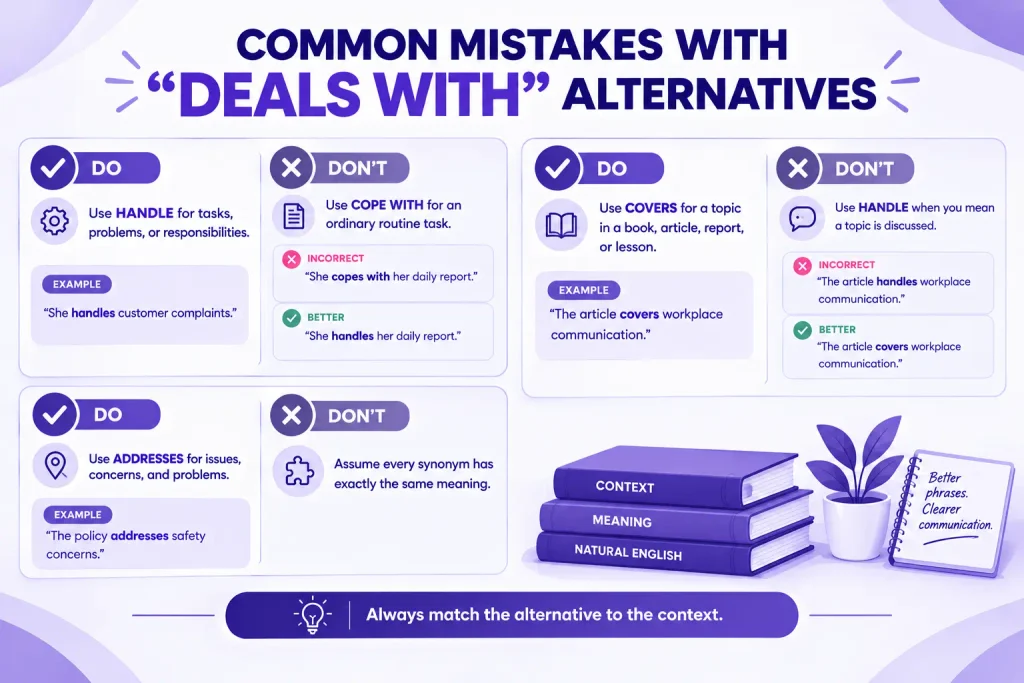
Using “cope with” for ordinary tasks
“Cope with” usually suggests difficulty or pressure.
I cope with my emails every morning. — Unnatural in most contexts
I handle my emails every morning. — Natural
Using “handles” for the subject of a book
When a book, article, or report is about a subject, covers, discusses, examines, or explores is usually more natural.
The article discusses climate policy. ✓
The article handles climate policy. — Awkward
Assuming every synonym has the same tone
“Deals with” is relatively neutral and versatile. “Tackles” sounds more active, “addresses” sounds more formal, and “takes care of” sounds more conversational.
Forgetting that “deal with” has multiple meanings
Context matters. “Deal with” can refer to managing something, discussing a topic, coping with difficulty, interacting with someone, or doing business with someone.
FAQs
What is the best synonym for “deals with”?
Handles is one of the closest general alternatives when “deals with” means manages or takes responsibility for something. However, addresses, manages, tackles, or takes care of may be better depending on the sentence.
What is a formal way to say “deals with”?
Addresses is often a strong formal alternative. For academic writing, examines, discusses, covers, or explores may be more precise when referring to a topic.
What is another way to say “deals with a problem”?
You can say handles a problem, addresses a problem, tackles a problem, manages a problem, or takes care of a problem. “Tackles” emphasizes active effort, while “addresses” has a more formal tone.
What is another way to say “deals with an issue”?
Good choices include addresses an issue, tackles an issue, handles an issue, and responds to an issue. In professional writing, “addresses an issue” is especially natural.
What is another way to say “deals with a topic”?
Use covers, discusses, examines, explores, or focuses on. These alternatives are more precise when a book, article, essay, report, or presentation is about a particular subject.
Is “handles” the same as “deals with”?
They are often interchangeable when referring to managing a person, problem, task, or situation. “Handles” can suggest direct or competent management, while “deals with” is broader.
Is “addresses” the same as “deals with”?
Not always. “Addresses” usually suggests responding to or giving attention to an issue, problem, or concern. “Deals with” has a wider range of meanings.
Is “takes care of” a synonym for “deals with”?
Sometimes. “Takes care of” works well when “deals with” means completing a task or responsibility. It is generally more conversational.
Conclusion
The best alternative to “deals with” depends on what you are trying to say. Choose handles or manages for responsibilities and situations, addresses for professional or formal issues, tackles for difficult problems, and covers, discusses, or explores when referring to a topic.
If you are replacing “deals with” in a specific sentence, the sentence itself matters. The most accurate alternative is the one that preserves both the original meaning and the intended tone.

Role: Editorial Contributor
Graham Ellis contributes practical English and communication guides to RepublicsPress. His content focuses on vocabulary, writing techniques, word usage, and clear communication, with an emphasis on straightforward explanations and real-world examples.