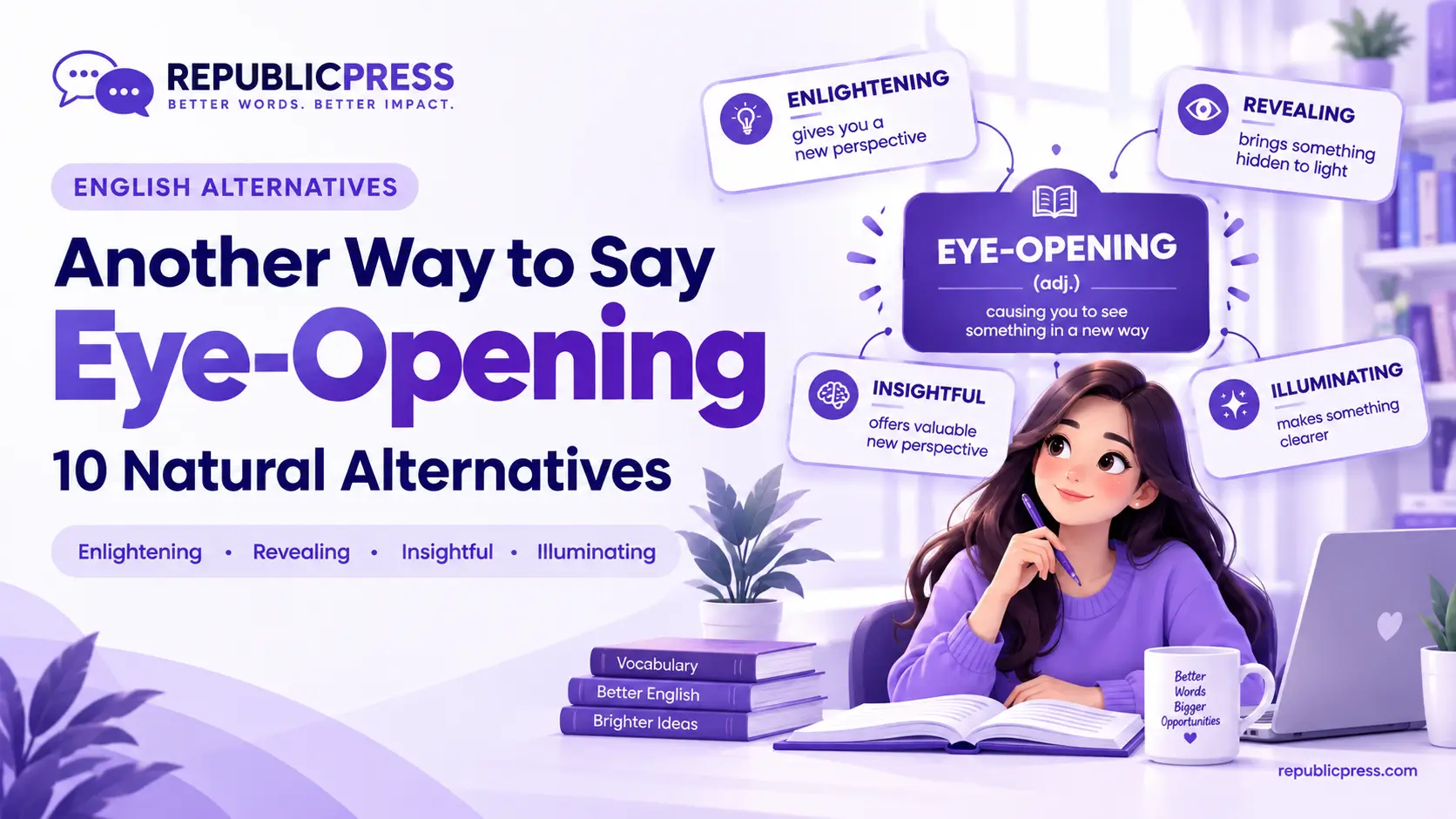
Another Way to Say Eye Opening: 10 Natural Alternatives
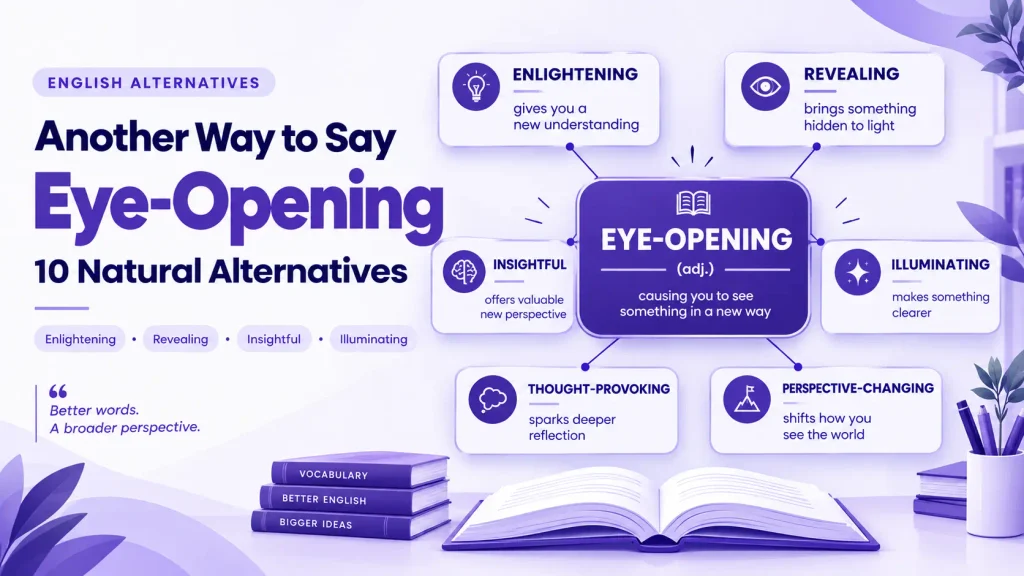
If you want another way to say “eye-opening,” good choices include enlightening, revealing, illuminating, insightful, informative, thought-provoking, perspective-changing, surprising, revelatory, and instructive. The best alternative depends on what you want to emphasize: new knowledge, a change in perspective, surprise, or a deeper understanding.
Key Takeaways
- Enlightening is one of the closest alternatives to “eye-opening.”
- Revealing works well when something uncovers information that was previously unknown.
- Illuminating emphasizes greater clarity or understanding.
- Insightful focuses on useful or meaningful understanding.
- Thought-provoking is useful when something makes you think deeply, although it does not always imply surprise.
- Perspective-changing is stronger and suggests that something changed the way you see an issue.
- The right phrase depends on context, tone, and the exact meaning you want to convey.
What Does “Eye-Opening” Mean?
Eye-opening is an adjective used for something that causes surprise because it reveals information, facts, or perspectives you did not know before. Cambridge Dictionary defines it as something that is “surprising and teaching you facts that you did not know.”
For example:
The documentary was an eye-opening look at how food is produced.
Here, eye-opening does more than mean interesting. The documentary provided information that changed or expanded the viewer’s understanding.
The related noun eye-opener can describe a surprising piece of information, realization, or experience.
10 Ways to Say “Eye-Opening”
1. Enlightening
Enlightening is probably the closest general alternative to eye-opening. It describes something that gives you a better understanding of a subject or teaches you something useful.
Example:
The workshop was incredibly enlightening and changed the way I approach the problem.
Best for: Education, discussions, books, documentaries, presentations, and personal experiences.
2. Revealing
Use revealing when something exposes information, details, or facts that were previously hidden or unknown.
Example:
The interview was revealing and gave us a better understanding of what happened.
Best for: Interviews, reports, investigations, conversations, and discoveries.
Usage tip: Revealing focuses more on uncovering information, while eye-opening can also emphasize the surprise or impact of learning something new.
3. Illuminating
Illuminating means something helps make a complicated subject clearer or easier to understand.
Example:
Her explanation of the research was extremely illuminating.
Best for: Academic writing, professional discussions, books, lectures, and explanations.
This is a useful choice when you want a somewhat polished or formal alternative.
4. Insightful
Insightful describes something that provides a deeper or useful understanding of a person, situation, or subject.
Example:
The author offered an insightful perspective on modern workplace culture.
Best for: Articles, books, interviews, discussions, reviews, and professional writing.
Usage tip: Something can be insightful without being surprising, so this word does not always carry the same sense of discovery as eye-opening.
5. Informative
Choose informative when the main point is that something provides useful facts or knowledge.
Example:
The seminar was informative and gave us several practical ideas.
Best for: Presentations, websites, guides, classes, reports, and educational content.
Important distinction: Informative emphasizes information. Eye-opening usually suggests that the information was surprising or changed your understanding.
6. Thought-Provoking
Thought-provoking describes something that makes you think deeply or consider an issue from a different angle.
Example:
The film was thought-provoking and raised some difficult questions about technology.
Best for: Films, books, essays, conversations, speeches, and social topics.
It is not an exact synonym because something can be thought-provoking without teaching you new facts.
7. Perspective-Changing
Perspective-changing is a strong alternative when an experience or piece of information changes the way you view a subject.
Example:
Volunteering at the shelter was a perspective-changing experience.
Best for: Personal experiences, travel, education, documentaries, and major realizations.
This phrase is especially useful when eye-opening means more than simply learning something new.
8. Surprising
Surprising is a simple alternative when the main idea is that something was unexpected.
Example:
The results were surprising and completely different from what we expected.
Best for: Everyday conversation and general writing.
Usage tip: Surprising does not necessarily mean that you learned something. If learning or understanding is important, enlightening or revealing may be more precise.
9. Revelatory
Revelatory is a more formal word for something that reveals important information or produces a new understanding.
Example:
The author’s discussion of the issue was revelatory.
Best for: Formal writing, reviews, essays, journalism, and analytical discussions.
It has a stronger and more formal tone than everyday eye-opening.
10. Instructive
Instructive describes something that teaches you something useful or provides a lesson.
Example:
The experience was instructive and helped me understand the challenges involved.
Best for: Academic, professional, educational, and formal contexts.
It is less emotional than eye-opening and focuses more on the lesson or educational value.
Which Alternative Is Closest to “Eye-Opening”?
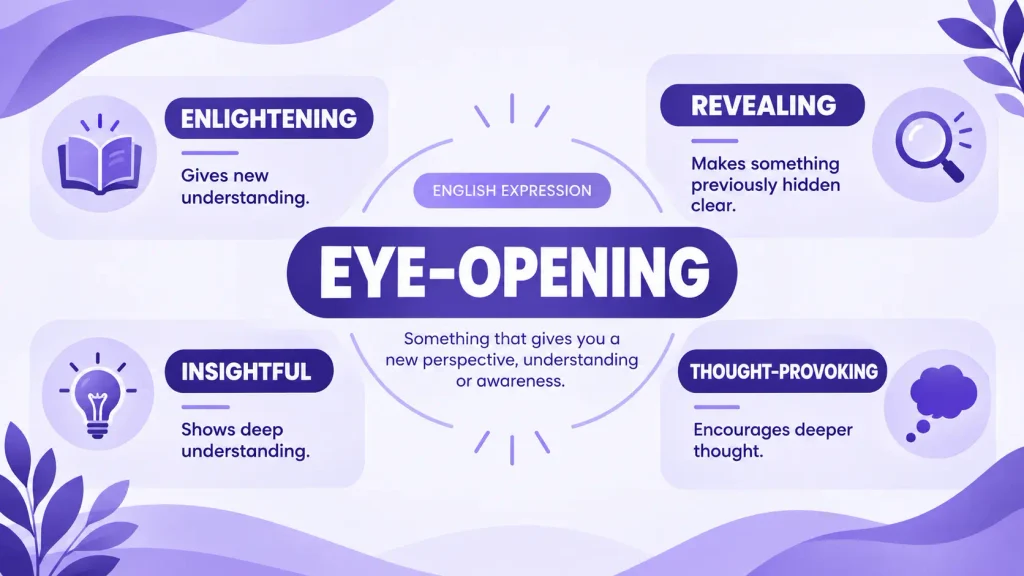
There is no single replacement that works in every sentence. Enlightening is usually one of the closest choices because it combines the ideas of learning and gaining a better understanding.
| Alternative | Main idea | Tone | Best context |
| Enlightening | Gives new understanding | Neutral | General, educational |
| Revealing | Uncovers information | Neutral | Reports, interviews |
| Illuminating | Makes something clearer | Formal/neutral | Academic, professional |
| Insightful | Provides deeper understanding | Neutral | Writing, discussions |
| Informative | Provides useful facts | Neutral | Guides, classes |
| Thought-provoking | Encourages deeper thought | Neutral | Books, films, essays |
| Perspective-changing | Changes your viewpoint | Strong | Experiences, documentaries |
| Surprising | Unexpected | Casual/neutral | Everyday situations |
| Revelatory | Reveals something important | Formal | Essays, analysis |
| Instructive | Teaches a useful lesson | Formal | Education, work |
“Eye-Opening” vs. “Enlightening”
These two expressions are especially close, but they are not always interchangeable.
Eye-opening often suggests that something was surprising and caused you to see a subject differently.
The trip was an eye-opening experience.
Enlightening emphasizes the knowledge or understanding you gained.
The lecture was enlightening.
You can use enlightening when the experience taught you something, while eye-opening is often better when you want to highlight the surprise or change in perspective.
“Eye-Opening” vs. “Revealing”
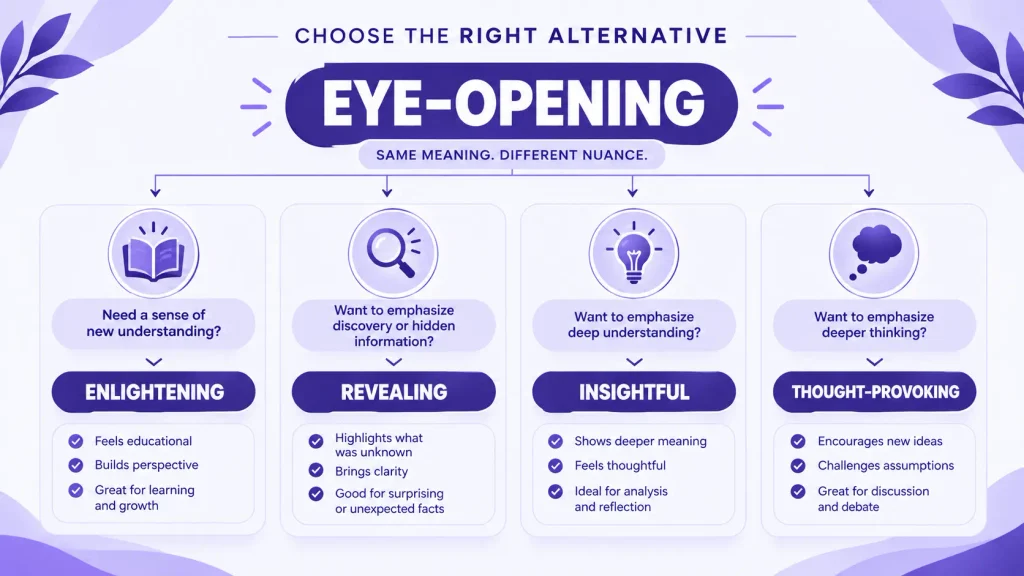
These expressions also overlap, but they emphasize different things.
Eye-opening focuses on the effect something has on your understanding.
The documentary was eye-opening.
Revealing focuses on the information that was uncovered.
The documentary was revealing.
If a documentary exposes information that people did not previously know, revealing works well. If watching it significantly changes your understanding, eye-opening may be more natural.
Formal Alternatives to “Eye-Opening”
If you’re writing an essay, report, review, or professional piece, you may want a more polished expression.
Good choices include:
- Illuminating
- Revelatory
- Insightful
- Instructive
- Informative
For example, instead of:
The study provided an eye-opening look at the issue.
You could write:
The study provided an illuminating perspective on the issue.
Or:
The study offered a revelatory look at the issue.
The best choice depends on whether you want to emphasize clarity, discovery, or new information.
Casual Alternatives to “Eye-Opening”
In everyday conversation, simpler expressions often sound more natural.
You could say:
- Really surprising
- A real surprise
- It opened my eyes
- I learned a lot from it
- It changed how I see things
- It made me see things differently
For example:
That trip was eye-opening.
Could become:
That trip really opened my eyes.
Or:
That trip changed the way I see things.
The phrase “opened my eyes” is especially natural when talking about your personal reaction to an experience.
Common Mistakes When Replacing “Eye-Opening”
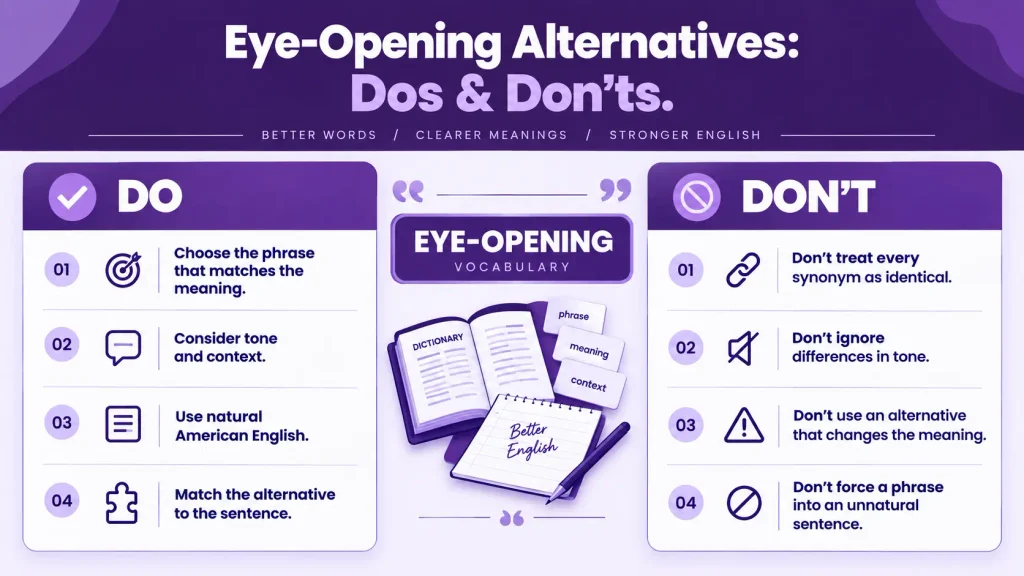
Using “amazing” as an exact synonym
Amazing can describe something impressive or wonderful, but it does not necessarily mean that it taught you something new.
The concert was amazing.
This tells us that the concert was impressive, but not that it changed the speaker’s understanding.
Using “shocking” when you only mean informative
Shocking is much stronger. It suggests that something caused a strong emotional reaction.
The report was eye-opening.
does not necessarily mean:
The report was shocking.
Choose shocking only when the information genuinely causes that level of reaction.
Using “informative” when perspective matters
An informative article can provide useful facts without changing how you think.
If the experience changed your perspective, eye-opening, enlightening, or perspective-changing may communicate the idea more accurately.
Treating every synonym as interchangeable
Words such as insightful, revealing, surprising, and thought-provoking overlap with eye-opening, but each highlights a different part of the meaning.
Choosing the closest word to your intended meaning makes your writing more precise.
Frequently Asked Questions
What is the best synonym for “eye-opening”?
Enlightening is one of the closest general alternatives. It emphasizes gaining new knowledge or understanding, which is central to the meaning of eye-opening.
What is another way to say “eye-opening experience”?
You can say enlightening experience, revealing experience, perspective-changing experience, or instructive experience, depending on what you want to emphasize.
For example:
Traveling alone was an eye-opening experience.
can become:
Traveling alone was an enlightening experience.
Is “enlightening” the same as “eye-opening”?
They are very similar, but not identical. Enlightening emphasizes gaining knowledge or understanding, while eye-opening often adds an element of surprise or a changed perspective.
What is a formal word for “eye-opening”?
Illuminating and revelatory are useful formal alternatives. Insightful can also work well in professional and academic contexts.
What is a casual way to say “eye-opening”?
You can say “it opened my eyes,” “it changed how I see things,” or “it made me see things differently.”
Can I use “revealing” instead of “eye-opening”?
Yes, when the context involves information or details being uncovered. Revealing focuses on what becomes known, while eye-opening focuses more on the effect that new information has on your understanding.
What is another way to say “that was eye-opening”?
Natural alternatives include:
- That was enlightening.
- That really opened my eyes.
- That made me see things differently.
- That was incredibly revealing.
- That gave me a new perspective.
Final Thoughts
The best alternative to “eye-opening” depends on the part of the meaning you want to preserve. Use enlightening when you want to emphasize new understanding, revealing when something uncovers information, illuminating when it brings clarity, and perspective-changing when an experience changes how you see something.
If you simply mean that something was unexpected, surprising may be enough. Choosing the alternative based on context will make your writing sound more natural and precise than relying on a thesaurus-style synonym alone.

Role: Editorial Contributor
Graham Ellis contributes practical English and communication guides to RepublicsPress. His content focuses on vocabulary, writing techniques, word usage, and clear communication, with an emphasis on straightforward explanations and real-world examples.