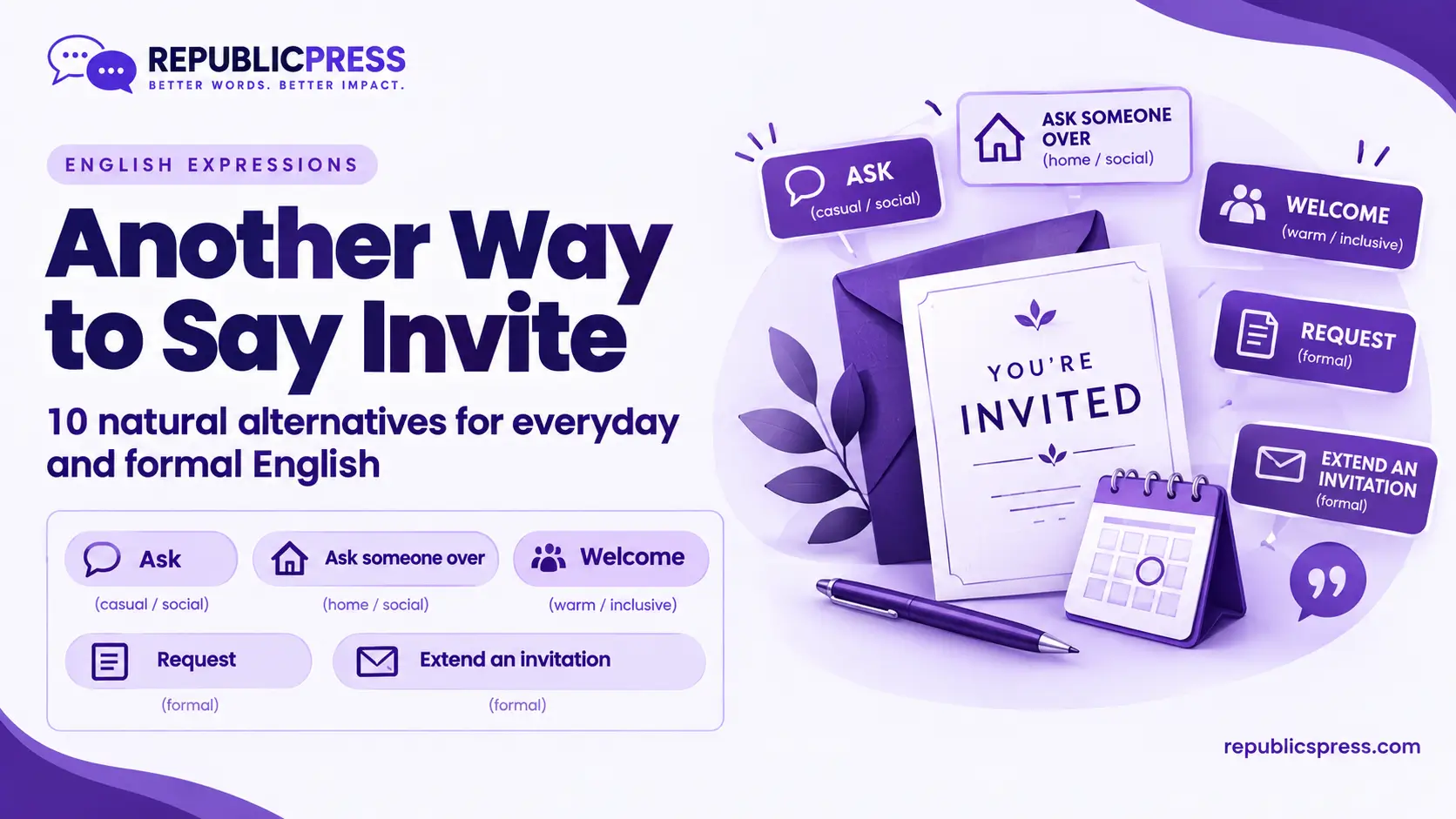
Another Way to Say Invite: 10 Natural Alternatives
If you’re looking for another way to say invite, the best choice depends on the situation. In everyday English, ask, welcome, and ask someone over are natural options. In formal or professional writing, request, solicit, or call for may fit better. Some alternatives change the meaning slightly, so context matters.
Key Takeaways
- Ask is the simplest everyday alternative to invite.
- Ask someone over works well when inviting someone to your home.
- Welcome emphasizes making someone feel accepted or included.
- Request is more formal and often involves asking someone to do something.
- Solicit is useful when asking for comments, ideas, applications, or proposals.
- Call for works well for formal announcements or requests for participation.
- Not every synonym of invite works in every sentence.
What Does “Invite” Mean?
The verb invite usually means to ask someone to come somewhere, join an activity, or do something. It can describe social situations, such as inviting someone to dinner, as well as formal situations, such as inviting candidates to an interview.
For example:
We invited our neighbors to dinner.
But invite has another important use: it can mean to formally request something or to encourage a particular reaction or result.
- The company invited applications for the position.
- His comments invited criticism.
Because of these different meanings, the best alternative depends on what you are trying to say.
10 Natural Alternatives to “Invite”
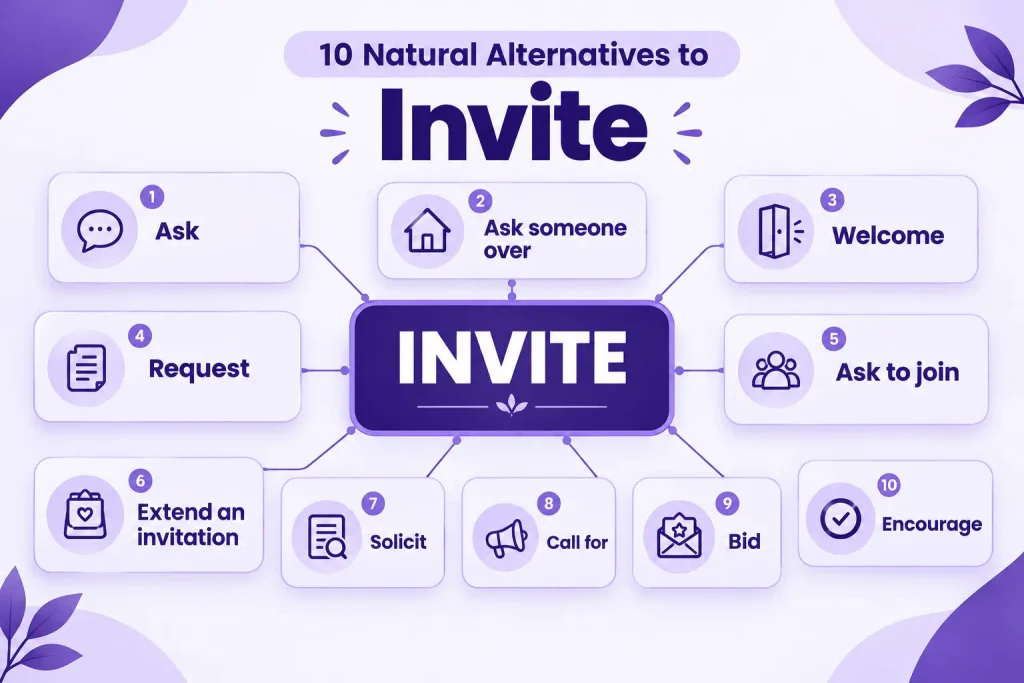
1. Ask
Meaning: To request that someone come somewhere or do something.
Best for: Everyday and conversational English.
Example:
I asked Sarah to join us for dinner.
Usage tip:
Ask is one of the most natural substitutes for invite in casual conversation. It is broader than invite, though, because you can ask someone to do something without necessarily inviting them to an event.
2. Ask Someone Over
Meaning: To invite someone to your home.
Best for: Casual conversations and social situations.
Example:
We asked our friends over for coffee.
This phrase is especially natural in American English when you’re talking about having someone visit your home.
Compare:
- I invited John to the party. → John is being invited to an event.
- I asked John over. → John is being invited to your home.
3. Welcome
Meaning: To receive someone gladly or make them feel included.
Best for: Hospitality, groups, organizations, and inclusive situations.
Example:
We’re happy to welcome new members to the club.
Usage tip:
Welcome is not always a direct replacement for invite. It focuses more on accepting or receiving someone than on making the initial invitation.
4. Request
Meaning: To formally or politely ask for something.
Best for: Professional, official, and formal situations.
Example:
We requested that all guests confirm their attendance.
You can also use request when asking someone to provide something:
The editor requested additional information from the author.
Unlike invite, request emphasizes the act of asking rather than the social act of inviting someone to attend.
5. Ask to Join
Meaning: To ask someone to become part of an activity, event, or group.
Best for: Meetings, activities, groups, and informal situations.
Example:
We asked Maya to join us for lunch.
This is a useful alternative when the main idea is including someone in an activity rather than sending them a formal invitation.
6. Extend an Invitation
Meaning: To formally or politely invite someone.
Best for: Formal writing, announcements, business communication, and special occasions.
Example:
We are pleased to extend an invitation to all community members.
This phrase is more formal than simply saying invite.
For example:
We invite you to attend the ceremony.
can become:
We are pleased to extend an invitation to you to attend the ceremony.
The second version sounds more ceremonial and formal.
7. Solicit
Meaning: To ask for something, especially information, opinions, applications, suggestions, or proposals.
Best for: Professional, business, organizational, and formal contexts.
Example:
The committee is soliciting feedback from local residents.
Usage tip:
Solicit should not normally replace invite when you’re simply asking someone to attend a birthday party or dinner. It is much more useful when you are seeking something from people.
8. Call for
Meaning: To officially ask for something or announce that something is wanted or needed.
Best for: Formal announcements, applications, proposals, responses, and public communication.
Example:
The organization is calling for applications from qualified candidates.
It can also describe a request for action:
The report called for immediate changes.
This is a contextual alternative rather than a direct synonym for every use of invite.
9. Bid
Meaning: To ask or invite someone to do something; it is relatively formal and can sound literary or old-fashioned in some modern contexts.
Best for: Formal or traditional expressions.
Example:
The host bid everyone welcome.
You may also encounter bid someone to do something in formal or literary writing. However, it is much less common in everyday American English than ask or invite, so it should be used carefully. Cambridge lists bid among words related to invite.
10. Encourage
Meaning: To persuade or prompt someone to take an action.
Best for: Participation, contributions, feedback, and action.
Example:
We encourage residents to attend the meeting.
Usage tip:
Encourage does not mean exactly the same thing as invite. An invitation gives someone an opportunity to participate, while encouragement emphasizes motivating them to participate.
For example:
We invited employees to share their ideas.
means employees were asked to participate.
We encouraged employees to share their ideas.
puts more emphasis on motivating them to do so.
Quick Comparison: Which Alternative Should You Use?
| Alternative | Main Use | Tone | Best Context |
| Ask | Request someone’s presence or participation | Neutral | Everyday conversation |
| Ask someone over | Invite someone to your home | Casual | Friends and family |
| Welcome | Receive or include someone | Warm | Social and group settings |
| Request | Make a formal or polite request | Formal | Workplace and official writing |
| Ask to join | Include someone in an activity | Neutral | Social and group activities |
| Extend an invitation | Give a formal invitation | Formal | Events and announcements |
| Solicit | Seek feedback, ideas, or applications | Formal | Business and organizations |
| Call for | Officially request something | Formal | Public or professional writing |
| Bid | Formally invite or ask | Formal/literary | Traditional writing |
| Encourage | Motivate participation | Neutral/formal | Meetings and activities |
Another Way to Say “Invite Someone to a Party”

If you’re talking specifically about a party, these are natural choices:
- Ask someone to the party
- Ask someone to come
- Ask someone to join us
- Welcome someone to the party
- Extend an invitation to someone
For everyday American English, ask someone to the party is usually much more natural than trying to replace invite with an unusual synonym.
Example:
I invited Jake to the party.
You could say:
I asked Jake to come to the party.
The second sentence is conversational and natural, but it is technically a paraphrase rather than a perfect synonym.
Another Way to Say “Invite Someone Over”

When the person is being invited to your home, ask someone over is one of the most natural alternatives.
Original:
I’m going to invite Lisa over tonight.
Alternative:
I’m going to ask Lisa over tonight.
You can also say:
I’m going to ask Lisa to come over tonight.
These expressions are casual and work well for friends, family members, or other informal social situations.
Another Way to Say “Invite” in Professional Writing

Professional contexts often require more precise wording. Depending on the situation, you could use:
- Request
- Solicit
- Call for
- Ask
- Extend an invitation
- Encourage
For example:
Original:
We invite qualified applicants to apply.
More formal:
We welcome applications from qualified candidates.
Or:
Applications are invited from qualified candidates.
For proposals or bids, invite can also be used in a formal sense:
The company invited contractors to submit proposals.
Here, solicit proposals or call for proposals may work depending on the intended tone and context.
Cambridge specifically distinguishes the social meaning of invite from its formal use for requesting bids, applications, comments, suggestions, and other submissions.
Common Mistakes When Replacing “Invite”
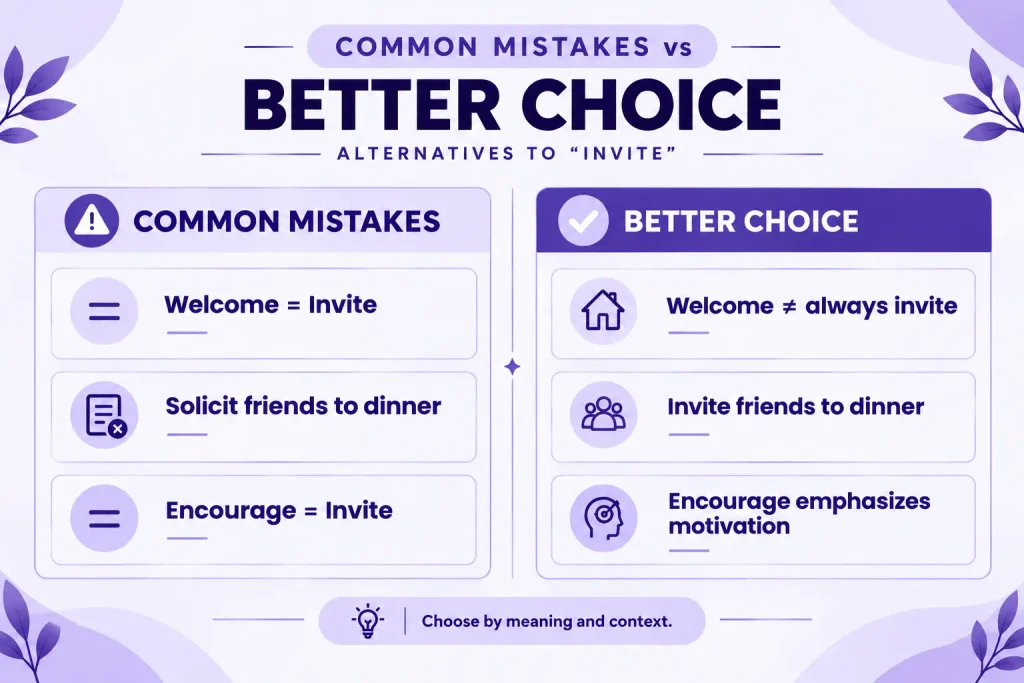
Using “Welcome” as an Exact Synonym
These words overlap, but they are not identical.
We invited new members to the club.
means you asked them to join.
We welcomed new members to the club.
means you received or accepted them warmly.
Using “Solicit” for Social Invitations
You generally would not say:
I solicited my friends to dinner.
That sounds unnatural.
Instead, say:
I invited my friends to dinner.
Or:
I asked my friends over for dinner.
Using “Encourage” When You Mean “Invite”
These sentences have different meanings:
We invited employees to attend the meeting.
We encouraged employees to attend the meeting.
The first tells employees that they are being asked to attend. The second emphasizes motivating them to attend.
Forgetting the Preposition
For social events, invite someone to something is standard:
She invited me to the wedding.
For activities or meals, other constructions may be possible:
He invited me to dinner.
He invited me for dinner.
Cambridge’s grammar guidance notes that to is used for social events, while to or for can be used with meals in appropriate contexts.
Frequently Asked Questions
What is the most common synonym for “invite”?
Ask is one of the most natural alternatives in everyday English. However, it is broader than invite, so the exact meaning depends on the sentence.
What is a formal word for “invite”?
Request, solicit, and extend an invitation can work in formal contexts, depending on what is being requested.
What is another way to say “invite someone over”?
The most natural alternative is ask someone over. You can also say ask someone to come over.
What is another way to say “invite someone to a party”?
You can say ask someone to the party, ask someone to come, or ask someone to join us. Invite remains the most direct choice.
Is “welcome” the same as “invite”?
Not exactly. Invite means asking someone to come or participate, while welcome focuses on receiving or accepting someone warmly.
Is “request” the same as “invite”?
No. Request emphasizes asking for something, while invite commonly means asking someone to attend, participate, or do something. In formal contexts, the two can overlap.
What is a professional way to say “invite”?
Depending on the context, request, extend an invitation, solicit, or call for may work. Choose based on whether you are inviting a person, requesting participation, or seeking information or applications.
Can “invite” mean “encourage”?
Yes, in certain contexts. For example, invite criticism means to do something that encourages or makes criticism likely. This is a different meaning from inviting someone to an event.
Conclusion
The best alternative to invite depends on what you mean. For everyday conversation, ask and ask someone over are natural choices. For formal writing, request, extend an invitation, solicit, and call for can be more appropriate. If the goal is to motivate participation, encourage may fit better.
The key is not to treat every related word as a perfect synonym. Choosing the right phrase means matching the meaning, tone, and context of the original sentence.

Role: Editorial Contributor
Graham Ellis contributes practical English and communication guides to RepublicsPress. His content focuses on vocabulary, writing techniques, word usage, and clear communication, with an emphasis on straightforward explanations and real-world examples.