Another Way to Say “Not My Problem”: 15 Natural Alternatives
“Not my problem” means that a situation is not your responsibility or something you feel obligated to fix. Depending on the context, you can say “That’s not my responsibility,” “I’m not involved in this,” “That’s up to you,” or “I can’t take that on.” Some alternatives sound polite and professional, while others are direct or dismissive.
Key Takeaways
- Polite: “That’s not my responsibility” sets a clear boundary without sounding rude.
- Professional: “That falls outside my role” works well in workplace conversations.
- Casual: “That’s on you” is direct and informal.
- Neutral: “I’m not involved in this” clarifies that you are not part of the situation.
- Firm: “I can’t take that on” communicates that you cannot accept the responsibility.
- Important distinction: Some alternatives express a lack of responsibility, while others simply show that you cannot help.
What Does “Not My Problem” Mean?
The phrase “not my problem” is an informal expression used when someone believes a situation is not their responsibility. It can also suggest that they do not want to get involved or help resolve an issue.
For example:
- “You forgot to submit your assignment. That’s not my problem.”
- “I already finished my part of the project. The rest isn’t my responsibility.”
The phrase is clear, but it can sound cold, uncaring, or dismissive, especially when someone is asking for help. A different expression can help you communicate the same basic idea without creating unnecessary tension.
15 Other Ways to Say “Not My Problem”
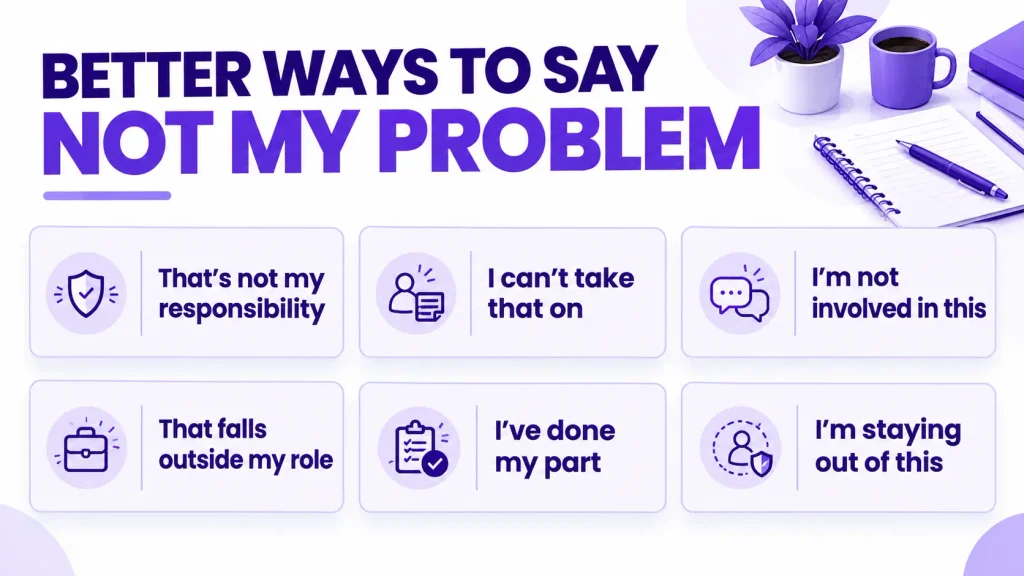
1. That’s Not My Responsibility
Meaning: The situation is not something you are expected or required to handle.
Best for: Professional conversations, personal boundaries, and serious discussions.
Example: “I completed my assigned tasks, so managing the other department’s schedule isn’t my responsibility.”
This is one of the best alternatives when you want to be firm without sounding openly rude.
2. That’s Not My Concern
Meaning: The issue does not directly involve you or fall within your interests or duties.
Best for: Formal or direct conversations.
Example: “How they choose to spend their budget is not my concern.”
Usage tip: This can sound detached or indifferent. Use it carefully when another person is seeking support.
3. I’m Not Involved in This
Meaning: You are not a participant in the situation and do not want to be treated as one.
Best for: Disputes, misunderstandings, and situations involving other people.
Example: “I’m not involved in this disagreement, so please don’t ask me to take sides.”
This option focuses on your lack of involvement rather than blaming anyone.
4. That’s on You
Meaning: The other person is responsible for the situation or its outcome.
Best for: Casual conversations with friends, family, or coworkers you know well.
Example: “You agreed to organize the trip, so making the reservations is on you.”
Usage tip: This expression is informal and can sound confrontational. It is not the best choice for a sensitive conversation.
5. I Can’t Take That On
Meaning: You cannot accept an additional task or responsibility.
Best for: Work, scheduling conflicts, and setting personal boundaries.
Example: “I’m already handling three projects, so I can’t take that on this week.”
Unlike “not my problem,” this phrase does not suggest that you do not care. It simply communicates a limit.
6. That Falls Outside My Role
Meaning: The task is beyond your assigned duties or professional responsibilities.
Best for: Workplace communication and business discussions.
Example: “Reviewing legal contracts falls outside my role as a website developer.”
This is a useful alternative when you want to explain why a task should be handled by someone else.
7. I’m Not the Right Person to Handle This
Meaning: Someone else has the skills, authority, or responsibility needed to deal with the situation.
Best for: Professional emails, customer service, and team communication.
Example: “I’m not the right person to handle this billing issue, but the finance team can help.”
It sounds more constructive when you can direct the person to the appropriate contact.
8. That’s Not Something I Can Control
Meaning: The situation is outside your ability to influence or change.
Best for: Unexpected problems, delays, and circumstances beyond your control.
Example: “I submitted the application on time, but the approval date is not something I can control.”
This phrase is not exactly the same as “not my problem.” It emphasizes a lack of control rather than a lack of responsibility.
9. I’m Staying Out of This
Meaning: You choose not to participate in a dispute or situation.
Best for: Personal disagreements, arguments, and social situations.
Example: “You both have your reasons, and I’m staying out of this argument.”
It is a natural way to avoid taking sides without directly criticizing anyone.
10. That’s Up to You
Meaning: The decision or action belongs to the other person.
Best for: Casual conversations and situations involving personal choices.
Example: “I’ve shared my opinion about the offer. Whether you accept it is up to you.”
Usage tip: This is not a direct replacement in every situation. It works when the other person has the power to decide, not simply because a problem does not concern you.
11. I’ve Done My Part
Meaning: You have completed your share of the work or fulfilled your responsibility.
Best for: Group projects, teamwork, and shared obligations.
Example: “I finished the design and sent the files yesterday. I’ve done my part.”
This phrase is helpful when you want to establish that your own duties are complete.
12. You’ll Need to Handle That Yourself
Meaning: The other person must take care of the issue without relying on you.
Best for: Practical situations, requests for assistance, and boundary-setting.
Example: “I showed you how to update the website last week. You’ll need to handle the next update yourself.”
It is clear and direct, although it may sound unsympathetic if the person genuinely needs help.
13. I’m Not Responsible for That
Meaning: You are not accountable for the particular task, action, or outcome.
Best for: Formal discussions, workplace disputes, and clarifying duties.
Example: “I maintain the website, but I’m not responsible for approving the advertising budget.”
Usage tip: Use this when responsibility is the main issue. It can sound defensive if you say it before understanding the situation.
14. That’s Beyond My Control
Meaning: You cannot determine or change what happens.
Best for: Delays, external decisions, and unexpected circumstances.
Example: “We sent the documents before the deadline, but the processing time is beyond my control.”
This is close to “that’s not something I can control.” It is often suitable for professional explanations, but it does not automatically mean you have no responsibility for the underlying issue.
15. I Don’t Want to Get Involved
Meaning: You prefer not to participate in a situation.
Best for: Personal conflicts, disagreements, and complicated social situations.
Example: “I understand why you’re upset, but I don’t want to get involved in the dispute.”
This is a direct statement of your choice. It is different from saying that you have no responsibility, because you may simply prefer to stay out of it.
Which Alternative Should You Use?
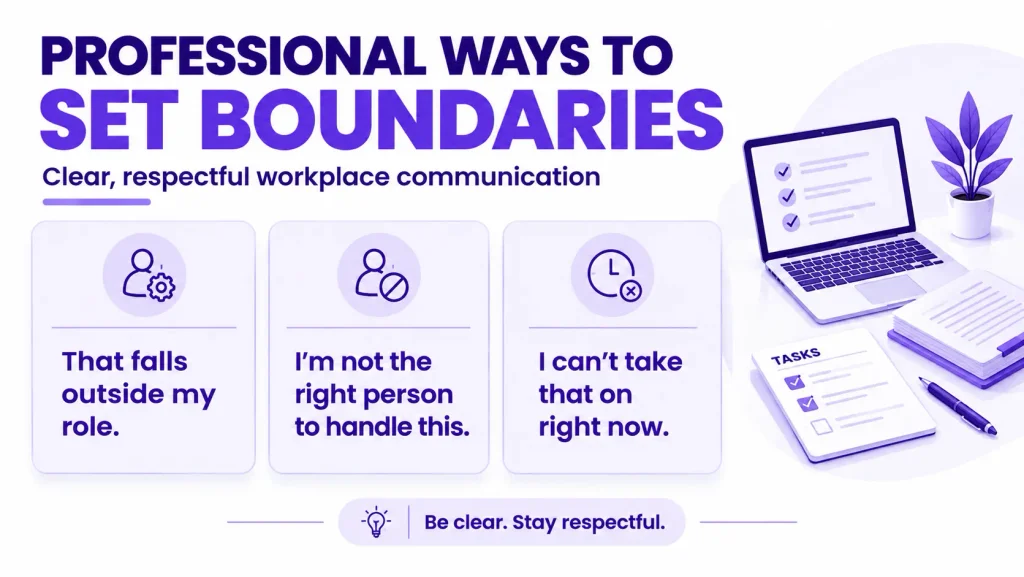
The best phrase depends on whether you want to sound polite, professional, casual, or firm.
| Alternative | Tone | Best context |
|---|---|---|
| That’s not my responsibility | Firm, neutral | Work and personal boundaries |
| That’s not my concern | Direct, detached | Issues that do not concern you |
| I’m not involved in this | Neutral | Disputes and misunderstandings |
| That’s on you | Casual, blunt | Informal conversations |
| I can’t take that on | Polite, firm | Workload and new requests |
| That falls outside my role | Professional | Workplace duties |
| I’m not the right person to handle this | Helpful, professional | Redirecting requests |
| That’s not something I can control | Explanatory | External circumstances |
| I’m staying out of this | Direct | Arguments and disagreements |
| That’s up to you | Neutral, sometimes dismissive | Personal decisions |
| I’ve done my part | Firm | Shared responsibilities |
| You’ll need to handle that yourself | Direct | Tasks assigned to others |
| I’m not responsible for that | Formal, firm | Accountability |
| That’s beyond my control | Professional | Delays and outside decisions |
| I don’t want to get involved | Honest, direct | Personal conflicts |
How to Say “Not My Problem” Politely
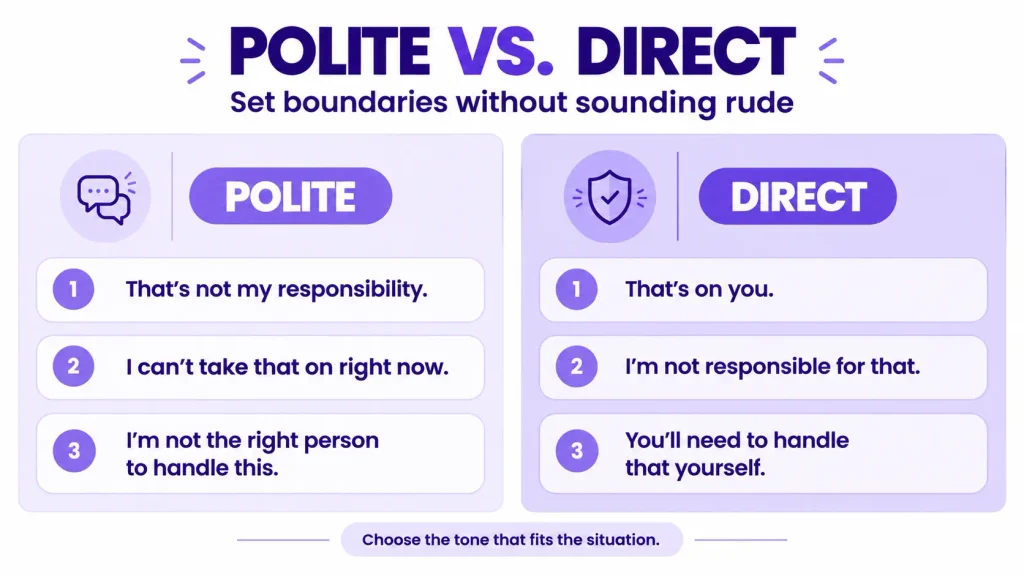
If you want to set a boundary without sounding rude, focus on what you can or cannot do instead of dismissing the other person’s concern.
Here are some natural examples:
- At work: “I’m afraid that falls outside my role, but I can point you in the right direction.”
- When you’re busy: “I’d like to help, but I don’t have the capacity to take this on right now.”
- When someone asks you to fix their mistake: “I understand the situation, but I’m not responsible for that task.”
- During an argument: “I care about both of you, but I’d prefer not to get involved.”
- When something is outside your control: “I’ve done everything I can on my end. The remaining steps are outside my control.”
You do not need to sound harsh to communicate a firm boundary. A clear explanation is often enough.
Common Mistakes to Avoid
Using “That’s on you” in formal situations
This expression can sound accusatory. In a professional email, “That responsibility belongs to your team” may be more appropriate.
Confusing responsibility with control
“I’m not responsible for that” and “That’s beyond my control” have different meanings. The first concerns accountability; the second concerns your ability to influence an outcome.
Sounding dismissive when someone needs help
“Not my problem” can make people feel ignored. If you cannot help, explain your limits or suggest another person who may be able to assist.
Using “That’s up to you” when no decision is involved
This expression works when someone has a choice. If the issue concerns a duty or assignment, “That’s not my responsibility” is usually clearer.
Frequently Asked Questions
What is a polite way to say “not my problem”?
“That’s not my responsibility” is a polite, clear option in many situations. If you want to sound more helpful, say, “I’m not the right person to handle this, but I can direct you to someone who is.”
What is a professional way to say “not my problem”?
“That falls outside my role” is a strong professional choice. You can also say, “I’m unable to take responsibility for that task,” when you need to clarify your duties.
What is a rude way to say “not my problem”?
“That’s your problem, not mine” is a blunt and often confrontational version. “I couldn’t care less” is even more dismissive because it directly expresses a lack of concern.
How do you say “not my problem” without sounding rude?
Explain your boundary calmly. For example, “I understand the issue, but I’m not responsible for that part of the project.” This communicates your position without attacking the other person.
Is “not my concern” the same as “not my problem”?
They are similar, but not identical. “Not my problem” usually suggests that you do not accept responsibility for an issue. “Not my concern” emphasizes that the issue does not involve or interest you.
What is a casual alternative to “not my problem”?
“That’s on you” is a common casual option when someone else is responsible. “I’m staying out of this” works better when you want to avoid getting involved in a disagreement.
How do you say “not my responsibility” in an email?
You could write, “This task falls outside my current responsibilities. Please contact the appropriate team for further assistance.” Adjust the wording based on your role and how formal the email needs to be.
Conclusion
The best alternative to “not my problem” depends on the message you want to send. Use “That’s not my responsibility” to set a clear boundary, “That falls outside my role” in professional settings, or “I’m staying out of this” to avoid a personal conflict. Choosing the right phrase helps you express your position clearly without creating unnecessary tension.

The Republics Press Editorial Team researches, writes and reviews every article on this site, checks facts against reliable sources and updates pages when readers point out errors.