Another Way to Say Thank You Very Much: 15 Natural Alternatives
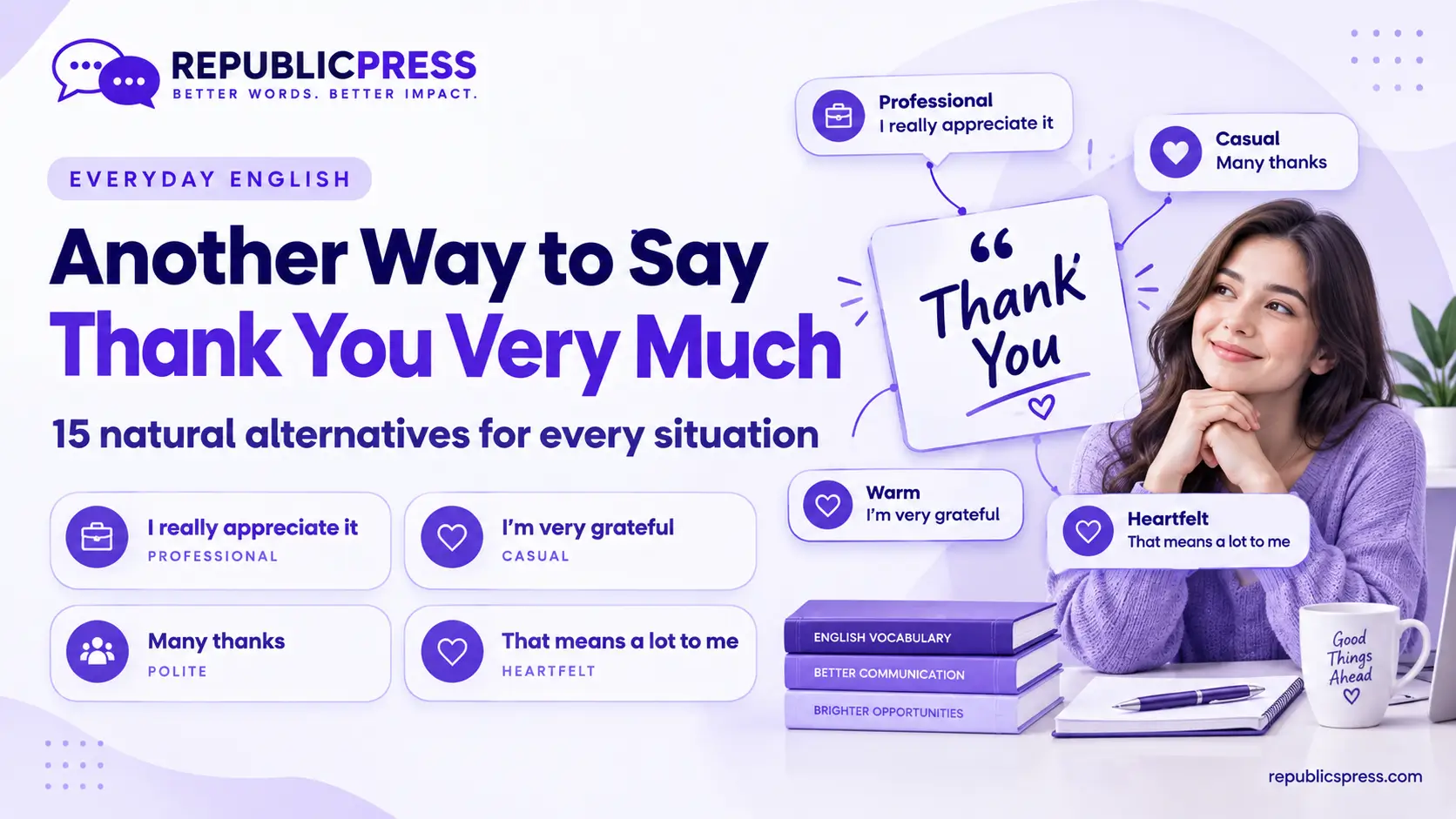
If you need another way to say “thank you very much,” you can use phrases such as “I really appreciate it,” “I’m very grateful,” “many thanks,” “I truly appreciate your help,” or “that means a lot to me.” The best choice depends on how formal, personal, or enthusiastic you want to sound.
Key Takeaways
- “Thank you very much” is a polite way to express stronger gratitude than a simple “thank you.”
- “I really appreciate it” is one of the most natural alternatives for everyday and professional situations.
- “I’m very grateful” works well when you want to sound sincere and heartfelt.
- “Many thanks” is useful in professional emails and written communication.
- “That means a lot to me” emphasizes the personal impact of someone’s kindness.
- Casual phrases such as “Thanks a ton” work better with friends and people you know well.
What Does “Thank You Very Much” Mean?
“Thank you very much” is used to express gratitude for something someone has done, given, or said. The phrase adds emphasis to a basic “thank you,” making the appreciation sound stronger. It can be used in both spoken and written English.
For example:
Thank you very much for helping me with the presentation.
The phrase is flexible, but the right alternative can make your message sound more natural for a particular situation. A professional email, a heartfelt message to a friend, and a quick text do not always need the same wording.
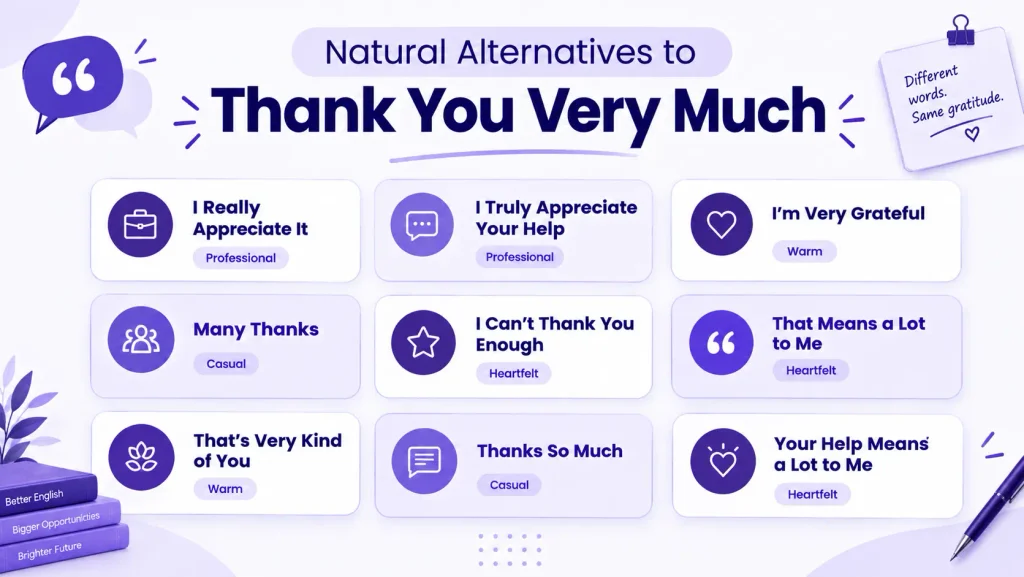
15 Natural Alternatives to “Thank You Very Much”
1. I Really Appreciate It
“I really appreciate it” is one of the most versatile alternatives to “thank you very much.” It sounds warm, natural, and sincere without being overly formal.
Best for: Work, everyday conversations, emails, and favors
Example:
I really appreciate it. Your help saved me a lot of time.
Use this when you want to acknowledge someone’s help without making your message sound overly emotional.
2. I Truly Appreciate Your Help
This phrase puts more emphasis on the person’s specific contribution. It is particularly useful when someone has taken time to assist you.
Best for: Professional and personal situations
Example:
I truly appreciate your help with the project.
It sounds more deliberate than simply saying “thanks,” while still feeling natural.
3. I’m Very Grateful
“I’m very grateful” is a sincere alternative when someone’s action has had a meaningful effect on you.
Best for: Heartfelt, personal, and respectful situations
Example:
I’m very grateful for everything you did to support me.
It works especially well when you want to express genuine appreciation rather than simply acknowledge a small favor.
4. Many Thanks
“Many thanks” is concise and commonly used in written communication. It can work in professional emails, messages, and letters.
Best for: Professional and written communication
Example:
Many thanks for sending the updated documents.
It is polite without sounding excessively formal.
5. I Can’t Thank You Enough
“I can’t thank you enough” communicates strong gratitude and suggests that ordinary words do not fully express how much you appreciate someone’s help.
Best for: Significant favors and meaningful support
Example:
I can’t thank you enough for helping me prepare for the interview.
Because it carries stronger emotion, it is better suited to meaningful situations than routine favors.
6. That Means a Lot to Me
This phrase focuses on the emotional importance of someone’s action rather than simply saying that you are grateful.
Best for: Personal, warm, and heartfelt situations
Example:
You remembered my graduation. That means a lot to me.
It is especially natural when someone has shown thoughtfulness, encouragement, or personal support.
7. That’s Very Kind of You
“That’s very kind of you” acknowledges both the action and the kindness behind it.
Best for: Polite, warm, and respectful situations
Example:
That’s very kind of you. I really appreciate your offer to help.
It can be used with friends, coworkers, acquaintances, or someone you have just met.
8. I’m So Appreciative
“I’m so appreciative” expresses warm gratitude and works particularly well when someone’s effort or thoughtfulness matters to you.
Best for: Personal and appreciative messages
Example:
I’m so appreciative of everything you’ve done for our team.
For a more neutral professional tone, “I really appreciate your help” is often more straightforward.
9. Thanks So Much
“Thanks so much” is a natural, conversational alternative to “thank you very much.” It sounds friendly and less formal.
Best for: Casual conversations, texts, and friendly messages
Example:
Thanks so much for picking me up from the airport!
It is appropriate when you want to sound warm without using a formal expression.
10. Thanks a Lot
“Thanks a lot” can express genuine gratitude, but context and tone matter. In some situations, especially in speech, it can also be interpreted sarcastically.
Best for: Casual conversations when the context is clear
Example:
Thanks a lot for helping me move this weekend.
If you are writing a professional message and want to avoid any possibility of ambiguity, “I really appreciate it” is a safer choice.
11. Thanks a Ton
“Thanks a ton” is an enthusiastic but casual way to show appreciation.
Best for: Friends, family, and informal messages
Example:
Thanks a ton for grabbing coffee for me!
It sounds friendly and upbeat, but it would usually be too casual for a formal business letter.
12. I’m Truly Grateful
“I’m truly grateful” has a sincere and somewhat more emotional tone than “thank you very much.”
Best for: Meaningful help, personal messages, and formal expressions of appreciation
Example:
I’m truly grateful for your support during such a difficult time.
Use it when you want your gratitude to feel especially genuine.
13. Your Help Means a Lot to Me
This phrase connects gratitude directly to the effect someone’s help had on you.
Best for: Personal support, important favors, and meaningful assistance
Example:
Your help means a lot to me, especially with everything I had going on this week.
It is more specific and personal than a general “thank you.”
14. I’m So Thankful
“I’m so thankful” is warm and sincere. It is particularly natural in personal conversations.
Best for: Friends, family, personal messages, and emotional situations
Example:
I’m so thankful you were there when I needed someone to talk to.
For professional writing, “I really appreciate your support” may sound more natural.
15. I Appreciate Your Time and Support
This is a useful professional alternative when you want to recognize both someone’s effort and the time they invested.
Best for: Emails, workplace communication, interviews, meetings, and professional favors
Example:
I appreciate your time and support throughout the hiring process.
It is specific, respectful, and appropriate for many workplace situations.
Quick Comparison of “Thank You Very Much” Alternatives
| Alternative | Tone | Best Context |
| I really appreciate it | Warm, neutral | Everyday and professional |
| I truly appreciate your help | Sincere, professional | Work and important favors |
| I’m very grateful | Sincere | Personal and meaningful situations |
| Many thanks | Polite, concise | Emails and written communication |
| I can’t thank you enough | Strong, heartfelt | Significant help |
| That means a lot to me | Warm, personal | Thoughtful gestures |
| That’s very kind of you | Polite, warm | Social and professional |
| I’m so appreciative | Warm, sincere | Personal and group appreciation |
| Thanks so much | Friendly | Casual and conversational |
| Thanks a lot | Casual | Everyday situations |
| Thanks a ton | Very casual | Friends and informal messages |
| I’m truly grateful | Sincere | Meaningful support |
| Your help means a lot to me | Personal | Important assistance |
| I’m so thankful | Warm | Personal conversations |
| I appreciate your time and support | Professional | Workplace communication |
How to Choose the Right Alternative
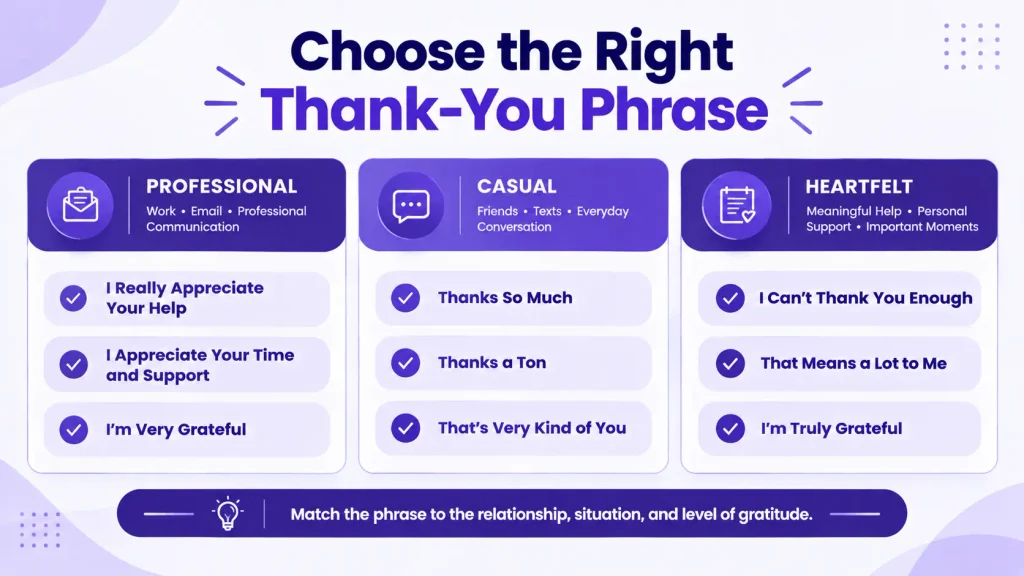
The best replacement depends less on the words themselves and more on the situation.
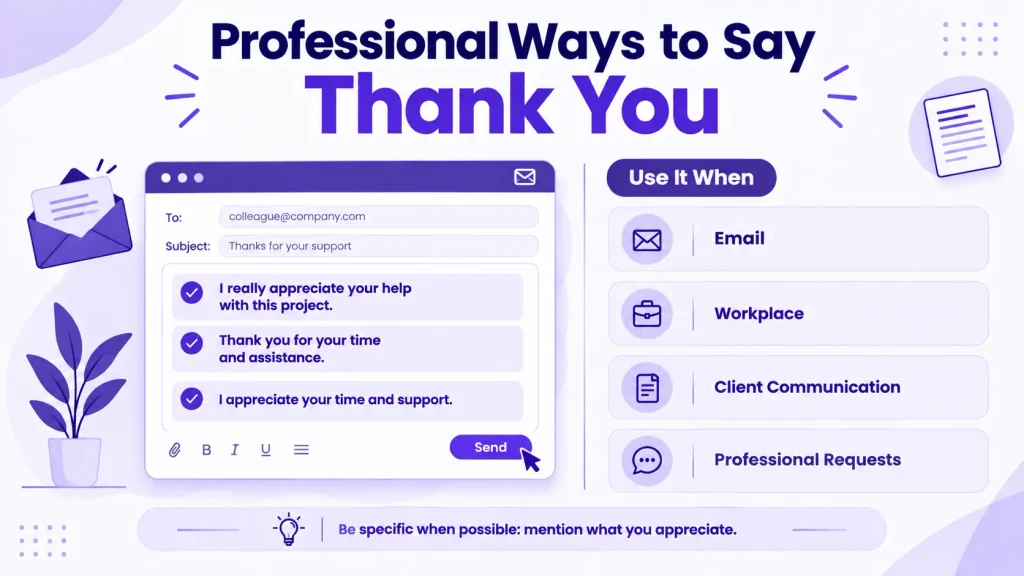
For a Professional Email
Choose a phrase that is warm but still appropriate for the workplace.
Good options include:
- I really appreciate your help.
- I appreciate your time and support.
- I truly appreciate your assistance.
- Many thanks for your help.
Example:
I really appreciate your help with the report. Your feedback made the final revisions much easier.
For a Friend
You can use something more relaxed and enthusiastic.
Good options include:
- Thanks so much!
- Thanks a ton!
- That means a lot to me.
- I can’t thank you enough.
Example:
Thanks a ton for helping me move. I couldn’t have done it without you.
For a Meaningful Favor
When someone has done something important for you, choose a phrase that communicates the emotional weight of their help.
Good options include:
- I’m truly grateful.
- I’m very grateful.
- I can’t thank you enough.
- Your help means a lot to me.
Example:
I’m truly grateful that you stayed with me through such a difficult week.
For a Quick Text
Shorter phrases usually sound more natural.
Try:
- Thanks so much!
- I really appreciate it!
- Thanks a ton!
- That means a lot!
Example:
Thanks so much! I really appreciate you picking that up for me.
“Thank You Very Much” vs. “Thank You So Much”
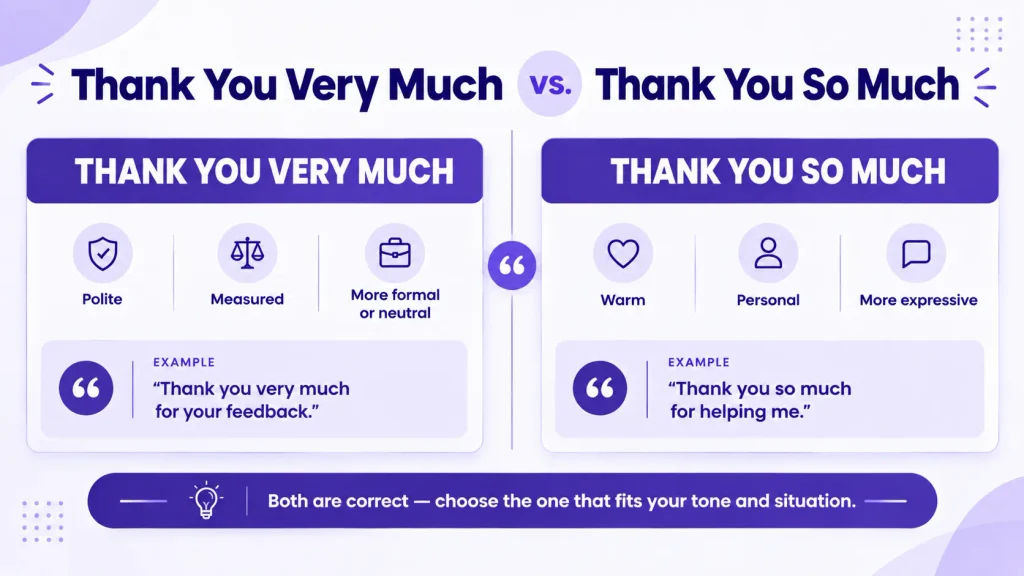
Both phrases express strong gratitude, and neither is incorrect. “Thank you so much” often feels slightly warmer and more conversational, while “thank you very much” can sound a little more formal or deliberate depending on the context.
For example:
Thank you very much for your assistance.
sounds more formal than:
Thanks so much for helping me out!
However, tone depends on the complete sentence, the relationship between the speakers, and the situation.
Common Mistakes When Expressing Gratitude
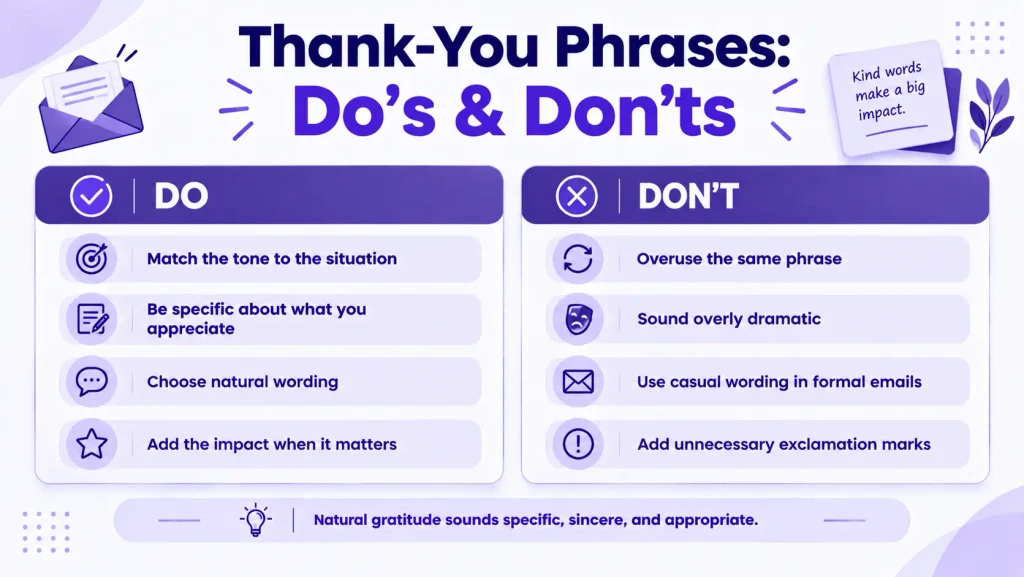
Using a Casual Phrase in a Formal Situation
“Thanks a ton” may sound perfectly natural in a text to a friend, but it may not be the right choice for a formal business email.
Instead, try:
I really appreciate your assistance.
Overusing “Thank You Very Much”
The phrase itself is completely correct. The problem is repetition.
If every message contains “thank you very much,” your writing can start to sound formulaic. Varying your wording can make your communication feel more natural.
Choosing a Phrase That Sounds Too Emotional
“I can’t thank you enough” suggests strong gratitude. It may sound excessive if someone simply handed you a pen.
For a small favor, something like this is more natural:
Thanks, I really appreciate it.
Forgetting to Say What You Appreciate
A specific thank-you often feels more genuine than a general one.
Instead of:
Thank you very much.
Try:
Thank you for taking the time to review my application.
The second version tells the recipient exactly what you appreciate.
How to Make Your Thank-You Sound More Genuine
You do not always need a stronger synonym to make your gratitude meaningful. Adding a specific detail can be more effective.
Compare:
Thank you very much for your help.
with:
Thank you for staying late to help me finish the presentation. I really appreciate it.
The second version identifies the action and explains why it mattered.
A simple formula is:
Thank the person + mention what they did + explain the impact.
For example:
I really appreciate your feedback on my proposal. Your suggestions helped me make the main points much clearer.
This approach works particularly well in professional emails because it sounds personal without becoming overly emotional.
Frequently Asked Questions
What is a professional way to say “thank you very much”?
“I really appreciate your help,” “I appreciate your time and support,” and “many thanks” are natural choices for professional communication. The best option depends on what you are thanking the person for.
What is a casual way to say “thank you very much”?
You can say “thanks so much,” “thanks a ton,” or “I really appreciate it.” These expressions are common in casual conversations and messages.
What is a heartfelt way to say “thank you very much”?
“I’m truly grateful,” “I can’t thank you enough,” and “that means a lot to me” can express stronger, more personal gratitude.
Is “thanks a lot” the same as “thank you very much”?
They can express the same basic gratitude, but “thanks a lot” is more casual. It can also sound sarcastic in certain contexts, so tone matters.
Is “thank you very much” too formal?
Not necessarily. “Thank you very much” is a standard and correct expression of gratitude in American English. Its tone can range from polite to emphatic depending on the situation and delivery.
What can I say instead of “thank you very much” in an email?
For a professional email, try “I really appreciate your help,” “I appreciate your time,” “I truly appreciate your assistance,” or “many thanks.”
How can I thank someone without sounding repetitive?
Be specific about what the person did. Instead of repeating “thank you very much,” mention the action and its impact:
I appreciate you taking the time to review the proposal. Your feedback helped me improve it.
Final Thoughts
“Thank you very much” is already a natural and useful expression of gratitude. You do not need to replace it every time. The goal is to choose wording that matches the situation.
For professional communication, “I really appreciate your help” and “I appreciate your time and support” are reliable choices. For personal situations, “that means a lot to me” or “I’m truly grateful” can sound more heartfelt. With friends, “thanks so much” or “thanks a ton” keeps the message relaxed.
The most effective thank-you is usually the one that feels specific and genuine. Instead of searching for the strongest possible phrase, choose words that accurately reflect how much you appreciate what the other person did.

Role: English Content Writer
Maren Whitlock writes practical English language content for RepublicsPress, with a focus on vocabulary, word alternatives, everyday expressions, and clear communication. Her articles are designed to make difficult or confusing language easier to understand, with simple explanations and useful examples readers can apply in real situations.