
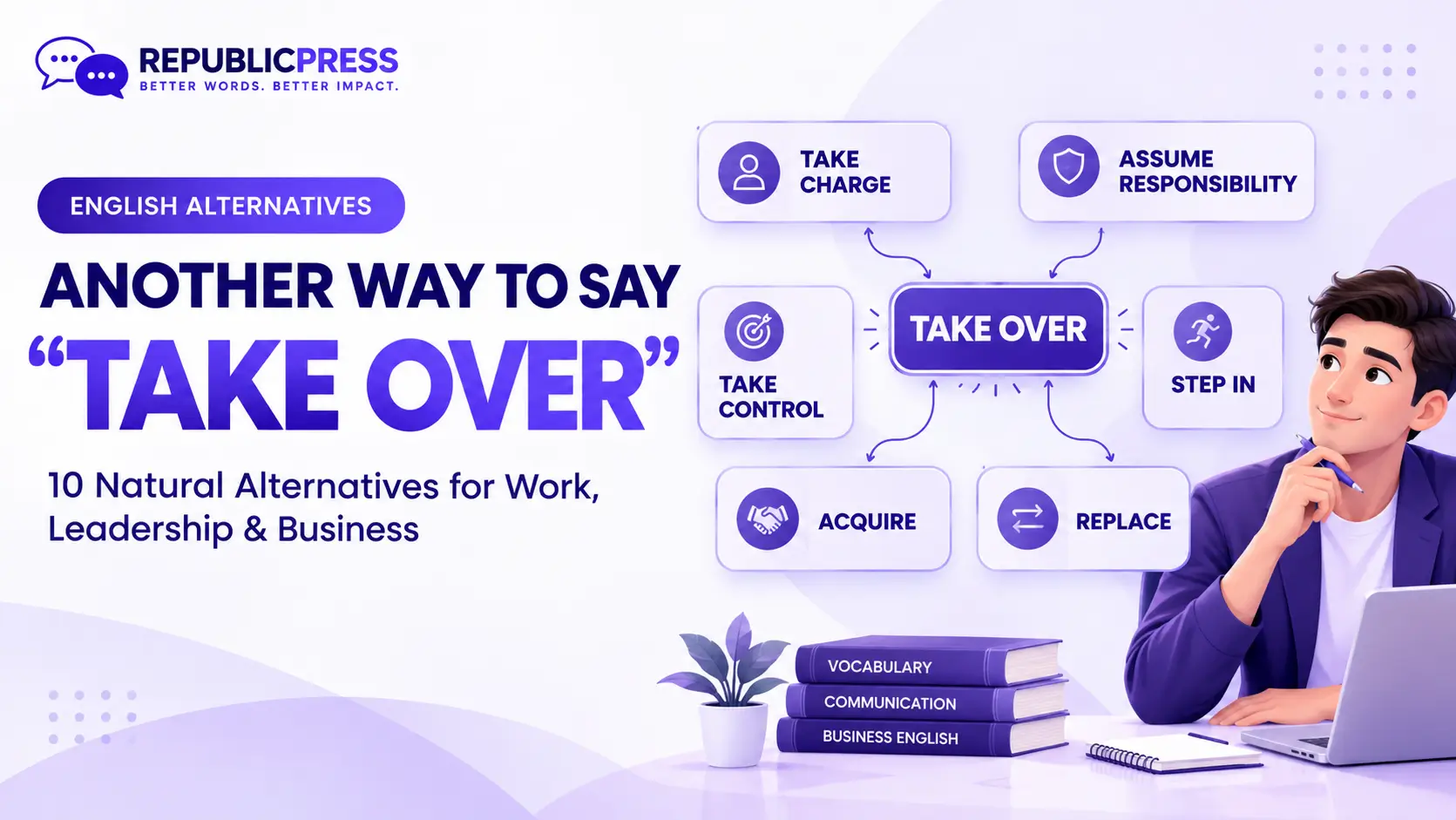
Another Way to Say Take Over: 10 Natural Alternatives
Looking for another way to say “take over”? The best alternative depends on the context. You can say take charge when someone accepts control, assume responsibility when they take on a duty, or acquire when a company gains ownership. Other useful options include replace, step in, take control, and take the lead.
Key Takeaways
- “Take over” can mean gaining control, accepting responsibility, or replacing someone.
- Use “take charge” when someone becomes the person in control.
- “Assume responsibility” works well in professional writing.
- “Step in” often describes temporary help or replacement.
- Use “acquire” when discussing business ownership.
- Choose the alternative that matches the exact meaning.
What Does “Take Over” Mean?
“Take over” has several meanings in American English. It can mean becoming responsible for something, gaining control, or replacing another person.
For example:
Maria will take over as department manager next month.
Here, Maria will become responsible for the department.
The phrase can also describe business ownership:
The company plans to take over its smaller competitor.
In this case, the company plans to gain control of another business.
Because “take over” has more than one meaning, the best alternative depends on the sentence.
10 Alternatives to “Take Over”
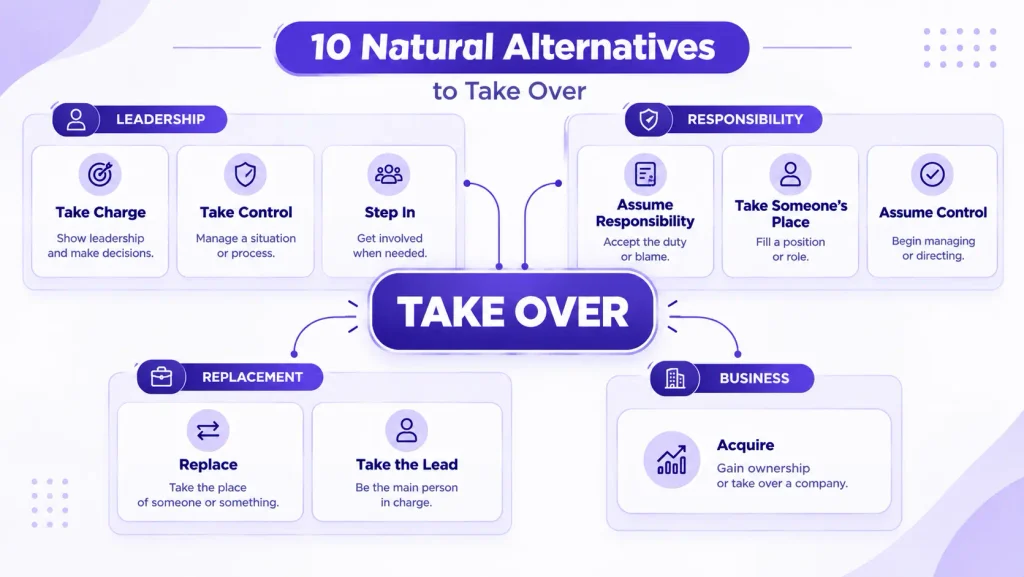
1. Take Charge
Take charge means to become responsible for something or start directing it.
It works well in workplace and everyday situations.
Example:
Sarah took charge of the project after her manager left.
Use this phrase when the main idea is leadership or control.
2. Assume Responsibility
Assume responsibility means to accept responsibility for a task, role, or situation.
It is especially useful in professional writing.
Example:
James will assume responsibility for the new client account.
This phrase sounds more formal than “take over.” Therefore, it works well in business emails, reports, and other professional documents.
3. Take Control
Take control means to gain or exercise control over something.
Example:
The new manager took control of the situation.
This is a good choice when control is the main idea. However, it does not always mean that one person replaced another.
4. Step In
Step in means to become involved, often because someone else cannot continue.
Example:
Emma stepped in when the team leader was unavailable.
This phrase often suggests temporary help. As a result, it may be better than “take over” when the change is not permanent.
5. Take Someone’s Place
Take someone’s place means to replace another person in a role or position.
Example:
Mark took his colleague’s place during the afternoon shift.
This option is useful when replacement is more important than control.
6. Assume Control
Assume control means to gain or accept control of something.
Example:
The new director assumed control of the department in July.
This phrase has a formal tone. It fits business, workplace, and organizational writing.
7. Take Responsibility
Take responsibility means to accept responsibility for something.
Example:
Lisa took responsibility for managing the schedule.
Although it can replace “take over” in some sentences, the meaning is slightly different. It focuses on responsibility rather than control.
8. Acquire
Acquire means to gain ownership or control of something.
It is especially common in business and finance.
Example:
The company acquired a smaller software firm.
When “take over” refers to gaining ownership of a company, “acquire” can be a more precise choice.
9. Replace
Replace means to take the place of someone or something.
Example:
The new system will replace the old software.
This word focuses on substitution. It does not always suggest gaining control.
10. Take the Lead
Take the lead means to become the main person directing or guiding something.
Example:
Daniel took the lead during the client presentation.
This phrase works well for projects, meetings, teams, and group activities. It also sounds less forceful than “take control.”
Which Alternative Should You Use?
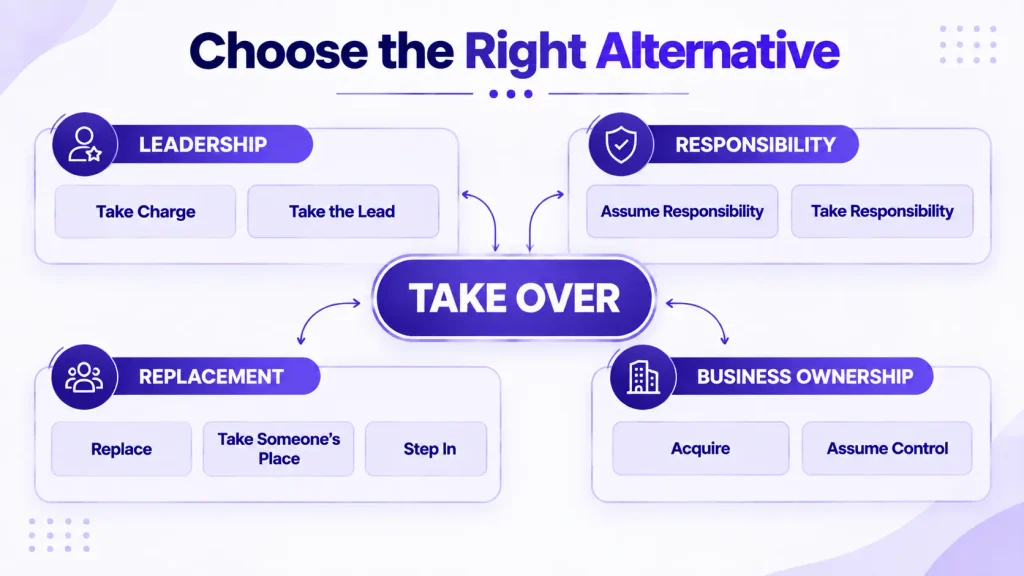
The right alternative depends on what you mean by “take over.”
| Alternative | Main Meaning | Best Context |
| Take charge | Become responsible or lead | Work, teams, projects |
| Assume responsibility | Accept a duty | Professional writing |
| Take control | Gain control | General and professional use |
| Step in | Help or replace temporarily | Work and emergencies |
| Take someone’s place | Replace someone | Jobs and shifts |
| Assume control | Gain control | Formal writing |
| Take responsibility | Accept a duty | Workplace situations |
| Acquire | Gain ownership | Business and finance |
| Replace | Take the place of something | People, systems, products |
| Take the lead | Become the main leader | Teams and projects |
Another Way to Say “Take Over” at Work
At work, the best alternative depends on the situation.
If someone becomes responsible for a project, you can say:
Maya will take charge of the project.
If the person accepts a specific duty, you can say:
Maya will assume responsibility for the project.
For a temporary replacement, “step in” may be more natural:
Maya stepped in while the manager was away.
These phrases are similar, but each one highlights a different part of the meaning.
Another Way to Say “Take Over” in Business
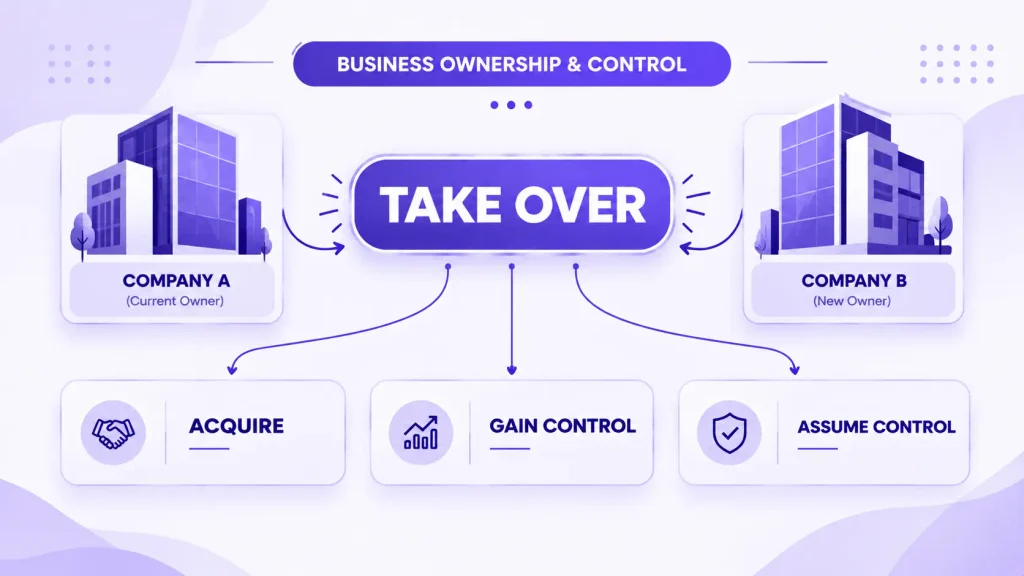
Business writing often needs more precise language.
For example:
The company took over its competitor.
You could say:
The company acquired its competitor.
You could also write:
The company gained control of its competitor.
“Acquire” is particularly useful when the meaning involves ownership or a business transaction.
Take Over vs. Take Charge
These phrases are related, but they are not always interchangeable.
Take over often describes a transfer of responsibility or control.
Nina took over the department after her manager retired.
Take charge focuses more on leadership.
Nina took charge of the department and organized the team.
So, use “take over” when the change in responsibility matters. Use “take charge” when leadership is the main point.
Take Over vs. Replace
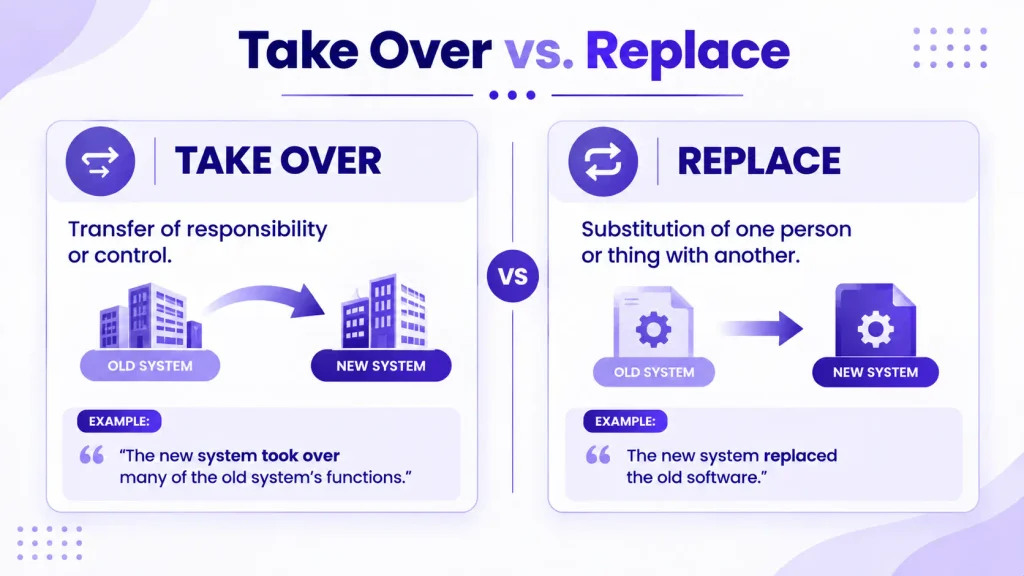
“Replace” focuses on substitution.
The company replaced the old software.
“Take over” can suggest a broader change in responsibility or control.
The new system took over many of the old system’s functions.
Therefore, the two phrases are related, but they do not always have the same meaning.
Common Mistakes When Using Alternatives
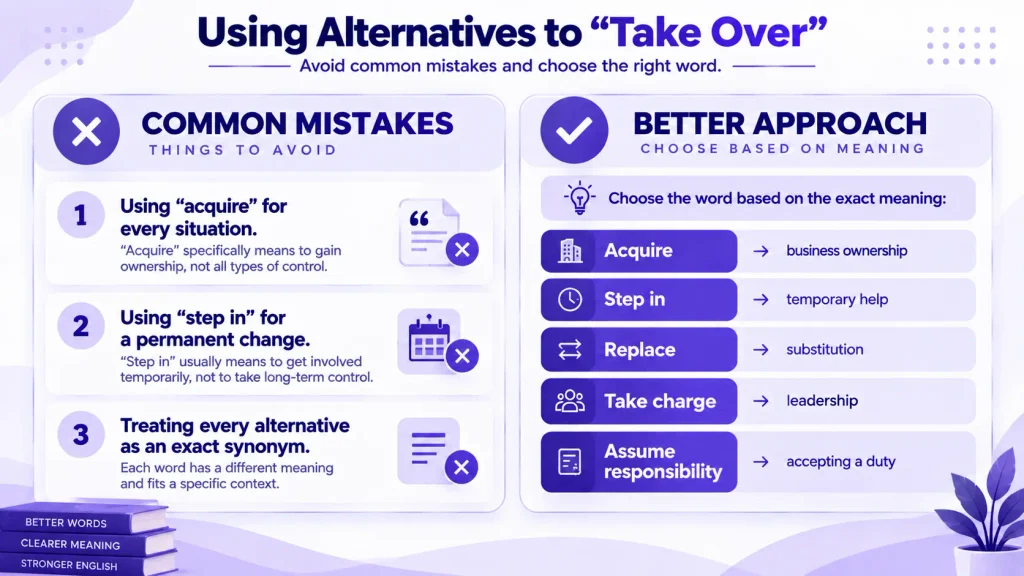
Using “Acquire” for Every Situation
“Acquire” is common in business, but it does not fit every use of “take over.”
For example:
Sarah acquired the meeting after John left.
This sounds unnatural.
Instead, say:
Sarah took charge of the meeting after John left.
Using “Step In” for a Permanent Change
“Step in” often suggests temporary help.
Alex stepped in while the manager was away.
If Alex permanently becomes the manager, “take over” or “assume responsibility” is clearer.
Treating Every Alternative as an Exact Synonym
Not every alternative has the same meaning.
“Take responsibility” focuses on accepting a duty. “Take control” focuses on control. “Replace” focuses on substitution.
For that reason, always choose the phrase that matches your intended meaning.
Frequently Asked Questions
What is a professional way to say “take over”?
You can use assume responsibility, assume control, or take charge. The best option depends on whether you mean responsibility, control, or leadership.
What is another way to say “take over a job”?
You can say assume responsibility for the job, take on the role, step into the role, or take someone’s place.
What is another word for “take over” in business?
Useful choices include acquire, gain control of, and assume control of. “Acquire” is especially useful when discussing company ownership.
Is “take charge” the same as “take over”?
Not exactly. “Take charge” emphasizes leadership, while “take over” can describe a transfer of responsibility, control, or a role.
Can “take over” mean “replace”?
Yes. In some contexts, “take over” means becoming responsible for a role or function that another person or thing previously handled.
What is a formal way to say “take over”?
Assume control, assume responsibility, and acquire can work in formal writing. Choose the one that matches the context.
Final Thoughts
There are many ways to say “take over,” but the right choice depends on your meaning.
Use take charge for leadership, assume responsibility for duties, step in for temporary help, replace for substitution, and acquire for business ownership.
Choosing the most precise phrase will make your American English clearer and more natural.

Role: English Content Writer
Maren Whitlock writes practical English language content for RepublicsPress, with a focus on vocabulary, word alternatives, everyday expressions, and clear communication. Her articles are designed to make difficult or confusing language easier to understand, with simple explanations and useful examples readers can apply in real situations.