Another Way to Say Have: 15 Natural Alternatives
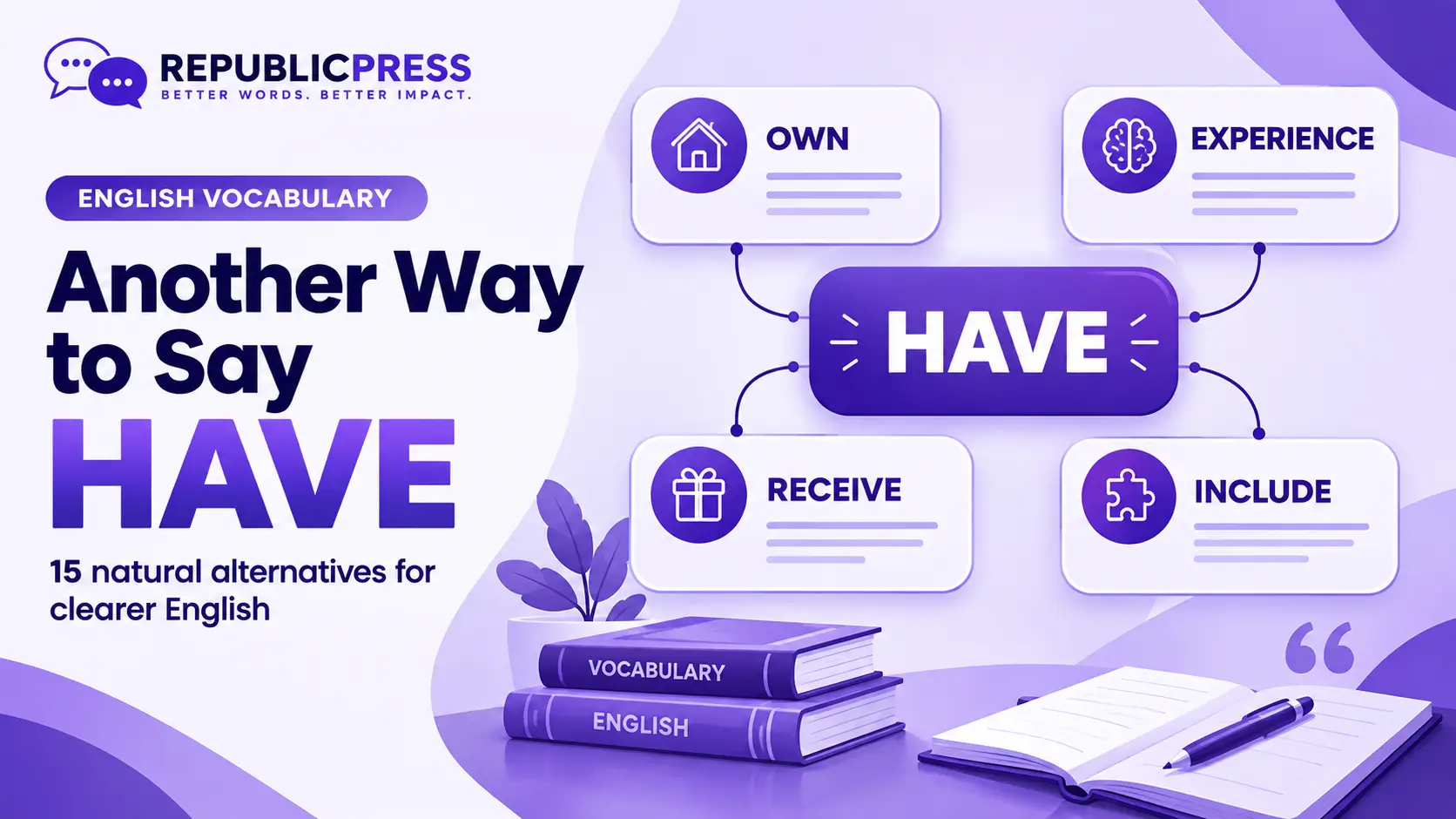
If you’re looking for another way to say “have,” the best choice depends on what “have” means in your sentence. You might use “own,” “possess,” “hold,” “experience,” “receive,” “contain,” or “need” instead. Some alternatives work only in specific contexts, so choosing the right one matters.
Key Takeaways
- “Have” has many meanings, so there is no single replacement that works everywhere.
- Use “own” when talking about possession or property.
- Use “possess” for formal writing or emphasis on possession.
- Use “experience” for feelings, events, or situations.
- Use “receive” when someone gets something.
- Use “contain” when describing what is inside something.
- In many everyday sentences, simply keeping “have” is more natural than replacing it.
What Does “Have” Mean?
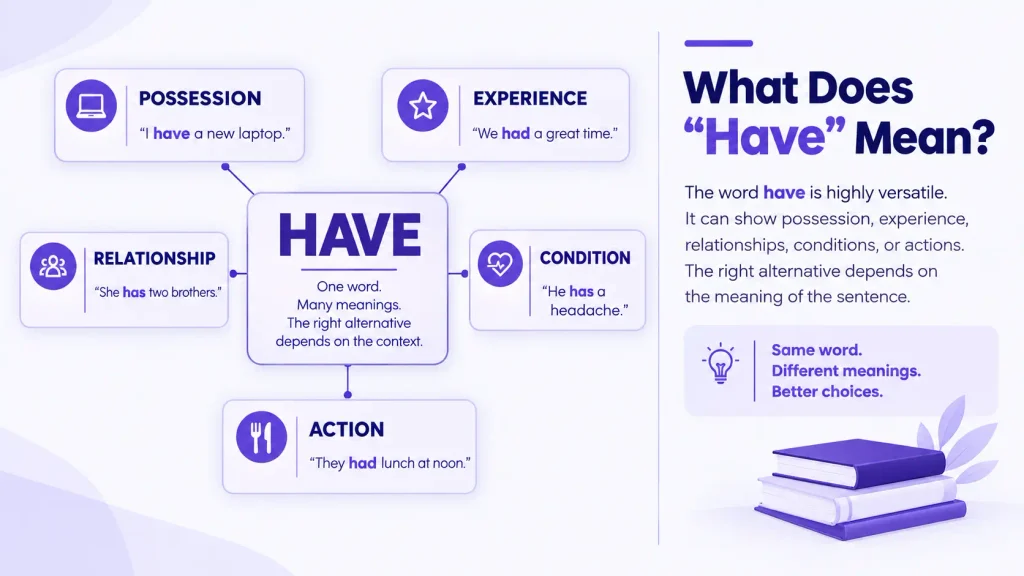
“Have” is one of the most versatile verbs in American English. It can describe possession, relationships, experiences, conditions, actions, or receiving something.
For example:
- “I have a new laptop.” → possession
- “She has two brothers.” → relationship
- “We had a great time.” → experience
- “He has a headache.” → condition
- “They had lunch at noon.” → action
- “I had an email from my manager.” → receiving something
Because “have” has so many uses, the right alternative depends on the meaning of the sentence.
15 Natural Alternatives to “Have”
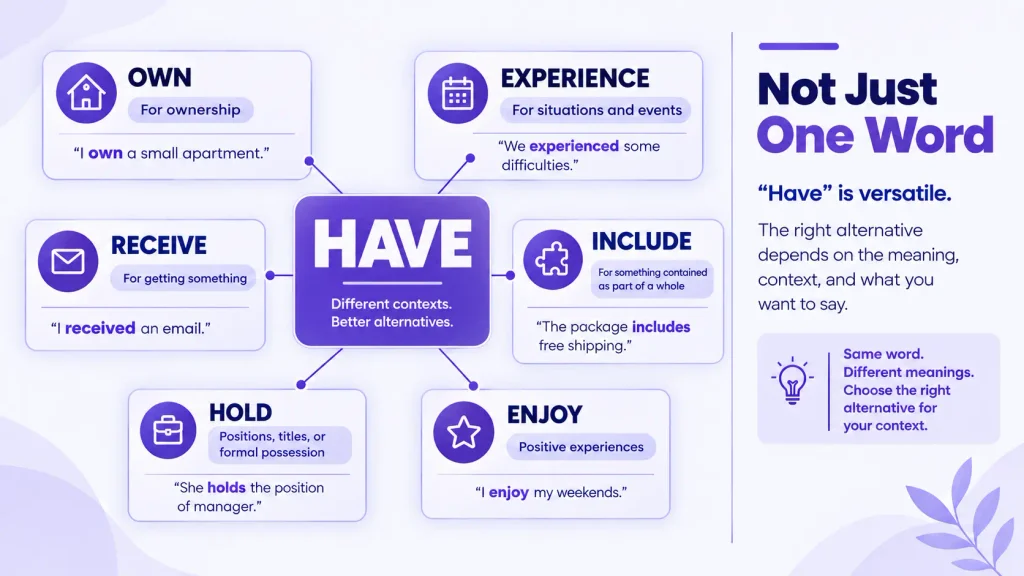
1. Own
Use “own” when “have” means that something legally or personally belongs to you.
Example:
“I have a small apartment.”
→ “I own a small apartment.”
Best for: Property, businesses, vehicles, possessions, and other things you legally possess.
“Own” is more specific than “have,” so it should not replace “have” in every situation.
2. Possess
“Possess” means to have or own something, but it sounds more formal.
Example:
“She has excellent communication skills.”
→ “She possesses excellent communication skills.”
Best for: Formal, academic, professional, or descriptive writing.
In everyday conversation, “have” usually sounds more natural.
3. Hold
“Hold” can replace “have” when someone has something in their hands, has a position, or has something formally.
Example:
“She has a leadership position.”
→ “She holds a leadership position.”
Best for: Positions, titles, records, meetings, documents, and physical objects.
You would not normally use “hold” as a general replacement for every meaning of “have.”
4. Experience
Use “experience” when “have” refers to going through an event, situation, feeling, or problem.
Example:
“We had some difficulties during the project.”
→ “We experienced some difficulties during the project.”
Best for: Problems, challenges, emotions, events, and situations.
This alternative is especially useful in professional and formal writing.
5. Receive
Use “receive” when “have” means getting something from another person or source.
Example:
“I had an email from the company.”
→ “I received an email from the company.”
Best for: Emails, messages, payments, invitations, documents, gifts, and information.
“Receive” makes the act of getting something clearer.
6. Get
“Get” can replace “have” in some informal contexts, especially when “have” means obtaining or receiving something.
Example:
“I had a new phone last week.”
→ “I got a new phone last week.”
Best for: Casual conversation and everyday American English.
Be careful: “get” has many meanings, so it isn’t always interchangeable with “have.”
7. Contain
Use “contain” when “have” means that something includes something inside it.
Example:
“The box has several documents.”
→ “The box contains several documents.”
Best for: Containers, documents, products, ingredients, books, and other objects with contents.
8. Include
“Include” works when “have” means that something is one part of a larger group, list, package, or offering.
Example:
“The package has free shipping.”
→ “The package includes free shipping.”
Best for: Features, services, items, benefits, lists, and packages.
9. Feature
“Feature” is useful when something has a particular characteristic, design element, or function.
Example:
“The new phone has a larger screen.”
→ “The new phone features a larger screen.”
Best for: Products, websites, technology, designs, and marketing descriptions.
10. Carry
Use “carry” when “have” means that someone is holding, transporting, or keeping something with them.
Example:
“I have cash with me.”
→ “I’m carrying cash with me.”
Best for: Money, bags, objects, supplies, and items being transported.
The meaning changes slightly because “carry” emphasizes having something with you.
11. Maintain
“Maintain” can sometimes replace “have” when describing something that is kept in a particular condition or state.
Example:
“The company has high safety standards.”
→ “The company maintains high safety standards.”
Best for: Standards, systems, relationships, records, conditions, and professional contexts.
It is not a general synonym for “have.”
12. Enjoy
Use “enjoy” when “have” refers to experiencing something positive or pleasurable.
Example:
“We had a great vacation.”
→ “We enjoyed a great vacation.”
Best for: Vacations, meals, experiences, opportunities, and pleasant activities.
“Enjoy” adds a positive meaning that is not always present in “have.”
13. Undergo
“Undergo” is appropriate when “have” refers to going through a process, treatment, examination, or difficult experience.
Example:
“She had surgery last month.”
→ “She underwent surgery last month.”
Best for: Medical procedures, examinations, training, testing, and significant processes.
It is considerably more formal than “have.”
14. Need
In some sentences, “have to” means that someone is required to do something. In that context, “need to” can sometimes express a similar idea.
Example:
“I have to finish this today.”
→ “I need to finish this today.”
Best for: Everyday conversation and situations involving necessity.
The meanings aren’t always identical. “Have to” often emphasizes an obligation, while “need to” emphasizes necessity.
15. Keep
“Keep” can sometimes replace “have” when the meaning is to continue possessing or retaining something.
Example:
“I have this receipt.”
→ “I’ll keep this receipt.”
Best for: Documents, objects, records, belongings, and things you intend to retain.
Again, “keep” adds the idea of retaining something rather than simply possessing it.
How to Choose the Right Alternative
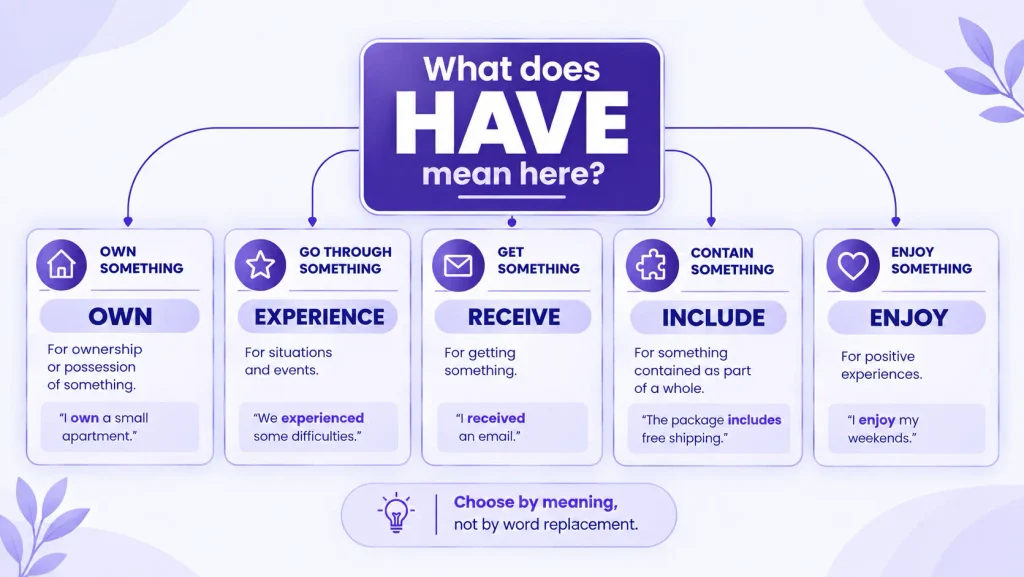
The easiest way to replace “have” is to identify what “have” means in your sentence.
| If “have” means… | Try… | Example |
| Own something | own | I own a house. |
| Formally possess | possess | She possesses valuable skills. |
| Hold a position | hold | He holds a senior position. |
| Go through something | experience | We experienced delays. |
| Get something | receive | I received your message. |
| Include something | contain / include | The package includes a charger. |
| Have a feature | feature | The phone features a larger display. |
| Enjoy something | enjoy | We enjoyed the evening. |
| Go through a procedure | undergo | He underwent testing. |
| Be required to | need to | I need to leave early. |
“Have” vs. “Own”
These two words are often confused.
“I have a car” simply states that you have access to or possess a car.
“I own a car” specifically states that the car belongs to you.
So, if legal ownership matters, “own” is more precise.
“Have” vs. “Possess”
“Possess” is more formal than “have.”
Compare:
- “She has strong leadership skills.” — natural and conversational
- “She possesses strong leadership skills.” — formal and polished
For most everyday writing, “have” is perfectly appropriate.
“Have” vs. “Experience”
These verbs are not interchangeable in every situation.
“I had a difficult day” describes the day you went through.
“I experienced a difficult day” emphasizes the experience itself and sounds more formal.
For professional writing, “experience” can sometimes make a sentence more precise.
When You Should Keep “Have”
Replacing every occurrence of “have” can actually make your writing less natural.
For example:
“I have two sisters.”
There is no need to replace “have” with a more complicated expression.
Likewise:
“We have a meeting at 10.”
“Have” sounds completely natural here.
The goal is not to avoid the word “have.” The goal is to choose a more precise alternative when the context calls for one.
Common Mistakes When Replacing “Have”
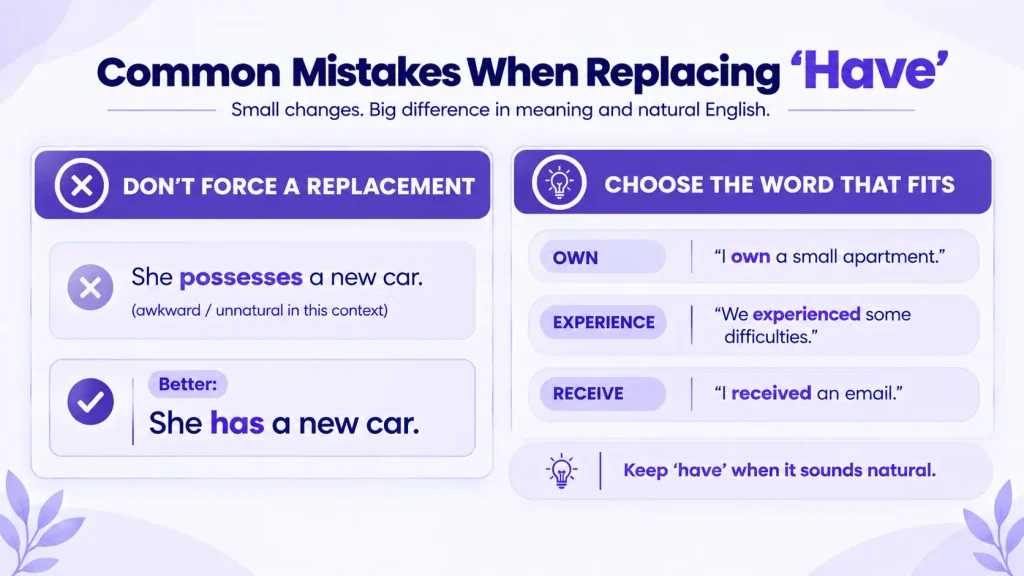
Using “possess” in casual conversation
“She possesses a new car” sounds unnecessarily formal.
Natural: “She has a new car.”
Using “own” for experiences
“I own a great vacation” is incorrect.
Say:
“I had a great vacation.”
or
“I enjoyed a great vacation.”
Using “receive” for possession
“I receive a car” means you are getting a car, not simply owning one.
If you mean possession, use “have” or “own.”
Treating “have” and “have to” as the same expression
“I have a car” and “I have to leave” have completely different meanings.
The first expresses possession. The second expresses obligation.
Frequently Asked Questions
What is a formal way to say “have”?
“Possess,” “hold,” “maintain,” “experience,” and “undergo” can work as formal alternatives, depending on the meaning of the original sentence.
What is a professional way to say “have”?
In professional writing, alternatives such as “possess,” “hold,” “maintain,” “include,” “experience,” and “receive” can provide greater precision when appropriate.
What is another word for “have” when talking about ownership?
“Own” is usually the clearest choice when you mean legal or personal ownership.
What is another way to say “have” when talking about an experience?
“Experience” or “undergo” may work, depending on the situation. For positive experiences, “enjoy” can also be appropriate.
What is another way to say “have” in an essay?
The best alternative depends on the sentence. Formal choices such as “possess,” “experience,” “contain,” “include,” and “undergo” may work, but “have” itself is not too informal for academic writing.
Is “possess” a synonym for “have”?
Yes, when “have” means possess or own something. But “possess” is more formal and cannot replace every use of “have.”
What is a casual way to say “have”?
In some contexts, “get,” “keep,” or simply “have” itself may sound natural. The correct choice depends on the intended meaning.
Conclusion
“Have” is a flexible verb with many meanings, so the best alternative depends on the sentence. Use “own” for ownership, “possess” for formal possession, “experience” for situations, “receive” for things you get, “include” for components, and “enjoy” for positive experiences. When no extra precision is needed, “have” is often the most natural choice.

Role: Language Editor
Caleb Mercer is a Language Editor at RepublicsPress, focusing on grammar, sentence structure, professional writing, and English usage. He helps ensure that language guides are clear, accurate, natural, and easy to follow.