Another Way to Say “But Then”: 15 Natural Alternatives
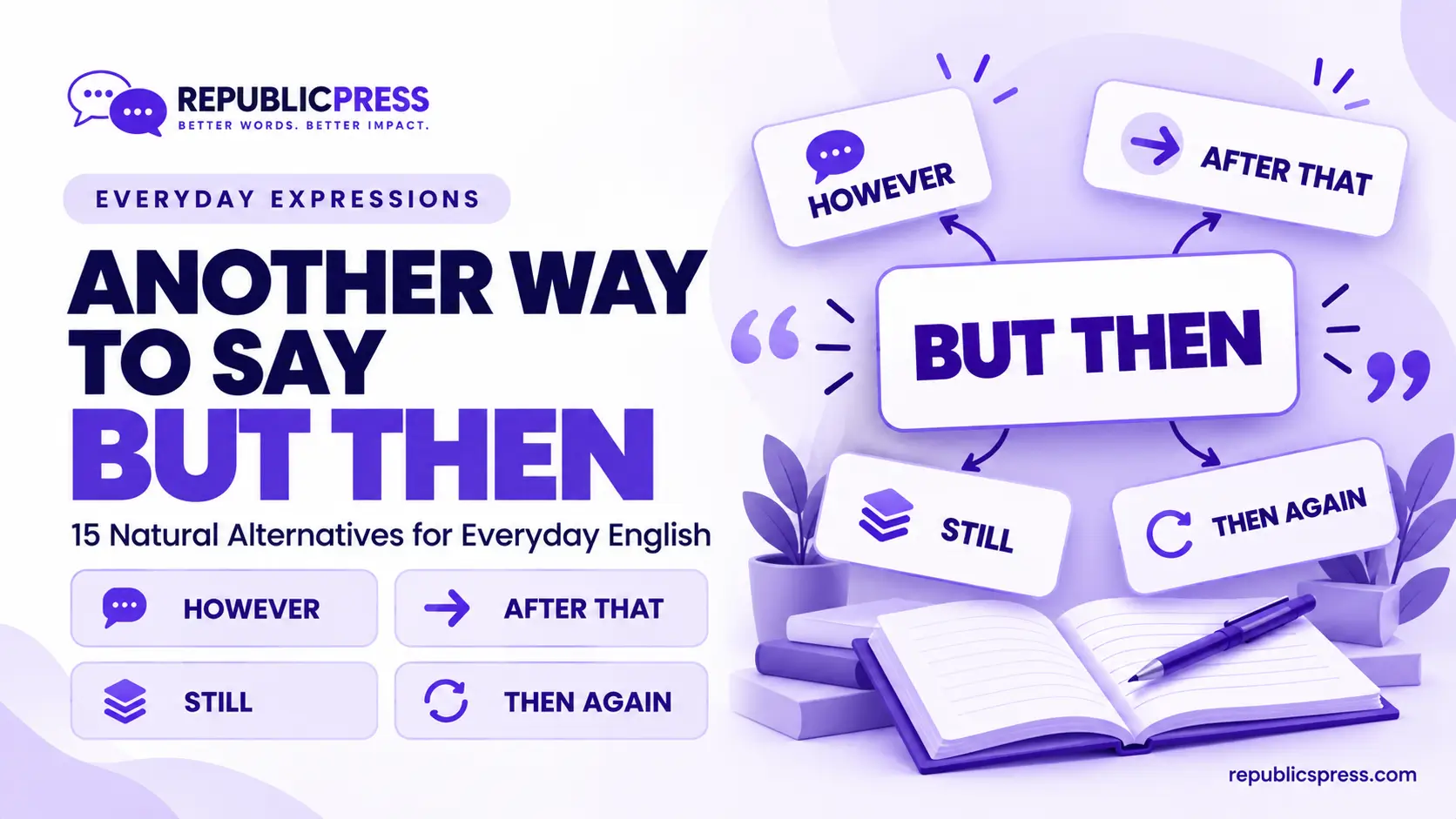
“But then” can introduce a contrast, explain what happened next, or show how a situation changed. The best alternative depends on your meaning. Phrases such as “however,” “yet,” “after that,” “but suddenly,” and “on the other hand” work in different contexts, so choose one that fits your sentence.
Key Takeaways
- Use however to introduce a contrast, especially in formal or professional writing.
- Choose yet to show an unexpected contrast.
- Use after that or then to describe what happened next.
- Choose but suddenly when an unexpected event interrupts a situation.
- Use on the other hand to present a different viewpoint.
- Not every alternative to “but then” preserves the same meaning. Consider the context before replacing it.
What Does “But Then” Mean?
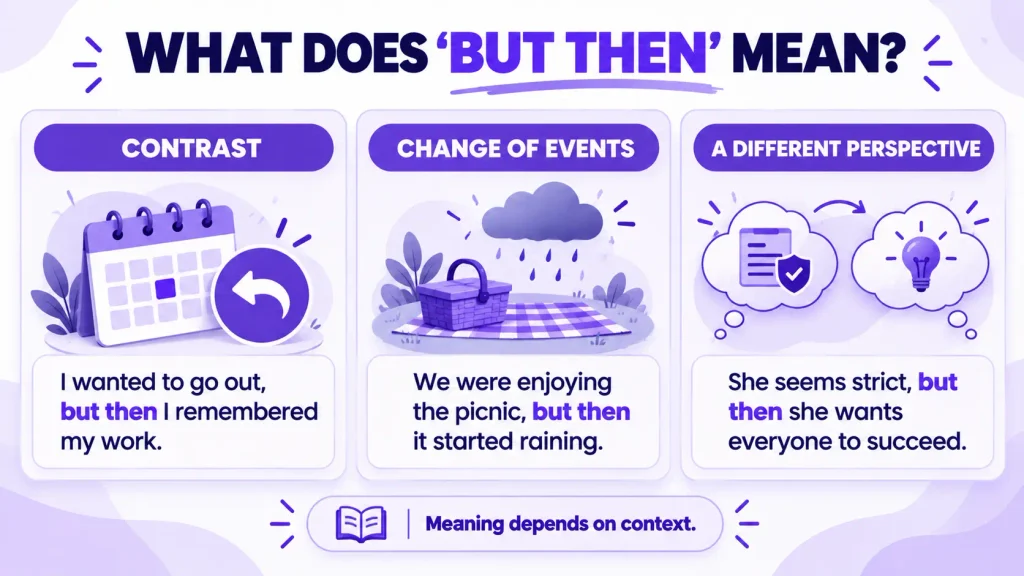
“But then” is a common English expression with several meanings. It can introduce a contrasting idea, describe a change in events, or explain why someone changed their mind.
For example:
- Contrast: I wanted to go out, but then I remembered I had work to finish.
- Change of events: We were enjoying the picnic, but then it started raining.
- Different perspective: She seems strict, but then she wants everyone to succeed.
The expression is flexible, which is why no single alternative works in every sentence.
15 Other Ways to Say “But Then”
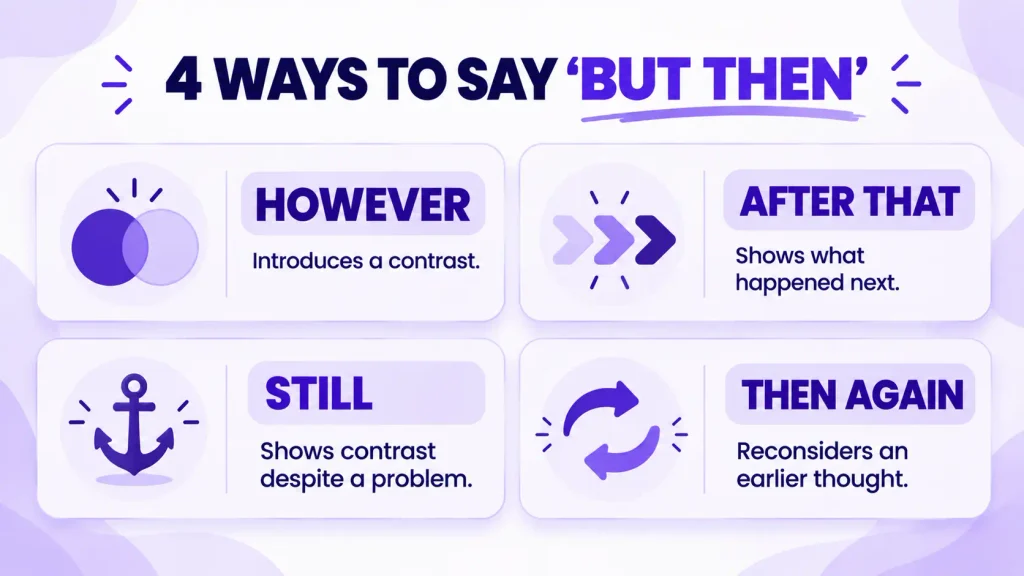
1. However
Best for: Formal writing, professional communication, and clear contrasts.
“However” introduces an idea that contrasts with something stated earlier.
Example: I wanted to attend the meeting. However, I had another appointment at the same time.
Unlike “but then,” it does not usually emphasize the order of events. It focuses on the contrast.
2. Yet
Best for: Showing an unexpected contrast.
“Yet” connects two ideas that seem different or surprising when considered together.
Example: The task looked difficult, yet she completed it in less than an hour.
Use it when you want to emphasize an unexpected result rather than simply describe what happened next.
3. But Suddenly
Best for: Stories, conversations, and unexpected events.
This phrase emphasizes that something changed quickly or without warning.
Example: We were walking home, but suddenly the lights went out.
It works especially well in storytelling, but it may sound too dramatic for formal reports.
4. After That
Best for: Narrating events in chronological order.
“After that” explains what happened next. Unlike “but then,” it does not express contrast by itself.
Example: I finished my homework. After that, I watched a movie.
Choose this phrase when the sequence of events matters more than a difference between ideas.
5. On the Other Hand
Best for: Comparing different viewpoints or options.
This expression introduces another side of an issue.
Example: The apartment is small. On the other hand, it’s close to my workplace.
It is useful in essays, discussions, and everyday conversations when you want to weigh advantages against disadvantages.
6. Still
Best for: Showing that something remains true despite a problem or contrast.
Example: The weather was terrible. Still, we decided to go hiking.
“Still” emphasizes that the second action or fact remains true despite the first situation.
7. Even So
Best for: Acknowledging a difficulty before presenting a contrasting result.
Example: The instructions were confusing. Even so, he managed to assemble the desk.
It is similar to “still,” but it often places more emphasis on the surprising result.
8. Nevertheless
Best for: Formal writing and strong contrasts.
“Nevertheless” introduces a statement that remains true despite what was mentioned earlier.
Example: The project faced several delays. Nevertheless, the team completed it on time.
It is more formal than “but then” and is best used when you want a polished, deliberate tone.
9. Nonetheless
Best for: Formal or neutral writing.
“Nonetheless” has a meaning very close to “nevertheless.” It introduces an outcome or fact that holds despite an earlier difficulty.
Example: The price was higher than expected. Nonetheless, we decided to purchase it.
Avoid using it when you simply want to say what happened next.
10. Instead
Best for: Describing a change in plans, choices, or actions.
Example: I planned to take the bus, but then I decided to walk instead.
“Instead” highlights a replacement or alternative action. It does not automatically communicate contrast in every situation.
11. Then Again
Best for: Casual conversations and reconsidering an opinion.
“Then again” introduces a second thought that may change or qualify what you just said.
Example: I might buy the new phone. Then again, my current one works perfectly.
This is especially useful when you are thinking aloud or reconsidering a decision.
12. At That Point
Best for: Explaining when a decision or change occurred.
Example: We had waited for two hours. At that point, we decided to leave.
It highlights a particular moment in a sequence of events rather than a contrast on its own.
13. But Eventually
Best for: Describing a final outcome after a delay or struggle.
Example: I struggled to understand the lesson, but eventually everything made sense.
Use this phrase when the outcome comes after some time. It is not suitable when the change happens immediately.
14. Although
Best for: Introducing a contrasting condition in a sentence.
Example: Although I was tired, I finished the assignment.
“Although” often replaces the relationship between ideas rather than the exact words “but then.” It usually requires a different sentence structure.
Avoid writing “although I was tired, but I finished” in standard English because “although” and “but” duplicate the contrast.
15. In Contrast
Best for: Comparisons, essays, and analytical writing.
Example: The first plan was expensive. In contrast, the second option was affordable.
“In contrast” works when you want to highlight a difference between two situations, people, or ideas. It is less suitable for simply describing the next event.
Comparison Table: Choosing the Right Alternative
| Alternative | Main meaning | Tone |
|---|---|---|
| However | Introduces a contrast | Neutral or formal |
| Yet | Unexpected contrast | Neutral |
| But suddenly | Unexpected change | Conversational |
| After that | Next event | Neutral |
| On the other hand | Different viewpoint | Neutral or formal |
| Still | Contrast despite a problem | Neutral |
| Even so | Unexpected result despite a difficulty | Neutral |
| Nevertheless | Contrast despite circumstances | Formal |
| Nonetheless | Contrast despite circumstances | Formal |
| Instead | Replacement or alternative | Neutral |
| Then again | Reconsidering a thought | Casual |
| At that point | A specific moment | Neutral |
| But eventually | Final result after time | Conversational |
| Although | Contrasting condition | Neutral or formal |
| In contrast | Difference between two things | Formal or analytical |
How to Choose the Best Alternative
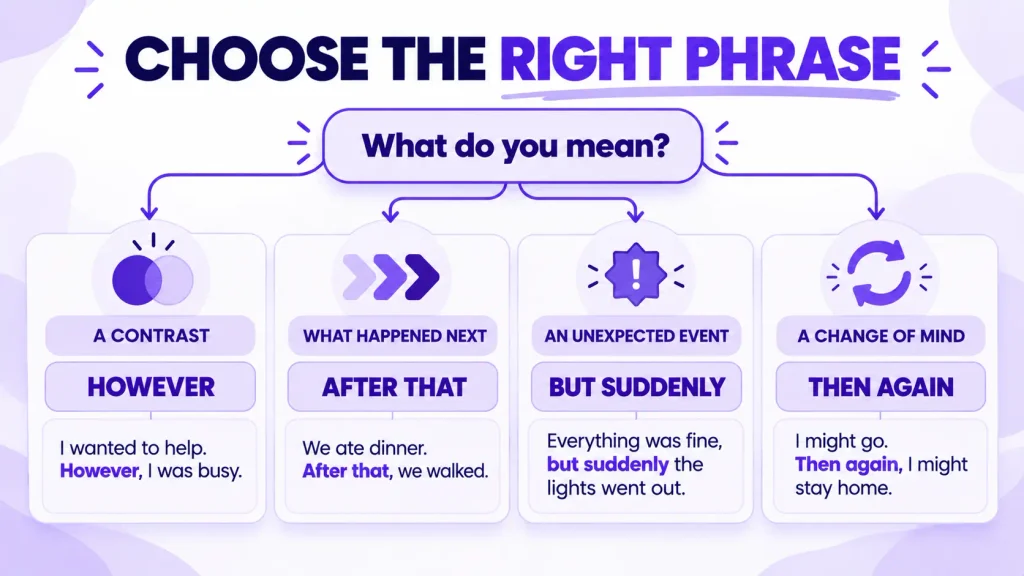
The easiest way to replace “but then” is to identify what the phrase does in your sentence.
When You Mean “However”
Use “however,” “yet,” or “still” when the second idea contrasts with the first.
- Original: I wanted to help, but then I realized I didn’t have enough time.
- Alternative: I wanted to help. However, I realized I didn’t have enough time.
When You Mean “What Happened Next”
Use “after that” or “at that point” when the order of events is important.
- Original: We finished dinner, but then we went for a walk.
- Alternative: We finished dinner. After that, we went for a walk.
The alternative removes the sense of opposition because the events are simply happening in sequence.
When You Mean “Something Unexpected Happened”
Use “but suddenly” or “yet,” depending on the sentence.
- Original: Everything was going well, but then the computer crashed.
- Alternative: Everything was going well, but suddenly the computer crashed.
“But suddenly” emphasizes the unexpected interruption.
When You Mean “I Changed My Mind”
Use “then again” when reconsidering a previous statement.
- Original: I think I’ll go to the party, but then I might stay home.
- Alternative: I think I’ll go to the party. Then again, I might stay home.
“Then again” sounds natural when you are weighing two possibilities.
Common Mistakes to Avoid
- Using “after that” for every contrast: It describes sequence, not disagreement or opposition.
- Using “nevertheless” in casual conversation unnecessarily: It can sound stiff when a simple “still” would work.
- Using “although” with “but” in the same clause: Write “Although it was late, we stayed” or “It was late, but we stayed.”
- Using “instead” without a replacement: It works best when one choice or action replaces another.
- Assuming “then again” means “next”: It usually signals reconsideration rather than chronological order.
Frequently Asked Questions
What is the most common alternative to “but then”?
“However” is a useful alternative when “but then” introduces a contrast. If the phrase describes what happened next, “after that” may be more appropriate.
What is a formal way to say “but then”?
“However,” “nevertheless,” and “nonetheless” are suitable formal alternatives when you want to express a contrast. The best choice depends on the sentence and the strength of the contrast.
What is a casual way to say “but then”?
“But suddenly,” “still,” and “then again” can sound natural in casual conversation, depending on the meaning. Use “then again” when reconsidering an opinion and “but suddenly” for an unexpected event.
Can I use “however” instead of “but then”?
Yes, if “but then” introduces a contrasting idea. However, if it describes the next event in a sequence, “after that” or “then” may be more accurate.
Is “but then again” correct English?
Yes. “But then again” is a common conversational expression used to reconsider or qualify a previous statement.
Example: I could take the job, but then again, the commute would be exhausting.
What is another way to say “but then” in an essay?
Use “however,” “nevertheless,” “nonetheless,” or “in contrast” when expressing a relevant contrast. For chronological transitions, use “after that” or “at that point.”
What is the difference between “but then” and “then again”?
“But then” can introduce a change, contrast, or later event. “Then again” usually introduces a second thought that makes the speaker reconsider an earlier statement.
Conclusion
The best alternative to “but then” depends on the meaning you want to express. Choose “however” for contrast, “after that” for sequence, “but suddenly” for an unexpected event, or “then again” when reconsidering an idea. Matching the phrase to the context will make your writing clearer and more natural.

The Republics Press Editorial Team researches, writes and reviews every article on this site, checks facts against reliable sources and updates pages when readers point out errors.