Another Way to Say Best: 10 Natural Alternatives for Any Situation
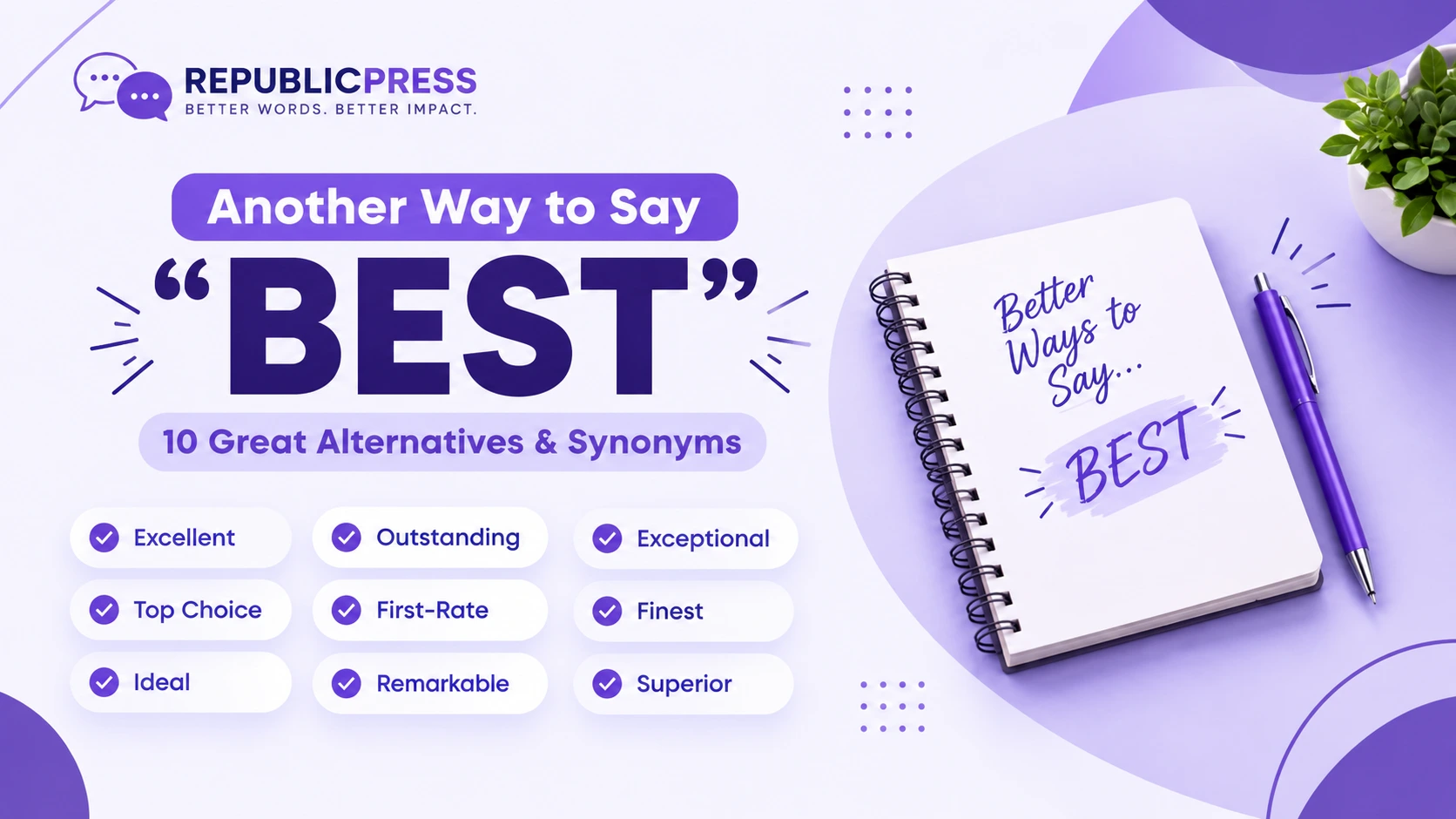
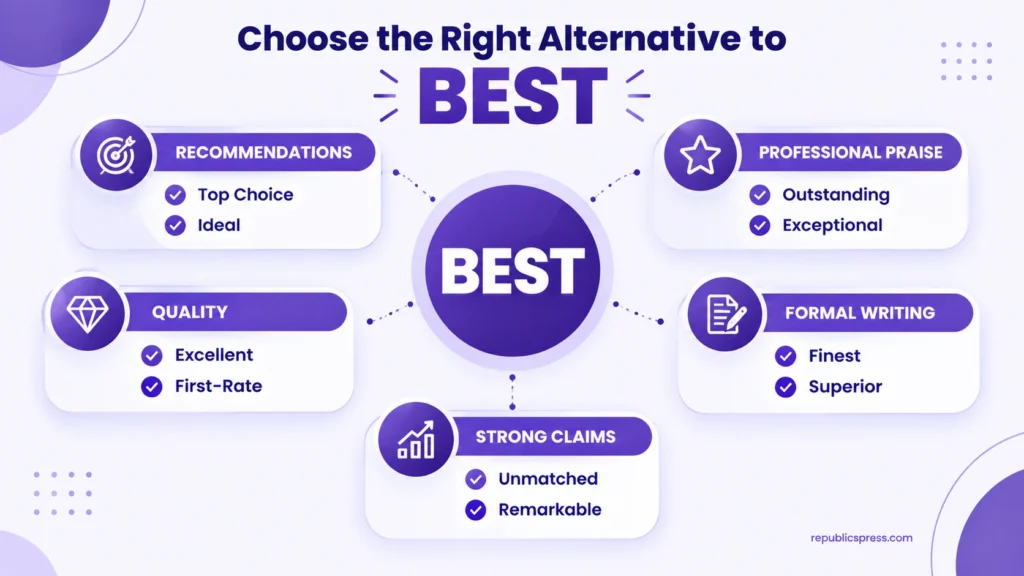
Looking for another way to say best? Depending on the context, you can use phrases such as top choice, outstanding, excellent, exceptional, first-rate, superior, remarkable, ideal, finest, or unmatched. The right alternative depends on whether you are describing quality, performance, preference, or someone’s achievements.
Key Takeaways
- “Best” has many alternatives, and the right choice depends on context and tone.
- Top choice and finest work well when describing preferences or recommendations.
- Outstanding, exceptional, and remarkable emphasize impressive quality.
- First-rate and superior sound more polished and professional.
- Avoid using a stronger synonym if the situation does not support such a claim.
What Does “another way to say best” Mean?
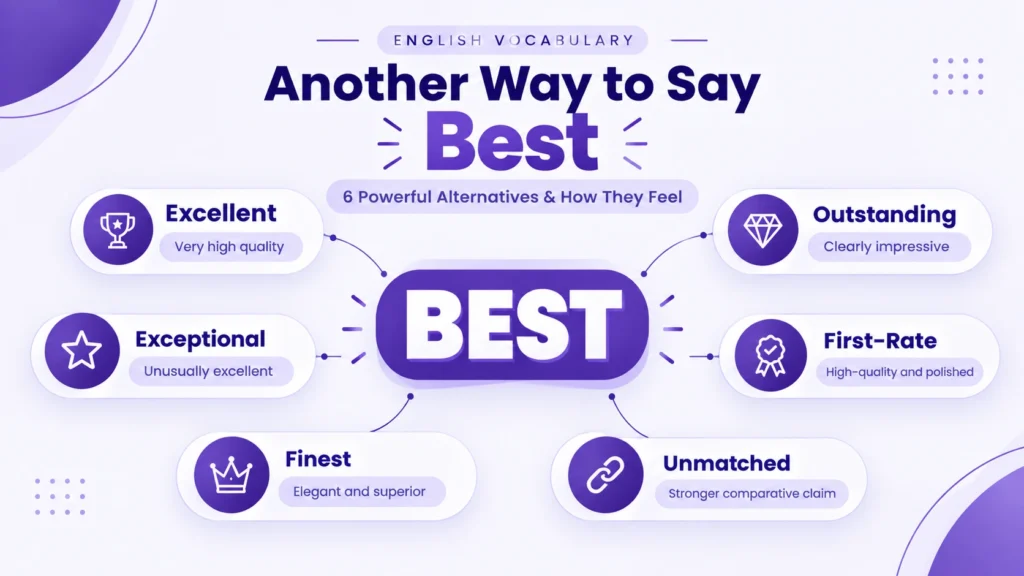
The phrase “another way to say best” means looking for a synonym or alternative expression for the word “best.” People search for alternatives when they want to avoid repetition, make their writing more interesting, or choose a word that better matches a specific situation.
“Best” can describe quality, performance, preference, or achievement. For example, you might call a restaurant your “top choice,” describe an employee as “outstanding,” or say a product is “first-rate.”
These alternatives are commonly useful in emails, essays, resumes, reviews, marketing copy, conversations, recommendations, and professional writing.
Why Use Other Ways to Say “Best”?
Although “best” is simple and natural, repeating it too often can make your writing feel predictable. A more precise alternative can also communicate exactly why something deserves praise.
Using different expressions can help you:
- Avoid repeating the same word.
- Make your writing sound more natural.
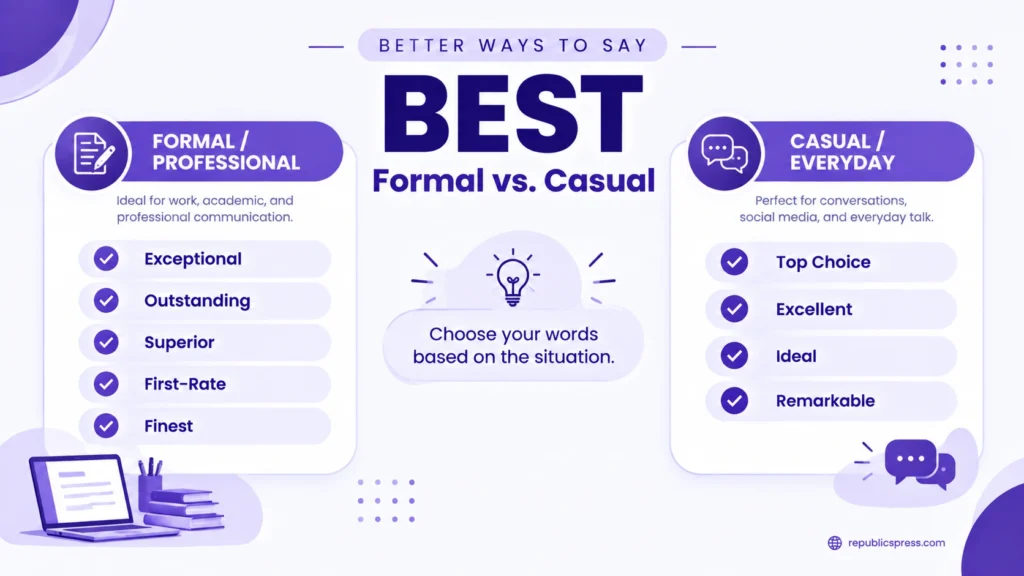
- Match formal, professional, or casual situations.
- Describe quality with greater precision.
- Make recommendations sound more persuasive.
- Express admiration without relying on the same adjective.
The key is to choose an alternative based on what you actually mean rather than replacing “best” with a random synonym.
10 Best Other Ways to Say “Best”
1. Top Choice
Meaning
Top choice means the option you prefer most or the option you consider the strongest among several choices. It is especially useful when recommending a product, service, location, or person.
Best For
- Professional
- Friendly
- Casual
- Polite
Example 1
“After comparing several laptops, this model is my top choice.”
Example 2
“For a relaxing weekend getaway, the lakeside cabin would be our top choice.”
Quick Tip
Use “top choice” when you are selecting one option from a group rather than simply describing excellent quality.
2. Outstanding
Meaning
Outstanding describes something that is noticeably better or more impressive than what is typical. It works especially well for achievements, performance, service, and professional work.
Best For
- Professional
- Formal
- Polite
Example 1
“Maria delivered an outstanding presentation to the leadership team.”
Example 2
“The restaurant received outstanding reviews for its customer service.”
Quick Tip
Choose “outstanding” when you want to praise something strongly without sounding overly dramatic.
3. Excellent
Meaning
Excellent is one of the most versatile alternatives to “best.” It means extremely good or of a high standard and fits both everyday and professional communication.
Best For
- Professional
- Formal
- Friendly
- Polite
Example 1
“Your report provides an excellent overview of the project.”
Example 2
“We had an excellent experience with the hotel staff.”
Quick Tip
“Excellent” is a safe choice when you need a positive word that works in almost any setting.
4. Exceptional
Meaning
Exceptional suggests that something is unusually good and stands above normal expectations. It carries a stronger sense of rarity than words such as “good” or “excellent.”
Best For
- Professional
- Formal
- Warm
- Polite
Example 1
“The candidate demonstrated exceptional leadership skills during the interview.”
Example 2
“This camera delivers exceptional image quality in low light.”
Quick Tip
Use “exceptional” when you want to emphasize that something goes beyond the usual standard.
5. First-Rate
Meaning
First-rate means extremely high quality or among the strongest available options. It has a polished tone but still sounds natural in everyday American English.
Best For
- Professional
- Formal
- Friendly
Example 1
“The company provides first-rate technical support to its customers.”
Example 2
“We found a first-rate mechanic who explained every repair clearly.”
Quick Tip
“First-rate” is particularly useful when talking about services, workmanship, products, or professional performance.
6. Superior
Meaning
Superior means higher in quality, performance, or value than another option. Because it often implies a direct comparison, it is more specific than simply saying something is “best.”
Best For
- Professional
- Formal
Example 1
“The updated software offers superior security compared with the previous version.”
Example 2
“Customers chose this material because of its superior durability.”
Quick Tip
Use “superior” when you can clearly identify what makes one option better than another.
7. Remarkable
Meaning
Remarkable describes something worthy of attention because it is unusually impressive, notable, or memorable. It can describe accomplishments, experiences, results, and personal qualities.
Best For
- Professional
- Warm
- Friendly
- Formal
Example 1
“She made remarkable progress during her first year on the team.”
Example 2
“The museum has a remarkable collection of American artwork.”
Quick Tip
Choose “remarkable” when the quality itself is impressive enough to deserve special attention.
8. Ideal
Meaning
Ideal means perfectly suited to a particular purpose, person, or situation. Unlike “best,” it focuses on suitability rather than absolute quality.
Best For
- Professional
- Formal
- Polite
- Friendly
Example 1
“This compact desk is ideal for a small home office.”
Example 2
“Saturday morning would be the ideal time for the meeting.”
Quick Tip
Use “ideal” when something is the right fit rather than necessarily the highest-quality option overall.
9. Finest
Meaning
Finest is a strong and polished way to describe something of exceptionally high quality. It is often used with products, materials, examples, traditions, and achievements.
Best For
- Formal
- Professional
- Warm
Example 1
“The chef prepares each dish using some of the finest local ingredients.”
Example 2
“This gallery features some of the finest examples of modern American design.”
Quick Tip
“Finest” often sounds more elegant than “best,” making it useful for polished descriptions and promotional writing.
10. Unmatched
Meaning
Unmatched means that nothing else compares with the quality, performance, or experience being described. It is a very strong expression, so use it when you can support the claim.
Best For
- Professional
- Formal
- Promotional
Example 1
“The resort is known for its unmatched views of the Pacific Ocean.”
Example 2
“Our team provides unmatched attention to detail on every project.”
Quick Tip
Because “unmatched” makes an absolute claim, avoid it when you cannot reasonably compare the subject with alternatives.
Comparison Table
| Alternative | Best Used In | Tone |
| Top choice | Recommendations, preferences | Friendly, practical |
| Outstanding | Performance, achievements | Professional, strong |
| Excellent | General praise | Versatile, positive |
| Exceptional | High-level praise | Formal, impressive |
| First-rate | Products, services, work | Polished, professional |
| Superior | Direct comparisons | Formal, confident |
| Remarkable | Achievements, experiences | Warm, impressive |
| Ideal | Suitability, recommendations | Practical, positive |
| Finest | Quality, products, descriptions | Elegant, formal |
| Unmatched | Strong claims, marketing | Confident, promotional |
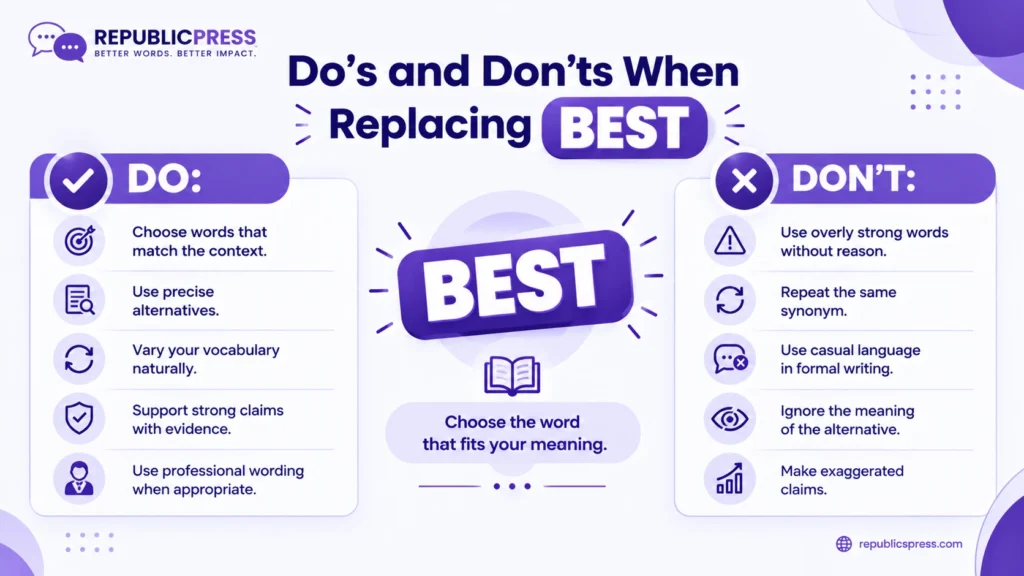
Common Mistakes
1. Using a casual phrase in a formal setting
Words such as “awesome” may sound natural in conversation but can feel too casual in a business report or professional email. Choose “excellent,” “outstanding,” or “exceptional” when the setting requires a polished tone.
2. Choosing an overly strong synonym
Not everything needs to be called “unmatched” or “exceptional.” If the evidence only shows that something is good, using an extreme word can make your writing sound exaggerated.
3. Repeating “best” too often
Using “best” several times in the same paragraph can make your writing feel repetitive. Replace some instances with precise alternatives that explain the type of quality you mean.
4. Forgetting the context
“Superior” suggests a comparison, while “ideal” suggests suitability. Treating these words as interchangeable can change the meaning of your sentence.
5. Sounding insincere
Strong praise works best when it has a clear reason behind it. Instead of saying something is “the best” without explanation, identify the quality, result, or feature that makes it impressive.
Frequently Asked Questions
What is a professional way to say “best”?
Professional alternatives include excellent, outstanding, exceptional, first-rate, and superior. The best option depends on your sentence. For example, “outstanding performance” works well in a performance review, while “superior durability” is better when comparing products or materials.
What is another word for “best” in an essay?
Good choices for an essay include finest, superior, exceptional, outstanding, and ideal. However, the word should match your argument. Academic writing usually benefits from precise language rather than simply choosing the strongest possible synonym.
What is a stronger word than “best”?
Words such as exceptional, unmatched, unsurpassed, and outstanding can communicate stronger praise than “best.” However, stronger does not always mean better. Select a word that accurately reflects the evidence and context of your statement.
What is another way to say “the best”?
You can say the top choice, the finest, the leading option, the outstanding choice, or the ideal option. “Top choice” sounds natural in recommendations, while “finest” has a more elegant tone and “leading option” works well in professional or business contexts.
What is a fancy word for “best”?
Finest, exceptional, superior, outstanding, and preeminent can sound more polished than “best.” “Finest” is especially natural in formal descriptions, while “preeminent” is more advanced and is usually better suited to formal or academic writing.
What can I say instead of “best” on a resume?
On a resume, use specific achievement-focused words such as outstanding, exceptional, accomplished, or top-performing when they accurately describe your experience. Rather than simply calling yourself “the best,” show measurable results, leadership, awards, or accomplishments that demonstrate your value.
What is another way to say “best choice”?
Common alternatives include top choice, ideal choice, preferred option, leading option, and most suitable option. “Top choice” is conversational, while “most suitable option” works well when you want to emphasize that something fits a particular need.
Is “excellent” better than “best”?
Neither word is always better. “Best” can indicate the highest position among several choices, while “excellent” usually means extremely good without necessarily making a comparison. If you are making a direct ranking, “best” may be more accurate; for general praise, “excellent” is often more natural.
Conclusion
Finding another way to say “best” is less about replacing one word and more about choosing language that expresses your exact meaning. Top choice works well for recommendations, excellent fits almost any positive situation, and outstanding is strong for performance or achievements.
For more formal writing, exceptional, superior, and finest can add precision and polish. If something is perfectly suited to a particular need, ideal may be a better choice than “best.” Meanwhile, unmatched should be reserved for situations where an absolute claim is reasonable.
The most effective writing does not simply use the strongest synonym. It uses the most accurate one. Choose your alternative based on context, tone, and the specific quality you want your reader to notice.

Role: Language Editor
Caleb Mercer is a Language Editor at RepublicsPress, focusing on grammar, sentence structure, professional writing, and English usage. He helps ensure that language guides are clear, accurate, natural, and easy to follow.